What is Music Structural Analysis? From Classical Rigor to Modern AI Solutions
Hello there! I’m Lucas Arden. My journey in music began not in a neon-lit studio, but in a dusty conservatory classroom, staring at complex orchestral scores until my eyes blurred. I’ve gone from analyzing Beethoven’s sonatas with a pencil in hand to producing pop hits in a Digital Audio Workstation (DAW).
If there is one thing that bridges the gap between a 19th-century symphony and a Top 40 hit, it is structure.
Many musicians misunderstand Music Structural Analysis. They think it’s just about knowing where the Chorus is. But for the true professional—whether a conductor, a composer, or a top-tier producer—it is a deep, rigorous discipline. It is the architectural blueprint of sound.
In this comprehensive guide, we will dive deep into the academic roots of Musical Form, explore how it applies to modern production, and reveal how new AI technology like Melogen AI Structural Analysis is revolutionizing the way we understand music.

The Academic Nightmare: Musical Form in Classical Music
Let’s get one thing straight: In the world of professional music education, Music Structural Analysis (often called Musical Form or Form and Analysis) is a heavyweight discipline. It is a core subject for composers, conductors, and instrumentalists.
For music students, this subject can be notoriously difficult. It’s not just about "feeling" the music; it’s about dissecting it with surgical precision.
The Strict Classifications of Classical Form
Unlike the relatively loose structures of pop music, classical music adheres to strict formal designs. To analyze a piece correctly, you must understand specific categories:
- Simple Ternary Form (ABA): A three-part structure where the first section (A) is repeated after a contrasting middle section (B).
- Compound Ternary Form: A more complex version where each part of the ABA structure is itself divisible into smaller forms (e.g., the A section is itself a binary form).
- Rondo Form (ABACA...): A principal theme (A) alternates with one or more contrasting themes (episodes).
- Sonata Form: The "king" of classical forms, consisting of an Exposition, Development, and Recapitulation. It’s a dramatic narrative of conflicting keys and themes.
- Rondo-Sonata Form: A hybrid that combines the recurring theme of a Rondo with the developmental drama of a Sonata.
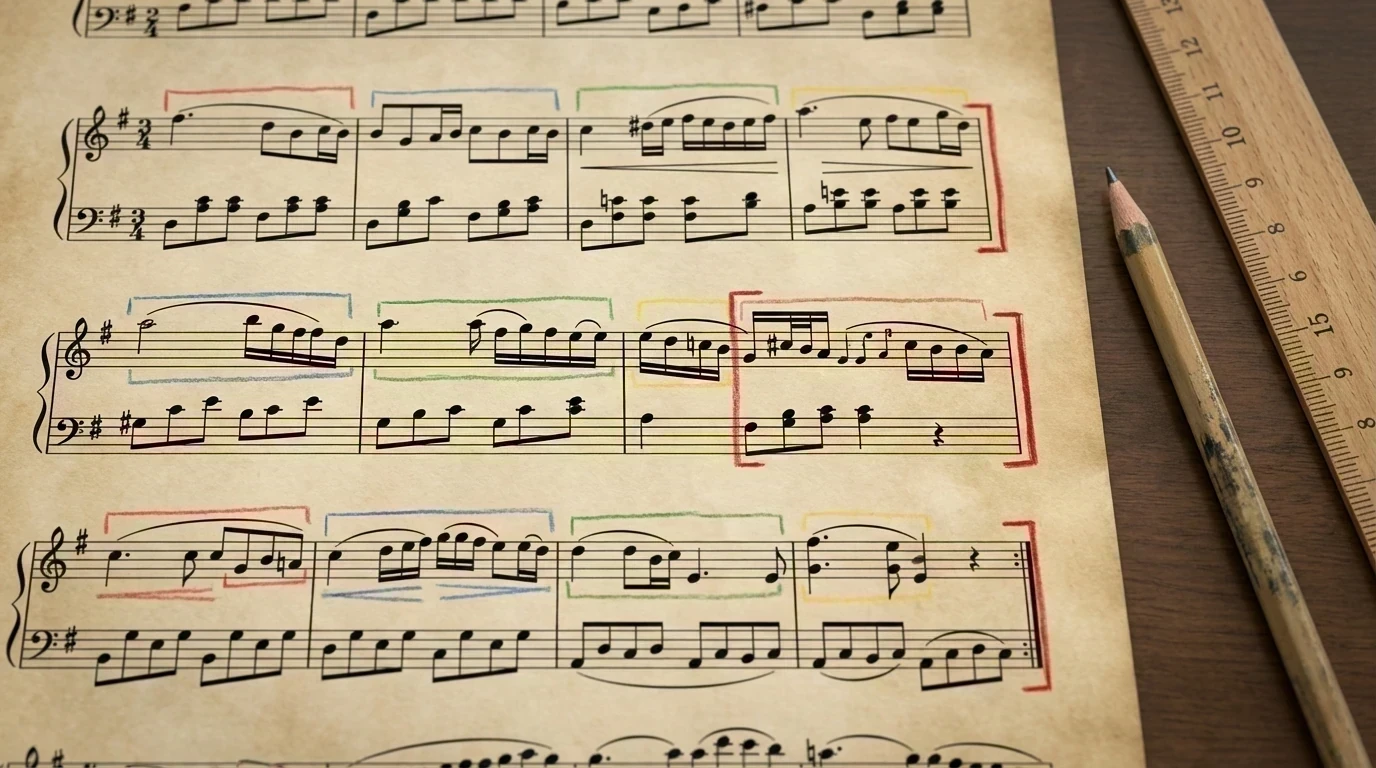
The Micro-Analysis: It’s More Than Just Sections
True structural analysis in the classical sense requires looking under the microscope. You cannot simply label a section "Part A." You must analyze:
- Motifs and Thematic Development: How a tiny musical fragment (a motif) evolves throughout the piece.
- Phrases and Periods: Identifying the "sentences" and "paragraphs" of the melody (e.g., a 4-bar antecedent phrase followed by a 4-bar consequent phrase).
- Harmony and Tonality: Tracking key changes (modulations) is crucial. A section isn't defined just by melody, but by whether it has moved from the Tonic to the Dominant key.
- Cadences: The punctuation marks of music. Identifying Perfect Authentic Cadences versus Half Cadences tells you whether a musical thought is finished or ongoing.
This level of analysis is mentally exhausting. It requires profound theoretical knowledge and a highly trained ear.
The Modern Shift: Structural Analysis in Pop & Production
When we step out of the conservatory and into the modern recording studio, Music Structural Analysis takes on a different, broader character. While it relies on the same fundamental principles of tension and release, the vocabulary becomes more accessible.
In the pop, rock, and EDM worlds, we focus on Macro-Structure. We are less concerned with "Rondo-Sonata" definitions and more focused on the energy flow that keeps a listener streaming on Spotify.
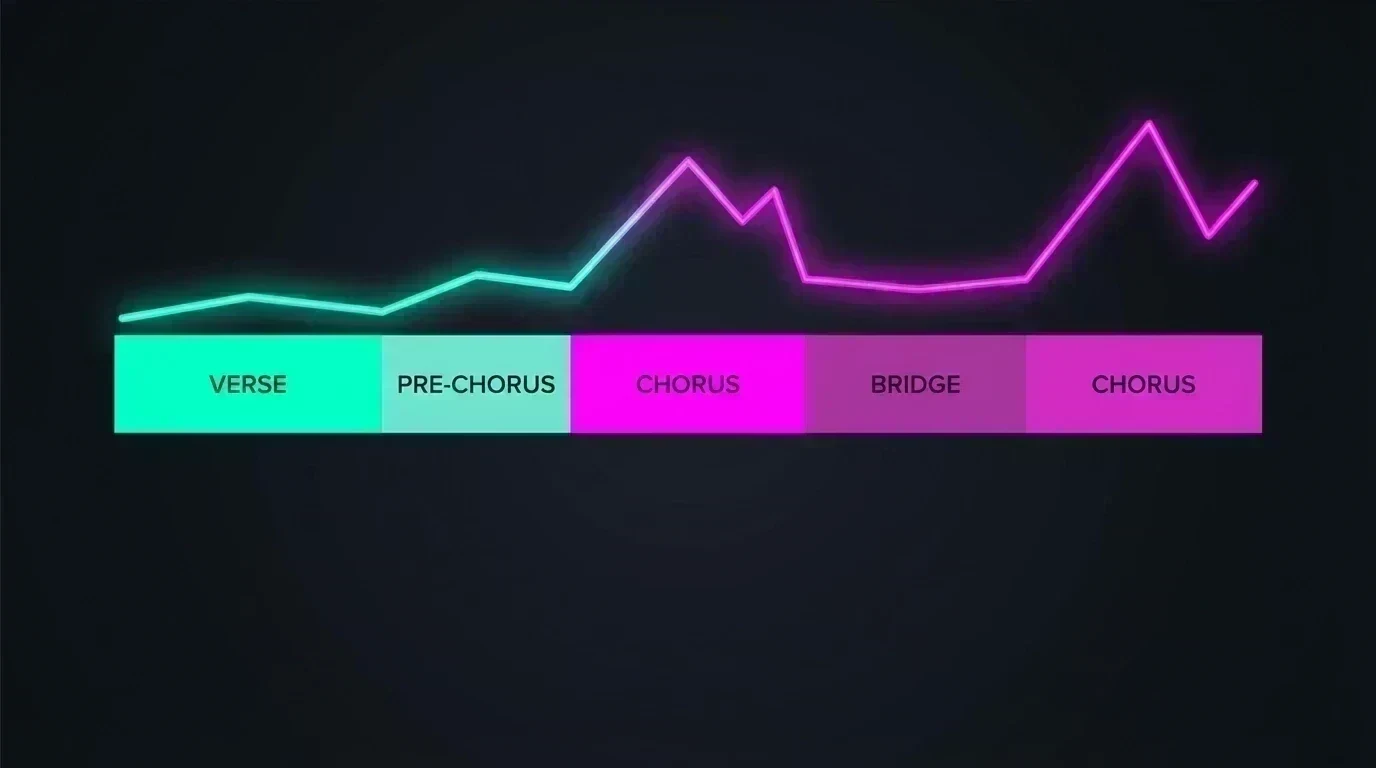
Common Modern Structures
- Verse-Chorus Form: The standard for 90% of radio hits.
- AABA (32-Bar Form): Common in Jazz standards and early Rock 'n' Roll.
- Through-Composed: A song that progresses without repeating sections (rare in pop, but powerful).
The Producer's Perspective
For us producers, analysis is about Arrangement.
- Verse: The storyteller. Low dynamic range.
- Pre-Chorus: The ramp-up. Increasing tension.
- Chorus: The explosion. Maximum width and volume.
- Bridge: The "palette cleanser." A shift in harmony or rhythm to prevent boredom.
While this looks simpler than a Beethoven symphony, the challenge remains: How do we visualize this quickly?
The Pain Points of Traditional Analysis
Whether you are a classical student trying to dissect a Mahler symphony or a producer trying to "reference" a Dua Lipa track, the process of manual analysis is filled with friction.
- The "PDF Score" Disconnect: A PDF score is silent. To analyze it, you need to hear it. For conductors and composers, staring at a PDF and trying to imagine the structure is mentally taxing. You can't just "click play" on a piece of paper.
- Time-Consuming Transcription: For producers, "ripping" a track and manually marking out the Verse, Chorus, and Bridge in a DAW takes time. You have to listen, pause, drop a marker, listen, pause...
- Subjectivity: Sometimes, the line between a "Pre-Chorus" and a "Chorus" is blurry. Without a theoretical background, you might misinterpret the structure, leading to a weak arrangement in your own song.
- Complexity Overload: For students, tracking the harmonic rhythm and modulations simultaneously is overwhelming.

We need a way to bridge the gap between the complex theory and the audio reality.
The Solution: Melogen AI Structural Analysis
This is where technology catches up with art. As a producer who values efficiency, I have started incorporating AI tools into my workflow. Specifically, Melogen AI Structural Analysis is a game-changer for both the academic and production worlds.
Melogen has developed a specialized AI that doesn't just "listen" to music; it "understands" it structurally. It automates the heavy lifting of analysis that used to take us hours.
How Melogen AI Transforms the Workflow
1. Visualizing the Invisible
Instead of guessing where the "Development" section starts or where the "Bridge" hits, Melogen AI analyzes the audio file and creates a clear, visual map of the song's structure.
- For Students: You can upload a recording of the piece you are studying. The AI helps you identify the boundaries of sections, making it easier to correlate with your score study.
- For Producers: It instantly generates a "Song Map." You can see the energy dynamics—where the song gets loud, where it pulls back—allowing you to replicate successful formulas in your own tracks.
2. Deep Dive into Musical Elements
Melogen isn't just looking at volume. Its algorithms are trained to detect changes in:
- Harmony and Tonality: Identifying key changes that signal a new section.
- Rhythmic Patterns: Detecting the shift from a half-time Verse to a double-time Chorus.
- Timbre: Noticing when the full orchestra (or the synth stack) kicks in.

3. Solving the "PDF to Audio" Gap
One of the biggest struggles is connecting the visual score (PDF) to the auditory experience. While Melogen is an audio-first tool, using it alongside your score reading is powerful. You see the AI's analysis of the audio timeline, which validates your analysis of the sheet music. It acts as a "check" on your theoretical work.
Lucas's Insight: Think of Melogen AI as a professor sitting next to you, pointing out, "Hey, notice how the key changed here? That's the start of the Recapitulation."
Practical Application: How to Use AI for Structural Analysis
Here is how you can use Melogen AI Structural Analysis to improve your craft, whether you are studying for an exam or mixing a hit.
Scenario A: The Music Student
Task: Analyze a movement of a Mozart Sonata.
- The Challenge: You are struggling to find exactly where the Development transitions into the Recapitulation because the texture is thick.
- The AI Fix: Upload the audio to Melogen. The tool visualizes the structural boundaries.
- The Result: You compare the AI's markers with your score. You notice the AI flagged a tonal shift you missed. You mark your score with confidence.
Scenario B: The Music Producer
Task: You are arranging a pop track, but it feels "boring" in the middle.
- The Challenge: You don't know why the energy is sagging.
- The AI Fix: Upload a reference track (a hit song in the same genre) to Melogen.
- The Analysis: The AI reveals that the hit song has a Post-Chorus section you didn't notice, and a shorter Bridge than yours.
- The Result: You adjust your arrangement to match the structural pacing of the hit, instantly making your song more engaging.

Comparison: Traditional Analysis vs. Melogen AI
| Feature | Traditional Academic Analysis | Melogen AI Structural Analysis |
|---|---|---|
| Primary Method | Pen, Paper, Score, Piano | Algorithmic Audio Processing |
| Key Focus | Motifs, Cadences, Sonata Form | Waveform, Sections, Energy Flow |
| Speed | Slow (Hours/Days) | Instant (Seconds/Minutes) |
| Difficulty | High (Requires advanced theory) | Low (Accessible to everyone) |
| Objectivity | Subjective (Prone to human error) | Objective (Data-driven) |
| Best For | Deep theoretical understanding | Workflow efficiency & reference |
Conclusion
Music Structural Analysis is the skeleton that holds the body of music together. In the classical world, it is a rigorous science of Sonata Forms, Cadences, and Motivic Development—a challenging but necessary discipline for any serious musician. In the modern world, it is the secret weapon of producers who understand how to manipulate the listener's emotions through Verses and Choruses.
We are living in a unique time where we no longer have to struggle through this analysis alone. Tools like Melogen AI Structural Analysis provide a bridge, offering the depth of analysis with the speed of modern technology.
Whether you are a student trying to pass your Form and Analysis final, or a producer trying to break into the Billboard Hot 100, understanding structure is your key to success. Don't just listen to the music—see the blueprint.
FAQs about Music Structural Analysis
Q1: Why is Classical Structural Analysis considered so difficult?
Classical analysis goes beyond just naming sections. It requires a deep understanding of harmony (chord progressions), tonality (key relationships), and cadences (musical punctuation). For example, distinguishing between a Rondo and a Rondo-Sonata requires analyzing how themes are developed and recapitalized, not just the order in which they appear.
Q2: Can Melogen AI analyze complex classical forms like Sonata Form?
Yes, Melogen AI Structural Analysis is designed to detect significant structural boundaries. While it may label sections using modern terminology or generic segmentations, it accurately identifies the tonal and textural shifts that define classical forms like the transition from Exposition to Development.
Q3: What is the difference between a Motif and a Phrase?
In structural analysis:
- A Motif is the smallest structural unit possessing thematic identity (e.g., the first four notes of Beethoven's 5th).
- A Phrase is a substantial musical thought, which ends with a musical punctuation called a cadence. A phrase is often made up of multiple motifs.
Q4: How does structural analysis help with writer's block?
Writer's block often comes from not knowing "what comes next." By using structural analysis (or seeing a map generated by AI), you get a template. If you know you are in the Development phase or the Bridge, you know your goal is to create instability and tension, which gives you a clear direction for your writing.
Q5: Is Melogen AI suitable for beginners?
Absolutely. While Structural Analysis is a deep topic, Melogen AI makes it accessible by visualizing the music. You don't need a PhD in music theory to understand the visual "Song Map" it creates, making it a perfect learning tool for beginners to start understanding how their favorite songs are built.