2026 Editor's Comparison

Mureka V8 vs Suno V5Which one feels closer to a finished song?

Mureka usually gets to performance and hook energy faster. Suno still feels stronger when the real job starts after generation: fixing sections, exporting stems, and pushing the track further down the production chain.

Vocals and emotional deliveryStructure and hook developmentAudio upload and custom voice workflowsStems, MIDI, and studio handoffWhat creators keep praising or complaining about

Editor's note: Suno's official flagship is V5, while some third-party leaderboard references still surface Suno V4.5. To keep the comparison useful, this page combines official V5 product capabilities, public benchmark signals, and the kinds of comments producers actually leave after repeated use.

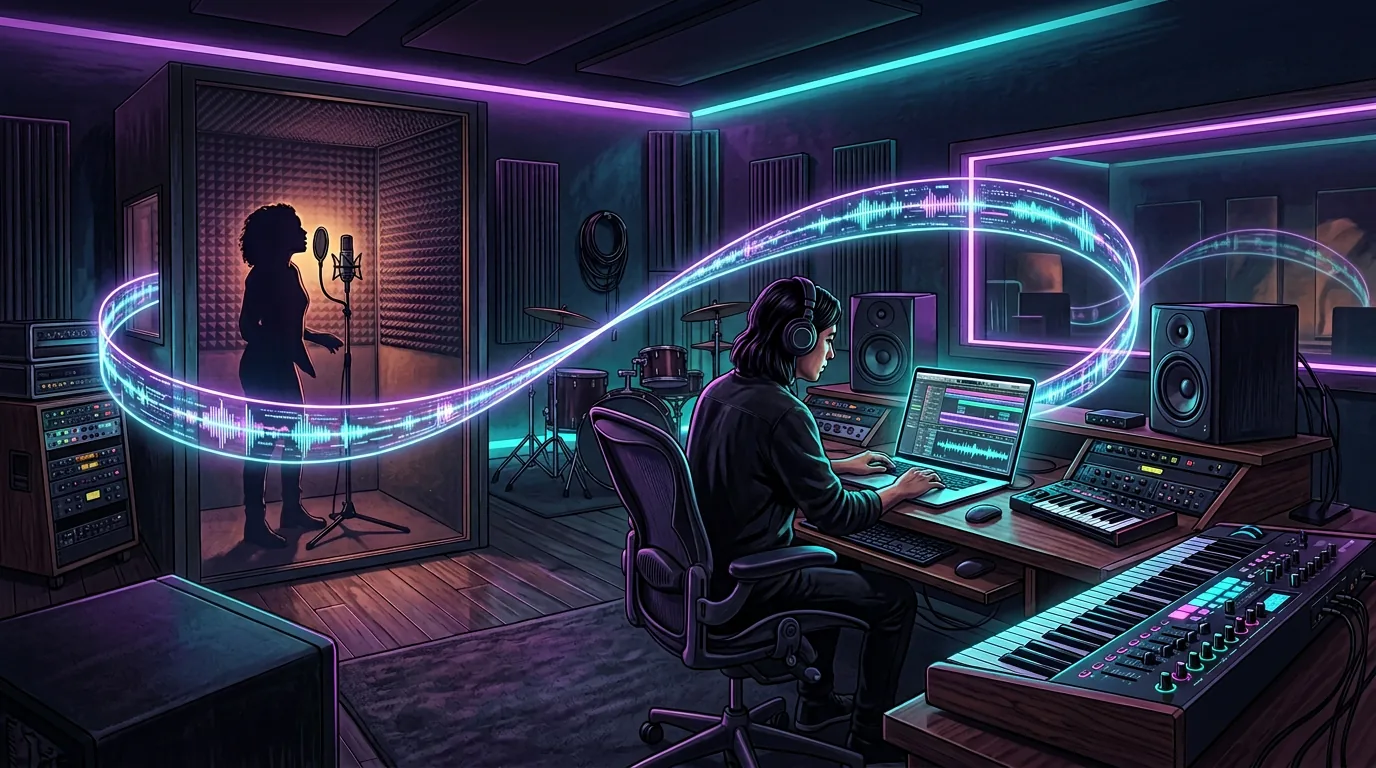
Neon-lit AI music production studio with a vocalist, a producer, and glowing sound waves crossing the room

AI music production lab

A fair comparison starts with the same brief, not with the loudest render.

The best differences show up when both tools face the same songwriting problem and you listen for what survives the second pass.

Studio singer under dramatic purple and cyan lighting beside a microphone

Vocal texture

Music production desk with a laptop arrangement timeline, controller knobs, and headphones

Editing workflow

Model overview

What each model is really trying to help you finish

This comparison gets clearer once you stop asking which company has more hype and start asking which workflow matches the way you actually build songs.

V8
Mureka V8
Song-first

Built for creators who want the first pass to already feel like a song

Mureka V8 leans hard into structure, vocal character, and emotional arc. The pitch is not just 'type something and get audio back.' It is closer to 'shape an idea until it feels performed.' That framing matters if your biggest bottleneck is getting from lyric or topline concept to something that already sounds alive.

  • Reference-aware creation: higher tiers talk openly about reference audio, melody extension, and deeper guidance for the generation process.
  • Singer direction: voice-centric controls, humming input, and custom voice workflows make Mureka feel closer to a songwriting assistant than a raw audio toy.
  • Commercial usefulness: the paid tiers are framed for creators who want to keep and reuse the output in real projects.
  • Fast emotional read: when people like Mureka, they usually talk about catchiness, vocal feel, and the impression that the track already knows where it is going.

Best fit: songwriters, topline writers, fast demo builders, and anyone who values the feeling of a performed song more than a dense editing toolset.

V5
Suno V5
Edit-first

Stronger when the output is only the start of the workflow

Suno V5 makes a broad production argument: generate, inspect, revise, extend, export, and keep refining. That is a different promise from 'give me the strongest first impression.' If your process regularly continues in a DAW, Suno's surrounding toolkit still carries serious weight.

  • Structured generation: official Suno materials emphasize arrangement, transitions, verses, choruses, and longer-form coherence.
  • Studio workflow: stems, MIDI export, remastering, and section-level adjustments help Suno stay relevant after the first render.
  • Identity recall: Personas and related workflows help preserve a song's style or vocal feel across further iterations.
  • Post-generation leverage: Crop, Extend, Replace Section, and similar features are easier to justify when you already know you will keep editing.

Best fit: producers, arrangers, and creators who treat AI as the first stage of a longer production session instead of the final stop.

Workflow visualized

How each tool fits into the room

The gap is less about brand loyalty and more about where the tool sits in your actual chain of work.

Dramatic performance-focused studio scene representing Mureka V8's vocal-first creative style
Mureka V8 focus

Performance energy, hooks, and the feeling that the song is already moving

Mureka makes the strongest impression when you care about singer feel, melody pull, and whether the first output already sounds emotionally committed.

VocalsHooksSong-first
Producer-focused studio editing scene representing Suno V5's control-first workflow
Suno V5 focus

Editing depth, production handoff, and control after generation

Suno makes more sense when you already know the track will keep moving through revisions, stems, MIDI export, and a deeper production pass.

StudioEditingExports
Quick answer

Choose based on the job, not the logo

You do not need one permanent winner. You need the tool that removes the next bottleneck in front of you.

Choose Mureka V8 if...

You care most about the first pass sounding like a song

Mureka is easier to justify when your instinct is to judge output by vocal pull, hook quality, and whether the song already feels emotionally pointed.

  • You want reference audio, melody extension, and stronger singer-shaping options.
  • You care more about vocal presence and hook impact than detailed timeline editing.
  • You want a workflow that feels closer to idea to song than idea to session file.
Choose Suno V5 if...

You care most about what happens after generation

Suno is the safer pick when the generated result is just raw material for the next round of production work.

  • You want stems, MIDI export, audio uploads, and a browser-based studio layer.
  • You regularly fix sections, replace endings, remaster drafts, or continue inside a DAW.
  • You think of AI as a sketch-and-edit partner rather than an instant-finish engine.
Best practice

Run the same prompt through both and listen with discipline

The fastest way to stop arguing in the abstract is to hold the prompt constant and compare what each tool actually does with it.

  • Does the chorus feel earned or simply louder?
  • Does the lyric meter sound intentional against the bar line?
  • Does the singer feel expressive, or just polished?
Listening checklist

What to listen for in a fair shootout

Loud mastering and shiny highs can fool anybody. These are the details that still matter on the second listen.

Chorus lift

A real chorus opens up the track. A fake one just arrives louder and denser.

Lyric meter

Listen for whether syllables land naturally or whether the line feels shoved into the bar.

BPM honesty

Fast prompts should feel fast. Aggressive prompts should not collapse into safe midtempo drift.

Vocal believability

Pay attention to breath, restraint, emphasis, and whether the singer sounds committed to the line.

Ending quality

The stronger generations resolve with intent. The weaker ones simply run out of ideas.

Prompt-matched listening room

Use the same brief and compare the right details

This page avoids fake audio players with no source files behind them. Use the prompt frames below to run your own A/B test and focus on the parts of the song that actually reveal quality.

The Digital Parade

Focus: vocals, hooks, and chorus lift

This is the fastest way to hear whether a model can carry intimacy in the verse and still open up convincingly in the chorus.

Sample 014:08
Moody pop vocal recording session in a modern studio

What to listen for

Does the singer sound persuasive? Does the chorus actually rise, or does it just get shinier?

Source file

The Digital Parade.mp3

The Digital Parade

Browser-ready playback

MP3

Embedded directly into the page so the listening section works as an actual reference bench instead of a placeholder card.

What to listen for

Does the singer sound persuasive? Does the chorus actually rise, or does it just get shinier?

Listen for chorus impactListen for lyric meterListen for emotional nuance

Lost in the Hateful Afternoon

Focus: tempo pressure and transition clarity

High-energy prompts expose whether a system can keep urgency without turning the whole track into blur or midtempo compromise.

Sample 023:03
High-energy electronic rock concert scene with dramatic lighting and motion

What to listen for

Can the model keep speed, arrangement pressure, and final-chorus payoff without sounding crowded or evasive?

Source file

Lost in the Hateful Afternoon.mp3

Lost in the Hateful Afternoon

Browser-ready playback

MP3

Embedded directly into the page so the listening section works as an actual reference bench instead of a placeholder card.

What to listen for

Can the model keep speed, arrangement pressure, and final-chorus payoff without sounding crowded or evasive?

Listen for real speedListen for transition clarityListen for final-chorus pressure

Fluorescent Silence

Focus: realism, phrasing, and endings

Stripped-back prompts reveal whether the model can hold attention without leaning on density, gloss, or obvious production tricks.

Sample 033:17
Intimate acoustic songwriting room with a guitarist under warm and cool lighting

What to listen for

Do small phrases feel intentional? Does the ending resolve like a songwriter made a decision?

Source file

01 - Fluorescent Silence [116978914295809].mp3

Fluorescent Silence

Browser-ready playback

MP3

Embedded directly into the page so the listening section works as an actual reference bench instead of a placeholder card.

What to listen for

Do small phrases feel intentional? Does the ending resolve like a songwriter made a decision?

Listen for phrasingListen for restraintListen for ending quality
Workflow split

Pick the tool that removes today's bottleneck

Most creators do not need one forever answer. They need the quickest route through the next step in front of them.

01

Starting from lyrics or a text brief

Both tools are credible here. The useful question is whether you care more about song feel on the first pass or about refinement options afterward.

Slight edge · Mureka
02

Starting from a melody idea or vocal concept

Mureka's reference-aware and voice-aware workflow makes more sense when the seed of the song already exists in your head or in a rough recording.

Clearer edge · Mureka
03

Editing after generation

If you expect to crop, replace sections, remaster, split stems, or keep nudging the arrangement, Suno's toolkit is easier to justify.

Clearer edge · Suno
04

Needing a browser-to-DAW bridge

For producers who think in timelines, exports, and handoff, Suno still reads like the more mature bridge into the rest of the production stack.

Workflow edge · Suno
Detailed comparison

Mureka V8 vs Suno V5 feature matrix

A side-by-side view of the capabilities that matter once you stop talking in brand slogans and start talking in actual workflows.

CategoryMureka V8Suno V5What it means
Independent benchmarksArtificial Analysis currently shows Mureka V8 leading both instrumental and vocal leaderboard views, which gives it a cleaner third-party momentum story.Suno's official flagship is V5, while some public benchmark rows still reference V4.5, which makes direct scoreboard reading a little messier.Mureka has the better benchmark headline right now. Suno still deserves direct testing if your workflow is heavy on editing and export.
Song structure and compositionMusiCoT is framed as a structure-first approach that models musical sections and emotional flow before final audio is rendered.Suno V5 is presented as a more arrangement-aware system with stronger section handling, bridges, outros, and cleaner structural transitions.Both are competing on real-song quality. Mureka reads as more composer-facing. Suno reads as more production-facing.
Vocals and singer identityVoice-aware workflows, humming input, and custom-voice positioning give Mureka a clearer singer-shaping story.Suno's Personas workflow is useful when you want to preserve or reuse the identity of a previous Suno output.Mureka feels stronger when you want to shape a vocalist. Suno feels stronger when you want consistency across iterative generations.
Audio inputReference audio is part of the documented higher-tier workflow and is presented as a real part of the creation stack.Audio uploads are well documented, especially around longer uploads and editing-driven workflows on paid plans.Both support input-led creation, but Suno's practical upload story is easier to understand from the documentation.
Editing after generationAdvanced editing and newer studio-oriented messaging suggest Mureka is expanding here, but the product story is still more first-pass centered.Replace Section, Crop, Extend, Remaster, and related tools make Suno the safer recommendation when editing is not optional.If the main job is fixing, replacing, and extending, Suno still has the better argument.
Exports and handoffPaid materials mention MP3, WAV, instrumental versions, and stem downloads, which is enough for many songwriter-first workflows.Suno's studio export path, including stems and MIDI, makes it easier to keep moving into a more traditional production environment.Mureka is enough if you mostly want usable songs. Suno is stronger if you need a fuller handoff into the rest of the stack.
Song length and continuityMureka is strong at fast full-song generation, though community comments do mention uneven extension quality in certain scenarios.Suno's documentation around longer generations and extension tooling makes it look safer for longer-form continuity work.If long-form control matters a lot, Suno has the more reassuring toolkit today.
The reality check

The honest takeaway

There is no universal winner here. The better tool depends on what kind of friction you are trying to remove from your process.

Where Mureka stands out

A stronger whole-song story

Mureka's momentum makes sense because it gives creators a story that is easy to feel on first listen: stronger vocal presence, quicker song identity, and a more immediate emotional read.

  • The product story lines up well with real songwriting behavior such as humming, referencing, and shaping singer feel.
  • When Mureka lands, the output often feels more like a performance than a glossy draft.
  • Third-party benchmark momentum gives it a cleaner headline for creators comparing tools quickly.
Where Suno stands out

A deeper post-generation story

Suno keeps its edge when the output is not the finish line but the raw material for more edits, more exports, and more production decisions.

  • Studio features, stems, MIDI, Replace Section, Crop, Extend, and Remaster add real workflow gravity.
  • Audio uploads and identity-preserving workflows are easier to fold into a longer production process.
  • If you already know the track is heading into a DAW, Suno usually makes that easier to justify.
What we recommend

Start with the tool that matches the next decision you need to make

Use Mureka if you need a song to feel present fast. Use Suno if you need the generation to survive a longer editing journey. If you are unsure, run the same prompt twice and compare on the checklist above.

  • Choose Mureka for song feel, singer direction, and faster first-pass conviction.
  • Choose Suno for edits, stems, MIDI, and heavier post-generation control.
  • Keep the prompt constant and let the listening test answer the argument for you.
Community voices

What public creator conversations keep repeating

These comments are not formal benchmarks. They are useful because they show what people remember after making more than one track.

Mureka · praisePublic creator forum
On Mureka the vocals for me were great, a big selling factor. Better than all of them.
Read thread
Mureka · critiquePublic creator forum
I have several songs that are absolutely insanely high quality, but when I extend them the sound quality gets ruined.
Read thread
Mureka · catchinessPublic creator forum
This song is stuck in my head. I have made more songs since then but none have been as catchy.
Read thread
Suno · praisePublic creator forum
The production quality on even my discarded versions tramples most songs. It is amazing, and it is scary at the same time.
Read thread
Suno · feedbackPublic creator forum
V5 is a very capable model, but it is a wild animal that cannot be tamed.
Read thread
Suno · critiquePublic creator forum
The audio quality is insane, but it often feels a bit too polished.
Read thread
Choose your pathway

Where each route makes the most sense

The best choice changes depending on whether you are writing from scratch, producing from exports, or starting from notation instead of prompts.

For songwriters

Need a convincing demo fast?

If you want lyrics, melody, or a vocal concept to turn into something that already feels like a performance, Mureka V8 is the more natural starting point.

Try Mureka V8
For producers

Need more post-generation control?

If the real work begins after the first render, Suno V5's editing, stems, and export depth make more sense.

Review the matrix
For arrangers

Already have sheet music and just need MIDI?

If you are not starting from prompts at all, you may get more value by converting notation straight into editable MIDI.

Open Sheet Music to MIDI

Ready to create?

Want the fairest answer? Run the same prompt twice.

Start in Mureka V8, mirror the exact brief in Suno V5, and judge on chorus lift, lyric fit, vocal feel, and how much repair work is still waiting for you afterward.

Producer toolkit

Starting from notation instead of prompts? Skip prompt roulette.

If you already have a score, a PDF lead sheet, or scanned sheet music, you may not need a generative music model for that step at all. Use Melogen AI's Sheet Music to MIDI workflow and move straight into editing.

Input

PDF, JPG, or PNG sheet music

Output

Editable MIDI ready for your browser or DAW workflow

Best for

Notation-first production, arranging, education, and score cleanup

Why it works

It preserves the written composition instead of asking a text-to-song model to guess what you meant

When this shortcut makes more sense

If your bottleneck is digitizing written music, not generating new music from scratch, this route gets you to useful material faster.

FAQ

Common questions creators ask before switching tools

Short answers, without pretending one platform solves every job equally well.

Is Mureka V8 better than Suno V5?+

It depends on what you mean by better. If you care about faster song feel, stronger vocal direction, and a more immediate emotional read, Mureka V8 often feels stronger. If you care about edits, stems, MIDI export, and section-level repair, Suno V5 remains the safer production choice.

Which platform sounds more convincing on vocals?+

Mureka V8 currently has stronger momentum in public conversations about vocal feel and singer presence. Suno V5 has improved a lot, but some users still describe its best renders as highly polished rather than deeply expressive.

Which platform gives more post-generation control?+

Suno V5. Its Studio-oriented workflow, stem extraction, MIDI export, and section-level editing features make it the clearer choice when the first render is only the beginning.

Can I use my own audio or melody with both?+

Yes. Suno documents audio uploads clearly, while Mureka's higher tiers also lean into reference audio, humming-style inputs, and voice-aware workflows.

What if I already have sheet music and just need MIDI?+

In that case, a text-to-song tool may be the wrong first stop. Use Melogen AI's Sheet Music to MIDI converter and go directly from score to editable MIDI.