How to Read Guitar Sheet Music: Standard Notation Guide
Learn how to read guitar sheet music through treble clef, rhythm, fretboard mapping, position choices, and a notation-first Melogen workflow.
 Zhang Guo
Turn a static score into editable MIDI
Contents
If you are trying to learn how to read guitar sheet music, the fastest way to make progress is to separate the job into two layers. First, standard notation tells you the pitch and rhythm. Second, the guitar forces you to decide where that note should live on the fretboard. When beginners blur those two jobs together, every bar feels harder than it really is.
That is why this guide stays practical. We will cover the symbols that matter first, show how written notes connect to strings and frets, treat fretboard references as a support layer, and finish with a simple practice workflow. If your source is a scan, PDF, or a song you want to decode faster, I will also show where Melogen fits without pretending software replaces musicianship.
Start with the five things every guitar score tells you
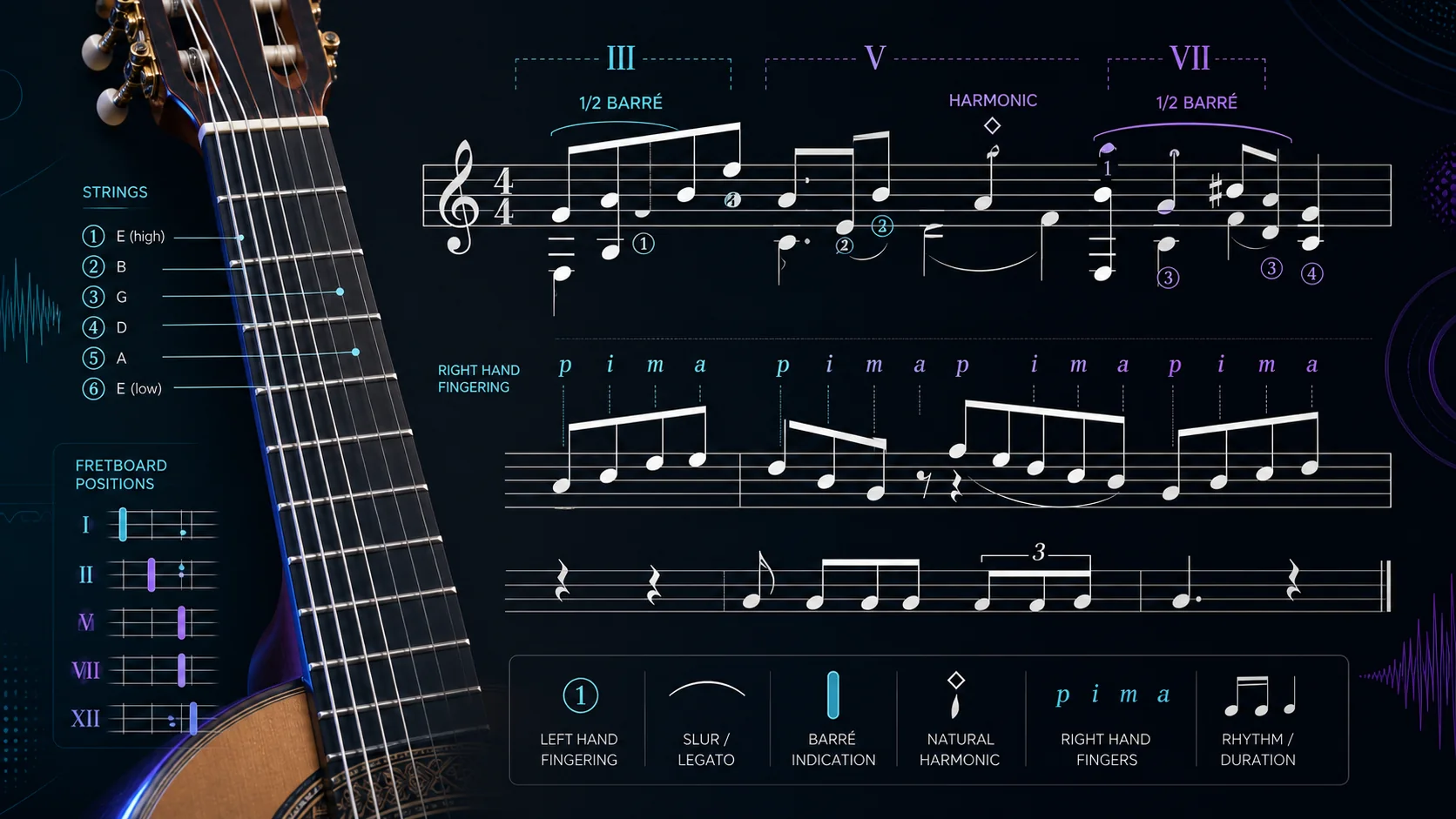
Most beginner frustration comes from looking at the entire page at once. A better approach is to scan the score in the same order every time: clef, key signature, time signature, note location, and any position or fingering hints. Guitar music is usually written in treble clef, and it is conventionally notated one octave higher than it sounds. That sounds technical, but the practical takeaway is simple: trust the page layout you are reading and do not panic if the sounding pitch feels lower than the written register.
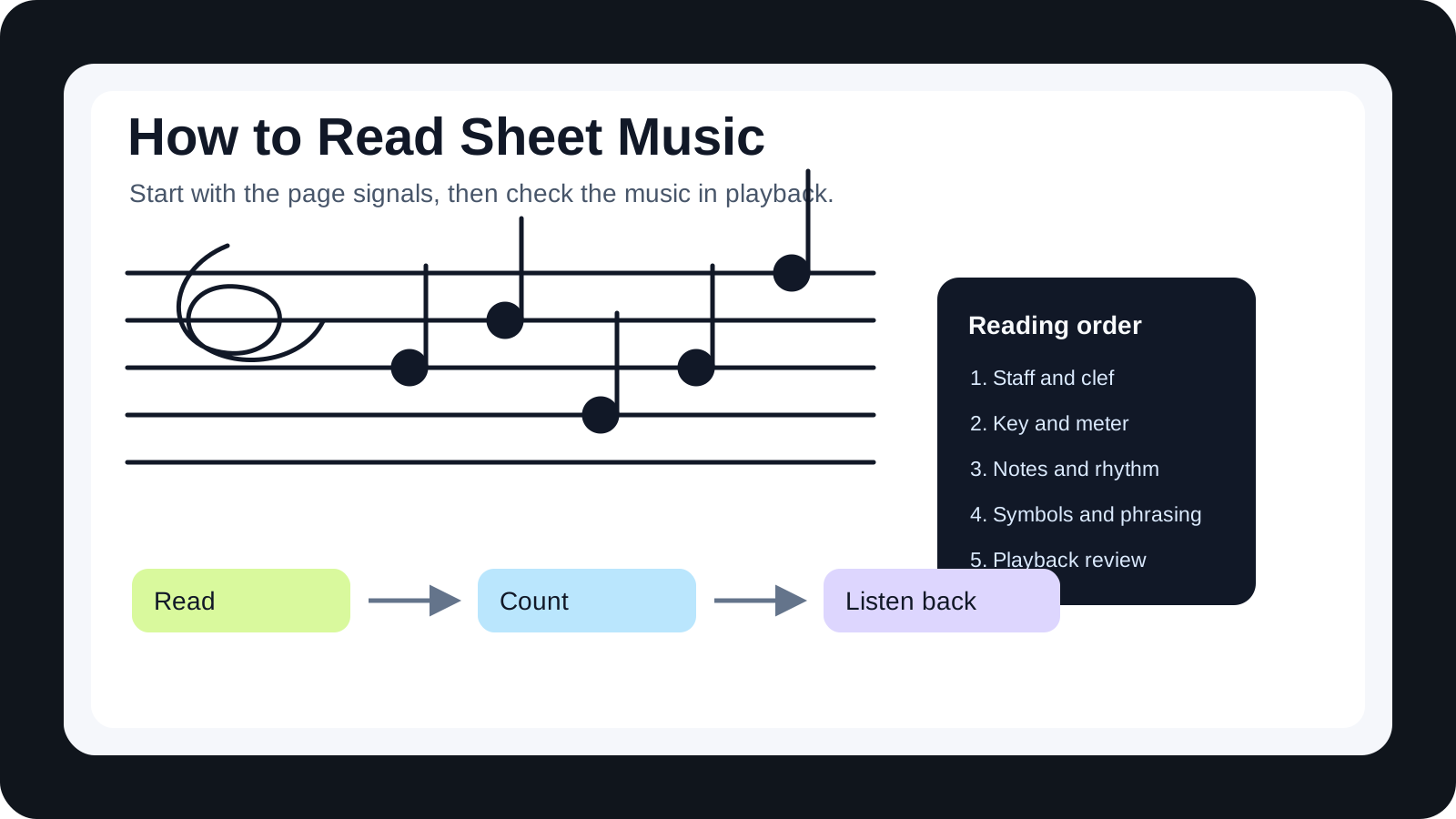
Here is the first-pass checklist I recommend before you even start fingering notes on the instrument:
| Score element | What to read first | Why it matters on guitar | Beginner action |
|---|---|---|---|
| Clef | Treble clef | Tells you the staff map you are using | Confirm you are reading treble clef, not TAB alone |
| Key signature | Sharps or flats at the start | Changes note spelling across the whole line | Say the scale tones out loud before playing |
| Time signature | Beats per bar | Rhythm mistakes usually break the phrase before pitch mistakes do | Count one bar out loud before touching the guitar |
| Note position | Line or space on the staff | Gives you the written pitch name | Name the note before choosing a fret |
| Position hints | Roman numerals, fingerings, string markings | Helps you choose one guitar-friendly location | Use them when present, but do not guess them into every bar |
Once you know those five signals, the page stops looking like random dots. It becomes an instruction set: what pitch, what rhythm, what register, and what likely hand position.
Learn how written pitch maps onto the fretboard
The biggest difference between piano notation and guitar notation is choice. On a keyboard, one written pitch usually points to one key. On guitar, the same pitch can often be played in multiple places. That means good guitar reading is not only about recognizing the note name. It is also about choosing an efficient position.
Start with the open strings, because they give you six orientation anchors immediately: E A D G B E. When you can see those anchor notes on the staff and feel where they sit on the instrument, the notes around them become easier to decode. Then expand by learning the first five frets on each string instead of trying to memorize the entire fretboard in one pass.
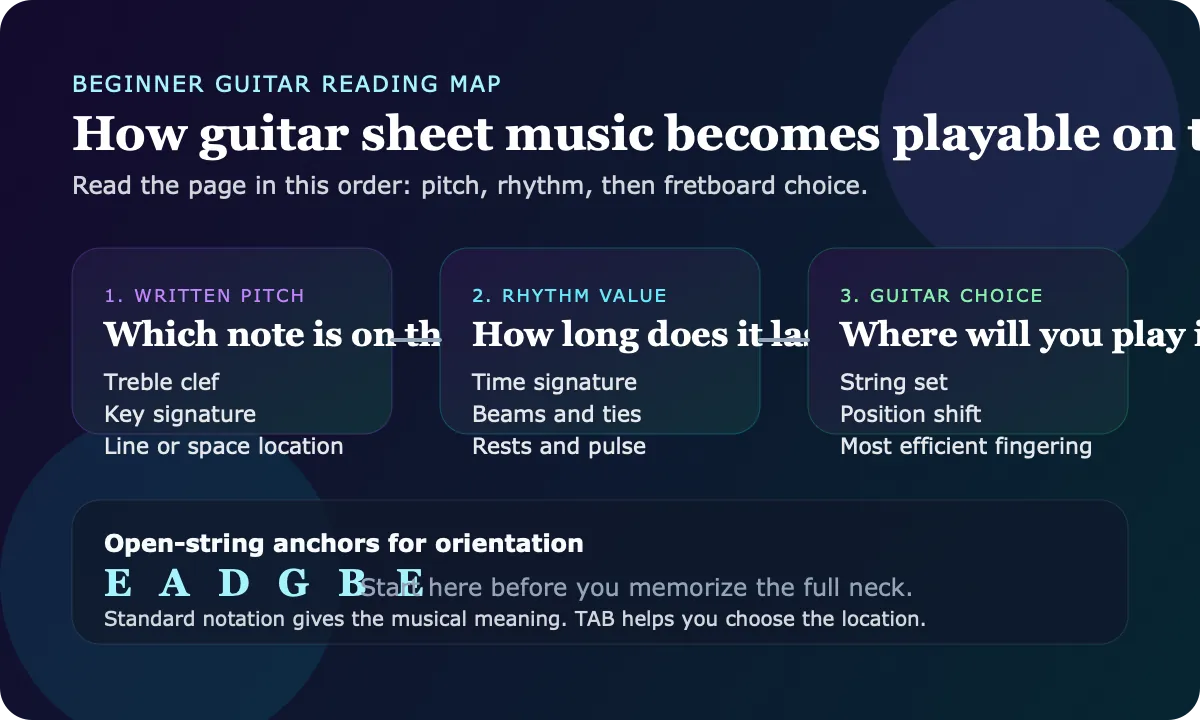
A useful mental model is this: the page gives you note identity, the fretboard gives you location options, and your job is to choose the cleanest route for the phrase. If a passage feels impossible, it is often not because you misread the pitch. It is because you chose an awkward string set.
Three habits help here:
- Look for small position groups instead of isolated notes.
- Favor nearby string and fret choices before jumping across the neck.
- Check repeated note patterns, because guitar writing often reuses shapes.
Read rhythm before you chase fingerings
Many guitar players can identify note names but still feel lost because the rhythm layer is underdeveloped. In real playing, rhythm usually collapses before pitch does. A wrong fret is one note. A broken pulse can derail the whole bar.
When you read a new line, clap or tap the rhythm first. Quarter notes, eighth notes, tied notes, rests, and beamed figures should feel stable before you worry about left-hand efficiency. This matters even more on guitar because a hard fingering can tempt you to distort timing just to survive the bar.
I like using this order:
- Count the measure.
- Speak the rhythm.
- Name the pitches.
- Only then decide the fingering.
That sequence feels slower for the first few days, but it saves time because you stop debugging too many variables at once. If the rhythm is right and the pitch names are right, your remaining problem is usually just position planning.
Use fretboard references without replacing notation
A fretboard reference can be useful, but it should not replace the notation work in this guide. Standard notation tells you the exact pitch, rhythmic value, and often the articulation. A fretboard reference tells you where a note can sit on the neck. If you only follow fret positions, you may miss rhythmic detail or phrasing logic. If you only read standard notation, you may spend too much time finding the most playable string set.
For guitar sheet music, the sweet spot is to keep standard notation in charge and use position hints only when they reduce friction:
| Format | Best at | Weak spot | When to trust it most |
|---|---|---|---|
| Standard notation | Pitch, rhythm, phrasing, musical literacy | Does not always tell you the easiest fingering | Reading melodies, ensemble parts, and formal arrangements |
| Fretboard reference | String and fret placement | Can hide deeper rhythmic understanding if used alone | Checking a fingering or neck position after reading the notes |
| Notation plus reference | Gives both musical meaning and physical placement | Still needs musical judgment for phrasing | Beginner-to-intermediate guitar study |
This is the boundary to keep clear. This article is about reading guitar sheet music from standard notation. If your real task is decoding tab lines, fret numbers, and symbols, use the separate guitar-tabs workflow rather than folding that job into this page.
Use Melogen when you need a faster bridge from notation to practice
Melogen is most helpful when you treat it as a bridge, not as a substitute for reading. The goal is to reduce setup friction so you can spend more time hearing, checking, and refining the music.
If you are working from a song, audio file, or YouTube link, Melogen's AI Guitar Tab Generator is the most direct fit. The local product copy describes it as a workflow that turns songs, audio files, and YouTube links into readable guitar tabs online, with support for MP3, WAV, M4A, FLAC, and YouTube links. That makes it useful when your real bottleneck is getting a playable first view of a riff, chord pattern, or lead line.
If you are working from printed notation, scanned pages, or PDF scores, Melogen's Sheet2MIDI workflow is the better bridge. The repo and MCP docs describe support for PDF, PNG, and JPG input with MIDI and MusicXML output. That gives you a practical way to inspect pitch and rhythm in a DAW or notation editor before you finalize guitar fingerings yourself.
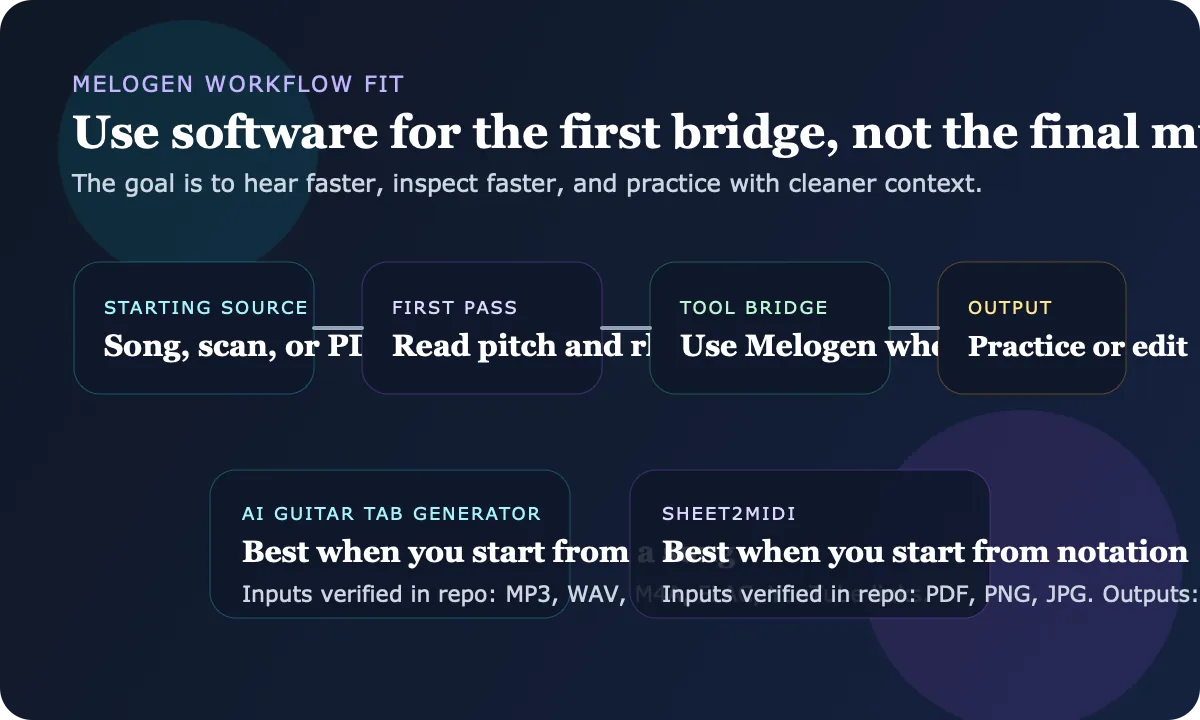
The important limit is honesty: no tool eliminates the need for musical judgment. If a scan is messy or the source material is dense, you should still expect a cleanup pass. But Melogen can shorten the distance between "I found this music" and "I can now hear, inspect, and practice it."
Move from notation to something playable faster
Use Melogen AI Guitar Tab Generator when you start from a song, or open Sheet2MIDI when your source is a scanned score or PDF. Both routes help you build a faster first pass before the real musical cleanup.
A first-week practice plan
You do not need a giant curriculum to start reading better. You need a repeatable loop.
- Day 1: Memorize the open-string anchors and locate them on the staff.
- Day 2: Read only quarter-note melodies on one string set.
- Day 3: Clap rhythms from a short exercise before playing them.
- Day 4: Read a line in notation, then compare it with a TAB version.
- Day 5: Shift one melody into a different neck position and notice what changes.
- Day 6: Use a simple Melogen workflow to generate a first-pass reference from audio or scanned notation.
- Day 7: Play, listen back, and mark the bars where rhythm or fingering broke down.
That loop teaches the right lesson: reading is not just identifying symbols. It is turning visual information into repeatable musical action.
The practical takeaway
Learning how to read guitar sheet music gets easier when you stop asking the page to do everything at once. Let standard notation tell you the pitch and rhythm. Let fretboard references help with neck placement when you need them. Let the fretboard become familiar in small zones instead of as one giant map.
If you keep the process simple, your next steps are clear:
- Scan the score for clef, key, time, and position clues.
- Read the rhythm before worrying about flashy fingerings.
- Use notation and TAB together when that reduces friction.
- Use Melogen for the first digital bridge, then make the final musical decisions yourself.
That is a musician-safe workflow: clear enough for a beginner, but still honest enough for real practice.
About the author
Zhang Guo
Composer - AI Product Manager
AI product manager and digital marketing consultant with a background in music. Creativity is the bridge between rhythm and logic, where musical intuition and mathematical precision can coexist in every meaningful product decision.
Follow on X