A Barbershop Music Guide for Singers and Arrangers
Learn barbershop music with voice-part roles, chord-tuning rules, rehearsal tips, score-reading workflows, and practical Melogen links.
 Zhang Guo
Turn a static score into editable MIDI
Contents
Barbershop music is close four-part a cappella harmony built around one practical goal: make the chord ring. The lead usually carries the melody, the tenor floats above it, the bass anchors the harmony, and the baritone fills the notes that make each chord complete.
That makes barbershop different from a normal SATB choral score. The melody is not normally the top voice. The chord is not tuned like a piano. The arrangement is built so singers can lock consonant chords, stretch cadences, and make the harmony feel larger than four people standing in a semicircle.
What barbershop music means
The Barbershop Harmony Society describes barbershop as close, four-part, a cappella harmony rather than a historical era or a generic genre label. Its music explainer is useful because it focuses on the arranging mechanics: the melody sits inside the texture, each melody note is harmonized, and the baritone often supplies the missing chord tone.
The sound is usually homorhythmic, which means the voices often sing the same words at the same time. That does not make the style simple. It means the complexity is packed into tuning, voice balance, chord choice, text delivery, and the way cadences expand.
Barbershop also has a specific historical context. The Barbershop Harmony Society's history page traces the style through African-American vocal traditions, late nineteenth-century quartet culture, and the twentieth-century revival that helped organize modern barbershop singing.
For a singer or arranger, the useful takeaway is this: barbershop is not just "four people singing old songs." It is a disciplined way to arrange and tune four independent roles so the harmony feels immediate.
How the four voice parts work
Barbershop parts are usually named tenor, lead, baritone, and bass. Those labels do not map cleanly to classical choir naming.
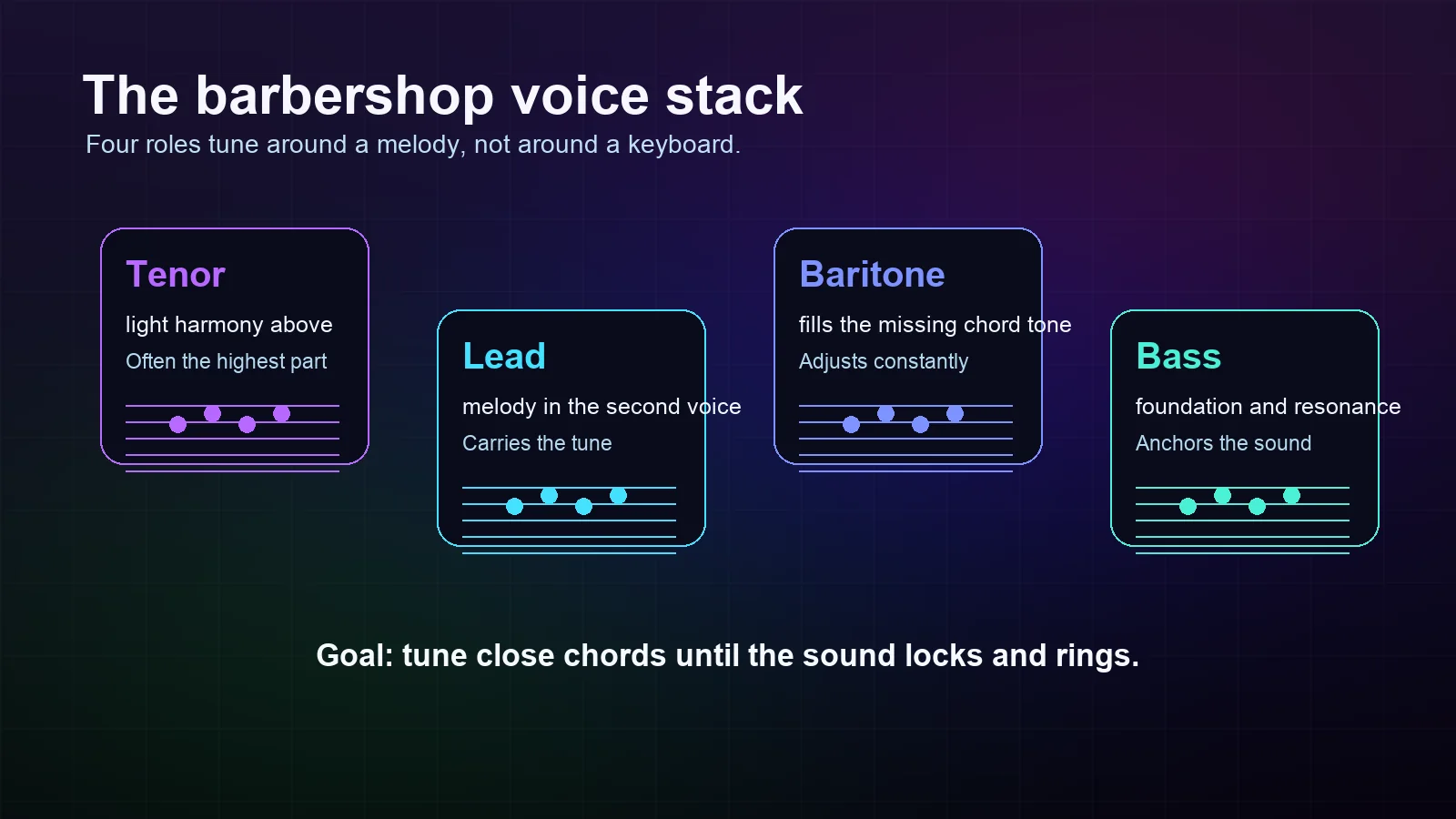
The lead sings the melody and should be easy to follow. The tenor normally harmonizes above the lead with a lighter sound. The bass sings the lowest foundation notes and gives the chord weight. The baritone is the puzzle piece: it moves above and below the lead, completing whatever note the chord still needs.
| Part | Main job | What to listen for |
|---|---|---|
| Tenor | Light harmony above the melody | A floating color that does not overpower the lead |
| Lead | Melody and text clarity | The tune, phrase shape, and emotional line |
| Baritone | Missing chord tone and inner motion | Subtle voice leading that makes the chord complete |
| Bass | Foundation and resonance | Root motion, chord weight, and stable tuning |
This is why barbershop can feel strange to singers who come from SATB choir. In many choir pieces, the soprano line owns the tune. In barbershop, the melody often sits lower, and the top voice becomes a color line. If the tenor sings too heavily, the chord can sound bright but unstable. If the bass is weak, the whole stack loses its floor.
The balance is not a fixed mathematical rule for every ensemble, but the common barbershop idea is clear: bass and lead carry more of the sound, while tenor stays lighter and baritone adjusts constantly.
Why barbershop chords ring
The "ring" in barbershop comes from consonant close harmony, careful vowel matching, and tuning that is not locked to equal-tempered piano pitch. Singers adjust intervals so the chord settles acoustically. When the voices align, listeners hear a brighter overtone effect that makes the harmony feel bigger than the quartet.
The style favors chord colors that reward that tuning. Dominant seventh sonorities are especially important because they create a strong pull toward resolution while still leaving room for color. Cadences may be held longer than the printed rhythm so the group can tune, listen, and release the tension together.
This is where barbershop connects naturally to the Melogen guide on harmony and counterpoint. Barbershop is not counterpoint-heavy in the Renaissance sense, but each part still has a job. The vertical chord must ring, and the horizontal lines must remain singable enough for real people to rehearse.
Use this checklist when a barbershop chord feels close but not quite locked:
- Confirm the lead is clearly carrying the melody.
- Check whether the bass is giving the chord a stable root or inversion.
- Ask whether the tenor is too loud for a color part.
- Find the baritone note and test whether it completes the chord or fights it.
- Match vowels before making the pitch problem more complicated.
- Slow down the cadence and tune the last two chords as a unit.
Barbershop vs choral music
Barbershop sits inside the wider world of vocal ensemble music, but it solves different problems from most choral writing.
In choral music, the score may emphasize blend across SATB sections, text painting, contrapuntal entrances, orchestral doubling, or formal development. In barbershop, the arrangement usually keeps the words together and focuses the drama on chord color, balance, cadence shape, and direct audience communication.
That does not make one style more advanced than the other. It changes the rehearsal priorities.
| Question | Typical choral answer | Barbershop answer |
|---|---|---|
| Where is the melody? | Often soprano or a featured section | Usually the lead, inside the texture |
| How is tuning judged? | Often balanced against piano or ensemble context | Adjusted by ear so close chords lock |
| What drives the arrangement? | Texture, counterpoint, form, text, harmony | Melody support, chord color, tags, cadence energy |
| What does the singer need first? | Part accuracy and blend | Part role, vowel match, balance, and chord awareness |
If you want a broader vocal-music frame, the Melogen choral music guide is the natural companion. Barbershop is more specific: four roles, close harmony, a cappella tuning, and a strong expectation that singers understand their function inside each chord.
How to practice barbershop from a score
Start with the score, but do not treat the page as the finished performance. Barbershop print music may leave tempo, dynamics, and phrasing decisions more open than a classical choral score. The page gives you the notes. The quartet or chorus still has to create the style.
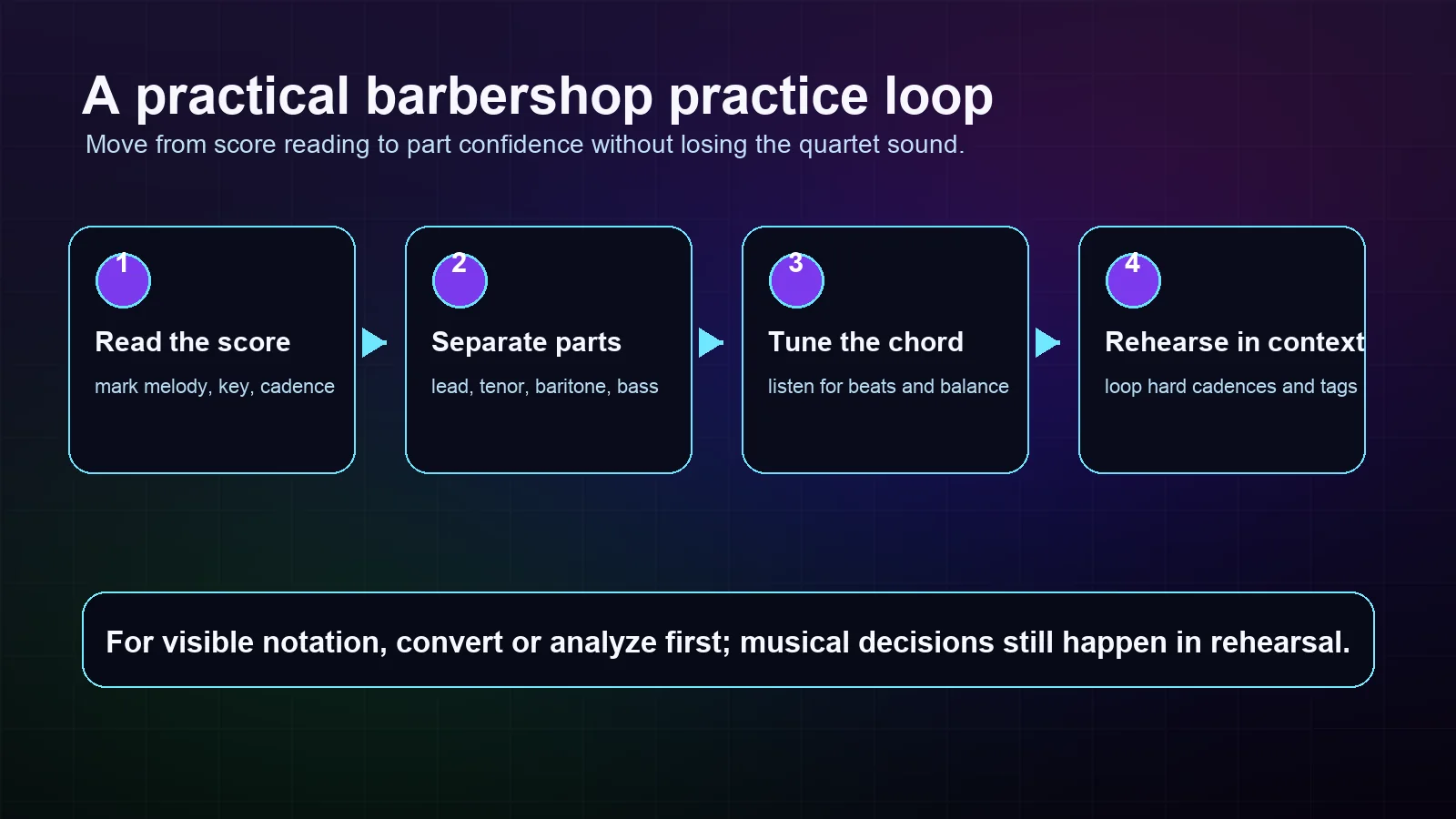
A useful practice loop is:
- Read the lead line first so everyone knows the tune.
- Add the bass and check whether the harmonic direction is obvious.
- Add tenor lightly and avoid covering the lead.
- Add baritone last and listen for the chord tone that completes the stack.
- Isolate cadences, tags, and chromatic moments.
- Slow the hard chord, match vowels, then return to performance tempo.
For singers learning alone, a playable score or MIDI export can help. The goal is not to replace ensemble listening. The goal is to arrive at rehearsal already knowing where your part lives.
That is also why barbershop overlaps with score-to-practice workflows. If you have printed notation, a readable PDF, or a clear photo, a first-pass conversion can help you hear the lines separately. Melogen's Sheet2MIDI workflow is most useful when the source is visible sheet music and you want editable MIDI for practice or cleanup.
Where Melogen fits
Melogen is not a barbershop coach, and it will not make musical taste decisions for a quartet. Its role is narrower and more practical: help you move from visible notation into a workflow where parts, harmony, form, and practice loops are easier to inspect.

For a barbershop chart, that can mean two different workflows. If you need playback or part isolation, start with Sheet2MIDI or another score conversion path. If you already have readable notation and want a faster overview of form, key, cadence areas, and harmonic motion, use Melogen Structural Analysis.
Structural analysis is especially useful before rehearsal planning. A director can mark the tags, identify places where the harmony changes quickly, and decide which measures deserve slow chord tuning. An arranger can use it as a second pass after checking the score manually.
Map the harmony before rehearsal
Use Melogen Structural Analysis when you have readable notation and want a faster view of form, key areas, cadences, and harmonic motion before tuning the quartet sound.
Finding barbershop music responsibly
Barbershop singers often look for arrangements, tags, and learning tracks. This is where rights matter. A song being old, popular, or easy to find online does not automatically mean an arrangement is free to perform or distribute.
The LABBS guide to finding barbershop arrangements gives a practical warning: some arrangements are unpublished, some are sold through organizations or arrangers, and some free music is free because the underlying song is public domain. If you plan to perform publicly, check the arrangement rights and the territory.
For practice, start with legitimate sources:
- Your chorus or quartet library.
- Barbershop organization shops and free-music pages.
- Directly licensed arrangements from arrangers.
- Public-domain songs with clear arrangement permissions.
- Your own arrangements, if you understand the rights for the underlying song.
This matters because barbershop is a community style. Respecting arrangers keeps more good charts available.
The practical takeaway
Barbershop music works because every part has a job. The lead carries the melody. The bass gives the chord weight. The tenor adds the upper color. The baritone completes the harmony, often in the least obvious way. When those roles tune together, the chord can lock and ring.
If you are new to the style, start by learning the role of your part before worrying about every historical detail. If you are arranging, write so the melody remains clear and the inner notes are singable. If you are rehearsing, slow the cadences, match vowels, and listen for the chord as one sound.
The page matters, but the ring happens in the room.
About the author
Zhang Guo
Composer - AI Product Manager
AI product manager and digital marketing consultant with a background in music. Creativity is the bridge between rhythm and logic, where musical intuition and mathematical precision can coexist in every meaningful product decision.
Follow on X