Choral Music Guide for Singers and Directors
Learn what choral music means, main choir formats, SATB voice roles, rehearsal choices, and how to turn clean scores into practice material.
 Zhang Guo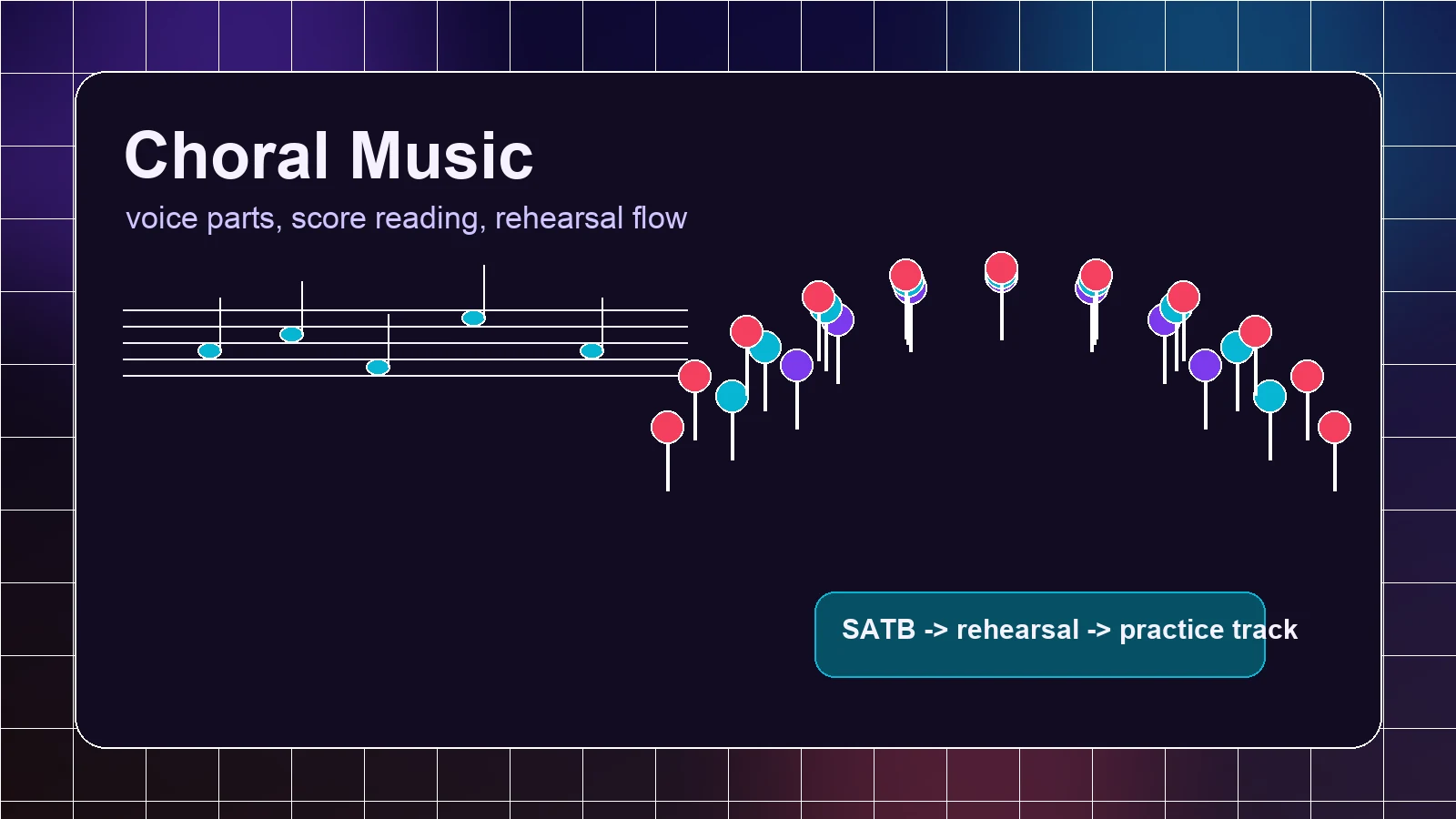
Turn a static score into editable MIDI
Contents
Choral music is music written or arranged for a choir, usually with more than one singer on a part. That can mean a church choir singing SATB harmony, a chamber choir reading Renaissance polyphony, a school choir learning a two-part arrangement, or a community chorus preparing a large work with piano or orchestra.
The useful way to understand choral music is not only by genre. It is by the job each voice has inside the shared sound. Soprano, alto, tenor, and bass lines may carry melody, harmony, rhythm, text, or a cue for another section. Good rehearsal starts when singers know both their own line and the texture around it.
Choral music in plain language
The standard definition is broad: choral music is music sung by a choir. Britannica's choral music overview describes the core idea as voices grouped into parts, while also showing why the category stretches across sacred, secular, small, and large ensemble traditions.
In practice, choral music can be simple or dense. A unison choir may sing one melody together. A two-part choir may split into high and low voices. A mixed choir may sing SATB harmony. A double choir may divide into two separate groups that answer each other across the room or stage.
That means the same word, "choir," can describe very different rehearsal problems. One group needs confident text rhythm. Another needs inner-part tuning. Another needs clean entrances after long rests. Another needs a way to turn a printed score into a practice reference before rehearsal.
Main choir formats and voice parts
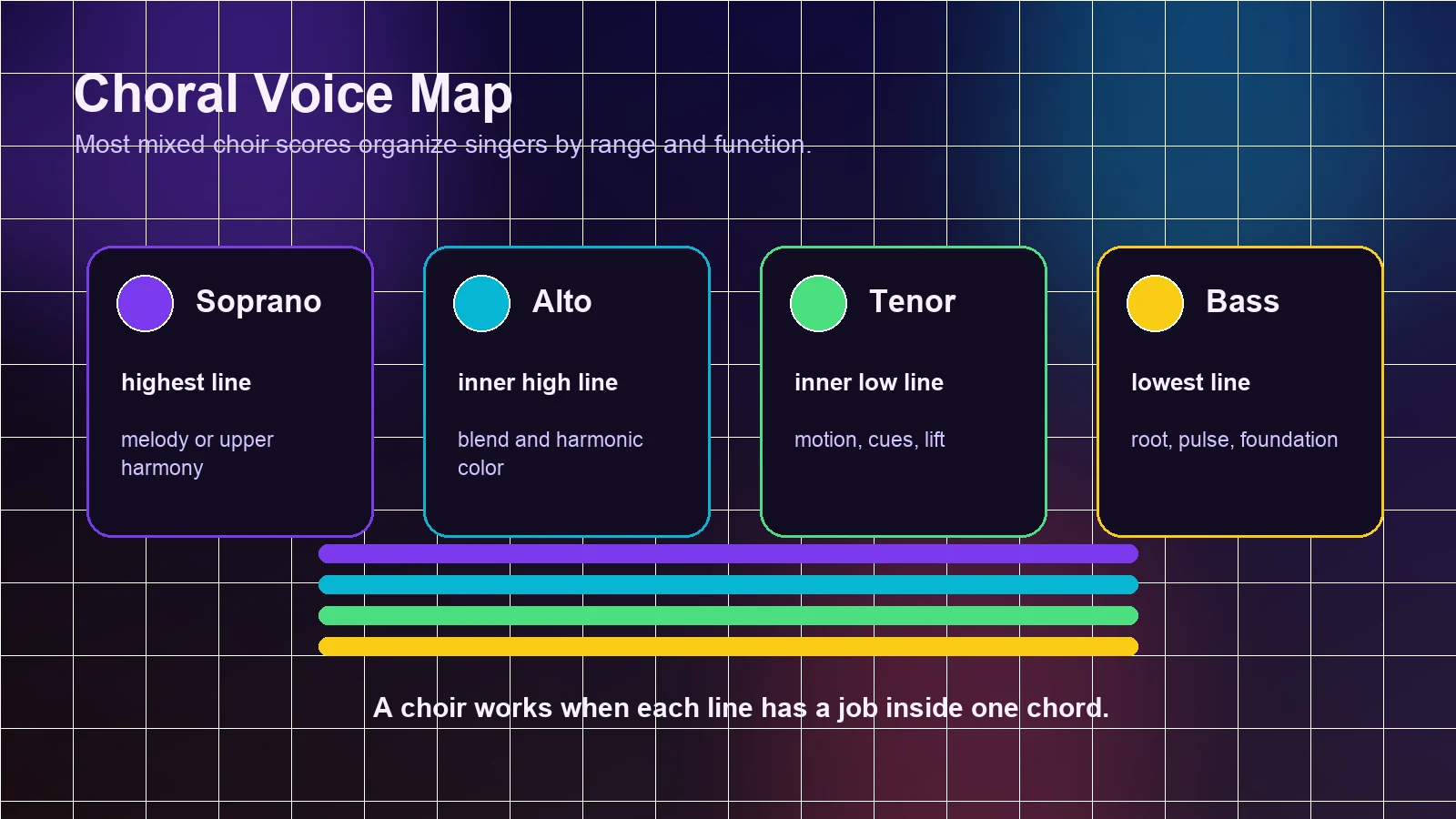
Most mixed choir notation starts from four voice families: soprano, alto, tenor, and bass. The labels are not only ranges. They also hint at how the musical texture works.
| Format | Common singers | What it usually means | Rehearsal watchpoint |
|---|---|---|---|
| Unison | everyone on one line | one melody, often for congregational, school, or simple chorus use | vowel shape, rhythm, and blend matter more than harmony |
| Two-part | high and low voices | melody plus support, echo, or simple harmony | keep the lower line independent instead of letting it disappear |
| SSA or SSAA | treble voices | upper-voice choir writing, often school, women's, or treble ensembles | watch balance because all parts sit in a similar register |
| TTBB | lower voices | men's chorus or low-voice ensemble writing | keep inner motion clear so the texture does not become heavy |
| SATB | mixed voices | soprano, alto, tenor, bass harmony | entrances, tuning, and text alignment across parts |
| Divisi | one part splits | a section divides into two or more lines | mark who sings which split before full runs |
| Double choir | two SATB groups | antiphonal or spatial writing | rehearse each choir alone, then together |
Soprano often carries the highest line and may carry the melody, but not always. Alto and tenor parts frequently hold the harmonic glue: suspensions, passing tones, and notes that feel strange alone but make sense in the chord. Bass usually supplies the foundation, root motion, or rhythmic weight.
If your immediate task is learning one line, read how to learn a choir part next. This page is the broader map; that guide is the practice loop.
How choral music changed across eras
Choral music has lived in churches, courts, schools, civic halls, concert stages, and community rooms. The history is too large for one rehearsal guide, but a few landmarks help musicians read the page more intelligently.
| Period or setting | Typical texture | What a modern singer should notice |
|---|---|---|
| Plainchant and early sacred song | mostly unison or monophonic lines | text flow and phrasing carry the music |
| Renaissance polyphony | interwoven independent lines | entrances and imitation matter as much as vertical chords |
| Baroque and Classical sacred works | choir with continuo, organ, piano, or orchestra | rhythm, text, and accompaniment cues drive rehearsal |
| Romantic and modern choral writing | wider harmony, bigger dynamic range, larger ensembles | tuning and balance become more exposed |
| Gospel, spirituals, and contemporary choir styles | call and response, groove, harmony, improvisatory energy | notation may not capture every performance practice detail |
| School, church, and community choir repertoire | practical scoring by ability and setting | source quality and rehearsal planning matter as much as style |
The Library of Congress American Choral Music collection is useful for seeing how choral repertoire sits inside a public archive, not only inside commercial sheet-music catalogs. For public-domain repertoire, the Choral Public Domain Library at CPDL can be useful, but every score still needs an edition and rights check before copying, performing, projecting, or recording.
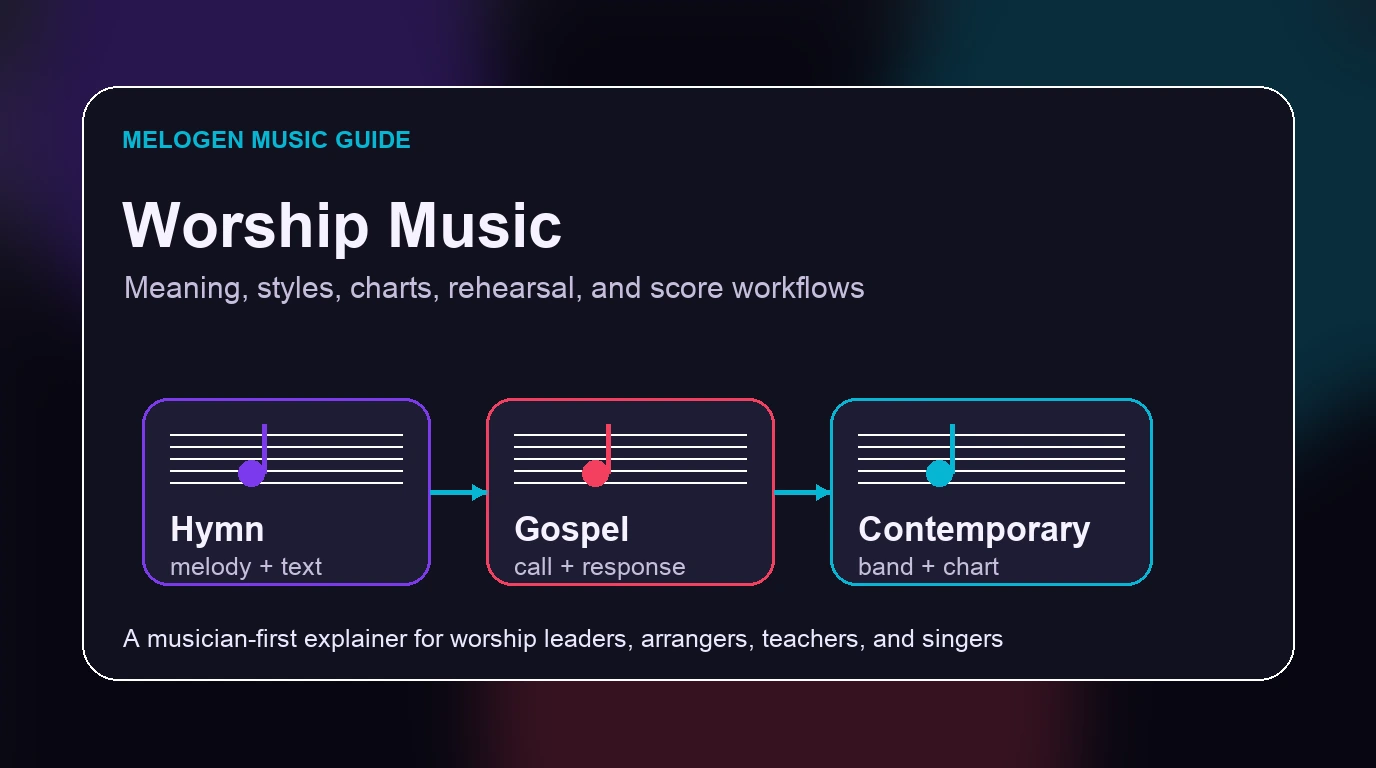
If the choral piece is part of a worship setting, the Melogen guide to worship music gives the broader service and style context. A choral anthem, a hymn, and a contemporary worship choir chart may all involve singers, but the musical job is not identical.
Read the score before rehearsing the sound
A choir score is a map of relationships. Before singing, identify the layout.
Start with these questions:
- Is the piece unison, two-part, SATB, divisi, or double choir?
- Which staff belongs to each voice?
- Does tenor sound as written, or is it written in treble clef sounding an octave lower?
- Where does each part enter after rests?
- Does the melody stay in soprano, or does it move between parts?
- Does the accompaniment double the voices, cue entrances, or create a separate texture?
- Are lyrics, translations, breath marks, or pronunciation notes part of the score?
This matters because choir mistakes often happen before the first note is sung. A singer follows the wrong staff. A section misses the entrance after a page turn. The alto line feels wrong alone because it is a suspension. The tenor line looks high because the notation is written differently from how it sounds.
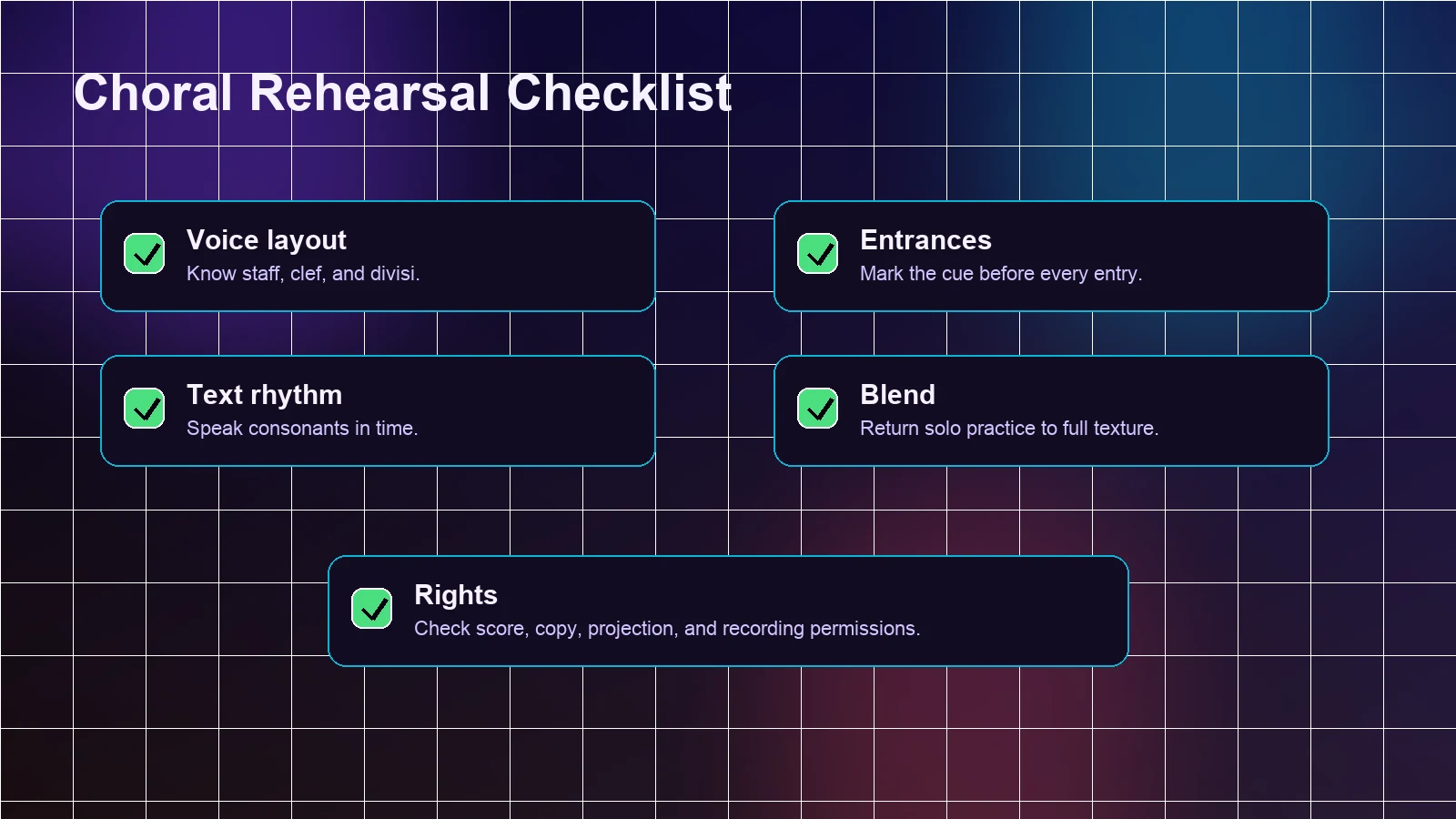
Use this checklist before a first rehearsal:
| Checkpoint | What to mark | Why it helps |
|---|---|---|
| Voice layout | your staff, clef, and divisi assignments | prevents wrong-line practice |
| Entrances | the cue one bar before each entry | fixes the most common choir error |
| Text rhythm | consonants, syllable stress, and melisma | keeps the ensemble aligned |
| Harmony role | melody, inner motion, bass, or support | explains why a part feels exposed or strange |
| Page turns | last note before the turn and first note after | avoids rehearsal stops |
| Rights | source, edition, copying, projection, recording | keeps practice materials legitimate |
For rhythm-heavy passages, use the same method from any good rhythm practice routine: reduce the bar to a steady pulse, clap the attacks, then add pitch and text.
Turn a choir score into practice material
Once the score is clear, decide what rehearsal material the choir actually needs. A full MIDI file is useful for some situations. A MusicXML file is better when the next step is notation cleanup. A marked PDF may be enough if the problem is entrances or text. A short loop can be better than a whole-piece playback file.
Use this decision table:
| Source you have | Best first output | Good next step |
|---|---|---|
| clean SATB PDF | MIDI or MusicXML from a short section | check entrances, rhythm, and part separation |
| phone photo of a choir score | crop and test one page first | retake if staves are curved or shadowed |
| public-domain score download | practice MIDI plus original PDF | verify the edition and keep the original as authority |
| piano-vocal reduction | rehearsal playback or MusicXML cleanup | decide whether singers need parts or accompaniment |
| lyrics and chords only | form map, key check, and rehearsal notes | do not expect conversion to invent voice leading |
For visible notation, Melogen Sheet2MIDI can help turn a readable PDF, PNG, or JPG score into MIDI or MusicXML. That is useful when a director wants a first-pass practice reference, a singer needs to hear a difficult entry, or an arranger wants to move a clean score into a notation editor.

Keep the boundary clear. A conversion is not the performance. It will not decide vowels, blend, breath, style, language, or conductor gesture. It gives you a faster way to inspect the written music and prepare rehearsal support.
If your source question is broader than a choir score, the guide on how to convert sheet music to MIDI goes deeper into scan quality, output checks, and cleanup expectations.
Where Melogen fits
Melogen fits best when choral music starts from visible notation and the next job is practical: hear the score, isolate a passage, export a first-pass MIDI, or open the music in a notation workflow. Use it for clean PDFs, scans, and images of sheet music. Use your own musical judgment for choir blend, language, style, and rehearsal leadership.
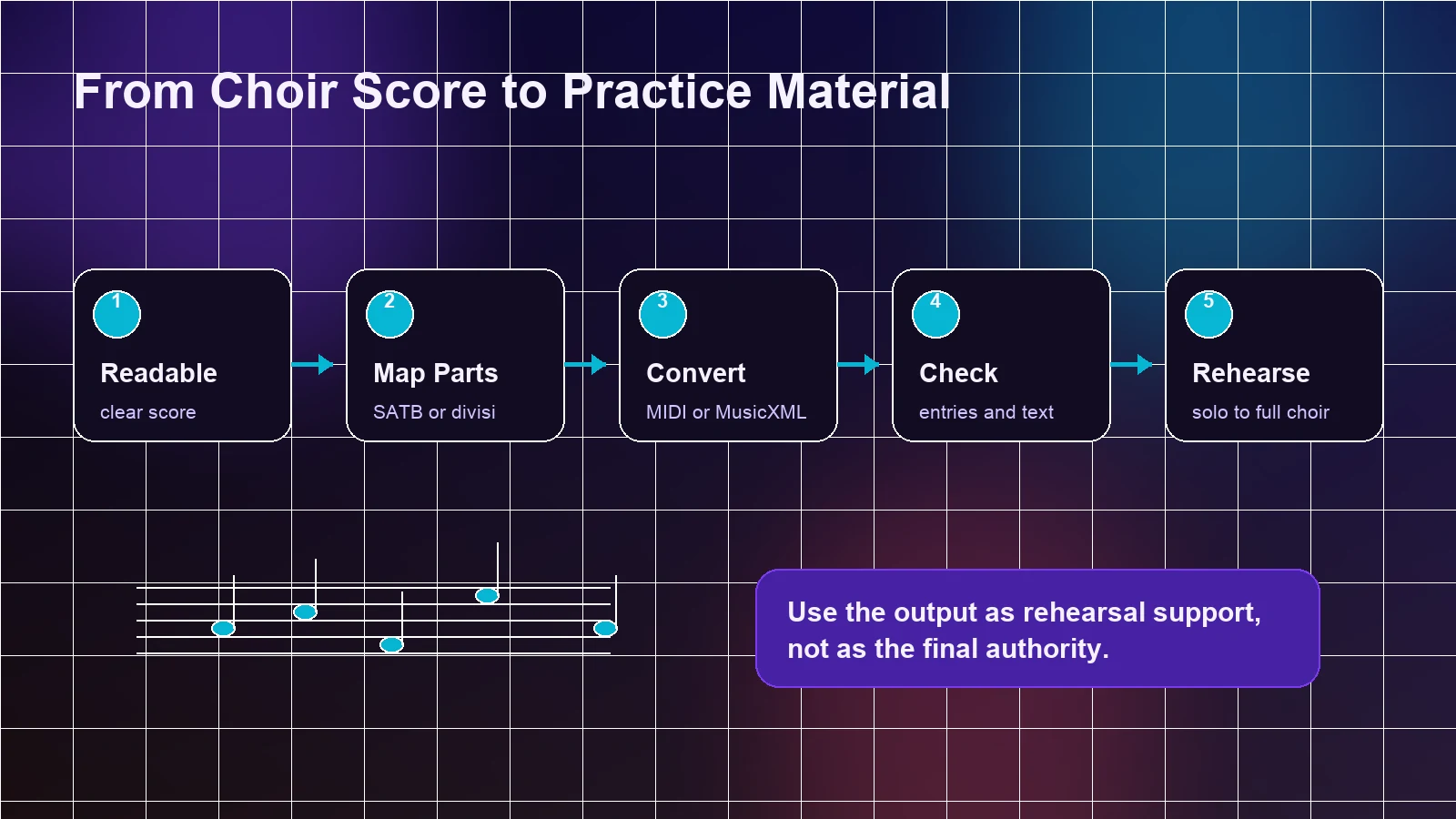
A practical choral workflow looks like this:
- Choose the cleanest score source you are allowed to use.
- Test one short section before converting a whole piece.
- Compare the output with the original page.
- Mark entrances, difficult text, and suspicious rhythms.
- Export MIDI for listening or MusicXML for notation cleanup.
- Bring the result back into rehearsal as support, not as the final authority.
Create rehearsal support from readable choir scores
Use Melogen Sheet2MIDI for a first MIDI or MusicXML pass from clean notation, then check the musical details before sharing practice material.
The practical takeaway
Choral music is not just music with many singers. It is music where several voices share one musical job. The page tells you more than the notes: it shows range, texture, entrances, text, balance, and where each singer fits inside the chord.
Before rehearsal, identify the choir format, mark entrances, understand the role of your line, and check whether the source is legal and clean enough to use. If the score is readable, a MIDI or MusicXML first pass can speed up practice preparation. If the source is only lyrics, chords, or an unclear scan, solve the musical and source-quality problem first.
The best choral preparation is simple: know your part, know the surrounding texture, and use technology only where it helps the choir rehearse more clearly.
FAQs
What is the difference between choir and choral music?
A choir is the group of singers. Choral music is the music written, arranged, or performed for that kind of group.
What does SATB mean in choral music?
SATB means soprano, alto, tenor, and bass. It is the most common mixed-choir layout, though many pieces use unison, two-part, SSA, SSAA, TTBB, divisi, or double-choir formats.
Is choral music always religious?
No. Choral music can be sacred, secular, educational, concert, community, theatrical, or ceremonial. Church music is an important part of the tradition, but it is not the whole category.
Can Melogen make a choir practice track?
Melogen can help when you have readable sheet music in PDF, PNG, or JPG form. Sheet2MIDI can create a first-pass MIDI or MusicXML file that you can check and use as rehearsal support. It does not replace the score, conductor, or singer judgment.
About the author
Zhang Guo
Composer - AI Product Manager
AI product manager and digital marketing consultant with a background in music. Creativity is the bridge between rhythm and logic, where musical intuition and mathematical precision can coexist in every meaningful product decision.
Follow on X