Harmony and Counterpoint Explained for Musicians
Learn harmony and counterpoint with plain definitions, composer checks, voice-leading examples, and a Melogen Structural Analysis workflow.
 Zhang Guo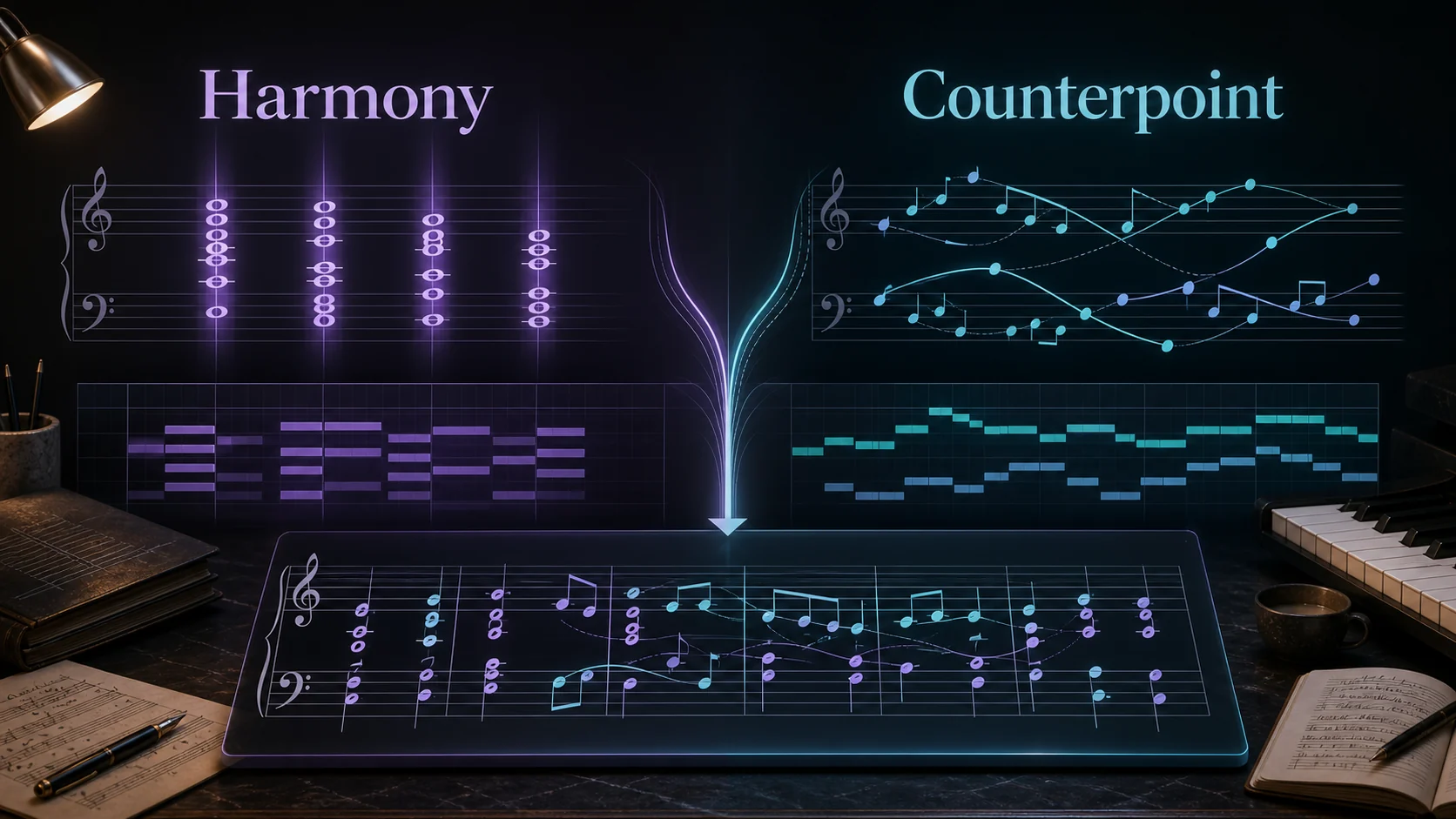
Turn a static score into editable MIDI
Contents
Harmony and counterpoint are two ways of organizing notes at the same time. Harmony asks what the notes create when they sound together. Counterpoint asks how independent melodic lines move with and against each other while still forming a coherent whole.
The practical difference is useful for composers, arrangers, students, and choir directors. If a passage sounds muddy, the problem may be harmonic spacing. If it sounds flat or mechanical, the problem may be that the inner lines have no life of their own. Good writing usually needs both: vertical clarity and horizontal motion.
Define harmony and counterpoint in plain language
Harmony is the chordal side of music. It includes triads, seventh chords, suspensions, cadences, bass motion, and the way tension resolves from one sonority to the next. When you ask whether a note belongs to the chord, whether the cadence lands clearly, or whether the voicing is too dense, you are thinking harmonically.
Counterpoint is the line-against-line side of music. It looks at whether two or more voices have their own contour, rhythm, and direction. When you ask whether the alto line is singable, whether the bass moves too parallel with the soprano, or whether a countermelody distracts from the main melody, you are thinking contrapuntally.
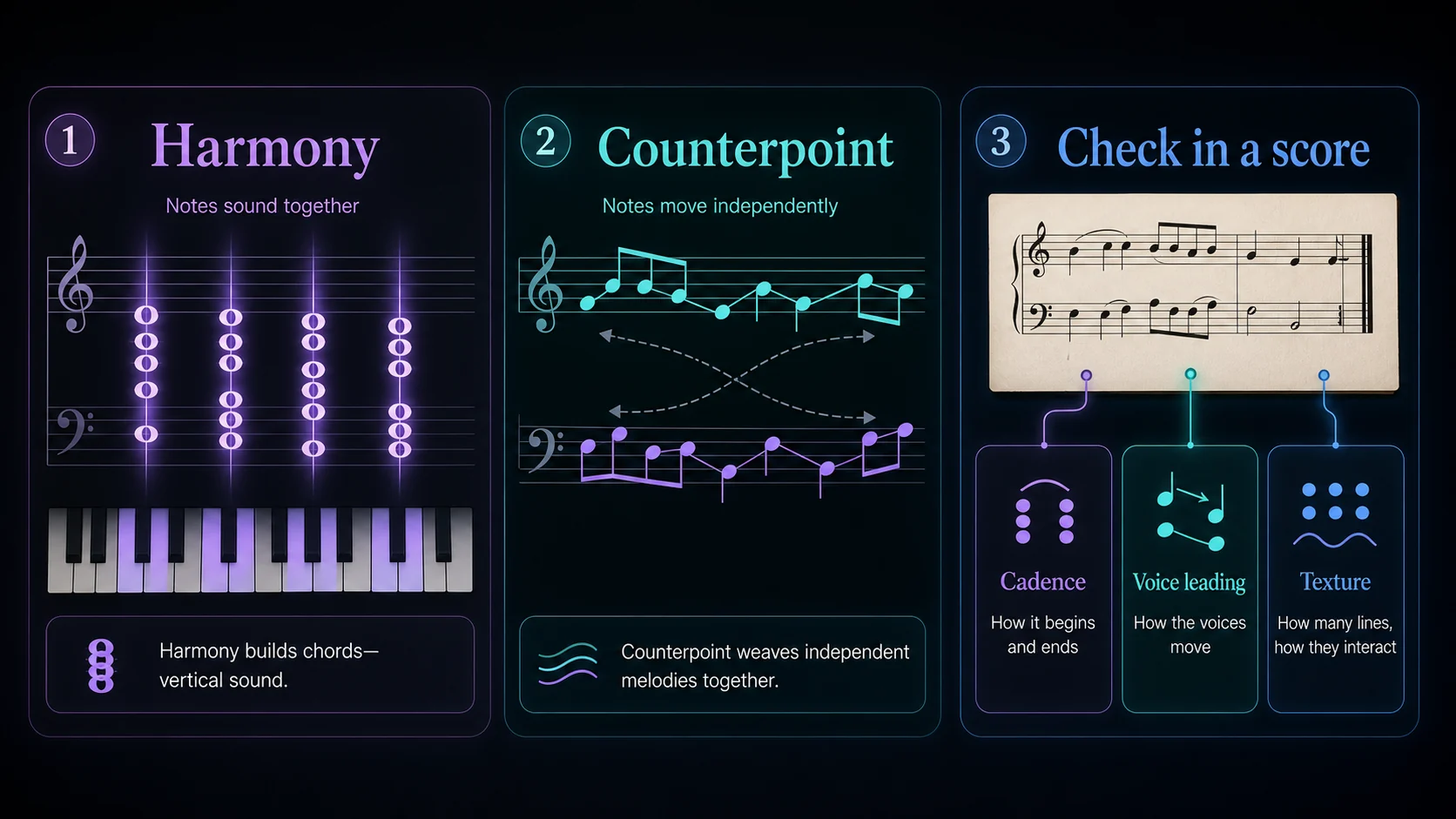
The two ideas are not enemies. Counterpoint creates harmony as the lines meet. Harmony gives counterpoint a sense of arrival, color, and tension. The beginner trap is trying to separate them completely. The useful move is to ask which layer needs your attention first.
| Question | Harmony lens | Counterpoint lens |
|---|---|---|
| What sounds stable or tense? | Chord quality, bass motion, cadence | Dissonance treatment between lines |
| What does the listener follow? | Harmonic rhythm and arrival points | Melody, countermelody, imitation, inner voices |
| What makes the passage unclear? | Muddy spacing or weak chord function | Lines moving without independence or direction |
| What should you revise first? | Voicing, bass, cadence, chord spelling | Contour, rhythm, entrances, voice leading |
For a wider historical frame, the Melogen guide to music composition history shows how line, harmony, form, and texture became working tools across different eras.
Hear the vertical and horizontal layers
Start by listening vertically. Stop on one beat and name what is sounding. Is it a consonant triad, a seventh chord, a suspension, an open fifth, a cluster, or an implied harmony created by melody and bass? This check tells you whether the moment is stable, tense, or unresolved.
Then listen horizontally. Follow one line for several bars without worrying about the full chord name. Does the line have a shape? Does it breathe? Does it move mostly by step, leap, sequence, repetition, or contrary motion? Could a singer or player understand it as a part instead of filler?
This small habit changes how you revise:
- Freeze a beat and ask what vertical sound is happening.
- Follow each active line across the barline.
- Mark where dissonances enter and where they resolve.
- Check whether the bass supports the phrase or only names roots.
- Decide whether the problem is spacing, chord direction, or weak line writing.
If you are reading a score for the first time, this is more reliable than staring at every note equally. A score is dense because several musical jobs are stacked on the same page. Harmony and counterpoint tell you which job you are inspecting.
Use species counterpoint as training, not as a cage
Traditional counterpoint study often starts with a cantus firmus, a fixed melody used as the line another voice writes against. Species counterpoint then gives controlled exercises: note against note, two notes against one, four notes against one, suspensions, and mixed rhythm.
Those exercises can feel strict, but their purpose is practical. They teach the ear to hear independence, consonance, dissonance, preparation, resolution, and line shape. Open Music Theory's species counterpoint chapter is a useful public primer if you want a structured exercise path.
The danger is treating species rules as the whole craft. Real music does not always look like a textbook exercise. Bach chorales, Renaissance polyphony, string quartets, jazz inner voices, film counterlines, and backing vocals all use line logic differently. The point is not to obey an exercise forever. The point is to develop a better instinct for how lines behave.
Use this quick distinction:
| Training idea | What it teaches | How it shows up in real writing |
|---|---|---|
| Note against note | Every vertical meeting matters | Strong-beat chord clarity |
| Passing motion | Dissonance can move smoothly | Melodic links between stable tones |
| Suspension | Tension can be prepared and released | Expressive delays before cadences |
| Contrary motion | Lines feel more independent | Bass and melody avoid moving as one block |
| Cantus firmus | One line can anchor the texture | A melody, bass, or chant-like idea guides the rest |
This is also why counterpoint matters outside classical composition. A bass line under a vocal, a second guitar part, a string pad, a backing vocal, or a synth countermelody can all either support the harmony or clutter it.
Decide what to fix when a passage sounds wrong
When a passage sounds weak, do not immediately add notes. Decide whether you are facing a harmony problem, a counterpoint problem, or a form problem.
If the issue is harmony, the passage may need cleaner spacing, a stronger bass, a clearer cadence, or less confusing chord color. If the issue is counterpoint, one or more lines may need better contour, more independence, or a cleaner approach to dissonance. If the issue is form, neither harmony nor counterpoint may save the passage until the phrase direction is clearer.
Here is a practical revision table:
| Symptom | Likely cause | First revision move |
|---|---|---|
| The chord sounds heavy or blurred | Harmony spacing is too dense | Open the voicing or move one part to a clearer register |
| The music has chords but no motion | Harmonic rhythm is static | Change when the bass or harmony moves |
| The inner voice feels random | Counterpoint lacks contour | Rewrite it as a singable line before reharmonizing |
| Two voices feel glued together | Too much similar motion | Try contrary or oblique motion |
| The cadence does not land | Arrival is harmonically unclear | Clarify bass motion and final chord function |
| The section sounds busy but empty | Lines are active without a job | Remove one layer and strengthen the remaining line |
The best test is often singing. If an inner line cannot be sung, heard, or described, it may not be a real line yet. If a chord cannot be named or felt as tension, color, or arrival, it may not be doing a harmonic job yet.
Where Melogen fits without overstating the product
Melogen does not replace harmony study, counterpoint exercises, or a musician's ear. Its useful role comes when you already have visible notation and need a faster way to inspect what the score is doing.
The local Melogen Structural Analysis page describes a score-first workflow for JPG, PNG, and PDF sheet music. The product metadata says it analyzes musical structure, tonality, harmony, form, key signatures, time signatures, harmonic progressions, cadences, melodic themes, formal sections, and exportable analysis results. That fits this topic because harmony and counterpoint become easier to discuss when the score's sections, cadences, and active lines are visible.

Use Structural Analysis after you can see the notation. If your source is still a static PDF and you need notation editing, use a conversion workflow first. The Melogen guide to MIDI vs MusicXML explains why MusicXML is usually better for notation cleanup, while MIDI is better for playback and DAW handoff.
Check harmony and structure in a visible score
Use Melogen Structural Analysis when you have readable notation and want a faster map of form, harmony, cadences, and active musical lines before the next revision.
Practice harmony and counterpoint together
The best practice loop is small. Choose eight bars, not a whole movement. Study the vertical sound first, then the horizontal lines, then rewrite one detail.
Try this sequence:
- Mark the bass notes on strong beats.
- Circle cadences or moments of arrival.
- Follow the highest line and name its contour.
- Follow one inner line and check whether it has a musical shape.
- Mark dissonances that need preparation or resolution.
- Rewrite one bar with clearer spacing or stronger line motion.
- Listen again before changing anything else.
Composers can use the same loop in a draft. Arrangers can use it when a texture feels crowded. Students can use it while studying Bach, Palestrina, hymn writing, choral music, jazz lead sheets, or even a pop hook with a strong bass counterline.
The point is not to label everything perfectly. The point is to hear what each layer is doing.
The practical takeaway
Harmony and counterpoint are different lenses on the same musical surface. Harmony explains the vertical result of notes sounding together. Counterpoint explains the horizontal motion of independent lines. A clear passage usually balances both.
When you revise, ask two questions before adding material: what chordal sound is this moment creating, and what line does each voice actually sing or play? If the vertical sound is clear but the passage still feels dull, strengthen the counterpoint. If the lines are active but the passage feels unstable or muddy, clarify the harmony.
That habit turns theory into a working tool. You are no longer memorizing terms. You are deciding what the music needs next.
About the author
Zhang Guo
Composer - AI Product Manager
AI product manager and digital marketing consultant with a background in music. Creativity is the bridge between rhythm and logic, where musical intuition and mathematical precision can coexist in every meaningful product decision.
Follow on X