Beginner Piano Pieces That Build Real Skills
Choose beginner piano pieces that teach reading, rhythm, and control, with a practical workflow for turning clean scores into MIDI.
 Zhang Guo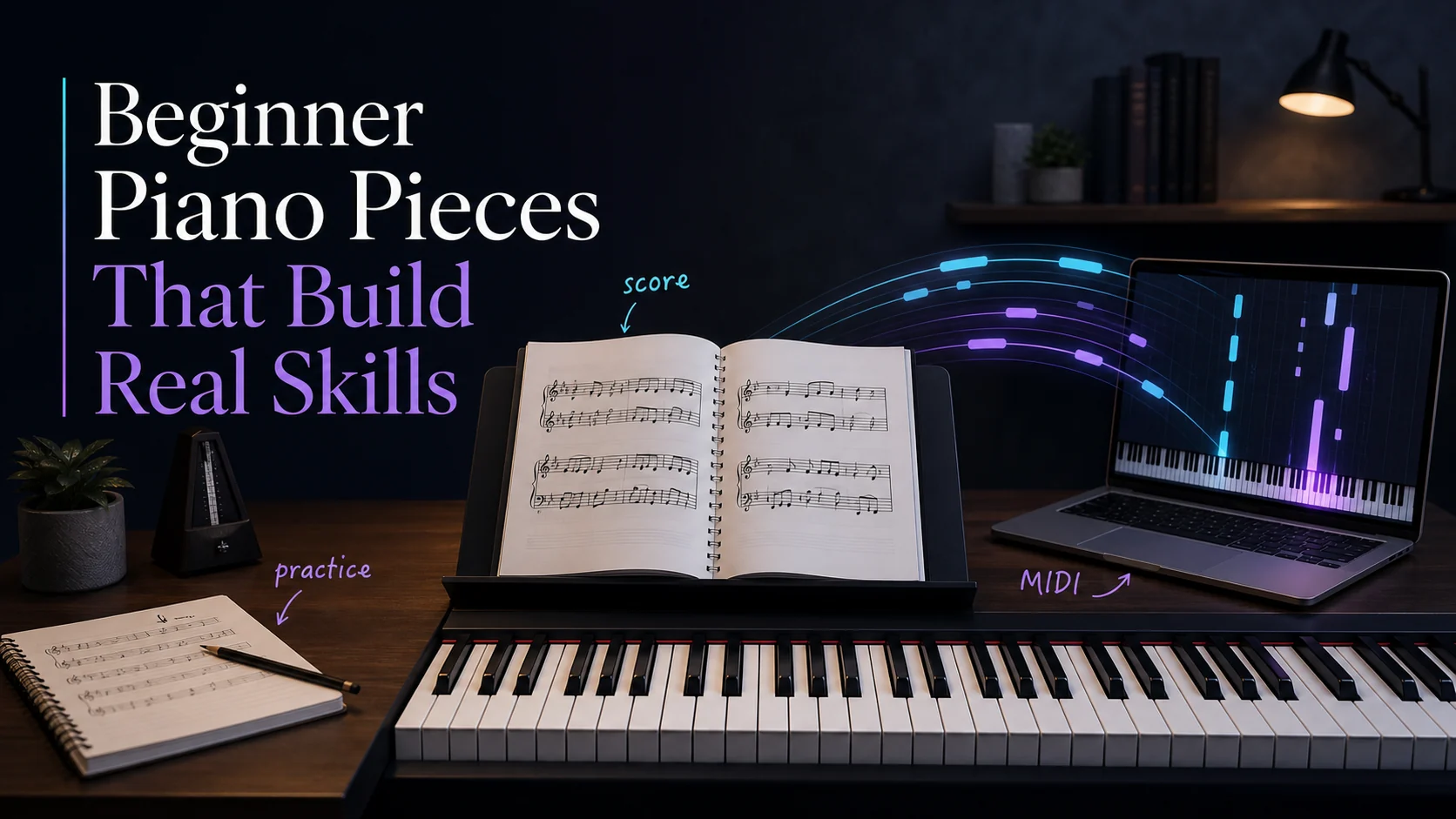
Turn a static score into editable MIDI
Contents
Beginner piano pieces should do more than sound easy. A good first piece teaches one clear skill at a time: reading notes, holding a steady pulse, moving the hands without panic, or shaping a phrase so the music still feels like music.
That is why the best starting list is not just "the easiest songs." Some pieces are simple because they repeat too much. Others are useful because they make a beginner practice the exact habits that carry into harder repertoire later. Use the list below as a practical path from readable scores to confident playing, with a few places where a MIDI preview can help you hear structure before you drill the bars.
Quick comparison table
| Piece or source | Best for | Main skill | Watch out for |
|---|---|---|---|
| Ode to Joy, simplified | First two-hand melody | Stepwise reading and phrasing | Do not rush repeated notes |
| Minuet in G, early arrangement | Classical style | Balanced hands and simple form | Keep the left hand light |
| Ecossaise in G | Short dance practice | Pulse, accents, and repeats | Accents can become heavy |
| Mikrokosmos Book 1 selections | Pattern reading | Small intervals and coordination | Some pages feel plain at first |
| Album for the Young selections | Musical expression | Dynamics and phrase shape | Choose the easiest pieces first |
| Easy keyboard-song arrangements | Motivation | Familiar melody and confidence | Avoid arrangements with giant jumps |
If a score looks clean but the rhythm feels uncertain, turn it into a listening and inspection loop. The goal is not to let software practice for you. It is to hear the structure, spot awkward bars, then go back to the keyboard with a clearer target.
Start with pieces that make the score readable
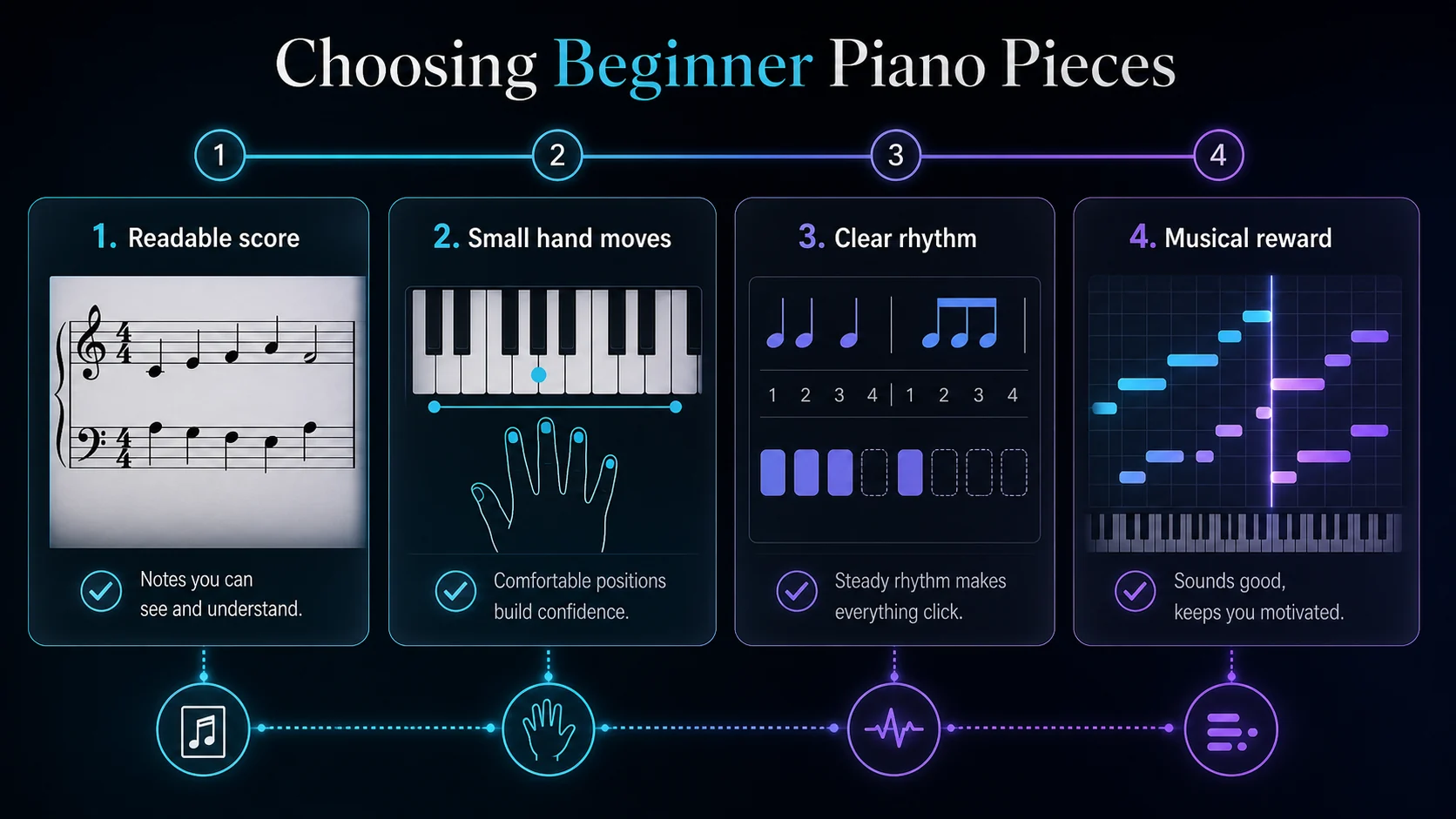
The first useful beginner piano pieces keep the staff readable. That usually means a narrow hand position, simple rhythms, and phrases that repeat enough for the eye to recognize patterns.
Simplified versions of "Ode to Joy" work well here because the melody mostly moves by step. The piece lets a beginner connect notation to sound without solving huge leaps every bar. It also teaches an important habit: repeated notes still need rhythm, tone, and direction.
Use this check before choosing a first piece:
- Can the student name most notes without writing every letter above the staff?
- Does each hand stay in a small position for several bars?
- Are the rhythms mostly quarters, halves, and simple eighth notes?
- Is the phrase short enough to repeat three times without fatigue?
- Does the melody sound satisfying at a slow tempo?
If the answer is mostly yes, the piece is useful. If the page needs finger numbers, letter names, and color coding for every note, it may be better to step back to simple piano notes for beginners before making it a repertoire piece.
Use classical miniatures for hand balance
Early classical pieces are valuable because they teach balance. A beginner can play all the right notes and still make the left hand too loud, the right hand too stiff, or every phrase the same shape.
Start with easy arrangements of Minuet in G or similar short dances. They are not magic beginner pieces, but they expose the right problems: a melody that needs shape, a left hand that should support rather than dominate, and repeated sections that let the player improve without learning a new page every minute.
Ecossaise-style pieces are also useful because the pulse is clear. The dance feel gives the player a reason to keep time, not just survive note names. If the rhythm wobbles, count the pattern away from the piano, then return to the keyboard.
| Skill target | Good piece type | Practice move |
|---|---|---|
| Hand balance | Short minuet | Play left hand at half volume |
| Steady pulse | Ecossaise or march | Count out loud for one full section |
| Phrase shape | Simple lyrical piece | Mark where the phrase breathes |
| Coordination | Five-finger pattern piece | Tap both hands before playing |
Do not turn these into speed tests. A slow, even minuet with a singing top line is a better beginner win than a fast version with a heavy left hand.
Add pattern pieces before harder songs
Some beginner piano pieces sound plain on the first pass, especially pattern-based studies. That does not make them weak. Pattern pieces train the eye to see intervals, repeats, mirrored shapes, and small changes.
Bartok's early Mikrokosmos selections are a good example of the category. The simplest pieces ask the player to notice motion and coordination instead of relying on a famous tune. That is useful if the student wants to improve reading rather than only memorize songs.
The same idea applies to modern method-book pieces. A page built around two-note slurs, repeated hand positions, or contrary motion may not be concert material, but it can solve one specific problem quickly.
Use this framework:
| If the student struggles with | Choose a piece that emphasizes |
|---|---|
| Reading by note name only | Steps, skips, and repeated interval shapes |
| Losing the beat | One rhythm pattern across the whole page |
| Tense hands | Small hand positions and repeated five-finger shapes |
| Weak left hand | Simple bass patterns under a slow melody |
| Memorizing without understanding | Clear phrase repeats and visible form |
Pattern pieces are especially helpful before moving into familiar pop or film arrangements. They give the hands a stable reading base first.
Keep familiar songs in the right difficulty range
Familiar melodies keep beginners motivated, but arrangements vary wildly. One "easy" version may be readable. Another may hide octave jumps, syncopation, dense chords, or left-hand patterns that are not beginner-friendly at all.
Before choosing a familiar song, look at the score instead of the title. A useful beginner arrangement usually has:
- a melody that stays mostly in one hand position
- chord symbols or simple left-hand notes instead of thick blocks
- no long runs, octave jumps, or fast syncopation
- a tempo that still sounds musical when slowed down
- repeats that help practice rather than punish the player
If the song is mainly there for motivation, that is fine. Just do not let a famous melody become the whole curriculum. Pair it with a short reading piece, a pattern piece, and one classical miniature so the student builds durable skills.
For more general song selection, the companion guide to good songs on piano is the better place to compare familiar beginner picks by skill level.
Preview the score with MIDI when rhythm is unclear
Melogen fits this workflow when you already have a clean score source, such as a PDF or image of notation, and you want a first-pass MIDI reference. The Sheet2MIDI workflow can help you hear the structure, inspect the output, and decide which bars need hands-on practice.

Use the preview carefully:
- Upload the clearest score source to Sheet2MIDI.
- Listen for the phrase shape and rhythm, not just whether the notes are present.
- Mark two or three bars that feel harder than the rest.
- Practice those bars slowly at the piano.
- Return to the full piece only after the hard bars feel controlled.
This is most useful for score-first practice. If your source is a printed or scanned page, the broader sheet music to MIDI workflow explains how source quality affects the result. If your goal is full notation editing rather than practice playback, compare MIDI with MusicXML before committing to the output format.
Turn a clean piano score into a MIDI reference
Use Melogen Sheet2MIDI to hear the structure of a beginner piano piece, then practice the hard bars by hand instead of guessing from the page.
Build a first-month repertoire path
A useful first month does not need twenty pieces. It needs a small set with different jobs.
Try this sequence:
| Week | Piece type | Practice focus |
|---|---|---|
| 1 | Stepwise melody such as a simplified Ode to Joy | Read notes and keep a steady pulse |
| 2 | Short minuet or dance | Balance melody and accompaniment |
| 3 | Pattern study | See intervals and repeat shapes faster |
| 4 | Familiar easy arrangement | Apply reading habits to something motivating |
Keep one rule: never add a new piece to hide an old problem. If the rhythm is unstable, fix rhythm. If the left hand is too heavy, choose a piece that makes balance obvious. If reading is slow, choose a score with cleaner spacing and smaller hand moves.
The practical takeaway
The best beginner piano pieces build one clear skill while still sounding rewarding. Start with readable notation, add short classical pieces for balance, use pattern studies to strengthen reading, and keep familiar songs inside a realistic difficulty range.
Before choosing the next piece, ask:
- What skill should this piece build?
- Can the score be read without heavy letter-name crutches?
- Does the rhythm stay clear at a slow tempo?
- Are the hand movements small enough to repeat calmly?
- Will the music still feel rewarding after a week of practice?
If the piece answers those questions, it belongs in the beginner path. If it does not, save it for later. A smaller piece played musically teaches more than a famous arrangement that turns every bar into survival mode.
About the author
Zhang Guo
Composer - AI Product Manager
AI product manager and digital marketing consultant with a background in music. Creativity is the bridge between rhythm and logic, where musical intuition and mathematical precision can coexist in every meaningful product decision.
Follow on X