Simple Piano Notes for Beginners: First Practice Loop
Learn simple piano notes for beginners with keyboard letters, Middle C, rhythm checks, and a first-week practice loop you can use right away.
 Zhang Guo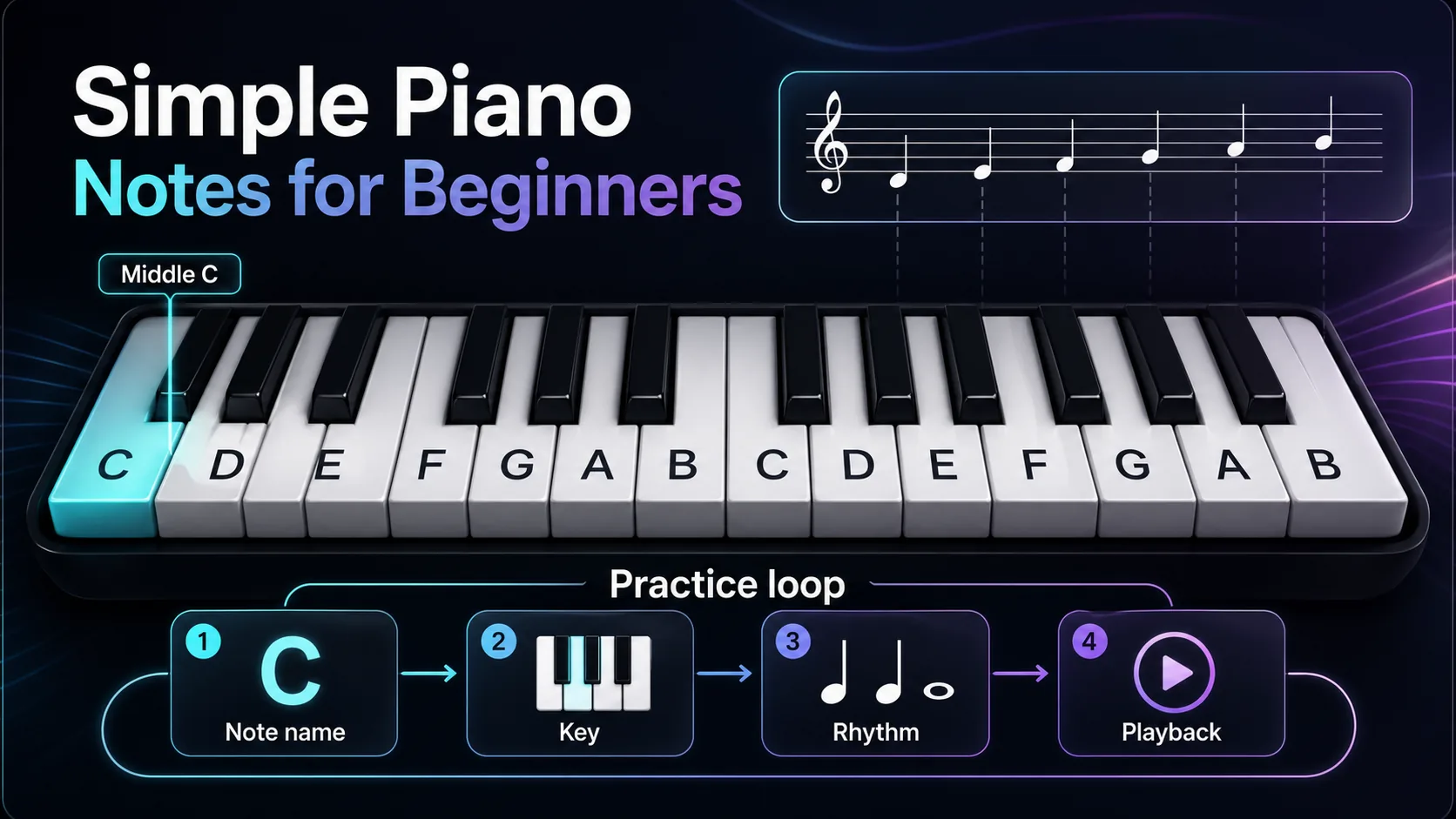
Turn a static score into editable MIDI
Contents
Simple piano notes for beginners are easiest to learn when you stop treating the keyboard as 88 unrelated keys. Start with the seven white-key letters: C D E F G A B. After B, the pattern repeats. Your first job is not to play a full song at speed. It is to find one note, say its name, count its rhythm, and repeat that small loop until the keyboard starts to feel predictable.
This guide gives you a notes-first practice path. You will learn how to find Middle C, how the note alphabet repeats, how keyboard notes connect to the staff, and how to use simple song notes without skipping rhythm. Keep the goal small: one note name, one key, one count, one correction.
Start with the seven-note alphabet
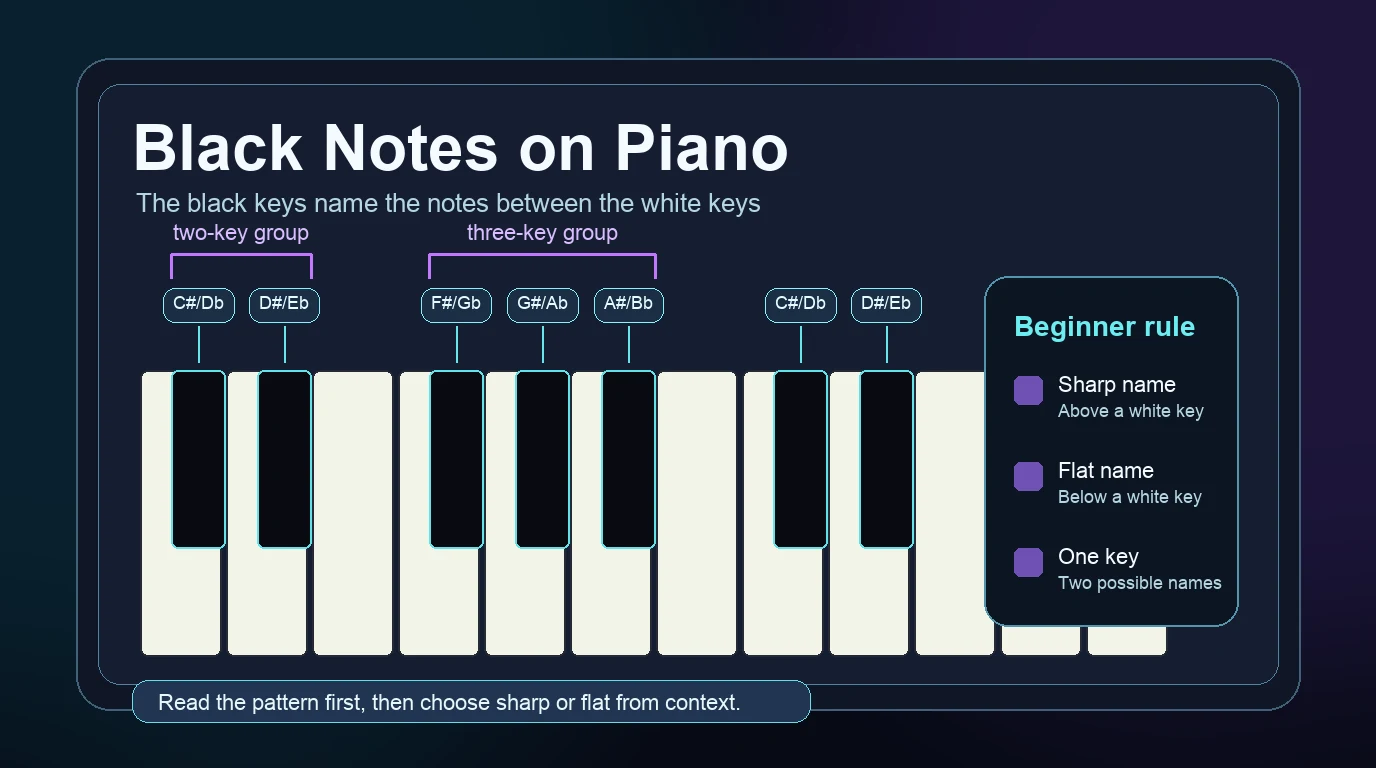
Piano note names use the letters A through G, but beginners should usually start on C. That is because C is easy to locate: it sits just to the left of a group of two black keys. Find any two-black-key group, move one white key left, and you have found a C.
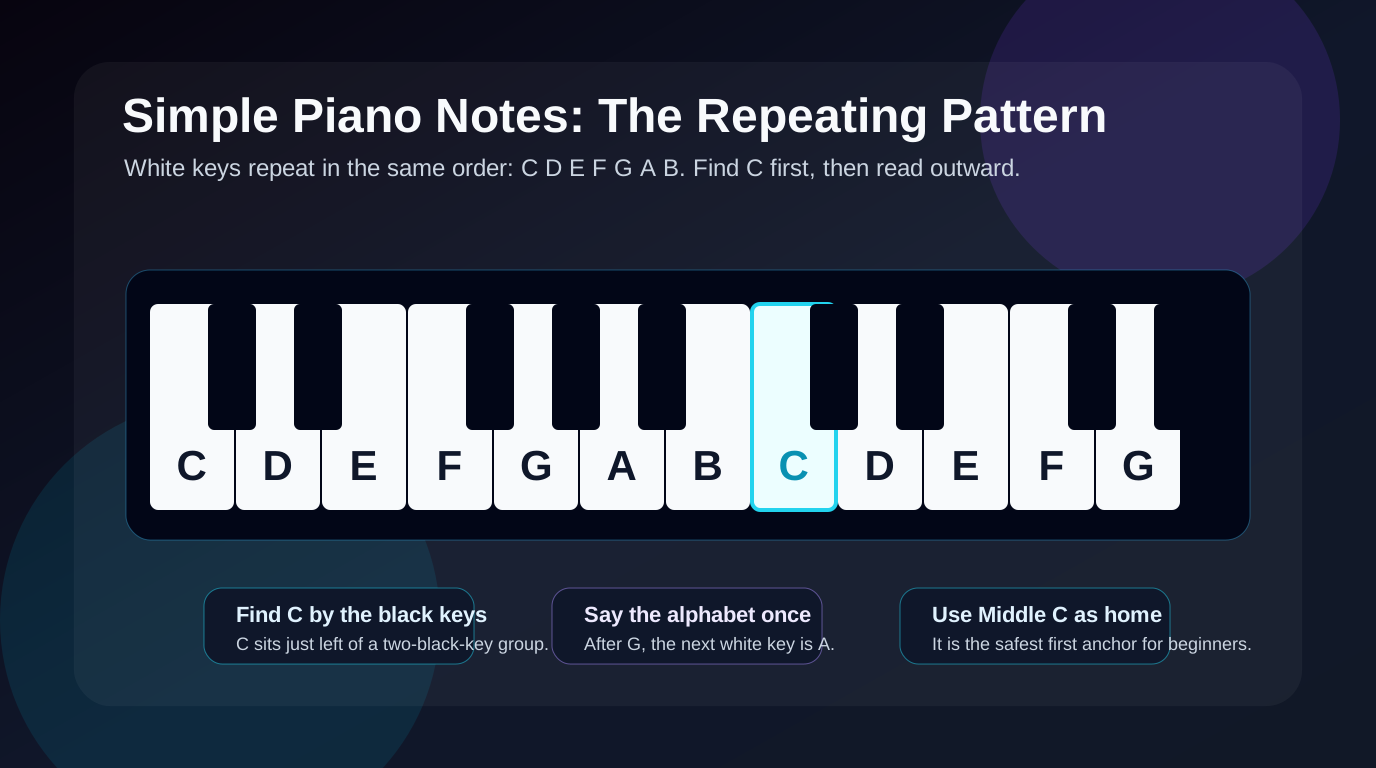
Use this first-pass map:
| Note | Where to find it | Beginner check | Common mistake |
|---|---|---|---|
| C | Left of two black keys | Say "C starts the group" | Starting on A because the alphabet starts there |
| D | Between the two black keys | Check both black keys around it | Confusing D and E |
| E | Right of two black keys | End the first small group | Skipping straight to F |
| F | Left of three black keys | Start the next group | Treating it like another C |
| G | Second white key in the three-key group | Say the next letter out loud | Jumping to A too early |
| A | Third white key in the three-key group | Notice it comes after G | Forgetting the pattern restarts soon |
| B | Right of three black keys | End the seven-letter cycle | Looking for an H |
Do not try to memorize every octave at once. Choose one small zone around Middle C and work outward. If you need the broader sheet-reading system later, the piano sheet music guide explains the grand staff, clefs, rhythm, and hand roles in more detail.
Find Middle C before learning more notes
Middle C is the safest first anchor because it sits near the visual center of many keyboards and between the treble and bass staves in beginner piano music. You do not need to know every staff note yet. You only need one reliable home base.
Try this:
- Find a group of two black keys near the middle of the keyboard.
- Put your right thumb on the white key just left of that group.
- Say "Middle C" before you play it.
- Play C, then move right through D, E, F, and G.
- Move back down and say every letter again.
The speaking matters. It keeps your eyes, hand, and ear attached to the same note name. If you silently guess, you may play the right key once without building a repeatable map.
Match keyboard notes to the staff
The keyboard tells you where a sound lives under your fingers. The staff tells you where that same sound lives on the page. Beginners often separate those worlds too much. A better habit is to pair them early: see the note, name the letter, find the key, then play.
For the first week, use only a small range:
| Staff cue | Keyboard target | Practice action |
|---|---|---|
| Middle C | C near the center | Play it with your thumb and say "C" |
| Step up | The next white key to the right | Move from C to D, then D to E |
| Step down | The next white key to the left | Move from E to D, then D to C |
| Repeat note | Same key again | Play twice without moving your hand |
| Skip | Miss one white key | Move from C to E or D to F |
If the staff itself still feels mysterious, read the parent guide on how to read sheet music. It explains staff lines, clefs, time signatures, and note values without assuming a piano-first view.
Use easy song notes without skipping rhythm
Simple note-letter songs can help, but only if you count. A string of letters such as C C G G A A G is not music yet. It becomes music when you know how long each note lasts and where the beat sits.
Use public-domain beginner patterns for practice, not as a shortcut around reading:
| Pattern | Notes to practice | What it teaches |
|---|---|---|
| Step pattern | C D E F G | Moving one white key at a time |
| Return pattern | G F E D C | Reading downward without panic |
| Skip pattern | C E G E C | Hearing a simple chord shape |
| Repeated-note pattern | C C D D E E | Keeping rhythm steady when the pitch repeats |
Clap the beat before playing. Then speak the note names in rhythm. Only after that should you put your fingers on the keys. It feels slower, but it prevents the classic beginner problem: correct note names with unstable timing.
Practice in a loop, not a rush
A good beginner loop has four steps: name the note, find the key, count the rhythm, and check the sound. Repeat the loop with a tiny phrase before adding more notes.
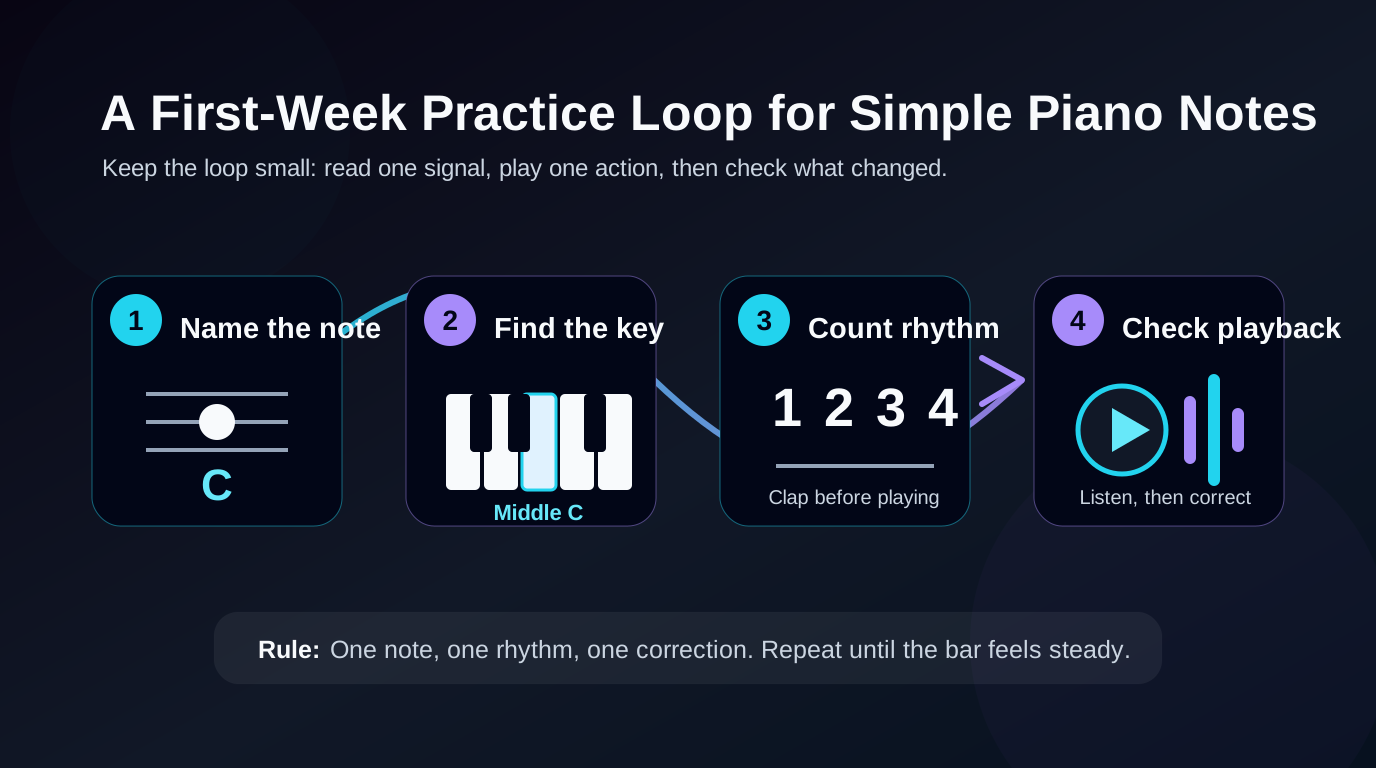
Use this first-week plan:
| Day | Focus | Small win |
|---|---|---|
| 1 | Find every C on the keyboard | You can locate C without counting from the edge |
| 2 | Play C D E F G and back | Your hand follows the alphabet smoothly |
| 3 | Add A and B | You understand that the pattern repeats after B |
| 4 | Clap four steady beats | Rhythm stays separate from note hunting |
| 5 | Pair one staff note with one key | The page and keyboard start to connect |
| 6 | Play a five-note phrase slowly | You can correct one bar without restarting everything |
| 7 | Listen back and mark mistakes | You know what to fix next |
The point is not to learn a big song immediately. The point is to build a loop you can trust. Once that loop is stable, simple songs become less like guessing and more like reading a small map.
Where Melogen fits
Melogen is useful when your source is visible notation and you want a faster way to hear or inspect what the page is doing. The Sheet2MIDI workflow supports PDF, JPG, and PNG sheet music input and produces editable MIDI that can move into a DAW or practice setup.
Use it as a check, not as a replacement for learning note names:
- Read the first few notes yourself.
- Convert a clean PDF, scan, or image when you need playback support.
- Listen for obvious pitch or timing mismatches.
- Return to the keyboard and correct one small section.
If your next step is a full conversion workflow, the guide on how to convert sheet music to MIDI gives the more detailed handoff from score to editable MIDI.
Turn a clean score into a practice reference
Use Melogen Sheet2MIDI when you want to hear a sheet-music phrase as editable MIDI, then return to the keyboard and make the musical decisions yourself.
The practical takeaway
Simple piano notes for beginners come down to a small, repeatable map. Find C. Move through C D E F G A B. Use Middle C as a home base. Pair the keyboard with the staff slowly. Count rhythm before trying to play faster.
Here is the short version:
- Find C by looking left of a two-black-key group.
- Say the note name before you play it.
- Practice one five-note area before chasing the whole keyboard.
- Clap rhythm separately from pitch.
- Use playback as a check, not as a substitute for reading.
If you can name a note, find the key, count the beat, and correct one mistake, you already have the practice loop you need. Keep that loop small for a week, and the keyboard will start to feel much less random.
About the author
Zhang Guo
Composer - AI Product Manager
AI product manager and digital marketing consultant with a background in music. Creativity is the bridge between rhythm and logic, where musical intuition and mathematical precision can coexist in every meaningful product decision.
Follow on X