Clarinet Transposition: Concert Pitch Rules That Work
Learn clarinet transposition for B-flat, A, and bass clarinet parts, with concert-pitch rules and a cleanup workflow for MusicXML or MIDI.
 Zhang Guo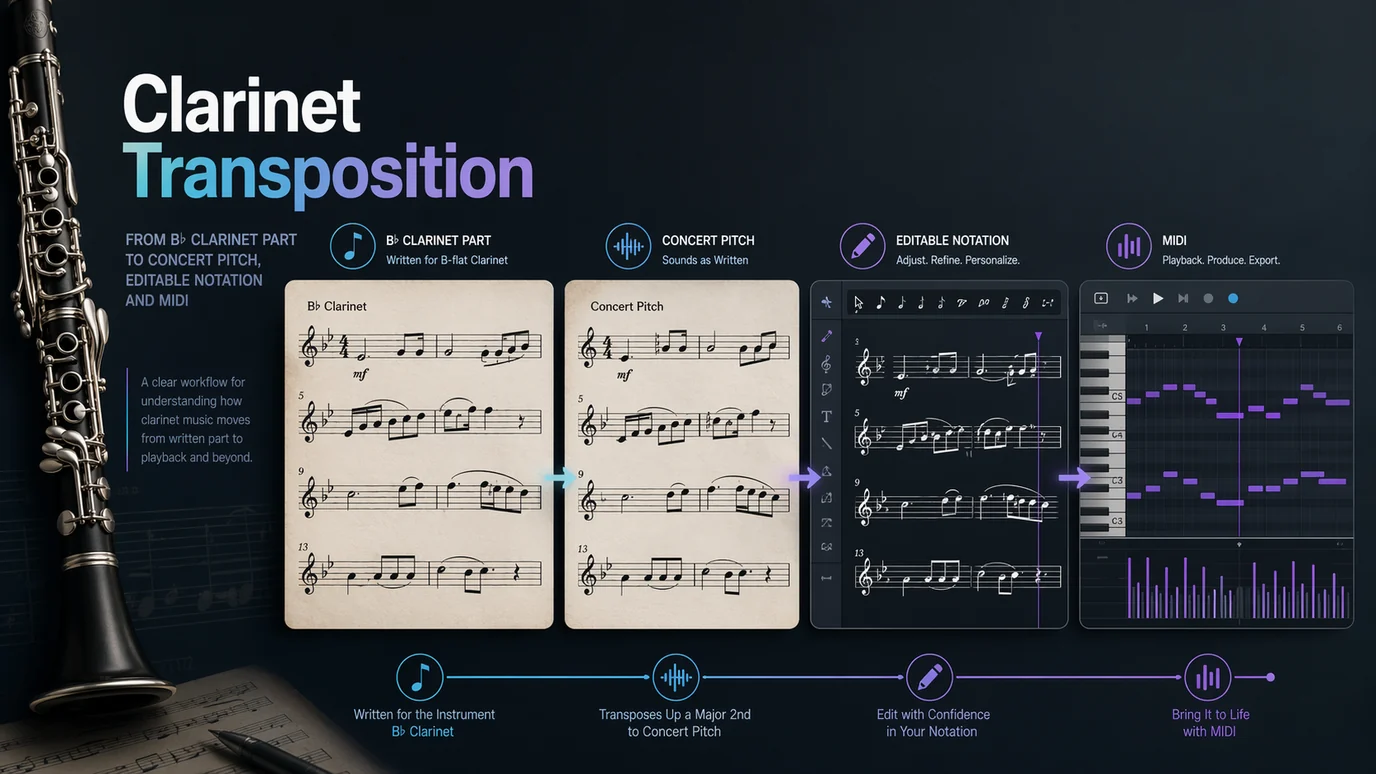
Turn a static score into editable MIDI
Contents
Clarinet transposition means the note a clarinet player reads is not always the note that sounds at concert pitch. The common B-flat clarinet reads a written C but sounds a concert B-flat, so a concert-pitch line must be written one whole step higher for that player.
That single rule solves a lot, but it is not the whole workflow. A clarinet family can include B-flat, A, E-flat, and bass clarinet parts, and each one needs a different written-to-sounding check. If you are digitizing an old part, preparing a rehearsal score, or cleaning a scanned PDF, treat transposition as a notation decision first and a playback decision second.
Quick Clarinet Transposition Rules
Use this table as the first check before you edit notes one by one.
| Instrument | Written C sounds as | To write from concert pitch | Common use |
|---|---|---|---|
| B-flat clarinet | Concert B-flat | Write up a major second | Band, jazz, orchestra parts |
| A clarinet | Concert A | Write up a minor third | Orchestral and chamber repertoire |
| E-flat clarinet | Concert E-flat above | Write down a minor third | High color lines and band/orchestra parts |
| Bass clarinet, treble clef | Concert B-flat an octave lower | Write up a major ninth | Bass clarinet parts and reductions |
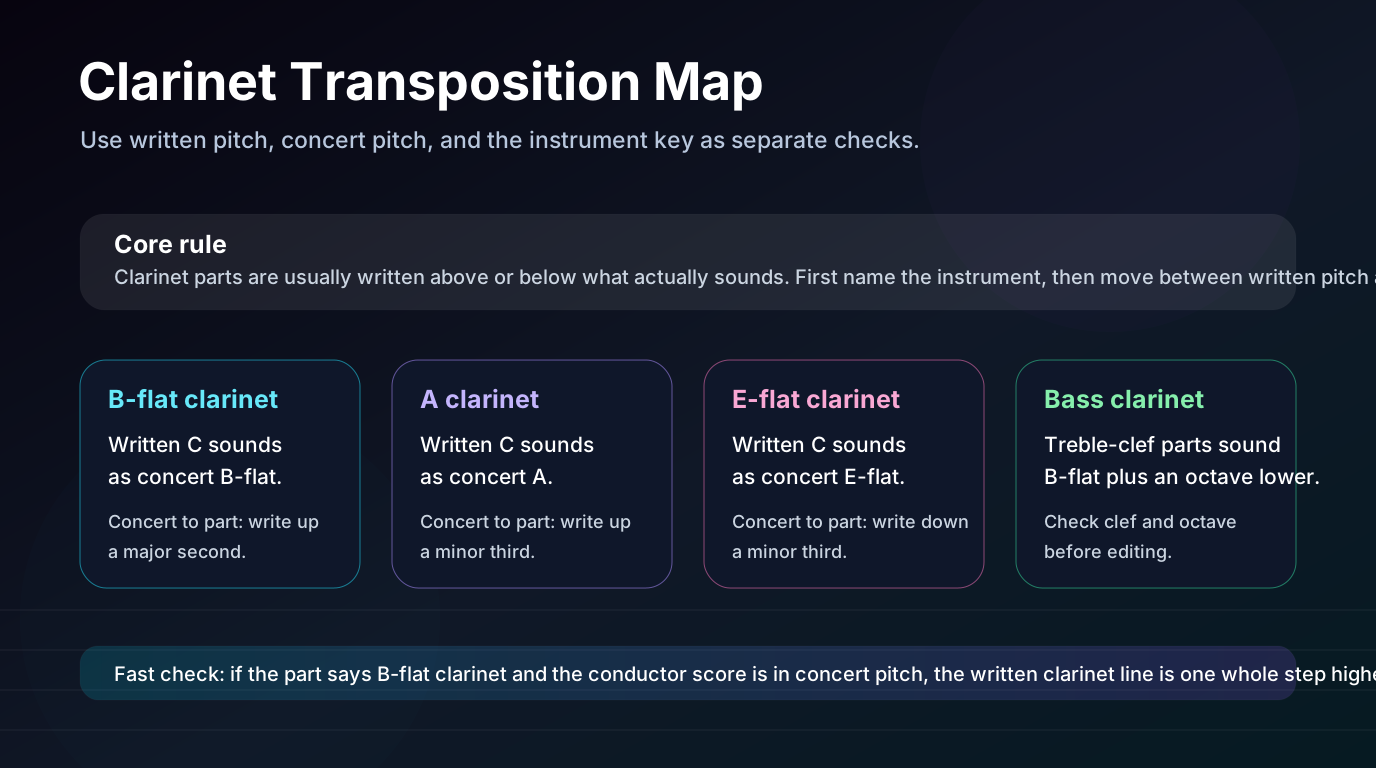
The useful mental model is this: concert pitch is what a piano, guitar, or conductor score usually shows. Written pitch is what the clarinet player sees. When you move from concert pitch to a B-flat clarinet part, you write the line higher so the instrument sounds in the intended key.
Why Clarinet Parts Are Transposed
Clarinet transposition exists because different clarinets are built around different fundamental pitches. A B-flat clarinet and an A clarinet use similar finger shapes, but the tube length changes the sounding pitch. The written notation lets the player keep familiar fingerings while the instrument produces the correct concert sound.
This is why a clarinetist can often switch instruments without relearning every fingering from scratch. The notation absorbs the pitch shift. For an arranger, teacher, or producer, the job is to keep the score, the player part, and the playback version aligned.
If you are still building basic notation confidence, read Melogen's how to read sheet music guide before diving into instrument-specific transposition. The staff, key signature, clef, and rhythm rules stay the same; the clarinet layer adds the written-versus-sounding pitch check.
How to Transpose a B-flat Clarinet Part
For the standard B-flat clarinet, remember two directions:
- Written to concert pitch: move down a major second.
- Concert pitch to written part: move up a major second.
Example: if the concert-pitch melody is C-D-E, the B-flat clarinet part should be written D-E-F-sharp. When the clarinet plays those written notes, the audience hears C-D-E.
The key signature moves the same way. Concert B-flat major becomes written C major for B-flat clarinet. Concert F major becomes written G major. This is why a clarinet part may look sharper than the conductor score even when it is sounding correctly.
A Clarinet, E-flat Clarinet, and Bass Clarinet Need Extra Checks
A clarinet in A is common in orchestral writing. Written C sounds as concert A, so a concert-pitch line must be written up a minor third. That is why a concert C major line becomes A-clarinet written E-flat major.
E-flat clarinet moves the other way in practical arranging. Written C sounds as concert E-flat, so when you write from concert pitch for E-flat clarinet, you usually write down a minor third.
Bass clarinet needs the most care because clef and octave conventions vary. In modern treble-clef notation, written C usually sounds as concert B-flat one octave lower. If you are importing an old part, do not fix only the key signature. Check whether the octave is also displaced.
MusicXML vs MIDI for Clarinet Transposition
The right output depends on what you need to fix.
| Goal | Better format | Why |
|---|---|---|
| Clean a player part | MusicXML | Keeps measures, clefs, voices, articulations, and notation structure editable |
| Hear whether the line sounds in the right key | MIDI | Makes pitch and timing easy to audition in a DAW or player |
| Prepare a corrected printable part | MusicXML | Lets you transpose, proofread, and export notation in a score editor |
| Build a mockup quickly | MIDI | Gets the line into playback and production software faster |
Melogen's MIDI vs MusicXML guide goes deeper on that choice. For clarinet transposition, MusicXML is usually safer when the printed part matters, while MIDI is useful for checking the resulting sound.
Where Melogen Fits
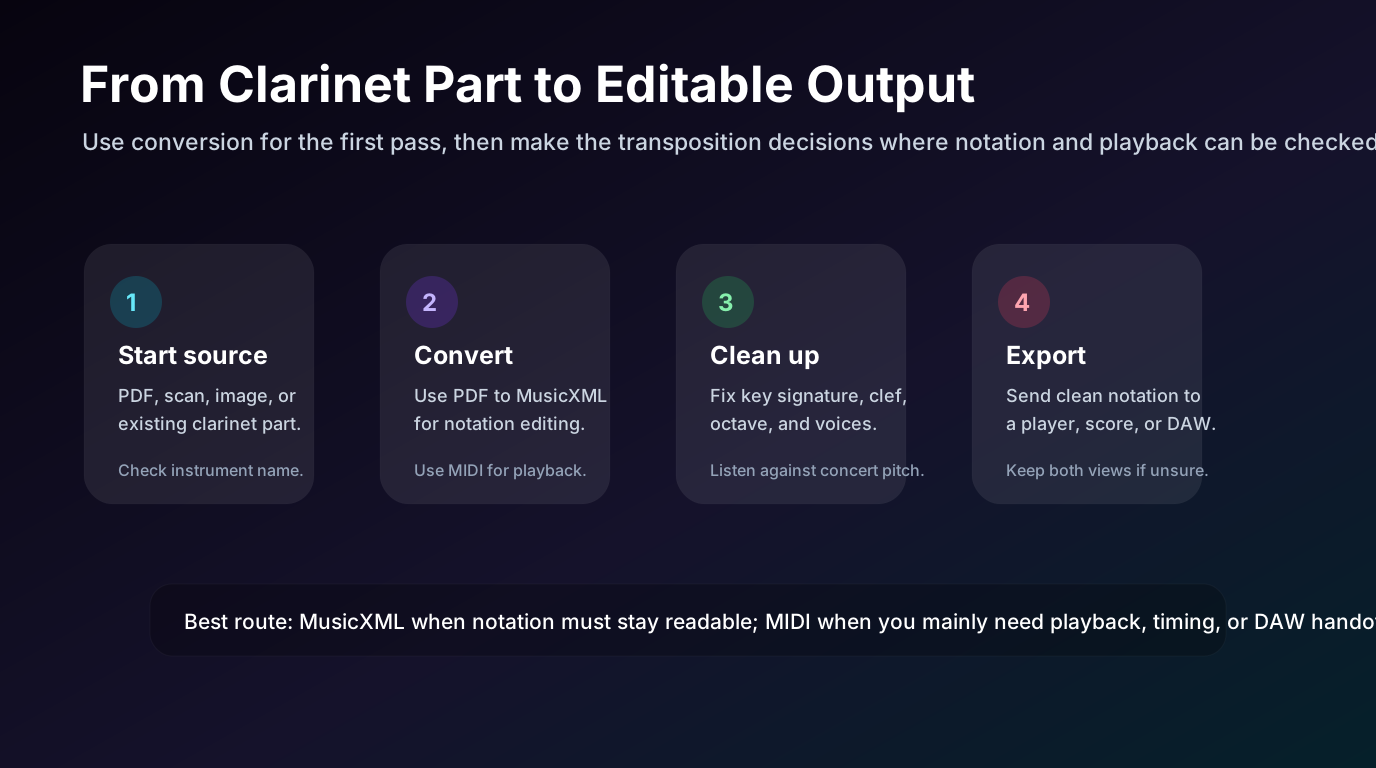
If your source is a static score, PDF, or scan, the slow part is often getting the notation into an editable place. Melogen can help with that first pass:
- Use PDF to MusicXML when you need to edit the score in notation software.
- Use Sheet2MIDI when you mainly need playback, DAW handoff, or a quick pitch check.
- Open the output in your notation editor or DAW.
- Apply the clarinet transposition rule, then check the key signature, octave, and accidentals.
Melogen should be treated as the bridge from a static page to editable material, not as a replacement for musical proofreading. A clean scan will get you there faster; a skewed photo, handwritten correction, or crowded orchestral page still needs a careful review pass.
Turn a clarinet PDF into editable notation
Use Melogen PDF to MusicXML for the first pass, then finish the clarinet transposition and proofreading inside your notation editor.
Clarinet Transposition Checklist
Before you send a part to a player or export a MIDI mockup, run this checklist:
- Confirm the instrument name: B-flat clarinet, A clarinet, E-flat clarinet, or bass clarinet.
- Confirm whether the source is concert pitch or already transposed.
- Move the melody in the right direction before changing individual accidentals.
- Update the key signature, then proofread altered notes.
- Check bass clarinet octave placement separately.
- Play the output against a concert-pitch reference, especially if you converted from a scan.
The Practical Takeaway
For B-flat clarinet, write the part one whole step higher than concert pitch. For A clarinet, write it a minor third higher. For E-flat clarinet, write it a minor third lower. For bass clarinet, check both transposition and octave.
If the source already exists as a PDF or scan, convert it into MusicXML or MIDI first, then make the transposition decision in an editable environment. That workflow keeps the musical judgment where it belongs: on the score, in the sound, and in the final player part.
About the author
Zhang Guo
Composer - AI Product Manager
AI product manager and digital marketing consultant with a background in music. Creativity is the bridge between rhythm and logic, where musical intuition and mathematical precision can coexist in every meaningful product decision.
Follow on X