How to Count Music Notes Without Losing the Beat
Learn how to count music notes by beats, subdivisions, and bars, then check timing with a simple MIDI workflow before editing pitch.
 Zhang Guo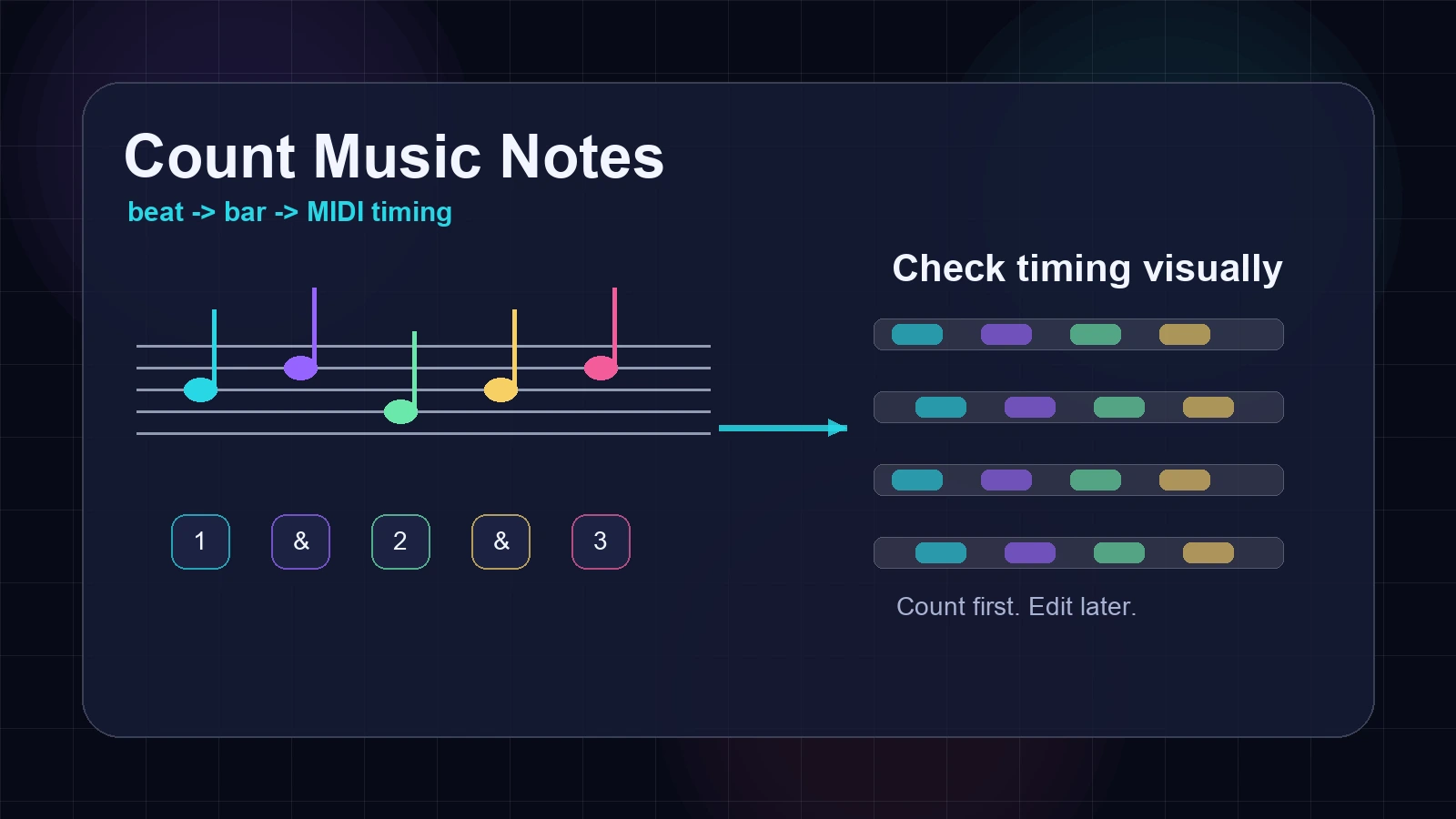
Turn a static score into editable MIDI
Contents
To count music notes, start with rhythm before pitch. Name the beat, say the subdivision out loud, and only then worry about whether the note is C, F sharp, or another pitch. The practical goal is simple: keep the bar moving in time so the music can be played, practiced, or converted into clean MIDI without guessing where every note belongs.
Most beginners reverse the order. They stare at note names, lose the pulse, and then wonder why the phrase feels late even when the pitches are correct. A cleaner workflow is to count the beat first, check the bar length, and use playback or MIDI lanes as a second pass for timing mistakes.
Start with the pulse before naming notes
The pulse is the steady beat you can tap while the measure moves forward. In common time, the bar usually gives you four main counts: 1 2 3 4. In 3/4, it gives you 1 2 3. In 6/8, you often feel two larger beats, but the written notes still need subdivision.
Before you name any pitch, ask three questions:
| Question | What it tells you | Quick action |
|---|---|---|
| What is the time signature? | How many beats belong in each bar | Mark the top number as the bar target |
| Which notes land on the main beats? | Where the pulse is stable | Say the beat numbers out loud |
| Which notes split the beat? | Where you need subdivisions | Add and, e, or a between beats |
This is why a simple quarter-note line feels easier than a run of eighth notes. The pitch may be equally simple, but the counting job changes.
Count note values instead of note heads
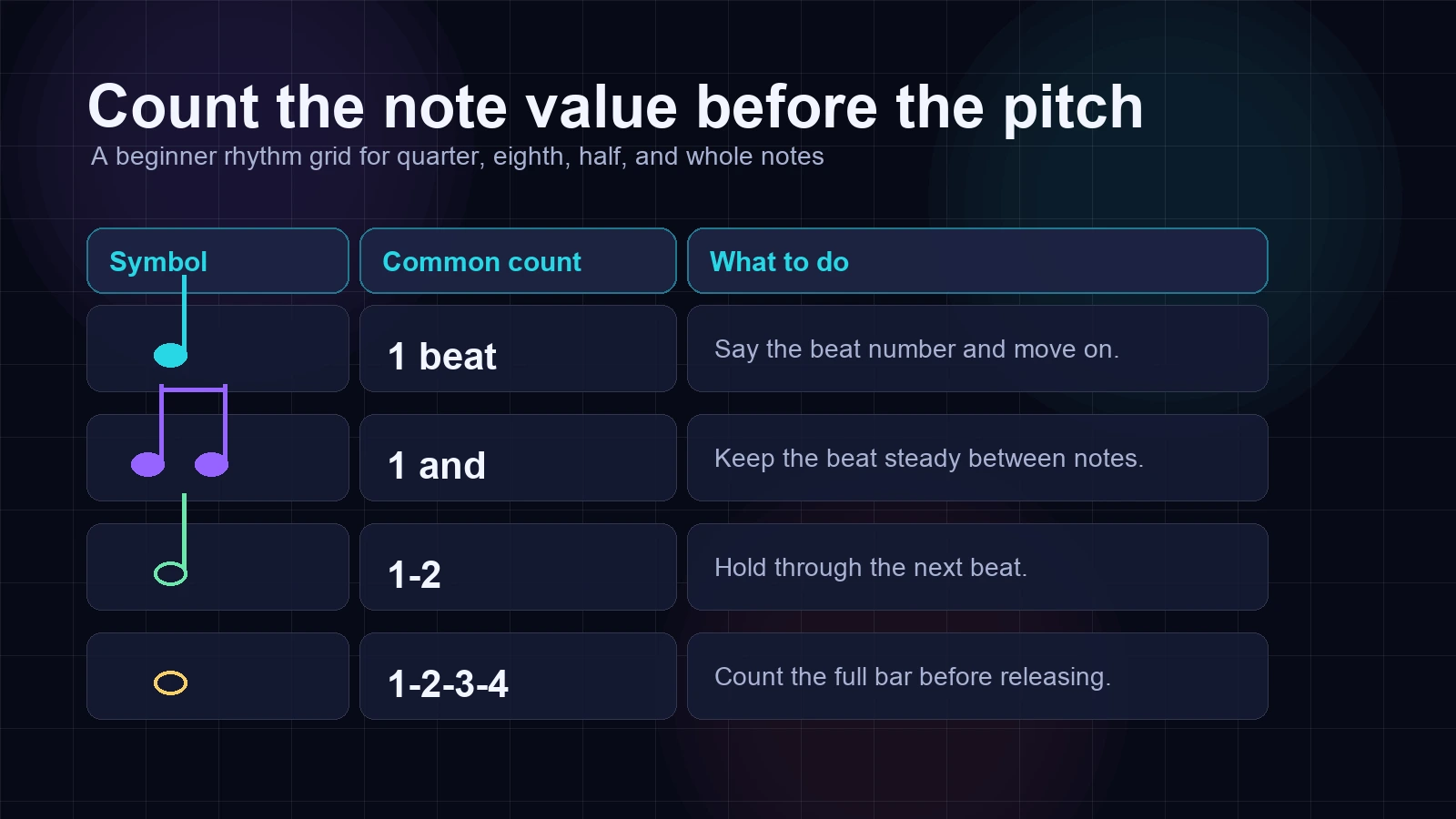
The shape of a note tells you how long it lasts. Treat that duration as the first clue.
- A quarter note usually takes one beat in 4/4.
- Two eighth notes usually split one beat into
1 and. - A half note holds across two beats.
- A whole note holds across the full four-beat bar in 4/4.
- A rest counts too, even when you do not play.
If you skip rests, the bar collapses. If you hold half notes for only one beat, everything after them arrives early. The fix is not musical talent; it is accounting. Every beat in the bar has to be spent somewhere.
For a deeper symbol-by-symbol reference, use Melogen's guide to sheet music symbols and meanings alongside this counting workflow.
Use subdivisions when the beat gets busy
Subdivision is the space between main beats. It lets you place shorter notes without rushing.
A useful beginner ladder looks like this:
| Rhythm value | Count aloud | What to listen for |
|---|---|---|
| Quarter notes | 1 2 3 4 | One sound per beat |
| Eighth notes | 1 and 2 and | Two even parts per beat |
| Sixteenth notes | 1 e and a | Four even parts per beat |
| Triplets | 1 trip let | Three even parts per beat |
Do not jump to sixteenth-note language unless the bar needs it. If the music only uses quarters and eighths, 1 and 2 and is enough. Extra counting words can make a simple phrase feel harder than it is.
This is also where readers confuse notation with technique. Counting does not tell your fingers how to play beautifully. It tells them when to move. Technique comes after the timing map is stable.
Check each bar like a small ledger
Once you can count the note values, check the bar. In 4/4, every measure needs four beats of rhythmic value. That might be four quarter notes, two half notes, eight eighth notes, a mix of notes and rests, or one whole note. The written surface can change; the bar total cannot.
Try this quick audit:
- Mark the time signature.
- Draw a light beat mark above the bar.
- Count each note or rest into those marks.
- Circle the spot where your spoken count stops matching the notation.
- Fix the rhythm before editing pitch, fingering, or expression.
If you are reading from a scan or a crowded PDF, this bar-level check matters even more. Optical recognition can mistake beamed notes, rests, ties, or pickup bars. When you convert a score with a sheet music to MIDI converter, listen for bars that feel too short or too long before making tiny note edits.
Use playback to find timing mistakes faster
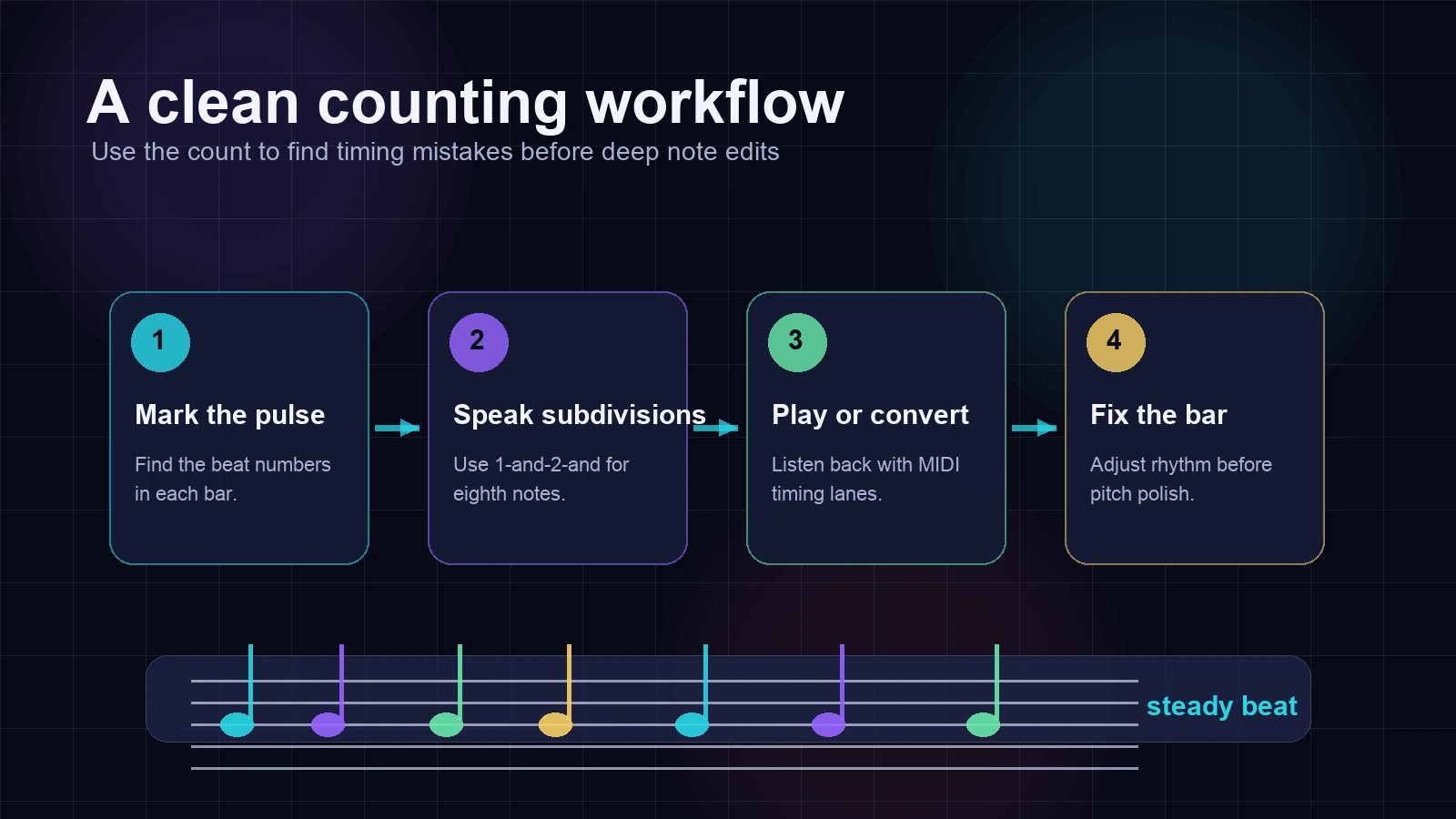
Counting out loud is the first pass. Playback is the second pass. A MIDI piano roll, notation playback, or simple metronome loop makes timing errors obvious because the notes either line up with the beat or they do not.
Here is the workflow I would use:
- Count the phrase slowly without playing.
- Tap the pulse while saying the subdivisions.
- Play or convert the phrase and listen only for timing.
- Fix missing rests, wrong note values, or misplaced ties.
- Then check pitch names, articulation, and musical shaping.
This order keeps the cleanup efficient. If you polish pitch first, a rhythm repair can force you to edit the same bar again. If you fix the count first, the later pitch pass is calmer.
Melogen fits best when you already have visible notation and want a first-pass MIDI file to inspect. Upload the score, review the converted timing, and use the MIDI lanes as a practical rhythm-check surface before you hand the file to a DAW or notation editor.
Turn counted notation into editable MIDI
Use Melogen Sheet2MIDI for a first pass, then inspect the rhythm and timing before detailed note cleanup.
Avoid the most common counting mistakes
Most counting problems come from a small set of habits:
- Counting only the notes you play and ignoring rests.
- Treating tied notes as a new attack instead of a held sound.
- Rushing beamed eighth notes because they look visually crowded.
- Forgetting that pickup measures can be shorter than full bars.
- Naming pitches before the rhythm is secure.
If the phrase still feels unstable, compare it with a more advanced timing guide such as how to play tricky rhythms. That article is better for syncopation and awkward subdivisions; this one is about the basic counting system that makes those later problems solvable.
The practical takeaway
To count music notes well, spend the bar before you decorate it. Find the pulse, count the note values, add subdivisions only when needed, and check the total length of each measure. Once the rhythm is stable, pitch names and MIDI cleanup become much easier.
If you want one rule to keep on the desk, use this: rhythm first, pitch second, polish last. That order turns counting from a theory exercise into a useful practice and editing workflow.
About the author
Zhang Guo
Composer - AI Product Manager
AI product manager and digital marketing consultant with a background in music. Creativity is the bridge between rhythm and logic, where musical intuition and mathematical precision can coexist in every meaningful product decision.
Follow on X