Easiest Acoustic Guitar Songs for Beginners
Pick the easiest acoustic guitar songs with simple chords, strumming checks, and a Melogen workflow for a playable practice reference.
 Zhang Guo
Turn a static score into editable MIDI
Contents
The easiest acoustic guitar songs are not always the shortest songs. They are the songs where the chord shapes, strumming pulse, tempo, and section changes stay manageable long enough for a beginner to sound musical. Start with two or three open chords, one repeatable rhythm, and a song you can hum before you worry about full arrangements.
This guide gives you a practical shortlist, a difficulty framework, and a practice workflow for turning a song title into something playable. It does not publish copyrighted tabs or lyrics. Use licensed charts, official songbooks, a teacher, or your own ear for the full arrangement; use this page to choose the right first target and practice it cleanly.
Quick comparison table
Use this table as a starting shortlist. Chord names can vary by key, capo, and arrangement, so treat the chord column as a common beginner route rather than the only correct version.
| Song | Beginner route | Main challenge | Start when you can |
|---|---|---|---|
| Horse With No Name | two-chord drone feel | staying steady without overstrumming | switch between two shapes cleanly |
| Knockin' on Heaven's Door | G-D-Am/C family | slow chord changes | count four beats per bar |
| Three Little Birds | I-IV-V feel | keeping the groove relaxed | play downstrokes evenly |
| Love Me Do | simple open-chord pop | changing without rushing | mute and strum in time |
| Stand by Me | four-chord loop | repeating the bass-like pulse | hear the loop before playing |
| Bad Moon Rising | bright three-chord pattern | faster changes | move between D, A, and G shapes |
| I'm Yours | four-chord loop with bounce | syncopated feel | keep the wrist loose |
| Riptide | compact beginner loop | accent control | strum lightly without speeding up |
| Brown Eyed Girl | open-chord classic | section transitions | change chords while counting |
| Take Me Home, Country Roads | folk-style progression | chorus lift | play a full verse slowly |
| Wonderwall | capo-friendly shapes | continuous strumming | keep the right hand moving |
| Free Fallin' | spacious chord movement | sustaining the groove | let chords ring cleanly |
The easiest choice is usually the one where you can play the first verse slowly without stopping. If you cannot keep the pulse, choose a simpler song even if the chord list looks familiar.
Start with two or three chord songs
Two-chord and three-chord songs teach the habit beginners need most: changing shapes without losing time. The goal is not to impress anyone with harmonic variety. The goal is to make the fretting hand and strumming hand agree on the beat.
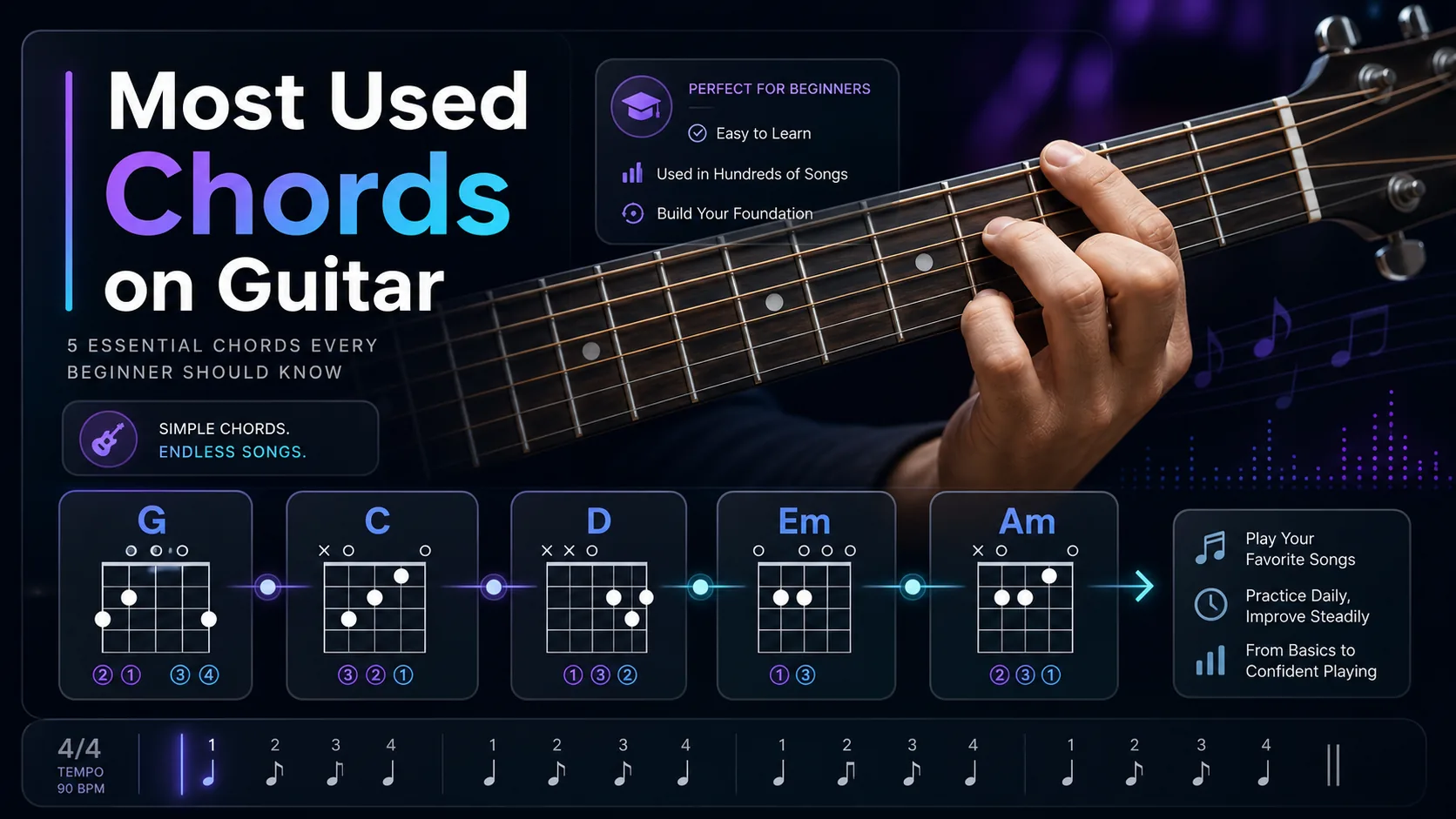
Good first targets are songs where the harmony stays inside common open shapes such as G, C, D, Em, Am, and A. A capo can make some songs easier, but do not use a capo to hide a rhythm problem. If the right hand is unstable, the capo only moves the problem to a new fret.
Use this starter filter:
| If the song has... | It is usually | Beginner decision |
|---|---|---|
| two or three open chords | first-week friendly | try it now |
| four open chords with slow changes | early beginner | practice one section first |
| one barre chord | later beginner | simplify or choose another song |
| fast sixteenth-note strumming | rhythm-heavy | learn the rhythm separately |
| many section-specific chord changes | arrangement-heavy | save it for later |
If you want a safe first batch, pick one two-chord song, one three-chord song, and one four-chord song. That gives you progress without turning practice into a scavenger hunt.
Add one strumming challenge at a time
Many beginner lists focus only on chord count, but acoustic guitar lives in the right hand. A song with three chords can still be hard if the groove depends on quick accents, missed strums, or a constant down-up motion.
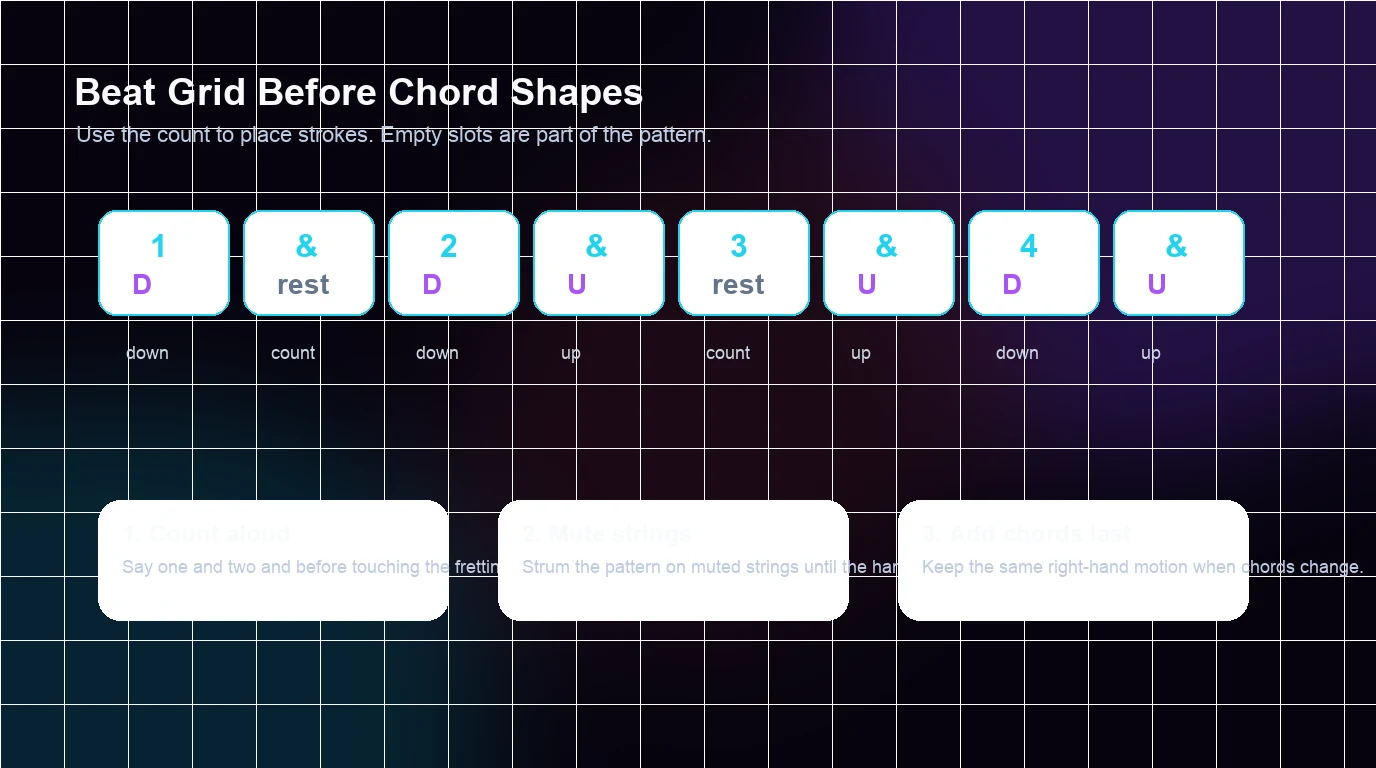
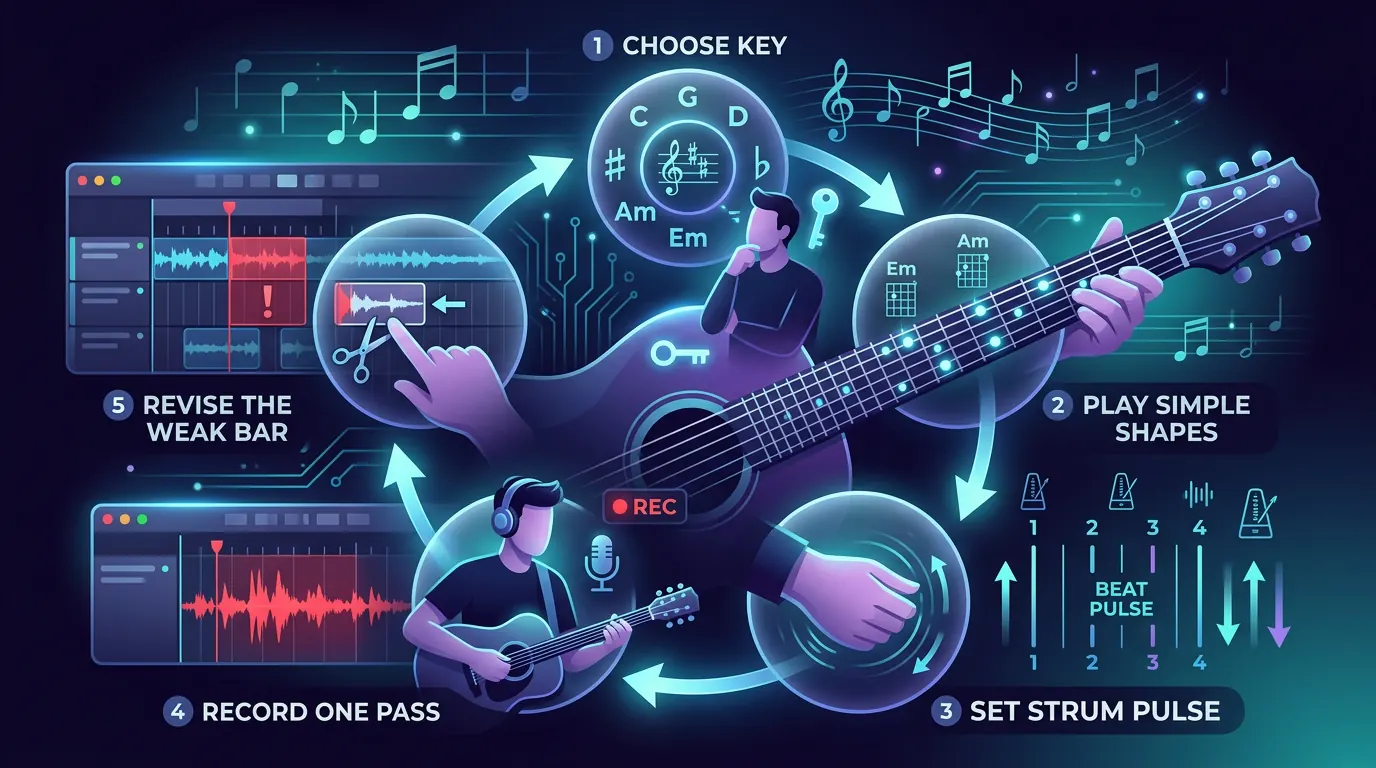
Before learning the full song, reduce the rhythm to one bar. Count 1 & 2 & 3 & 4 &, then mark which slots get played. If that sounds familiar, the detailed guide on how to read strumming patterns goes deeper into downstrokes, upstrokes, rests, and missed strums.
Try this progression:
- Strum downstrokes only on muted strings.
- Add the real chord changes without changing your arm speed.
- Add upstrokes only after the downbeats feel solid.
- Add accents last.
- Record one slow pass and check whether the tempo drifts.
The biggest warning sign is a song that only works when you play along with the recording. If it falls apart when you mute the strings and count alone, simplify the strum before you add more chord detail.
Choose songs by section, not title
A song title is not a practice plan. Some songs have an easy verse and a tricky chorus. Others have simple chords but a bridge that changes the feel completely. When you choose from beginner acoustic guitar songs, decide which section you are actually learning.
Use this section-first checklist:
| Section | What to check | Good beginner sign |
|---|---|---|
| Intro | Does it require a riff? | optional or easy to skip |
| Verse | Can you sing or hum over the chord loop? | steady repeat pattern |
| Chorus | Does the strum get bigger? | same rhythm, stronger accents |
| Bridge | Does it introduce new chords? | short enough to save for later |
| Ending | Can you stop cleanly? | simple final chord |
It is completely fine to learn only the verse and chorus first. A clean two-section version teaches more than a complete song played with panic pauses.
Use Melogen when your source starts as audio
Sometimes you do not start from a printed chart. You start from a song recording, a practice clip, or a video lesson and need a guitar-first reference before you slow everything down. The local Melogen AI Guitar Tab Generator route is built for that kind of source: audio files or supported video links, guitar-focused output, tuning and capo controls, focus modes, complexity choices, chord display, and section splitting.
That makes it useful when you are asking:
- Which part of the song should I practice first?
- Is the main pattern chord-based, riff-based, or both?
- Do I need a chord-plus-tab view or just a chord map?
- Where does the section repeat?

Use generated output as a reference, not as a legal shortcut or a final arrangement. For copyrighted songs, rely on licensed sources when you need a full official chart. For practice, a first-pass guitar reference can still help you locate the section, slow the rhythm down, and decide whether the song belongs in your current skill level.
Make a playable guitar reference before deep practice
Use Melogen AI Guitar Tab Generator when your source is a song, audio file, or supported video link and you need a first-pass chord or tab view.
Build a seven-day acoustic practice plan
The easiest song becomes hard when you try to learn every layer at once. Split the work into one small job per day.
| Day | Main task | Stop when |
|---|---|---|
| 1 | Choose one song section | you can hum the section and name the chords |
| 2 | Practice silent chord changes | the fingers arrive before the next beat |
| 3 | Add downstrokes only | the pulse stays even for one minute |
| 4 | Add the real strumming pattern slowly | you can count through every bar |
| 5 | Play verse plus chorus | the transition does not break tempo |
| 6 | Record a phone demo | you can hear the weak bar clearly |
| 7 | Fix one weak bar | the song feels repeatable, not lucky |
This plan keeps practice honest. If day four breaks, do not jump to day six. Go back to the strum grid and rebuild the pulse.
FAQs
What acoustic guitar song should a total beginner learn first?
Start with a song that uses two or three open chords and a slow, repeatable strum. The exact title matters less than whether you can change chords without stopping the beat.
Are popular songs okay for beginner practice?
Yes, as long as you use legitimate charts or your own learning notes and avoid copying full copyrighted tabs from unreliable sources. This guide names practice-friendly songs but does not replace licensed sheet music or tab sources.
Should I learn chords or strumming first?
Learn the chord shapes enough to change slowly, then practice the strumming motion on muted strings. If the rhythm is unstable, adding more chord detail will not fix it.
When should I use a capo?
Use a capo when it puts the song into easier open shapes or a singable key. Do not use it as a shortcut around basic chord changes you still need to learn.
The practical takeaway
The easiest acoustic guitar songs are the ones that let you stay musical while your hands are still learning. Choose songs by chord count, strumming difficulty, tempo, and section changes. Start with one playable section, keep the pulse steady, and add detail only after the song survives slowly.
Before you choose today's song, check four things:
- Can you name the hardest chord?
- Can you count the strumming pattern?
- Can you play one section slowly without stopping?
- Can you explain why this song is easier than your next target?
If the answer is yes, you have a real beginner song. If not, shrink the section, simplify the rhythm, or choose an easier acoustic guitar song for this week.
About the author
Zhang Guo
Composer - AI Product Manager
AI product manager and digital marketing consultant with a background in music. Creativity is the bridge between rhythm and logic, where musical intuition and mathematical precision can coexist in every meaningful product decision.
Follow on X