12-Tone Technique: Practical Tone Rows for Composers
Learn the 12-tone technique with tone rows, transformations, listening checks, and a composer-first workflow for sketching modern music.
 Zhang Guo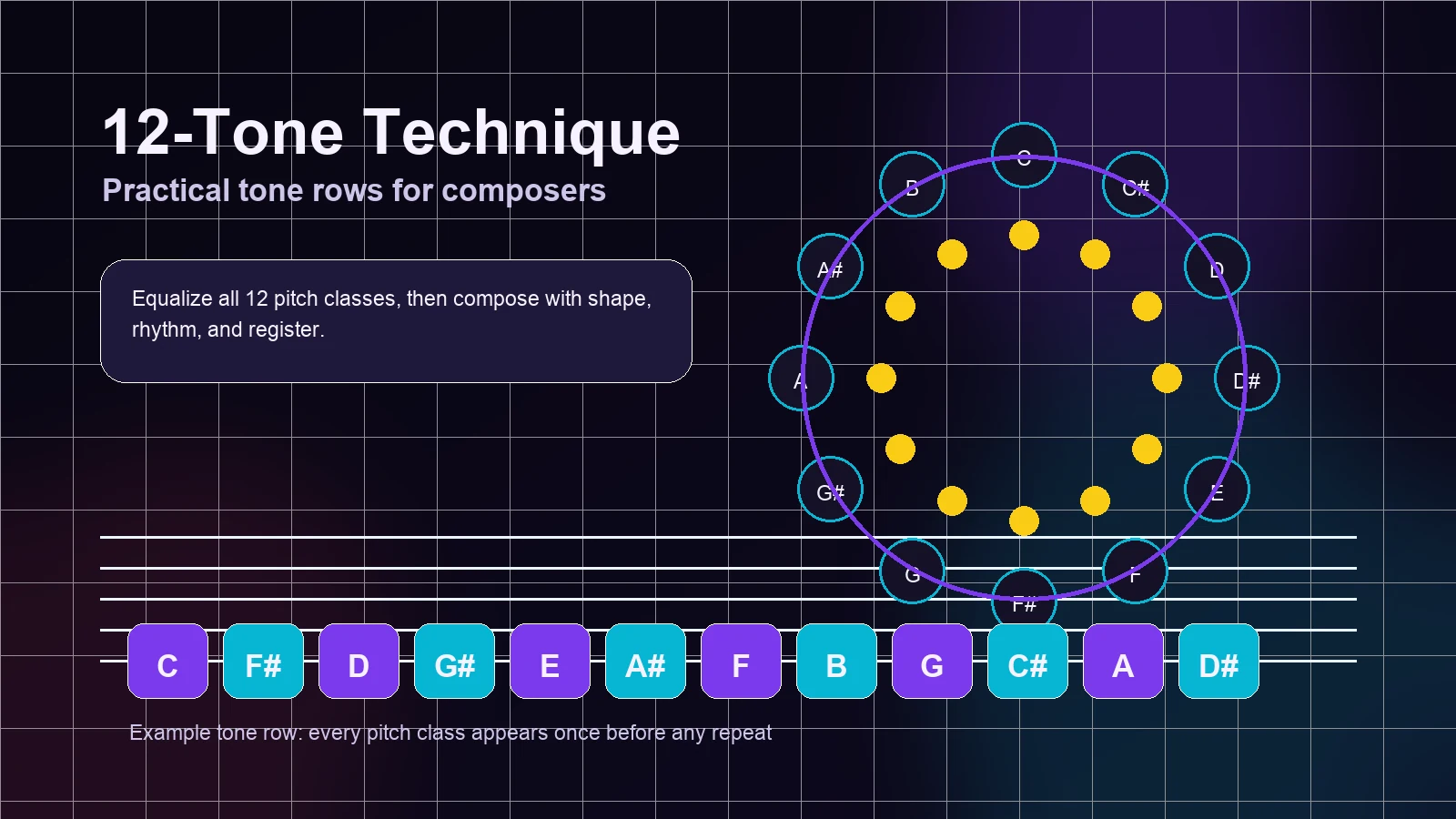
Turn a static score into editable MIDI
Contents
The 12-tone technique is a composition method that treats all 12 chromatic pitch classes as equal. Instead of starting from a key such as C major or A minor, the composer builds a tone row: an ordered set that uses each pitch class once before any pitch class returns.
That row is not the whole piece. It is the pitch source. The music still needs rhythm, register, phrase shape, silence, dynamics, and listening judgment. A useful 12-tone workflow is less about following a mathematical rule perfectly and more about turning the row into musical material you can hear, revise, and develop.
What the 12-tone technique means
In tonal music, one note or chord often feels like home. In the 12-tone technique, the goal is to avoid giving one pitch class that automatic privilege. The row gives every pitch class a place in the order before anything repeats.
If you are new to written pitch, it helps to separate this idea from the visual staff first. A staff tells you where a note sits on the page; the 12-tone technique tells you how pitch classes are ordered as compositional material. Melogen's guide to the musical stave is useful background if the notation layer still feels slippery.
Most introductions connect the technique with Arnold Schoenberg and early 20th-century serialism. For reference, Puget Sound Music Theory, Britannica, and the open composition text on dodecaphony all describe the same core idea: a composer orders the chromatic pitch classes and then derives musical material from that ordered set.
Here is the practical distinction:
| Term | Plain meaning | Composer action |
|---|---|---|
| Pitch class | A note name without octave, such as C or F# | Track which chromatic notes have appeared |
| Tone row | A 12-note ordering with no repeated pitch class | Use it as the pitch source for the piece |
| Prime form | The row in its original order | Start the main material here |
| Retrograde | The same row backward | Create a related answer or continuation |
| Inversion | The row with intervals mirrored | Keep the logic while changing direction |
| Retrograde inversion | The inversion backward | Add contrast without leaving the row family |
Build a row before writing a melody
A beginner mistake is to make the row first and assume the piece is done. A better move is to make the row, then test whether it can become a phrase.
Try this row as a neutral example:
C F# D G# E A# F B G C# A D#
It uses all 12 pitch classes once. That satisfies the basic pitch rule, but it does not yet say anything about rhythm, character, or form. Before writing a full passage, ask three questions:
- Does the row have a recognizable contour?
- Do any intervals feel too jagged for the instrument or voice?
- Can you hear at least one small motive inside it?
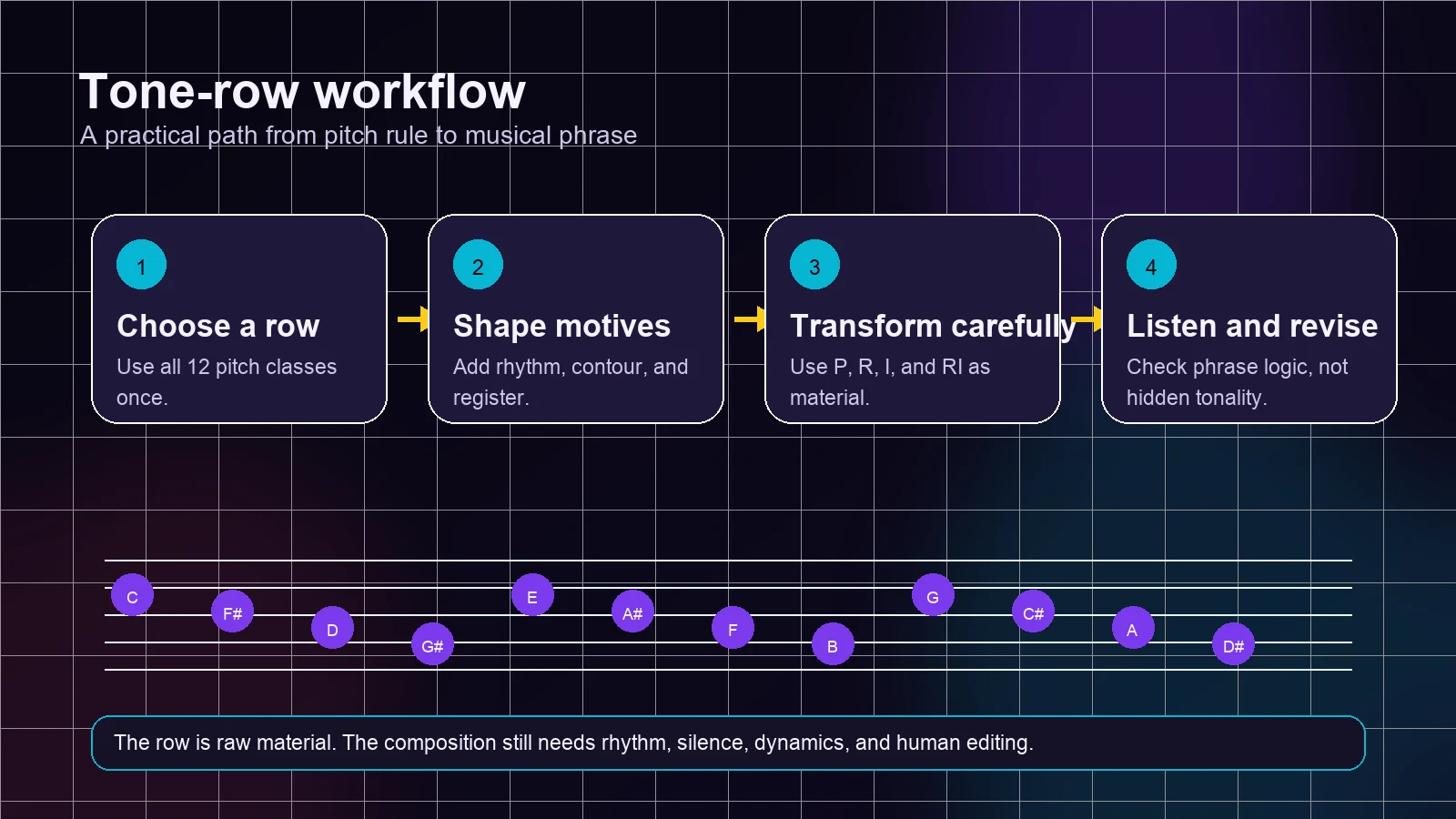
If the answer is no, rewrite the row. You are not breaking the technique by choosing a better row. You are doing the composer part of the job.
Transform the row without losing the idea
The four common row forms give you related material without simply repeating the same line.
Prime is the row as written. Retrograde reverses it. Inversion mirrors the intervals so upward motion becomes downward motion by the same distance. Retrograde inversion reverses the inversion. Those labels are often shortened to P, R, I, and RI.
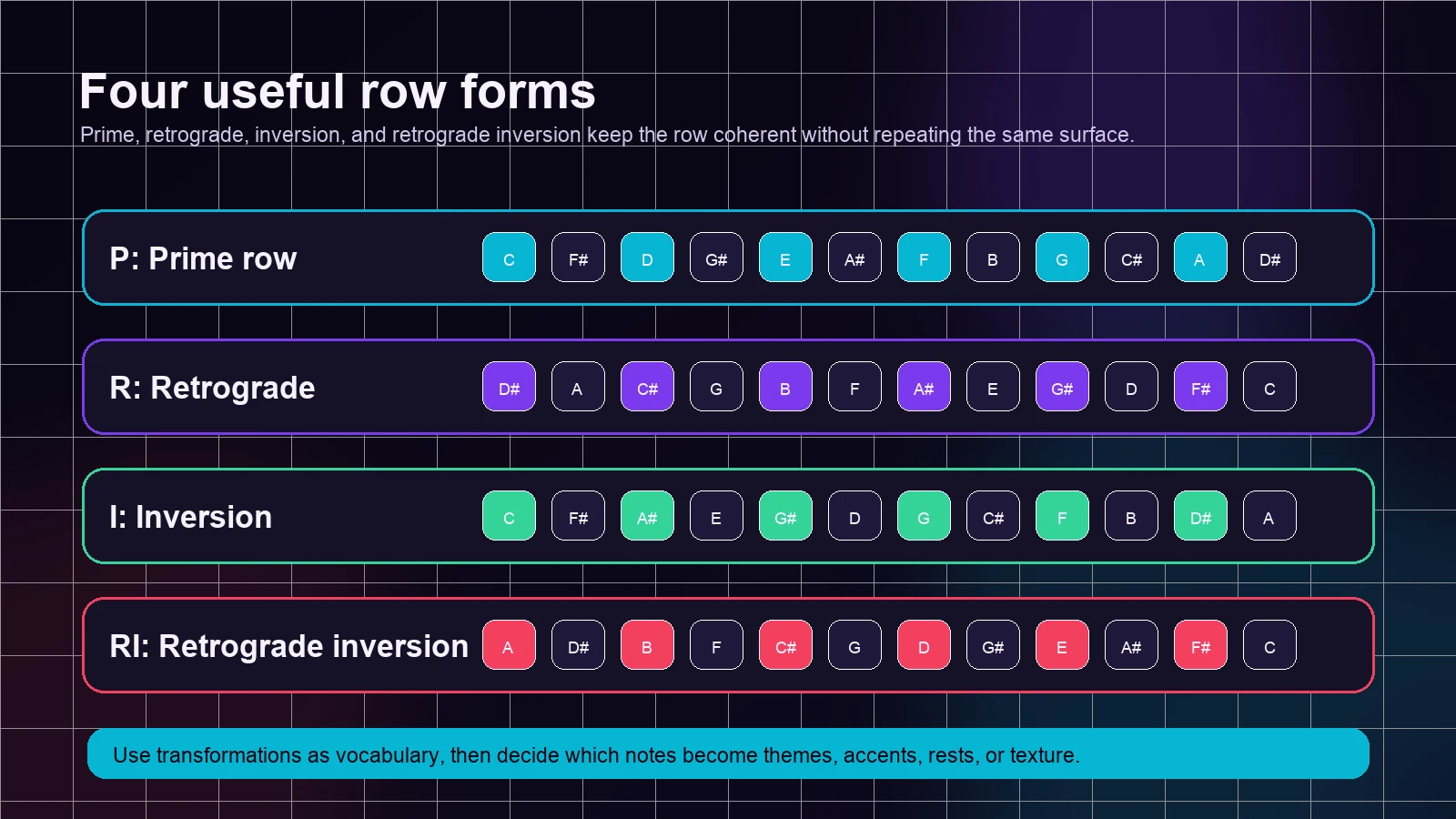
Use these transformations as vocabulary, not as a requirement to fill every bar with a table. A short phrase might use the first five notes of the prime row in the upper voice, then answer with an inverted shape in the bass. Another passage might stretch the same row across harmony, melody, and inner texture.
The row can also move by transposition. If the first row starts on C and you transpose it up one semitone, the same interval pattern starts on C#. That keeps the row relationship while giving the passage a different register or color.
Listen for shape, not a hidden key
The 12-tone technique does not automatically make music sound random. It can sound focused when the composer gives the row a clear musical surface.
Use this listening checklist while sketching:
- Give the phrase a rhythmic profile before adding more rows.
- Repeat a contour or register idea even when pitch classes change.
- Leave space so the listener can hear the motive.
- Avoid stacking too many transformations before the first idea lands.
- Check whether accents accidentally make one pitch feel like a tonal center.
This is where good 12-tone writing becomes musical rather than merely correct. The rule keeps pitch classes balanced, but the ear still follows rhythm, density, contour, and arrival points.
Use the technique in a modern workflow
A modern composer does not need to choose between theory and tools. You can sketch the row on paper, enter it in notation software, hear it in a DAW, and revise the phrase after listening.
Here is a practical workflow:
- Write the row as pitch classes first.
- Mark one or two motives you can actually hear.
- Draft a short phrase using rhythm and register.
- Test a transformation as an answer, not as a compulsory trick.
- Listen back and revise the musical surface.
- Only then expand the idea into a larger section.
For a broader view of composing tools, see the Melogen guide to technology for composing music. It separates notation editors, DAWs, score conversion, and analysis so the tool choice follows the musical job instead of the other way around.
Where Melogen fits
Melogen does not generate a Schoenberg-style row for you, and it should not pretend to replace the composer's ear. Its better role comes after you have visible notation or a score draft and want help moving into analysis or revision.
Use Structural Analysis when a score exists and the next question is form, harmony, sections, or musical organization. The local product page describes uploads from sheet music images or PDFs and analysis of structure, tonality, harmony, cadences, melodic themes, and formal sections. That is useful after a 12-tone sketch becomes notation, because the pitch row is only one layer of the piece. You still need to check how the sections behave.
For the larger concept, the guide to musical structure analysis explains how form and section-level listening can sit beside notation and production work.
Check the structure after the row becomes a score
Use Melogen Structural Analysis when your 12-tone sketch has become visible notation and you want clearer form, harmony, and section cues before the next revision.
The practical takeaway
The 12-tone technique is a way to organize pitch without relying on a tonal center. Start with a row, learn the main transformations, then make musical decisions about rhythm, contour, register, and form.
Keep this short checklist nearby:
- Use all 12 pitch classes before any repeat.
- Treat P, R, I, and RI as related material, not decoration.
- Let rhythm and register make the row audible.
- Revise rows that look correct but do not sing, speak, or move.
- Analyze the finished score as music, not only as a pitch system.
The row gives you a disciplined pitch world. The composition begins when you make that world breathe.
About the author
Zhang Guo
Composer - AI Product Manager
AI product manager and digital marketing consultant with a background in music. Creativity is the bridge between rhythm and logic, where musical intuition and mathematical precision can coexist in every meaningful product decision.
Follow on X