Technology for Composing Music: Tools That Fit
Choose technology for composing music by job: notation, DAW, score conversion, or analysis. See where Melogen fits without forcing one tool.
 Zhang Guo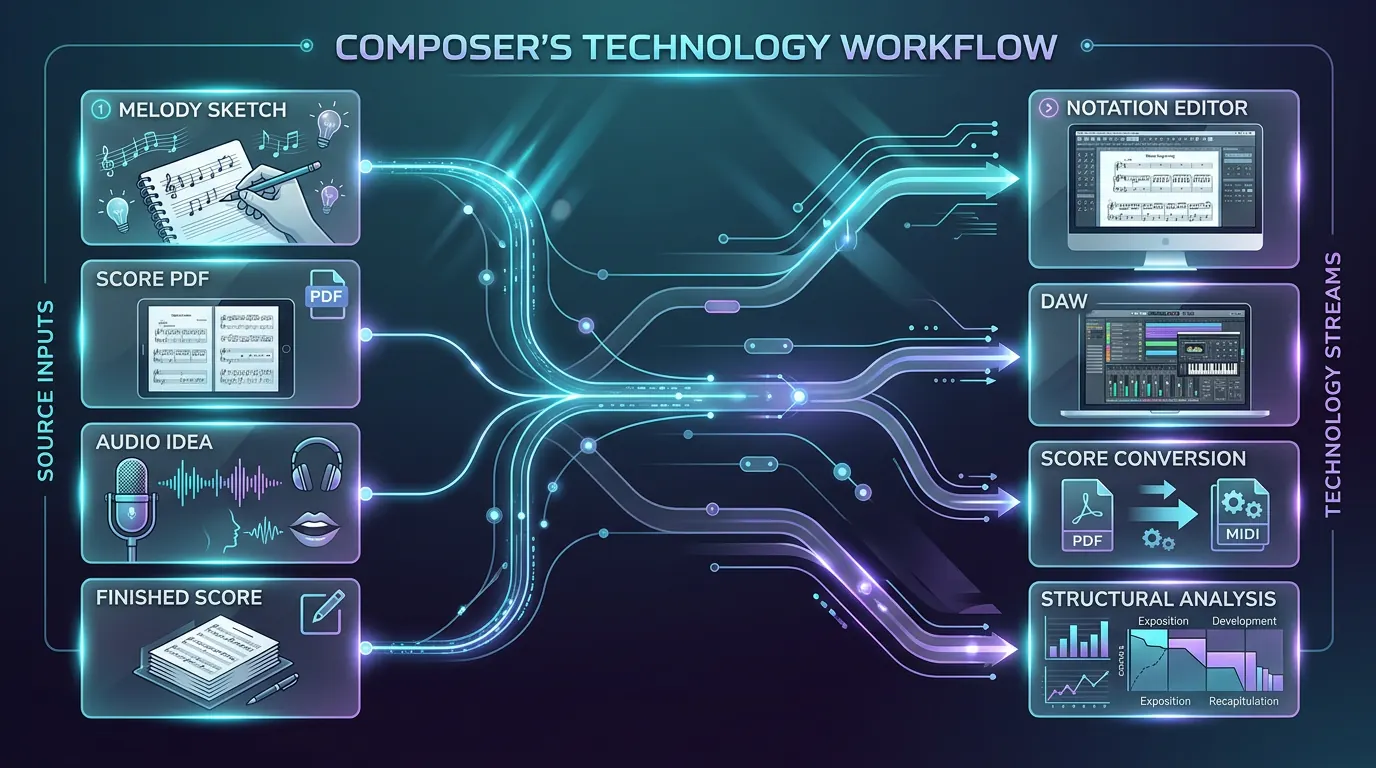
Turn a static score into editable MIDI
Contents
Technology for composing music is not one category. A notation editor, a DAW, a score scanner, a MIDI converter, and an AI analysis tool all help composers, but they protect different parts of the work. The fastest way to choose is to ask what musical decision needs to happen next: writing the score, hearing the idea, converting a static page, or understanding the structure.
That is the useful difference. Do not start by asking which tool has the longest feature list. Start with the source you have and the output you need next.
Start with the composing job, not the tool category
The same composer may need four different technology layers in one project. A melody sketch may belong in a DAW first. A chamber score may need notation software. A scanned part may need conversion before any editor is useful. A finished draft may need structural analysis before the arrangement is convincing.
Here is the cleanest way to separate the jobs:
| Composer job | Better first layer | Output to protect | Typical mistake |
|---|---|---|---|
| Write or engrave a score | Notation software | Readable parts, layout, articulations | Using a DAW when the page must be printed |
| Shape sound and timing | DAW or piano roll | MIDI lanes, tempo, mix decisions | Forcing notation software to solve production problems |
| Move a PDF or scan into editing | Score conversion | MusicXML or MIDI first pass | Opening a notation editor before recognition |
| Check form, harmony, or sections | Structural analysis | Analysis notes and revision targets | Treating a finished-looking score as finished music |
| Build from an audio idea | Audio-to-MIDI or DAW sketching | Editable notes and arrangement material | Expecting a perfect score from a rough recording |
This is why broad "music composition software" advice often feels vague. The real question is not whether a tool is modern. The real question is whether it preserves the kind of musical data you need next.
Compare the core technology layers
Most composing technology falls into a few practical layers.
Notation software is best when the written page matters. Use it for parts, engraving, orchestration, rehearsal materials, and score cleanup. Dorico, Sibelius, MuseScore, Notion, Noteflight, and similar tools belong in this lane. If you are evaluating a serious score editor, Melogen's Dorico review is a useful example of how to separate notation depth from upstream conversion.
DAWs and piano-roll editors are best when sound, timing, and production decisions matter. They are built around performance data, tracks, instruments, automation, audio, and mix decisions. A DAW is not automatically better or worse than notation software. It is just answering a different question.
Score conversion tools are best when the music is locked inside a PDF, scan, or image. Before a notation editor can help, the static page needs to become data. MusicXML is usually the better bridge for notation editing. MIDI is usually the better bridge for playback, arrangement, and DAW work. The MIDI vs MusicXML guide explains that destination choice in more detail.
AI structural analysis is best when the score exists but the composer needs a clearer map of form, harmony, sections, cadences, and musical tension. This does not replace musical judgment. It gives the composer a faster way to see where the piece is balanced and where the next revision should happen.
Match each source to the next output
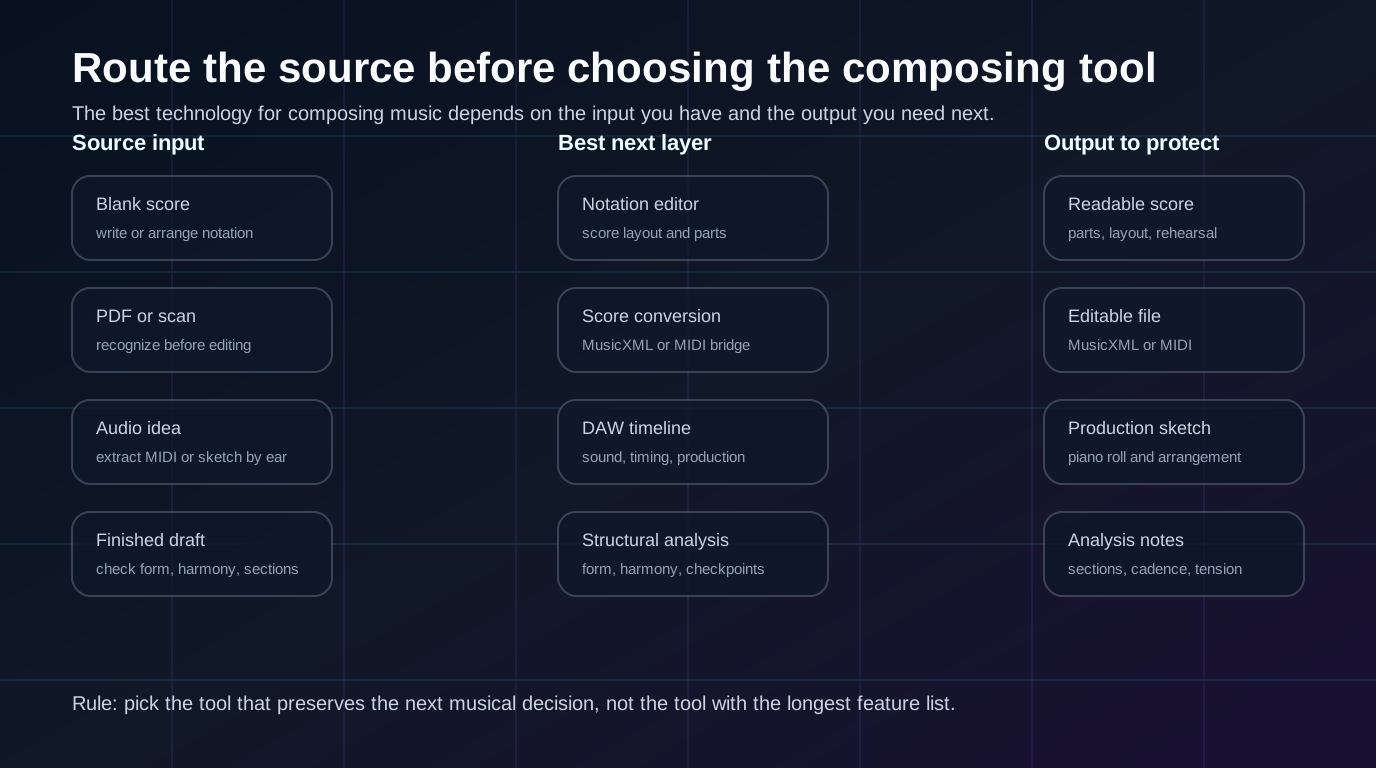
The source matters more than the brand name on the software.
If you have a blank score, start in notation software when the final artifact is written music. That keeps voices, clefs, measures, articulations, and layout close to the creative process.
If you have an audio idea, start in a DAW or audio-to-MIDI workflow. You need timing, feel, and playable note material before you worry about engraving.
If you have a PDF, scan, or photo of sheet music, start with conversion. Melogen's current product pages support this split: Sheet2MIDI turns sheet music images or PDFs into editable MIDI, while PDF to MusicXML is built for notation-first editing in tools such as MuseScore, Dorico, Sibelius, Finale, or Notion.
If you have a finished or nearly finished score, analysis may be the better next step. A composer can look for weak transitions, unclear sections, harmonic drift, or places where the music sounds complete but the form is not yet convincing.
The workflow is not linear for every project. A good composing setup lets you move between layers without losing the musical object you care about.
Use AI where it reduces friction, not where it steals judgment
AI is most useful in composition when it removes a mechanical bottleneck. It can recognize notation from a scan, extract a MIDI starting point, suggest structural checkpoints, or make a score easier to inspect. It is much less useful when it encourages the composer to stop listening.
Use this decision grid before adding another tool:
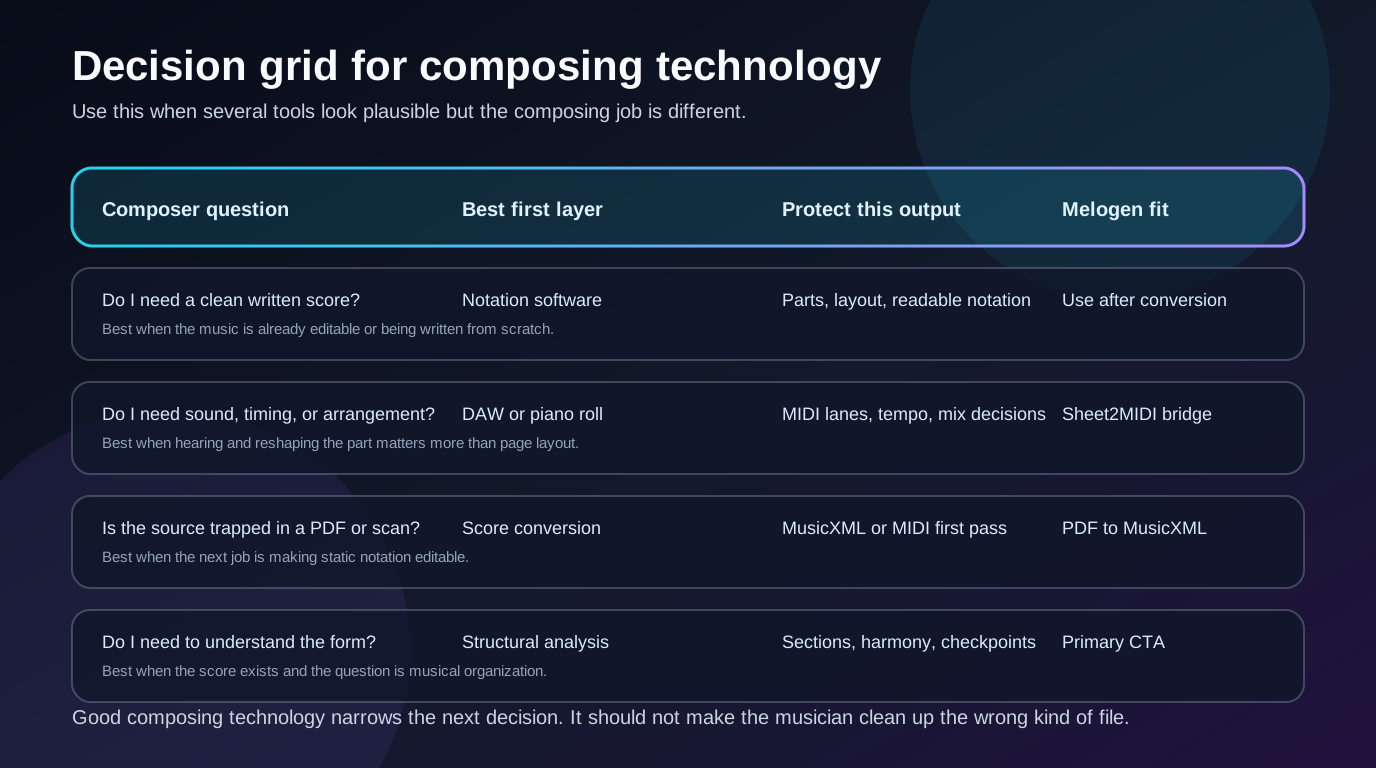
The catch: AI output still needs musical proofreading. A conversion can miss a voice. A MIDI line can need timing cleanup. A structural map can show likely sections, but the composer still decides whether the transition works.
That is not a weakness of the workflow. It is the point. Good technology moves the project to the next musical decision faster. It does not pretend the decision is gone.
Where Melogen fits in the composing stack
Melogen fits best at the handoff points where a composer needs static music to become usable data or a score to become easier to inspect.
Use Sheet2MIDI when a printed part, PDF, or score image needs to become playable MIDI for practice, arrangement, or DAW work. MIDI is the practical bridge when hearing and reshaping the material matters more than preserving the page.
Use PDF to MusicXML when the destination is notation software. MusicXML keeps more score structure than MIDI, so it is usually the better first export when the next job is correcting measures, voices, clefs, articulations, and layout.
Use Structural Analysis when the score exists and the question is musical organization. The local product page describes analysis of structure, tonality, harmony, form, key signatures, time signatures, harmonic progressions, cadences, melodic themes, and formal sections from JPG, PNG, or PDF scores. For the broader concept, see the guide to what music structural analysis is.
Check the structure before the next revision
Use Melogen Structural Analysis when a score exists and you want clearer form, harmony, and section cues before deeper composing or arranging decisions.
The practical takeaway
Technology for composing music works best when every tool has a job. Use notation software when the page matters. Use a DAW when timing, sound, and arrangement matter. Use score conversion when the source is still static. Use structural analysis when the music exists but the form needs clearer inspection.
A simple checklist is enough:
- Choose the output before choosing the tool.
- Use MusicXML when the next edit is notation-first.
- Use MIDI when the next edit is playback, production, or timing-first.
- Analyze the score when the structure, harmony, or sections are the real question.
- Keep the musician in charge of cleanup and revision.
The strongest composing workflow is not the one with the most software. It is the one that keeps the next musical decision visible.
About the author
Zhang Guo
Composer - AI Product Manager
AI product manager and digital marketing consultant with a background in music. Creativity is the bridge between rhythm and logic, where musical intuition and mathematical precision can coexist in every meaningful product decision.
Follow on X