Musical Structure Analysis: A Practical 2026 Guide
Musical structure analysis explained for classical scores, modern production, and AI-assisted workflows for students, composers, and producers.
 Zhang Guo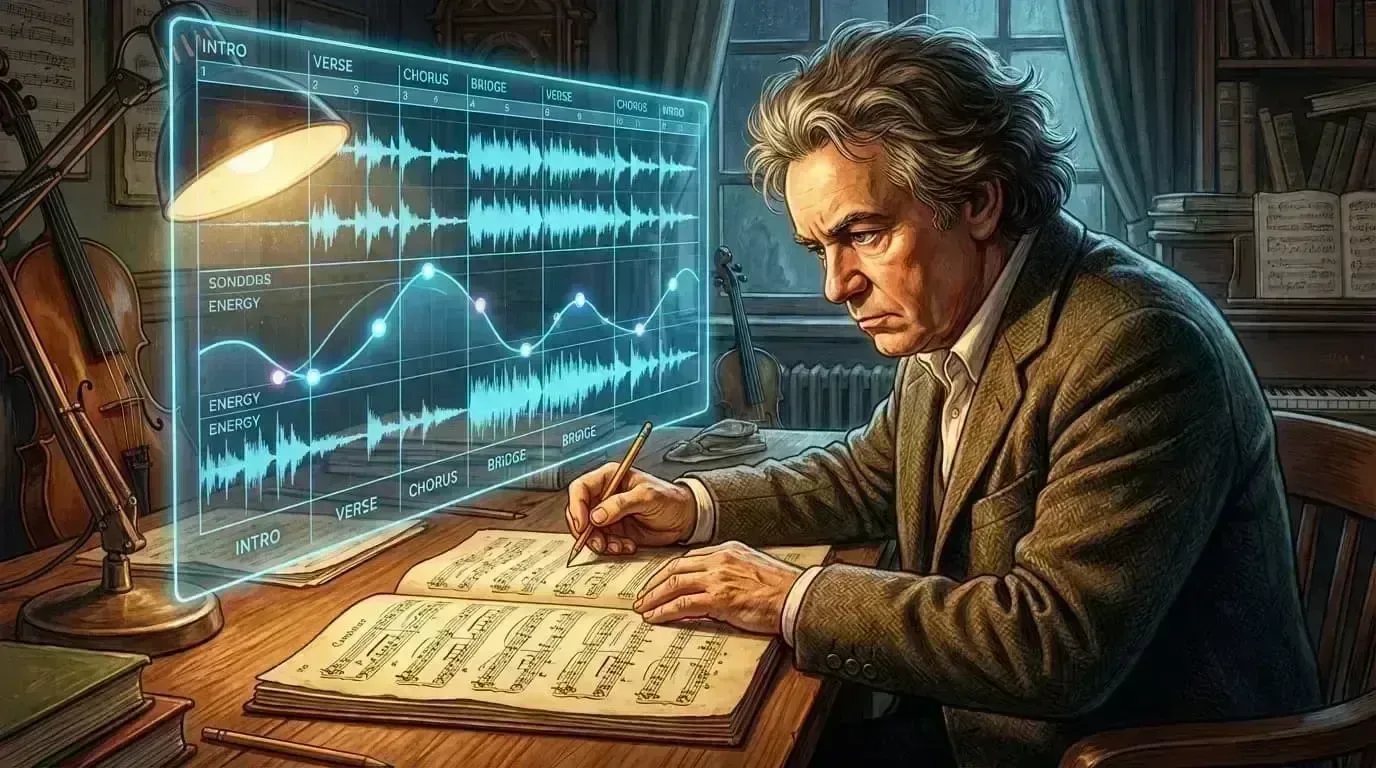
Turn a static score into editable MIDI
Contents
Musical structure analysis is the study of how a piece of music is organized over time. It asks where the phrases begin and end, how sections relate, how harmony creates tension and release, and why a listener feels arrival at one moment and motion at another.
In 2026, the useful update is not that AI replaces this kind of listening and score study. The useful update is that musicians can combine traditional form analysis, modern arrangement thinking, and AI-assisted first-pass mapping to work faster without giving up musical judgment.
The same idea applies whether the source is a Mozart sonata, a lead sheet, a film cue, or a pop arrangement. Structure is the blueprint: it explains how the music moves from one idea to the next.
Plain-language definition
Musical structure analysis looks at the architecture of a piece. Instead of asking only "what notes are here?", it asks "what job does this moment do inside the whole work?"
That can mean several levels at once:
- Small units such as motifs, cells, riffs, and melodic ideas.
- Phrase units such as two-bar, four-bar, or eight-bar statements.
- Harmonic units such as cadences, modulations, tonic areas, and dominant preparation.
- Large forms such as binary, ternary, rondo, sonata form, verse-chorus form, bridge, drop, and outro.
- Production shape such as density, register, drum energy, vocal entry, texture, and arrangement contrast.
For a beginner, the first goal is not to name every advanced form correctly. The first goal is to hear and see the main sections, then explain the evidence. If the page itself still feels unfamiliar, start with the broader guide on how to read sheet music before trying to analyze long-form architecture.
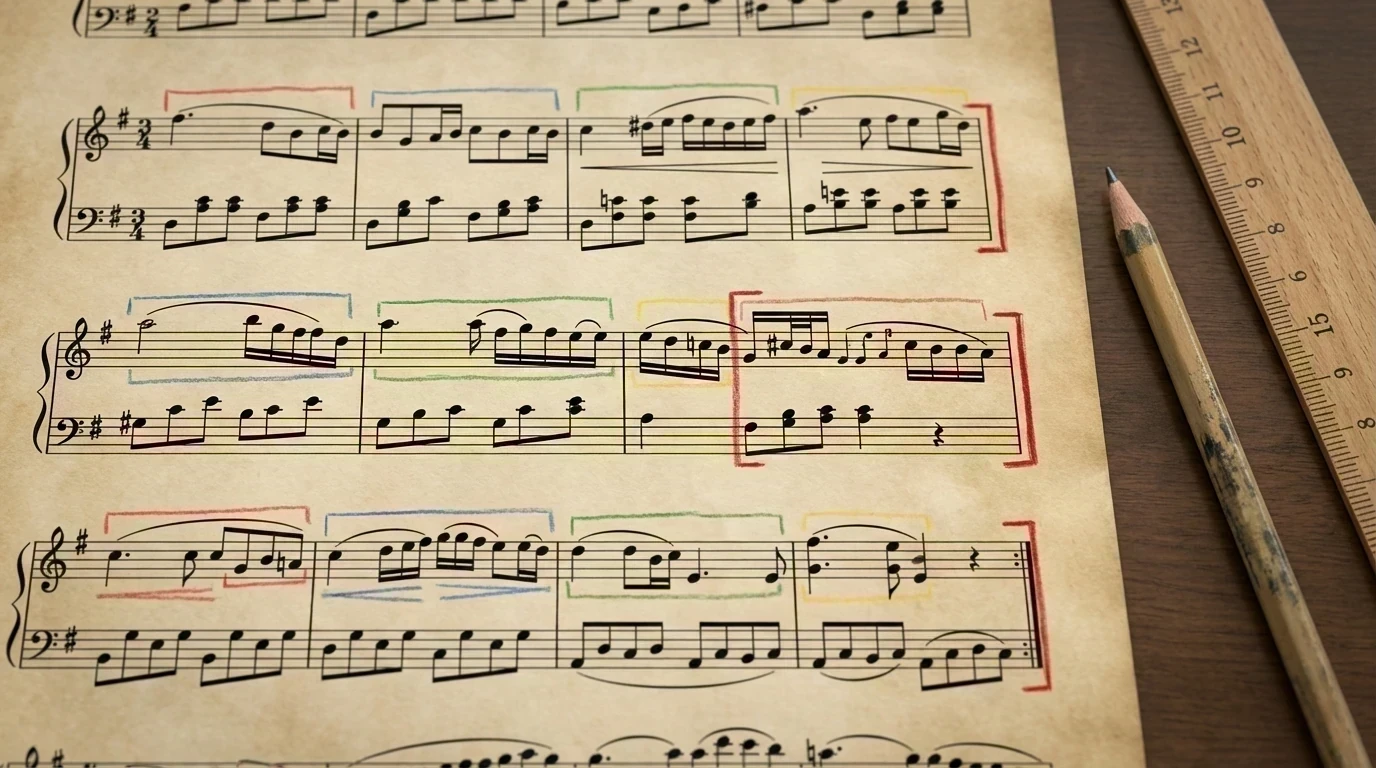
Classical vs modern production: two useful lenses
Classical form analysis and modern production analysis are not enemies. They answer different versions of the same question: how does the music create expectation, contrast, and return?
Classical analysis usually begins with the score. It studies phrase design, thematic development, cadence strength, tonal plan, and formal type. A sonata-form movement, for example, is not just "fast music with themes." It usually depends on exposition, development, recapitulation, key relationships, and the way thematic material changes under pressure.
Modern production analysis often begins with the listening timeline. It studies intro, verse, pre-chorus, chorus, bridge, drop, breakdown, outro, and the energy curve between them. A producer may care less about whether a section is a textbook period and more about whether the bass enters before the hook, whether the second chorus adds width, or whether the bridge resets the listener before the final chorus.
| Lens | Main question | Evidence to inspect | Typical output |
|---|---|---|---|
| Classical score analysis | How are themes, keys, and cadences organized? | Motifs, phrases, cadences, modulations, formal sections | Annotated score, formal diagram, harmonic summary |
| Modern production analysis | How does the arrangement move the listener? | Section labels, density, register, groove, vocal entry, texture | DAW markers, energy map, reference arrangement notes |
| Composer workflow | What structure can guide a new piece? | Proportion, return, contrast, harmonic pacing | Draft outline, section plan, motif-development map |
| Student workflow | What can be defended in class or practice? | Score evidence, listening evidence, terminology | Marked score, short analysis paragraph, study notes |
The best analysis often uses both lenses. A film cue may use classical sequencing and modulation while behaving like a modern production timeline. A pop song may use verse-chorus labels but still depend on cadence, phrase length, and motivic repetition.
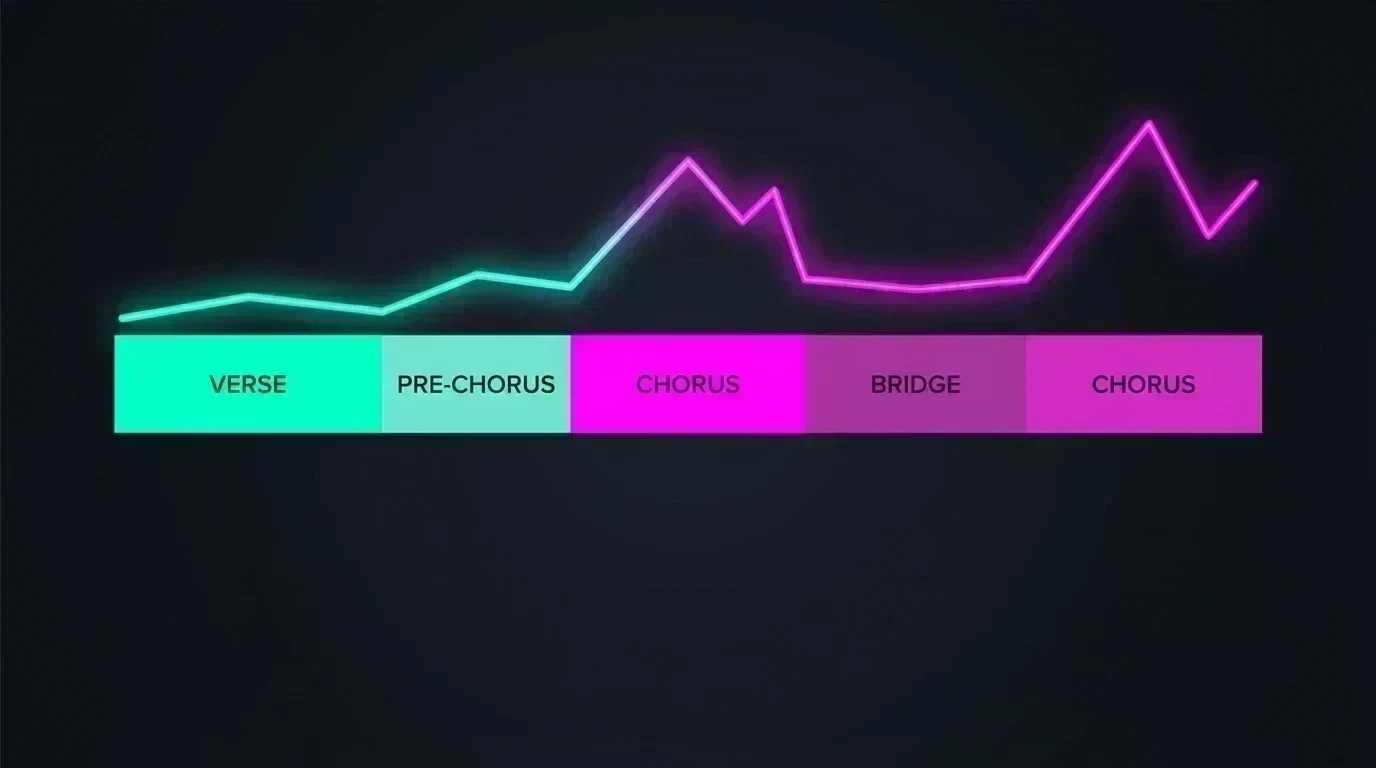
What to look for first
Start with the largest obvious boundaries before naming every detail. Most weak analysis fails because it jumps into terminology too early.
Use this order:
- Mark major section changes by ear or by page layout.
- Check phrase length and whether phrases answer each other.
- Find cadence points, especially places that sound closed or half-closed.
- Track key areas, modulations, and returns to the home key.
- Notice texture changes: solo to tutti, thin to dense, drums in or out, register shifts.
- Connect the evidence to a label only after the musical behavior is clear.
For modern writers, this same rule prevents lazy reference-track copying. Do not only write "chorus at 0:47." Write what changed: drums widen, melody moves higher, harmony resolves, background vocals enter, and the hook repeats.
What AI can and cannot do
AI is most useful as a first-pass assistant, not as the final authority. This distinction matters because structure is partly observable and partly interpretive.
An AI tool can help when the input is clear enough and the task is concrete. It can detect likely section boundaries, identify key and time-signature clues, summarize harmonic movement, highlight repeated motifs, and produce a map that gives the musician a starting point. That is valuable when a student has a dense score, a teacher needs a quick teaching aid, or a composer wants a neutral second reading of a reference piece.
AI cannot replace the part of analysis that depends on musical context. It cannot know the composer's intention with certainty. It can misread unclear scans, ambiguous enharmonic spelling, unusual notation, or sections that deliberately blur form. It also cannot decide whether a production choice is emotionally effective in your song. That decision still belongs to the musician.

The practical boundary is simple:
- Use AI to create a map faster.
- Use listening and score study to check the map.
- Use theory to explain why the map makes musical sense.
- Use creative judgment before applying the structure to a new composition or production.
Where Melogen fits
Melogen Structural Analysis is best understood as a score-first workflow for musical structure analysis. The product page supports sheet music images and PDFs, including JPG, PNG, and PDF uploads. The tool is framed around analyzing score structure, tonality, harmony, form, key signatures, time signatures, melodic motifs, cadences, and dynamic shape, with export options such as an analysis report or MusicXML.
That makes it useful when the music exists as notation and the reader needs a faster way to inspect the form before doing deeper study. It is not a replacement for a teacher, an exam answer, a full orchestration analysis, or a producer's taste. It is a structured starting point.
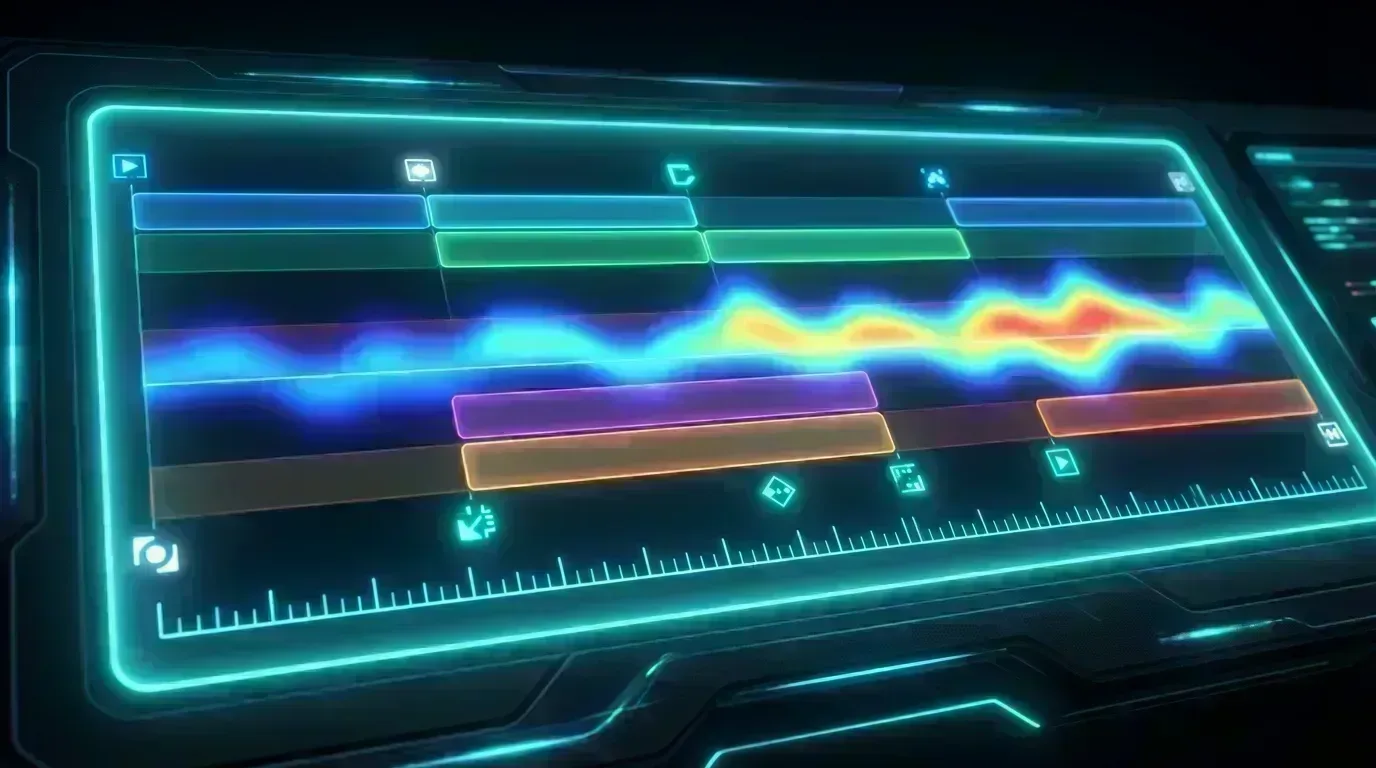
The strongest use cases are practical:
- A student uploads a clear score scan to compare AI markers against a hand analysis.
- A composer analyzes a reference score to study phrase proportion and return.
- A teacher prepares a class discussion around form, key areas, and cadences.
- A producer working from a score or lead sheet turns form insights into DAW markers.
If the next decision is about exporting into notation software or a DAW, the MIDI vs MusicXML guide can help clarify which format belongs in the next step.
Analyze the structure of a score in the browser
Use Melogen Structural Analysis when you have a clear sheet music image or PDF and want a first-pass map of form, tonality, harmony, motifs, and cadences before doing the final musical interpretation yourself.
Workflows for students, composers, and producers
Different readers need different outputs from the same concept. The point is not to make every workflow academic. The point is to produce a structure map that helps the next musical decision.
For students
Start by marking the score yourself. Circle cadences, write phrase lengths, and note where the key changes or where the main theme returns. Then use an AI-assisted map as a comparison layer.
A reliable student workflow looks like this:
- Read the score once without labels.
- Mark obvious phrase endings and repeated ideas.
- Run a structure analysis on a clean scan or PDF.
- Compare the AI output with your own labels.
- Write down disagreements and decide which evidence is stronger.
- Turn the final map into a short explanation, not just a diagram.
This protects the learning process. The goal is not to outsource the answer. The goal is to become faster at seeing why the answer is defensible.
For composers and arrangers
Composers use structure analysis to study proportion and possibility. A reference piece can show how long an idea can last, how often a theme returns, or how much contrast is needed before repetition feels satisfying.
The safe creative rule is to copy the function, not the material. You might borrow the idea of a four-bar antecedent followed by a varied consequent, or a bridge that delays the final return. You should not copy the melody, hook, or arrangement surface.
The related article on technology for composing music is useful if the bigger question is which tool belongs at each stage: notation, DAW, conversion, or analysis.
For producers
Producers can translate structure analysis into arrangement decisions. A score-based or lead-sheet analysis can become DAW markers: intro, theme, verse, pre-chorus, chorus, bridge, tag, outro. The same map can guide automation, drum entries, transitions, and density changes.
If the only source is a mastered audio file, do not pretend a score-first analyzer is the whole answer. Listen actively, drop DAW markers, compare energy changes, and use the analysis framework to explain what you hear. When notation is available, AI-assisted structure analysis can support that process by giving you a readable form map before the production rewrite begins.

Common mistakes to avoid
The first mistake is treating section labels as the analysis. Labels are shorthand. Evidence is the analysis. "ABA" matters only if the return of A is audible, visible, and meaningful.
The second mistake is confusing form with genre. Sonata form, rondo, verse-chorus form, and through-composed design can appear in many styles. Genre tells you the musical world; structure tells you how time is organized inside that world.
The third mistake is trusting a single pass. Human analysis can miss details. AI analysis can misread the source. The best workflow combines both and keeps a short list of uncertain spots.
The fourth mistake is forcing one vocabulary onto every piece. A pop bridge is not automatically the same thing as a classical development section. They may both create contrast, but the evidence and purpose can be different.
Practical takeaway
Musical structure analysis is a way to understand how music holds together. In classical study, it explains motifs, phrases, cadences, tonal areas, and formal design. In modern production, it explains sections, energy, contrast, and arrangement pacing.
AI can make the first map faster, especially when the source is a clear score. It cannot replace the musician's responsibility to listen, verify, and explain. The strongest 2026 workflow is therefore not "manual analysis or AI." It is a combined method: inspect the score, use AI for a first-pass structure map, compare the evidence, then make the musical decision yourself.
FAQs about musical structure analysis
What is the difference between form and structure?
Form usually names the large design, such as binary, ternary, rondo, sonata form, or verse-chorus form. Structure is broader. It includes form, but also phrase shape, cadence placement, harmonic pacing, texture, register, and production energy.
Can AI identify sonata form correctly?
AI can flag evidence that often supports a sonata-form reading, such as contrasting themes, tonal movement, development-like instability, and a return of earlier material. The final label should still be checked against the score, the key plan, and the style context.
Is musical structure analysis only for classical music?
No. Classical analysis has a rich formal vocabulary, but structure matters in pop, jazz, EDM, film scoring, worship music, game music, and songwriting. Any music that unfolds over time has some kind of structure.
What should beginners analyze first?
Beginners should start with section boundaries, phrase endings, repeated ideas, and cadences. Those details are easier to defend than advanced labels. Once the large map is stable, add harmony, key areas, and formal terminology.
When should a producer care about score-based structure analysis?
A producer should care when the source includes notation, a lead sheet, a piano-vocal score, a MIDI-derived score, or an arrangement chart. The analysis can become DAW markers and arrangement notes. For audio-only reference tracks, active listening and timeline marking remain essential.
About the author
Zhang Guo
Composer - AI Product Manager
AI product manager and digital marketing consultant with a background in music. Creativity is the bridge between rhythm and logic, where musical intuition and mathematical precision can coexist in every meaningful product decision.
Follow on X