Musical Stave: Meaning, Lines, and How Musicians Use It
Learn what a musical stave is, how its five lines organize pitch and rhythm, and when Melogen helps turn visible notation into editable MIDI.
 Zhang Guo
Turn a static score into editable MIDI
Contents
A musical stave is the set of five horizontal lines and four spaces where notes are written. The higher a note sits on the stave, the higher it usually sounds; the lower it sits, the lower it usually sounds. The stave becomes meaningful when you combine it with a clef, a key signature, rhythm, and bar lines.
If you are used to the word "staff," you already know the same idea. "Stave" is common in British English, while "staff" is common in American English. Musicians use both words for the visual grid that turns pitch and rhythm into readable notation.
Define the concept in plain language
Think of the musical stave as a map. The lines and spaces give each notehead a vertical address. The clef at the beginning tells you how to interpret that address. A treble clef, for example, makes the second line from the bottom the note G. A bass clef gives a different pitch map.
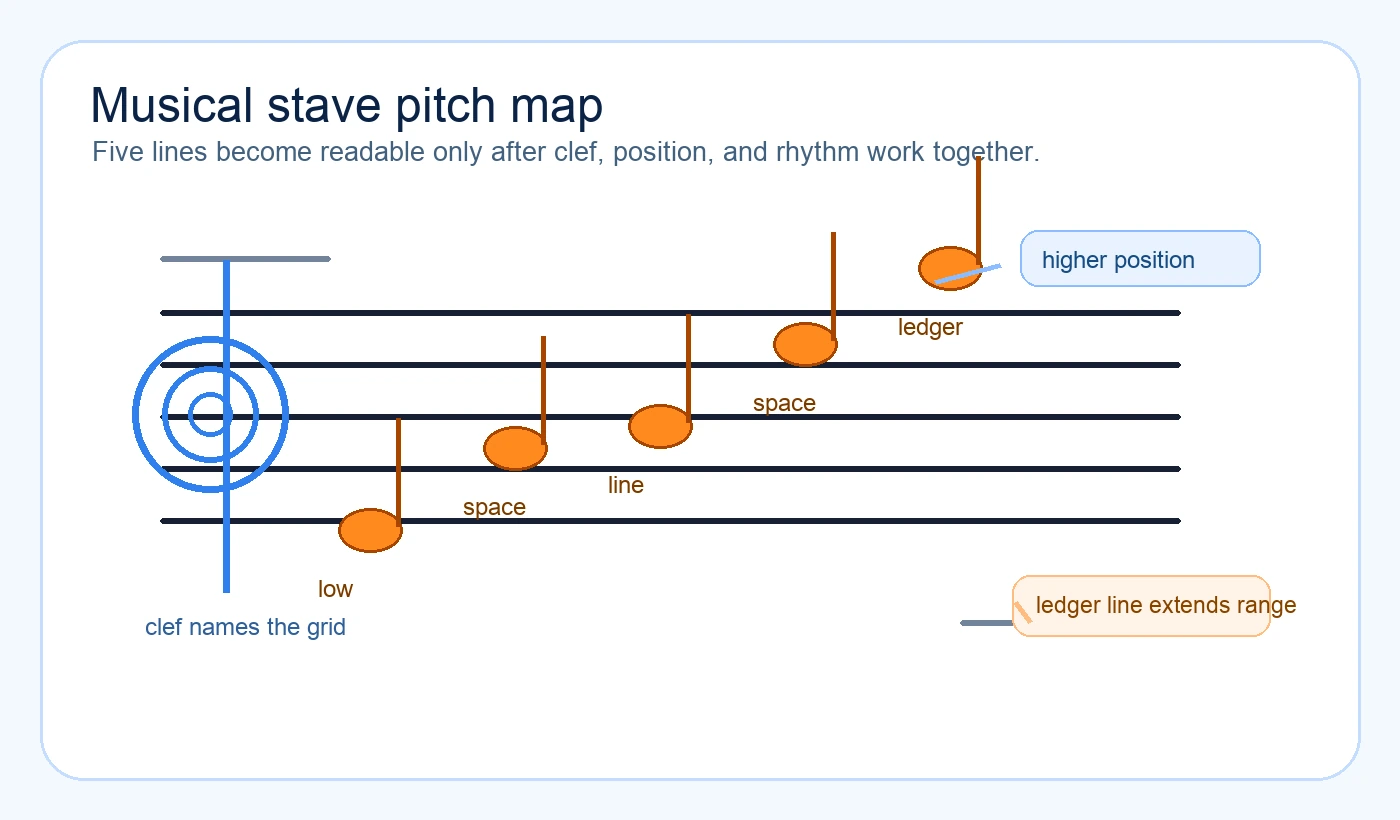
That is why five lines are enough for many instruments but not every note. When a note sits above or below the stave, short extra lines called ledger lines extend the map. Piano music often uses two staves together, called the grand staff, because the instrument covers a wide range. Melogen's guide on how to read piano sheet music walks through that two-stave reading problem in more detail.
Why it matters in a real music workflow
The stave matters because it keeps pitch relationships visible. You can see whether a melody climbs, falls, leaps, or repeats before you play a note. For composers and arrangers, that visual shape is faster than a list of note names. For producers, it is the bridge between written notation and MIDI editing.
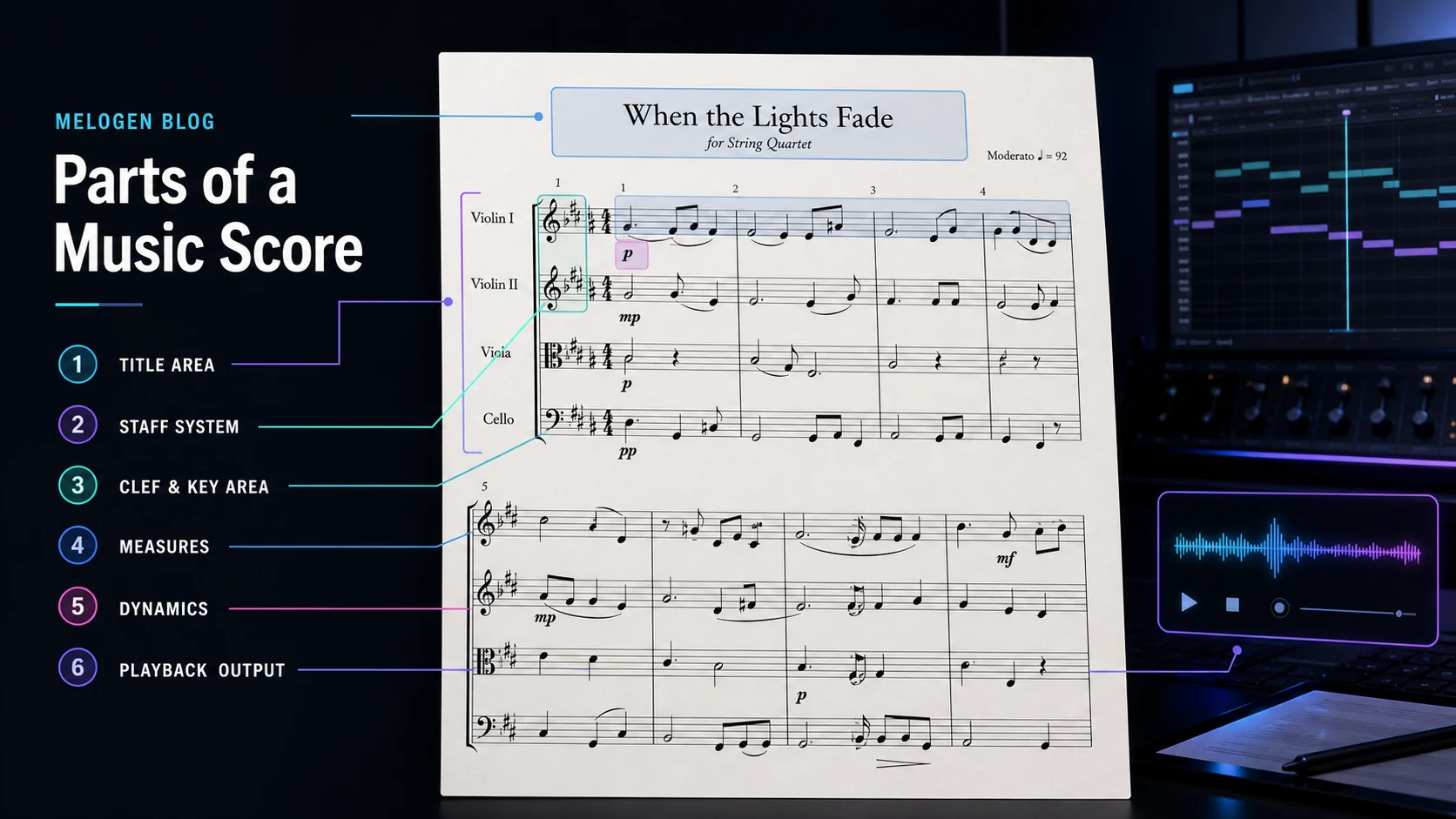
| Concept | What it means | Workflow consequence |
|---|---|---|
| Line or space | A vertical pitch position | You can name the pitch once the clef is known |
| Clef | The pitch key for the stave | The same notehead position can mean different notes under different clefs |
| Bar line | A measure boundary | Rhythm can be checked in small chunks |
| Key signature | The default sharps or flats | Pitch reading depends on the whole piece, not only one notehead |
| Ledger line | A temporary extension above or below the stave | Notes can move beyond the five-line grid without changing notation systems |
Once you understand those parts, a page of notation becomes less mysterious. You are no longer asking, "What are all these dots?" You are asking a better question: "Which grid, which clef, and which rhythm rule are active here?"
Common mistakes or misunderstandings
The first mistake is treating the stave as a fixed note chart. It is not fixed until the clef appears. A note on the same line means one thing in treble clef and another in bass clef.
The second mistake is reading pitch without rhythm. A notehead tells you where the note sits, but the note value tells you how long it lasts. If you only name letters, you are reading labels, not music.
The third mistake is assuming software can skip the logic. Optical music recognition still has to identify staff lines, clefs, noteheads, rests, and measure structure before it can export clean music data. If you want the technical bridge, this explainer on what OMR is gives the larger recognition picture.
How to apply the concept in practice
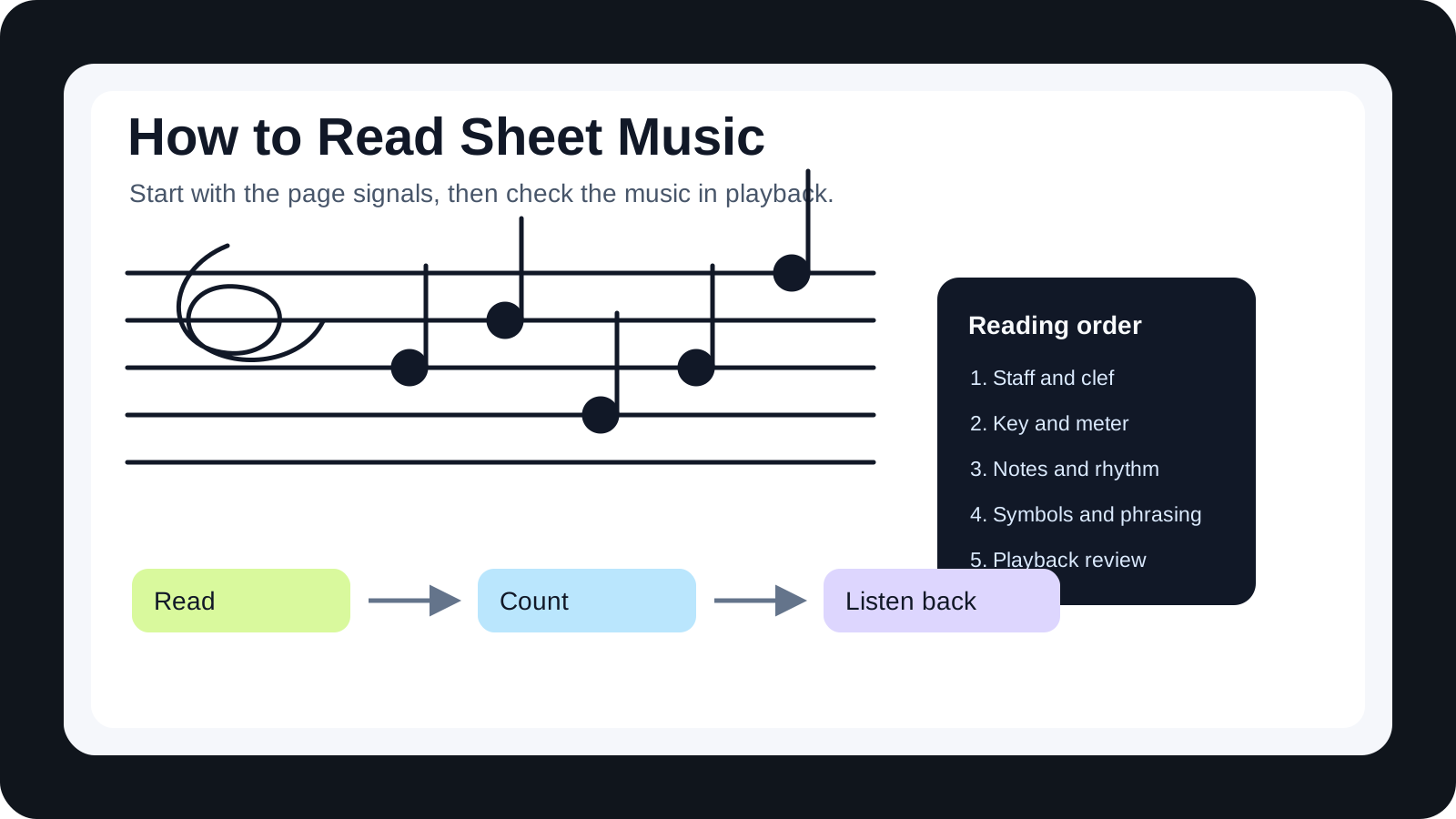
Use this quick reading order when a stave feels crowded:
- Find the clef first.
- Check the key signature.
- Count the beats in the measure.
- Read the noteheads by line and space.
- Watch for ledger lines above or below the stave.
- Only then worry about expression marks, articulation, or fingering details.
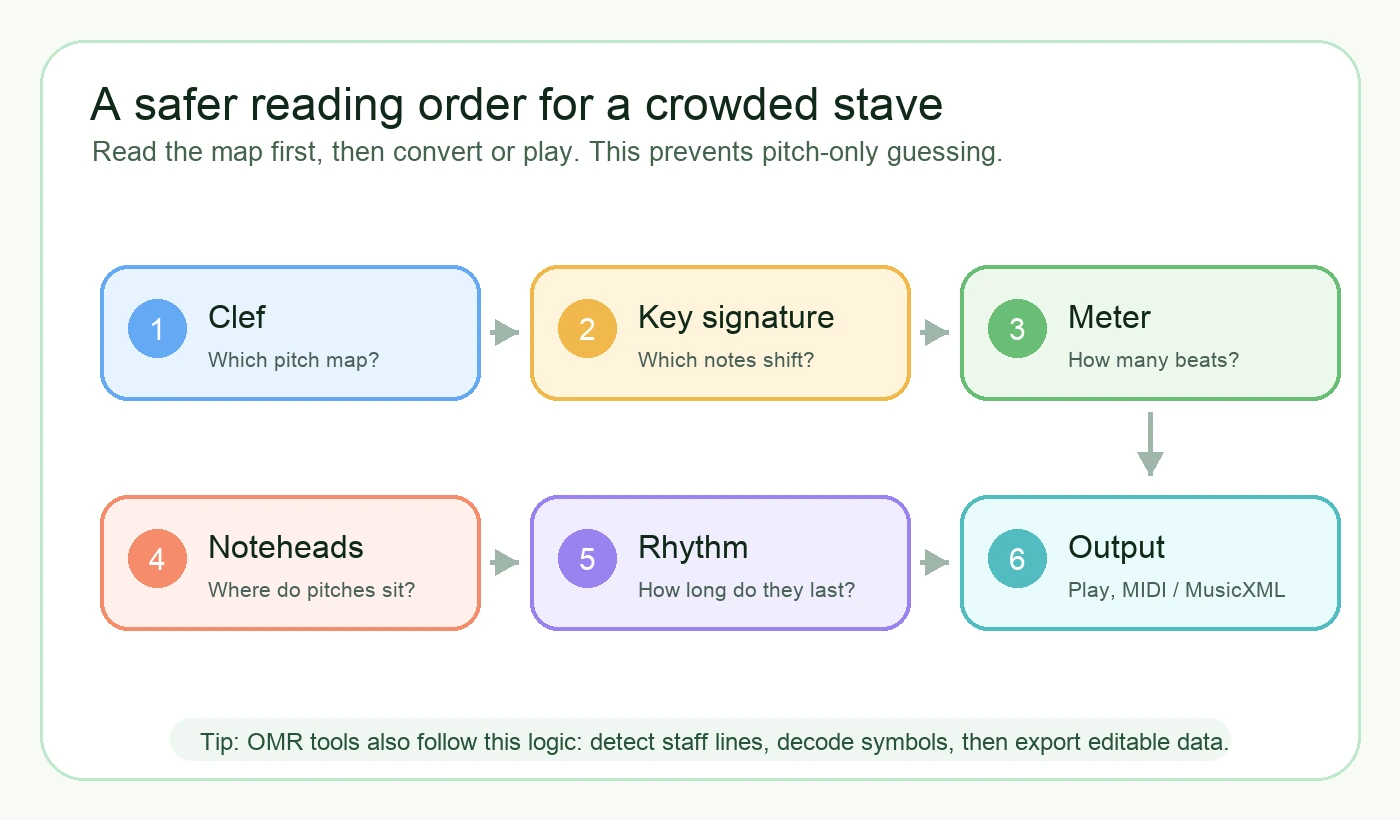
This order keeps you from over-focusing on one black dot. The stave is a coordinate system, but music still happens across time. A clean reading process needs both vertical pitch and horizontal rhythm.
Where Melogen fits without overstating the product
Melogen does not teach every stave rule inside the article page, and it should not replace basic music reading. Its useful role starts when you already have visible notation and want a digital first pass.
The local Sheet2MIDI product surface supports sheet music images and PDFs, including PNG, JPG, and PDF input, with MIDI output for editing or playback. That makes it helpful when you want to move a readable stave from a static page into a DAW or notation cleanup workflow. The limits still matter: unclear scans, dense polyphony, and handwritten notation need review after conversion. For a step-by-step version of that handoff, use the guide on converting sheet music to MIDI.
Move from static notation to editable MIDI faster
Use Melogen Sheet2MIDI when you need a fast first pass from sheet music, scans, or PDFs before you do the detailed musical cleanup yourself.
The practical takeaway
A musical stave is the five-line grid that makes written music readable. It does not work alone: clef, key signature, note values, and bar lines turn the grid into instructions.
When you read a new score, start with the clef, then the measure, then the note positions. When you convert a scanned score, use the same expectation: the cleaner the stave and symbols are on the page, the easier it is for a tool like Melogen Sheet2MIDI to create a useful first-pass MIDI file for review.
About the author
Zhang Guo
Composer - AI Product Manager
AI product manager and digital marketing consultant with a background in music. Creativity is the bridge between rhythm and logic, where musical intuition and mathematical precision can coexist in every meaningful product decision.
Follow on X