Buy MP3 Music Online: 8 Legal Stores for Musicians
Compare where to buy MP3 music online legally, from Amazon and iTunes to Bandcamp, DJ stores, hi-res shops, and licensed music sources.
 Zhang Guo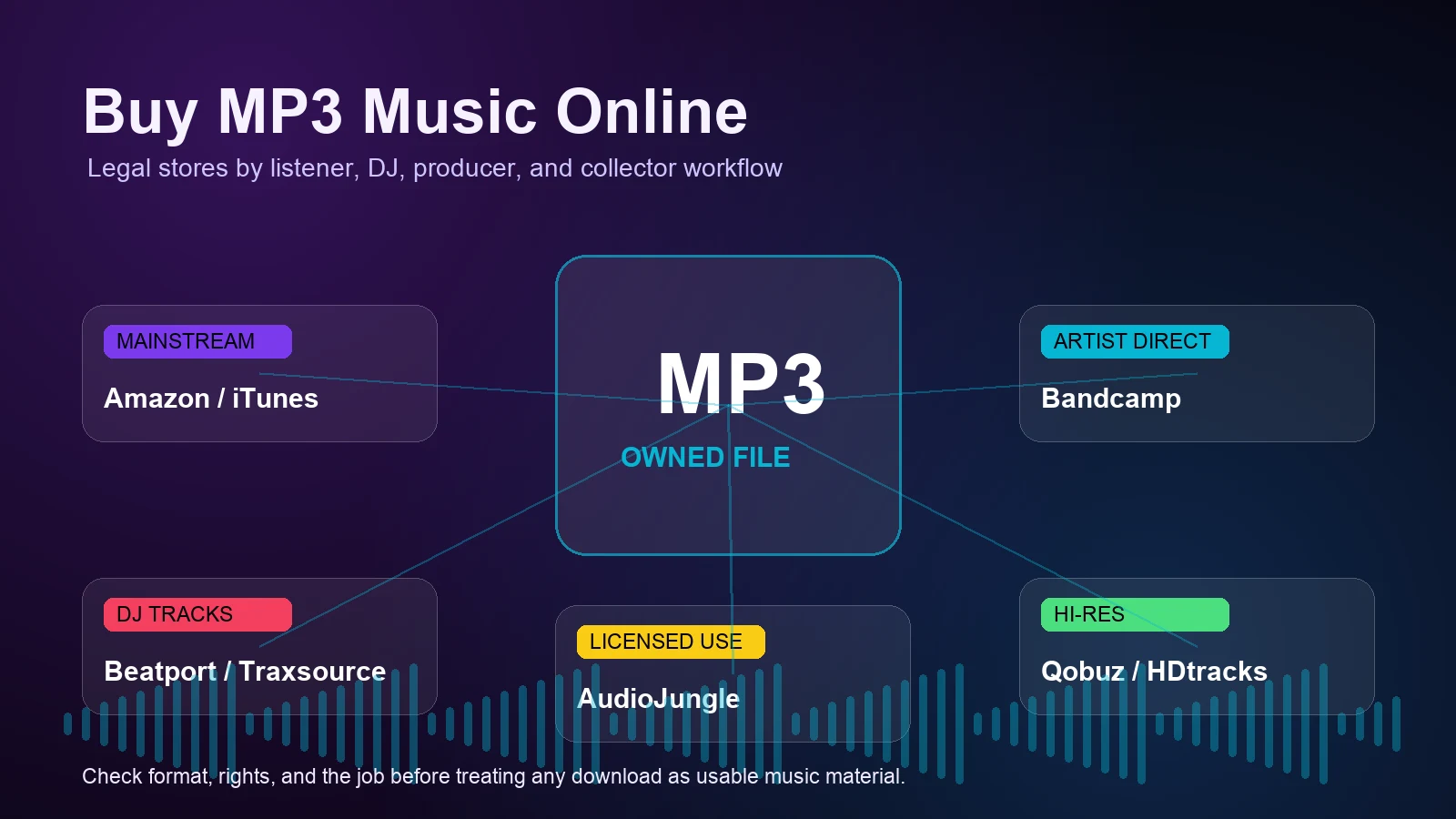
Turn a static score into editable MIDI
Contents
If you want to buy MP3 music online, start with the job behind the purchase. A casual listener needs a reliable store for songs and albums. A DJ may need WAV or AIFF as much as MP3. A producer needs a license that allows use in a video, game, podcast, or client project. A collector may care more about FLAC or hi-res downloads than MP3 at all.
That distinction keeps the search honest. Buying a track is not the same as downloading a stream, ripping audio from a platform, or exporting your own MIDI demo to MP3. The best store is the one that gives you a legal file, a clear rights path, and a format you can actually use.
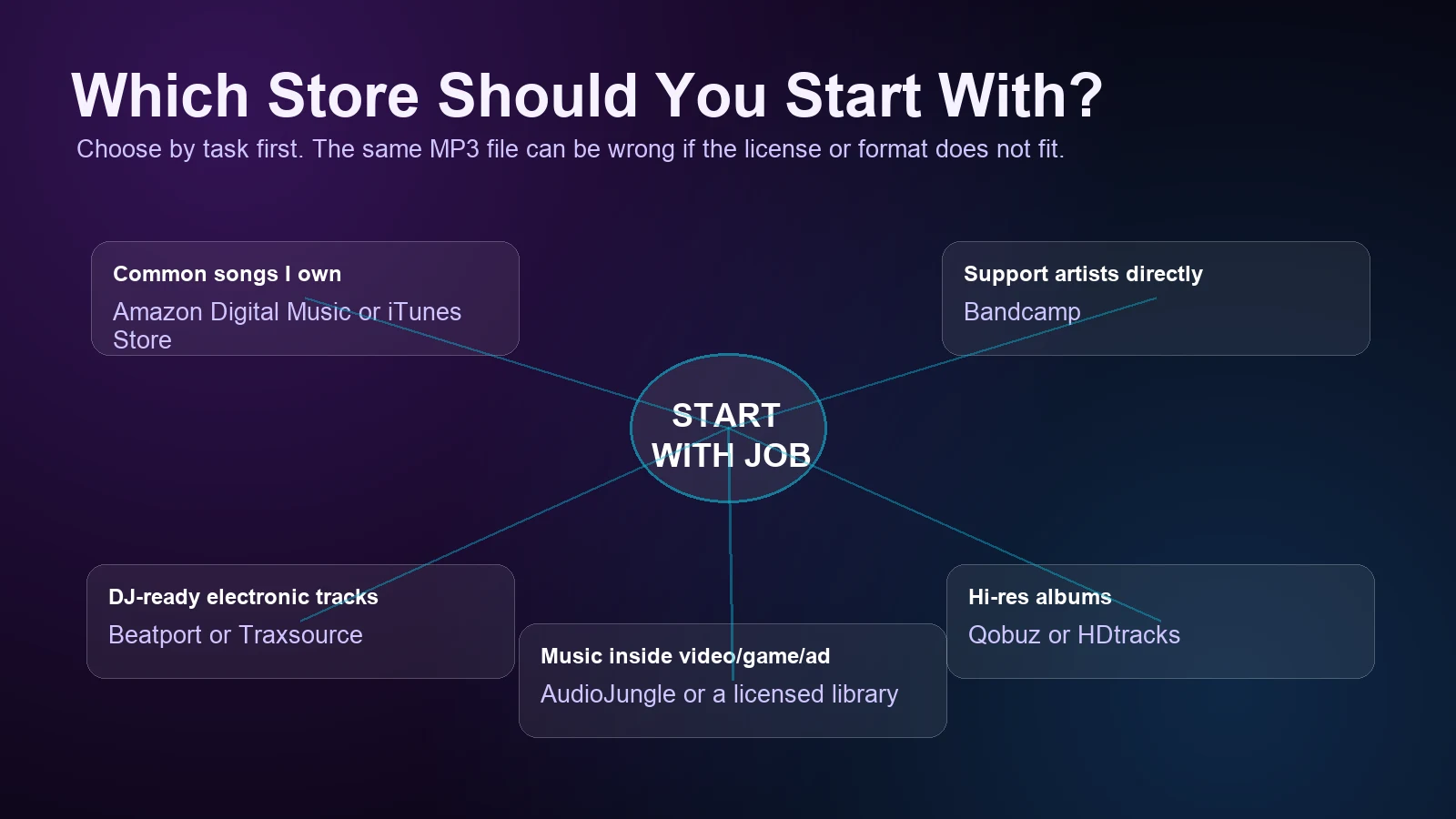
Quick comparison table
| Store or source | Best for | Common format angle | Main strength | Main caution |
|---|---|---|---|---|
| Amazon Digital Music | Mainstream song and album purchases | MP3-first store experience | Broad catalog and simple purchasing | Catalog and purchase options vary by region |
| iTunes Store / Apple Music app | Apple ecosystem purchases | Purchased music through Apple apps | Familiar for iPhone, Mac, and Windows users | Not every Apple Music stream is a purchased download |
| Bandcamp | Supporting independent artists | Artist-controlled downloads | Strong artist-direct culture | Availability and formats depend on the release |
| Beatport | DJs and electronic music | DJ-oriented digital tracks | Strong electronic catalog and charts | Not the best first stop for general pop listeners |
| Traxsource | House, dance, and underground selectors | MP3, WAV, and AIFF positioning | Focused dance-music discovery | Genre focus is narrower than mainstream stores |
| Qobuz download store | Hi-res music ownership | FLAC and hi-res downloads | Better when fidelity matters | Not an MP3-first store |
| HDtracks | Audiophile downloads | High-resolution downloads | Master-quality positioning | Larger files and higher-fidelity focus may be overkill |
| AudioJungle | Licensed music for media projects | Royalty-free music licensing | Built for video, games, podcasts, and ads | It is production music, not a retail song store |
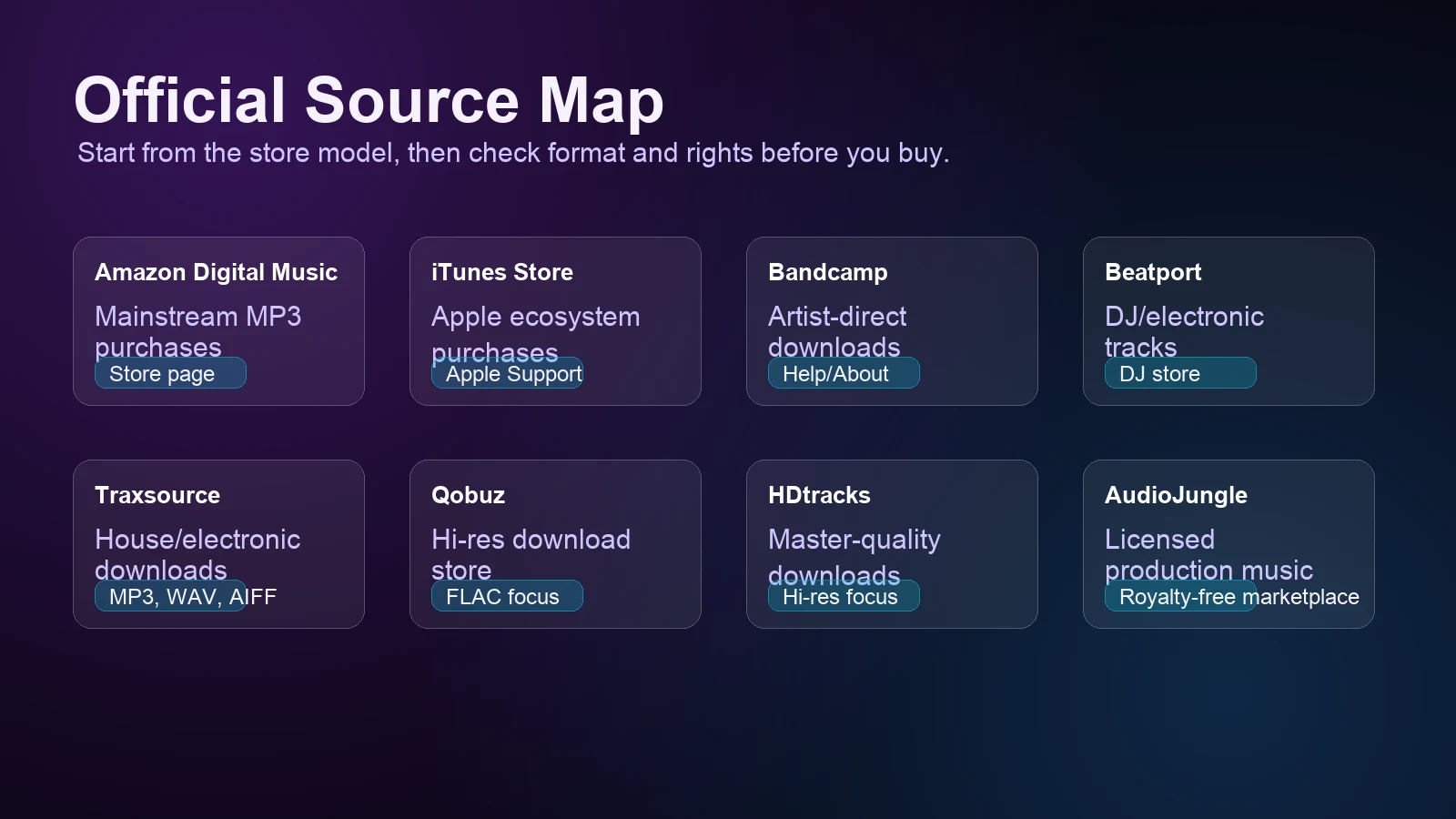
Start with rights before format
MP3 is only a file format. It does not tell you whether you can use the music in a YouTube video, DJ mix, school project, paid ad, or client deliverable. The store and license decide that part.
For personal listening, a normal retail purchase may be enough. For a remix, public performance, livestream, commercial video, or game soundtrack, the rules change. You may need a DJ store, a direct artist license, a stock-music license, or a separate permission path.
This is the same habit musicians should use when finding scores, samples, and reference material. The free sheet music online guide uses the same source-first logic: the fastest download is not always the safest source.
Best for mainstream MP3 purchases: Amazon Digital Music
Amazon Digital Music is the practical first stop when the task is simple: buy a common song or album as a digital music file. The official store page still presents itself as a Digital Music store, with genre browsing and MP3 purchase paths.
Use it when you want a straightforward owned file for personal listening, library building, or a non-production reference track. It is not the right source if you need synchronization rights, remix permission, or music for a commercial project.
Best-fit reader: a listener who wants familiar catalog access and does not need a special license.
Best for Apple users: iTunes Store purchases
Apple's official support page explains how to buy music from the iTunes Store through the Apple Music app or iTunes for Windows. That makes this route useful if your music library already lives on iPhone, Mac, iPad, or Windows iTunes.
The important distinction is purchase versus streaming. An Apple Music subscription gives access to streams. Buying from the iTunes Store is the ownership-style path. If you need a file you can redownload as a purchase, follow the store flow rather than assuming every streamed song behaves like a bought track.
Best-fit reader: someone already inside the Apple ecosystem who wants purchased music to sit beside an existing library.
Best for supporting independent artists: Bandcamp
Bandcamp is the store I would check when the goal is artist support and independent releases. It is especially useful for niche scenes, small labels, experimental music, live releases, and artists who sell directly to fans.
The advantage is the relationship. You are not only buying a file; you may be supporting the artist or label more directly than on a generic retail platform. The tradeoff is consistency. Formats, price, bonus items, and availability depend on how the artist set up the release.
Best-fit reader: listeners who want to own music and support artists directly, especially outside the most mainstream catalog.
Best for DJ-focused electronic tracks: Beatport
Beatport is a better fit when the search is really about DJ and electronic music discovery. Its official page positions Beatport around DJ and electronic dance music, tracks, mixes, charts, and new releases.
Use it when genre, chart, label, and DJ workflow matter more than a general retail catalog. It is also the place to compare whether MP3 is enough or whether you need a higher-quality file for a set, edit, or library.
Best-fit reader: DJs, electronic producers, and selectors who want a catalog organized around dance-music use.
Best for house and underground dance music: Traxsource
Traxsource is more specialized. Its public page positions the catalog around real house and electronic music downloads, including MP3, WAV, and AIFF.
That makes it useful when you already know the style lane. If you are shopping for house, soulful, Afro, garage, disco, or other club-oriented releases, a specialist store can save time compared with broad search.
Best-fit reader: DJs and collectors who want house and underground electronic music with format choices beyond a casual stream.
Best when MP3 is not enough: Qobuz
Qobuz is worth knowing because sometimes the honest answer to "where can I buy MP3 music online?" is "you may want lossless instead." Its official download-store positioning focuses on 24-bit hi-res music and FLAC quality.
Choose Qobuz when ownership and fidelity matter more than file size. For casual phone listening, MP3 may be fine. For a hi-fi library, archival listening, or careful reference work, FLAC and other lossless formats may be the better purchase.
Best-fit reader: listeners and collectors who want owned downloads with higher fidelity than MP3.
Best for high-resolution music collectors: HDtracks
HDtracks is another hi-res download option. Its public positioning is about high-resolution music downloads and master studio quality, which puts it closer to collectors and audiophile listeners than to quick MP3 shopping.
This is not where I would start if you only need a small MP3 for everyday playback. It is where I would compare albums when the recording quality itself is part of the reason you are buying.
Best-fit reader: collectors who care about album fidelity and are willing to handle larger files.
Best for licensed production music: AudioJungle
AudioJungle solves a different problem. It is not mainly a store for chart songs or personal listening. It is a marketplace for royalty-free music tracks created for projects.
Use it when music will live inside something else: a video, intro, explainer, podcast, game, ad, or client deliverable. In that case, the license is the product. A normal retail MP3 purchase is usually not enough for that job.
Best-fit reader: creators and teams who need licensed music for media, not just a song to keep in a personal library.
Check format and license before you buy
The easiest mistake is treating every digital music purchase as interchangeable. It is not.
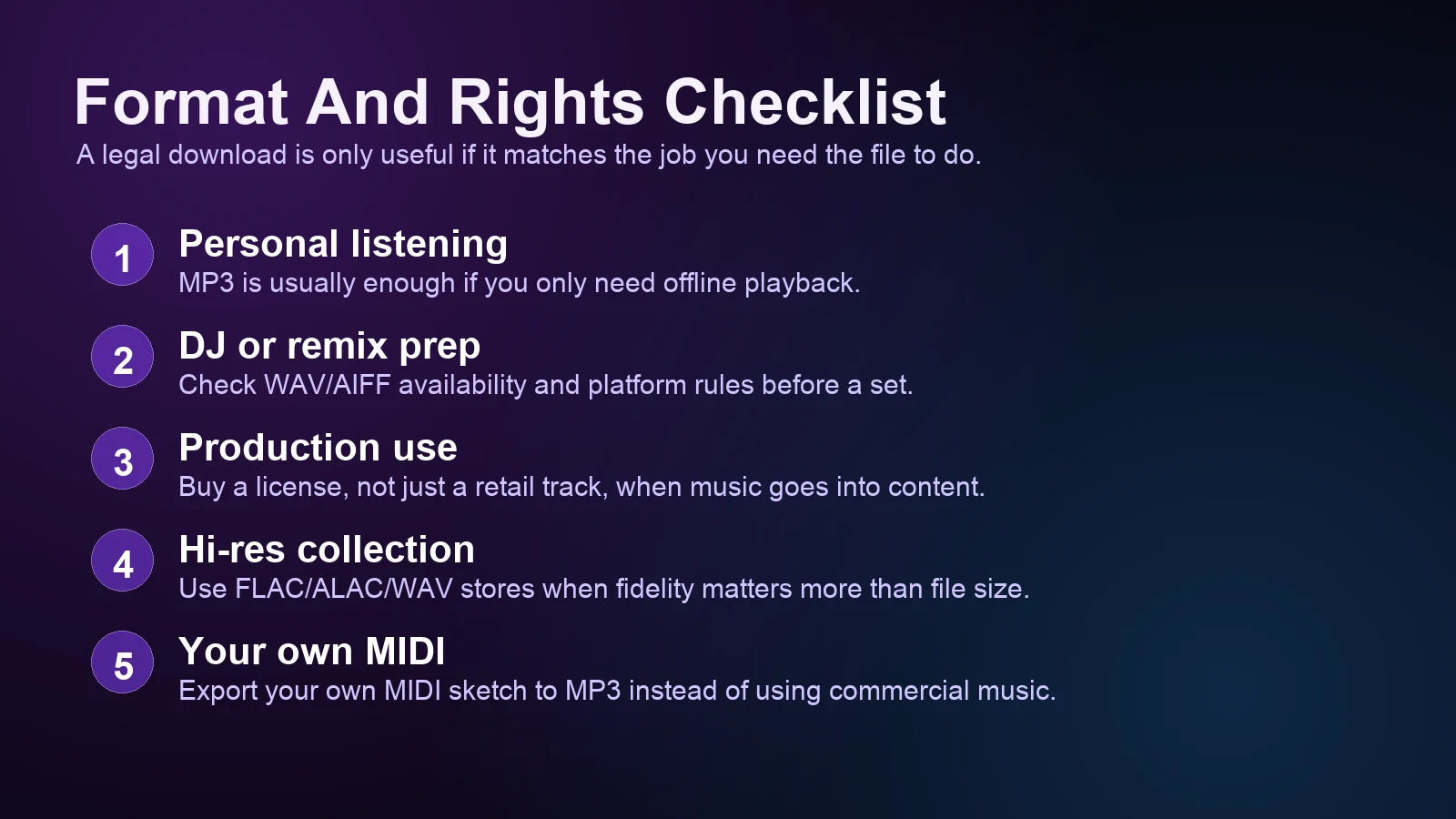
Use this quick check before checkout:
| Question | Why it matters | Better source if the answer is yes |
|---|---|---|
| Is this only for personal listening? | A retail MP3 or purchased track may be enough. | Amazon Digital Music, iTunes Store, Bandcamp |
| Will I DJ or remix with it? | You may want WAV/AIFF and clearer platform rules. | Beatport, Traxsource, artist stores |
| Will it appear in a video, game, ad, or podcast? | You need license terms, not just a sound file. | AudioJungle or another licensed music library |
| Do I care about hi-res fidelity? | MP3 may be the wrong format. | Qobuz, HDtracks |
| Is the music my own MIDI or arrangement? | You can export your own audio instead of buying a track. | Melogen MIDI to MP3 |
If you are comparing audio files against editable music data, read MIDI vs MusicXML as the useful boundary: MP3 is finished audio, while MIDI and MusicXML are editing-friendly music data.
Where Melogen fits
Melogen is not a music store. It should not be used to copy, rip, or bypass a streaming catalog. It fits a different case: you already own or created the music material, and you need to turn it into a practical file for review, sharing, or cleanup.
Use the MIDI to MP3 converter when you have your own MIDI sketch and want an audio preview. Use Sheet2MIDI or related score workflows when the source is visible notation and you need editable output before a DAW or notation pass. For audio-first transcription choices, the best AI music transcription tools roundup compares the cleaner routes.
Export your own MIDI sketch to MP3
Use Melogen when the source is your own MIDI or score workflow and you need a clean audio preview before sharing or editing further.
FAQs
Can I still buy MP3 music online?
Yes. Amazon Digital Music, iTunes Store purchase flows, Bandcamp releases, DJ stores, and some artist stores still support owned digital music purchases. The exact catalog, region, and format options vary by store.
Is buying an MP3 the same as licensing music for a video?
No. A retail music purchase is usually for personal listening. If the music appears in a video, ad, podcast, game, or client project, use a licensed music source and read the terms before publishing.
Which store is best for DJs?
Beatport and Traxsource are better starting points for electronic and DJ-oriented music because their catalogs, charts, genres, and formats are organized around selector workflows.
Should I buy MP3 or FLAC?
Buy MP3 when file size and compatibility matter most. Buy FLAC, WAV, AIFF, or another lossless format when fidelity, archiving, or DJ/audio workflow matters more than small files.
The practical takeaway
Buy MP3 music online from the store that matches the job. Use Amazon Digital Music or iTunes Store for mainstream purchases, Bandcamp for artist-direct support, Beatport or Traxsource for DJ-focused tracks, Qobuz or HDtracks when hi-res ownership matters, and AudioJungle when the music needs a production license.
The clean rule: buy songs for listening, license music for projects, and export your own MIDI when the music is yours to render.
About the author
Zhang Guo
Composer - AI Product Manager
AI product manager and digital marketing consultant with a background in music. Creativity is the bridge between rhythm and logic, where musical intuition and mathematical precision can coexist in every meaningful product decision.
Follow on X