Worship Music Meaning, Styles, and Practice Guide
Learn worship music meaning, styles, gospel and hymn differences, plus practical chart, arrangement, rehearsal, and Melogen score workflows.
 Zhang Guo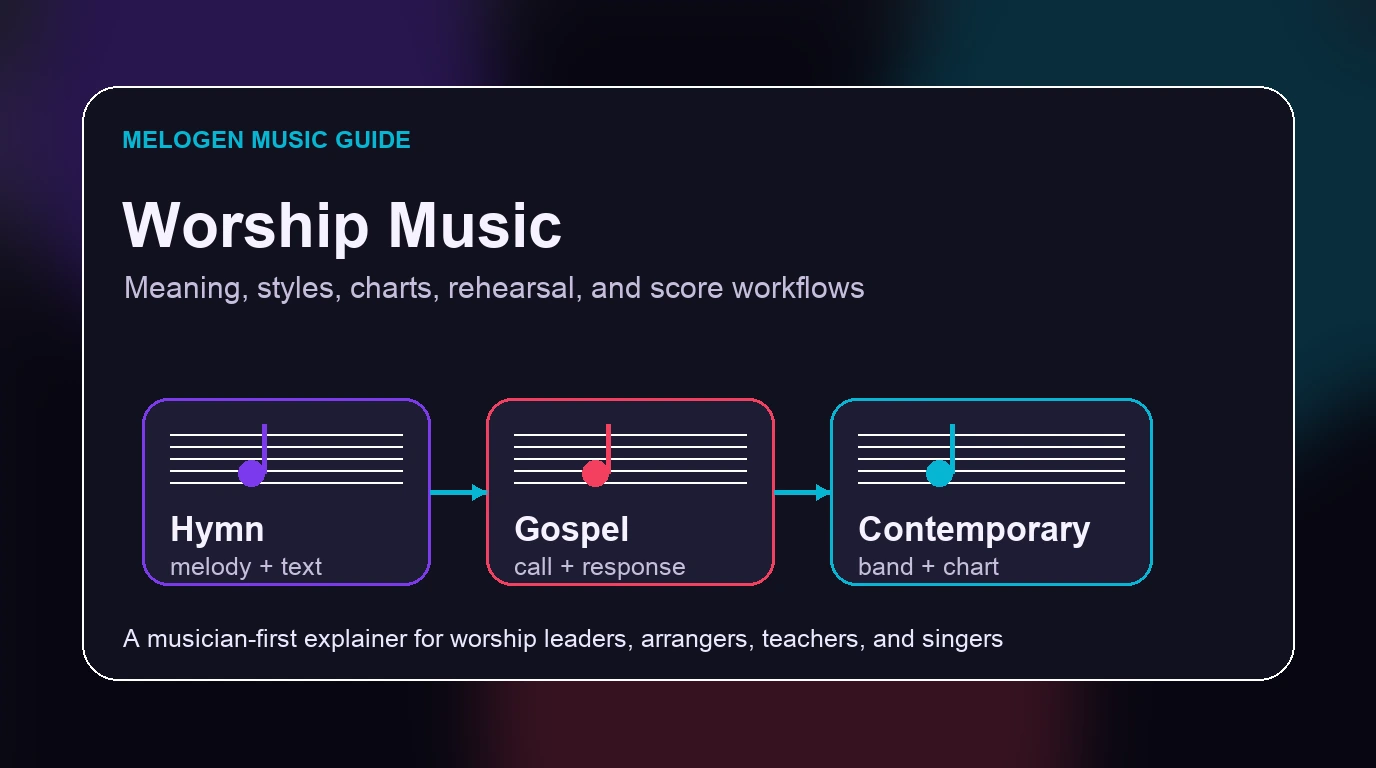
Turn a static score into editable MIDI
Contents
Worship music is music written or chosen to support communal worship. In Christian settings, that can mean hymns, gospel songs, psalms, chant, contemporary praise songs, choir anthems, piano-vocal charts, or band-led arrangements. The sound changes by tradition, but the musical job is usually the same: help a group sing, pray, remember text, and move through a service with clarity.
For musicians, the useful question is not only "Is this old or modern?" It is "What does this song need from the people playing and singing it?" A hymn needs clear melody and text. A gospel song may need call-and-response energy, choir blend, and rhythmic feel. A contemporary worship chart may need repeatable form, playable keys, and band cues that do not bury the congregation.
Worship music in plain language
The broadest definition is simple: worship music is sacred or devotional music used in worship. It can be performed by a congregation, choir, worship band, cantor, organist, pianist, or small ensemble. Some traditions emphasize written liturgy and choir repertoire. Others emphasize congregational singing with chord charts and band arrangements.
That is why a worship song can look very different on the page. One church may sing from a hymnbook. Another may project lyrics while a band plays from chord charts. A choir may rehearse from SATB notation. A pianist may use a lead sheet. The same musical category can move between full notation, lyrics and chords, audio references, and rehearsal files.
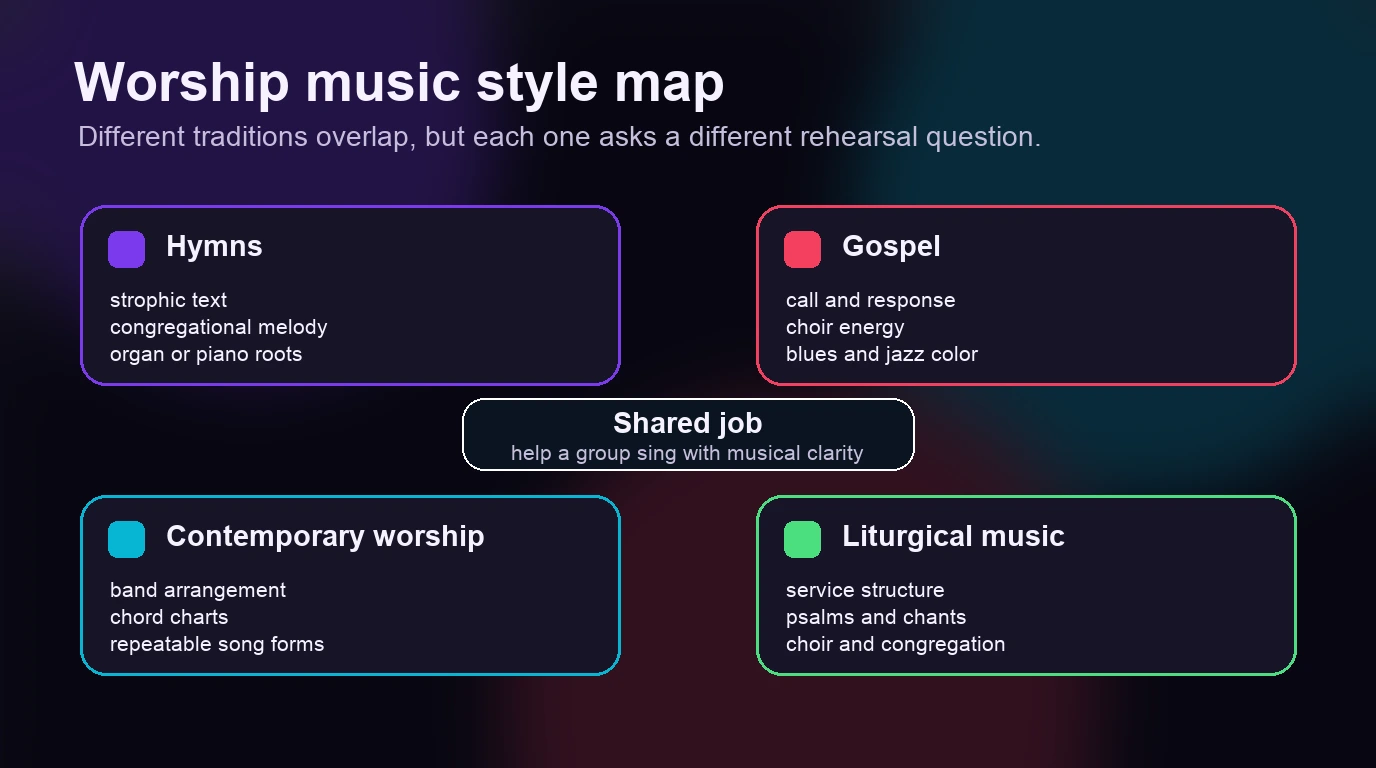
The term also overlaps with related labels. "Sacred music" is broader and can include concert works, liturgical repertoire, masses, motets, and spirituals. "Gospel music" has its own history and sound world; Britannica's gospel music overview and the Library of Congress page on African American Gospel are useful public starting points. The Library of Congress also has a separate resource on African American spirituals, which helps explain why gospel and spiritual traditions should not be flattened into one generic "church music" label.
Main worship music styles and how they differ
The styles below overlap in real services, but separating them helps arrangers and worship leaders choose the right source material.
| Style | Typical source | Musical center | Practical rehearsal question |
|---|---|---|---|
| Hymn | hymnbook, lead sheet, SATB setting | strong melody, strophic text, functional harmony | Can everyone sing the melody and text clearly? |
| Gospel | choir score, piano-vocal chart, rhythm section chart | call and response, choir energy, expressive rhythm | Does the arrangement keep the groove, response, and choir blend alive? |
| Contemporary worship | chord chart, lyrics, band arrangement, multitrack reference | repeated song forms, pads, guitars, drums, congregational hooks | Is the key, tempo, and form playable for the room? |
| Liturgical music | service book, chant, psalm setting, choir anthem | ritual function, text placement, response patterns | Does the music support the order of the service? |
| Choir anthem | SATB score or piano-vocal score | written voice parts, text painting, ensemble balance | Do singers know entrances, vowels, and harmonic cues? |
The useful distinction is workflow. A hymn may only need a confident melody line and a key that fits the room. A gospel arrangement may need stronger rhythmic leadership and choir rehearsal. A contemporary worship song may need a band chart, section map, and a clear ending. A liturgical setting may need exact text placement and service timing.
If the song is choir-led, the Melogen guide on how to learn a choir part is a better next step than a generic style definition. If the song is chart-led, the guide to lead sheets for piano explains how melody, chords, and form cues become a playable arrangement.
Read the page before choosing the technology
Worship musicians often jump straight to tools: chord chart app, notation software, rehearsal track, multitrack stem, MIDI playback, MusicXML export, or projector system. The better first step is to identify what kind of musical page you actually have.
Start with these questions:
- Is the source only lyrics and chords, or does it include notation?
- Does the group need to sing melody, harmony, or both?
- Is the form fixed, or will the leader repeat sections live?
- Is the key comfortable for the congregation, not just the lead vocalist?
- Does the arrangement need choir entrances, band cues, or a piano reduction?
- Are the chart, lyrics, and projection handled under the right license for your setting?
Licensing is not a side detail. Worship teams often copy lyrics, project slides, share charts, record services, or stream music. Melogen is not a licensing tool, so treat rights as a separate church or organization policy question. CCLI's public Church Copyright Licence fact sheet is one example of how worship copying and projection can be handled, but your exact situation may need local guidance.
Turn charts and scores into rehearsal material
Once the source is clear, choose the output that solves the rehearsal problem. A worship leader preparing a Sunday set, a choir director preparing an anthem, and a pianist checking a hymn arrangement do not need the same file.
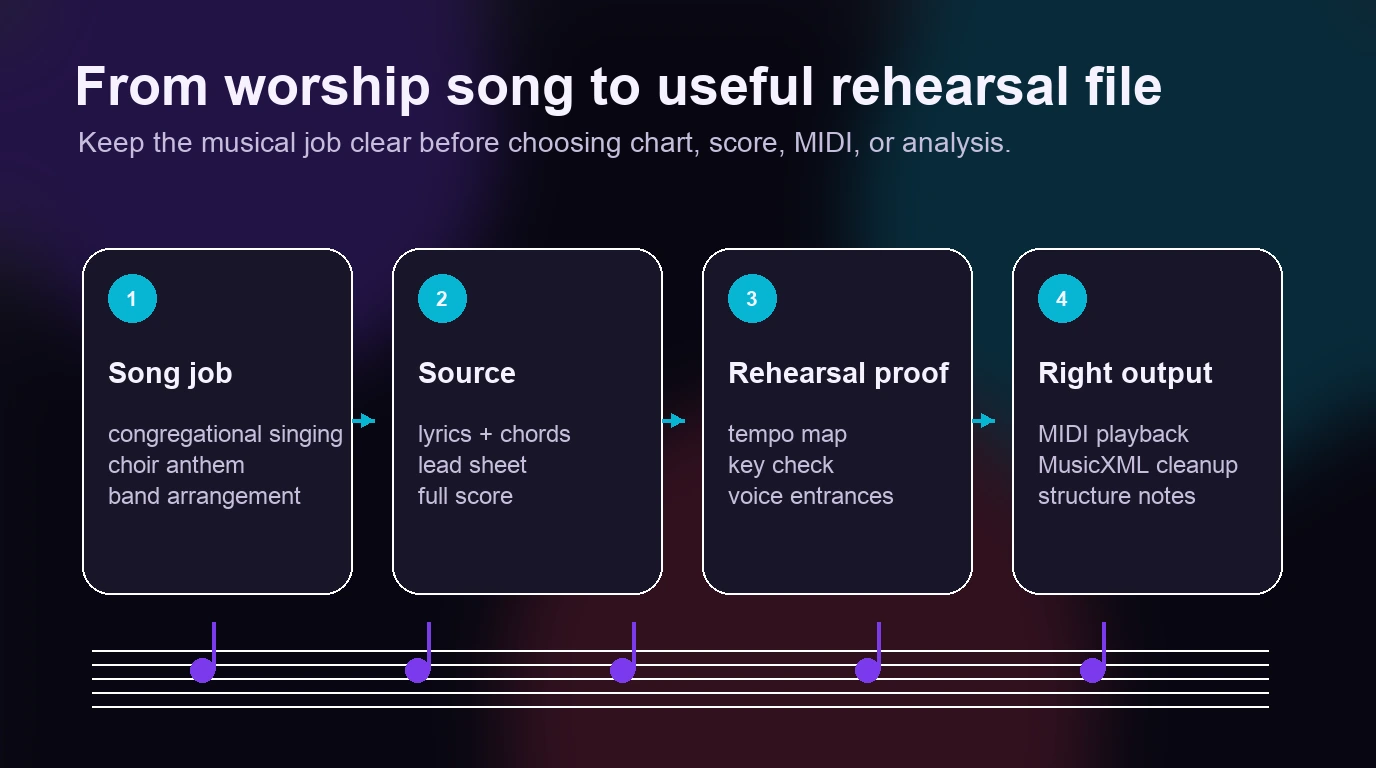
Use this workflow before you spend time polishing:
| If your source is... | Best first output | Why it helps |
|---|---|---|
| lyrics and chords | section map plus key check | the band needs form, tempo, and entry cues |
| lead sheet | slow playback or harmonic sketch | melody and chords can be tested before arranging |
| SATB choir score | part practice file or marked score | singers need entrances, text rhythm, and blend cues |
| piano-vocal score | rehearsal piano reduction plus form notes | the accompanist needs playable support, not every detail |
| full notated score | MIDI or MusicXML first pass | playback and notation cleanup become easier |
This is where a browser workflow can help, but only if the source contains visible notation. Melogen Sheet2MIDI supports JPG, PNG, and PDF sheet music inputs and can produce MIDI or MusicXML output from readable notation. That is useful for a hymn page, choir score, or piano-vocal excerpt when the next job is hearing the piece, checking a part, or moving into notation cleanup.
If the source is only lyrics and chord symbols, do not pretend conversion will invent the final arrangement. Use the chart to make musical decisions first: key, tempo, form, voicing, and who carries the melody.
Arrange worship music without losing the congregation
The most common worship arrangement problem is overbuilding. A chart may look simple, but the service needs clarity more than density. Before adding pads, counter-melodies, vocal harmonies, percussion loops, or a bigger bridge, ask whether the room can still sing.
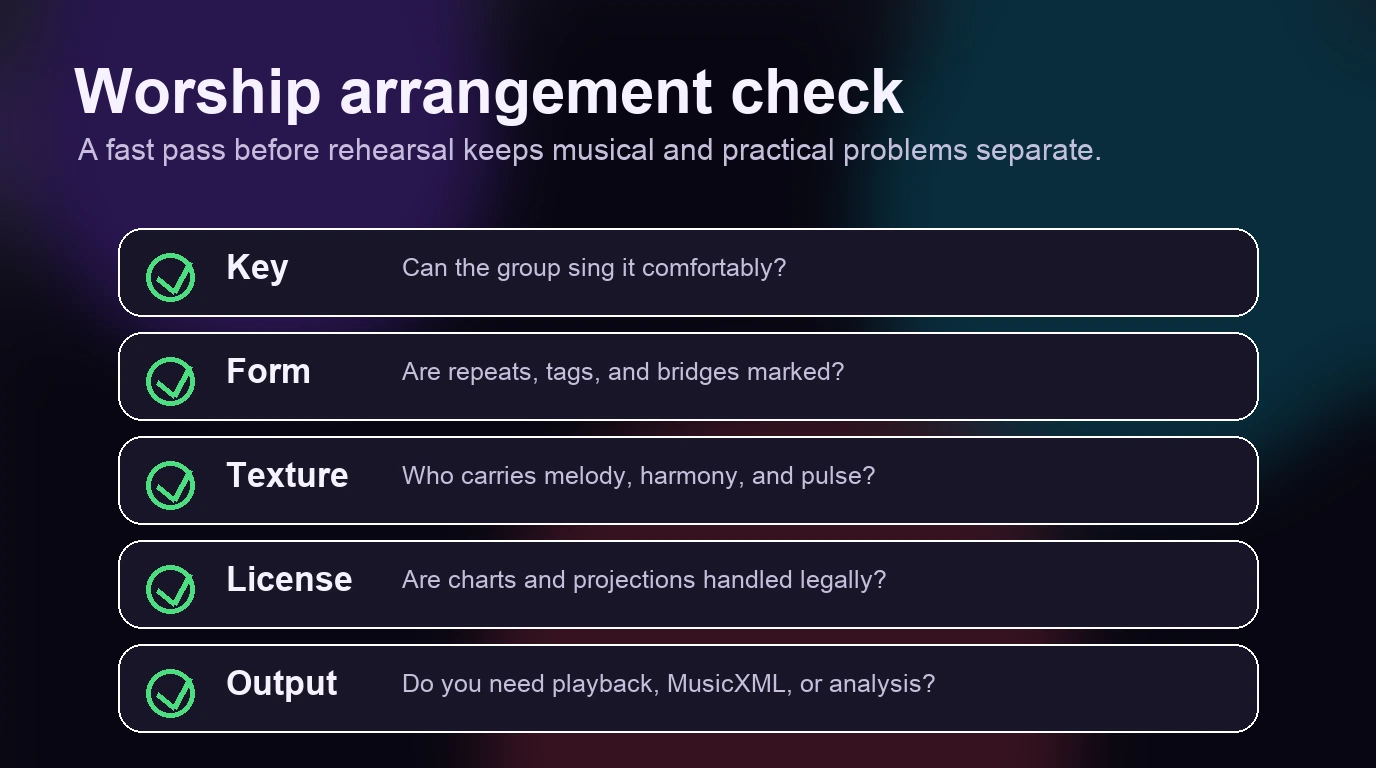
A simple arrangement check works well:
| Layer | Question to ask | Common fix |
|---|---|---|
| Key | Can ordinary voices sing the highest and lowest notes? | transpose before rehearsal, not during it |
| Form | Are repeats, tags, bridge, and ending clear? | write a one-page form map |
| Texture | Who carries melody, harmony, bass, and pulse? | remove parts that compete with the vocal line |
| Rhythm | Does the groove help the text speak? | simplify the pattern under dense lyrics |
| Choir or backing vocals | Are entrances and vowel shapes marked? | rehearse cues before full runs |
| Output | Do we need playback, MusicXML, or analysis? | choose the file type by the next task |
For contemporary worship, a repeated four-chord loop can still fail if the form is unclear. For a hymn, the harmony may be straightforward but the text can suffer if the tempo is too slow or the key sits too high. For gospel, the written page may not fully capture feel, response, and energy. In every case, the arrangement should serve participation before it serves display.
Where Melogen fits
Melogen fits when worship music starts from visible notation and the team needs a faster way to inspect, hear, or move the score into another workflow. Use Sheet2MIDI when a hymn, choir score, or piano-vocal page needs a first-pass MIDI or MusicXML output. Use Structural Analysis when the source is a score and the next question is form, harmony, key, cadence, or section layout.
The boundary matters. Melogen does not choose the theology of a song, decide a service order, clear licensing, or replace rehearsal leadership. It helps with the musical material after the source is clear enough to read.
A practical workflow looks like this:
- Pick a short section of a readable score.
- Convert or analyze that section first.
- Check the result against the original page.
- Mark key, form, entrances, and problem bars.
- Use the output as rehearsal support, not as the final authority.
If the larger question is how a worship song is organized over time, the guide to musical structure analysis gives a broader framework for section mapping, phrase shape, cadence, and arrangement energy.
Turn a readable worship score into rehearsal support
Use Melogen Sheet2MIDI for first-pass MIDI or MusicXML from clear notation, then use Structural Analysis when you need form, harmony, and section clues.
The practical takeaway
Worship music is best understood by its job, not by one fixed sound. Hymns, gospel songs, contemporary worship, choir anthems, chants, and liturgical music can all belong in the category, but each one asks different musical questions.
Before rehearsal, identify the source, the singers, the form, the key, and the output you actually need. If the source is notation, a MIDI, MusicXML, or structure-analysis pass can save time. If the source is only lyrics and chords, focus first on key, form, rhythm, and participation.
The strongest worship arrangement is usually not the most complicated one. It is the one the group can sing clearly, rehearse honestly, and carry into the service without the technology getting in the way.
FAQs
Is worship music the same as gospel music?
No. Gospel music can be worship music, but gospel is also a distinct tradition with its own history, vocal style, rhythmic language, and cultural roots. Worship music is the broader functional category.
Is contemporary worship music just Christian pop?
Sometimes it uses pop instrumentation, but the job is different. A contemporary worship song is usually built for communal singing, repeated forms, service flow, and congregational participation, not only for radio listening.
Do worship teams need sheet music?
Not always. Some teams work from lyrics and chords. Choirs, pianists, organists, arrangers, and classically trained players often need notation because it shows melody, harmony, entrances, and voice leading more precisely.
Can Melogen convert worship music into MIDI?
Melogen can help when the worship music exists as readable sheet music, such as a PDF, image, scan, hymn page, or choir score. It is not meant to convert protected recordings or replace licensing and rehearsal judgment.
About the author
Zhang Guo
Composer - AI Product Manager
AI product manager and digital marketing consultant with a background in music. Creativity is the bridge between rhythm and logic, where musical intuition and mathematical precision can coexist in every meaningful product decision.
Follow on X