How to Learn a Choir Part: SATB Practice Loop
Learn how to learn a choir part from SATB sheet music with mapping, slow playback, line isolation, rehearsal checks, and a Melogen practice loop.
 Zhang Guo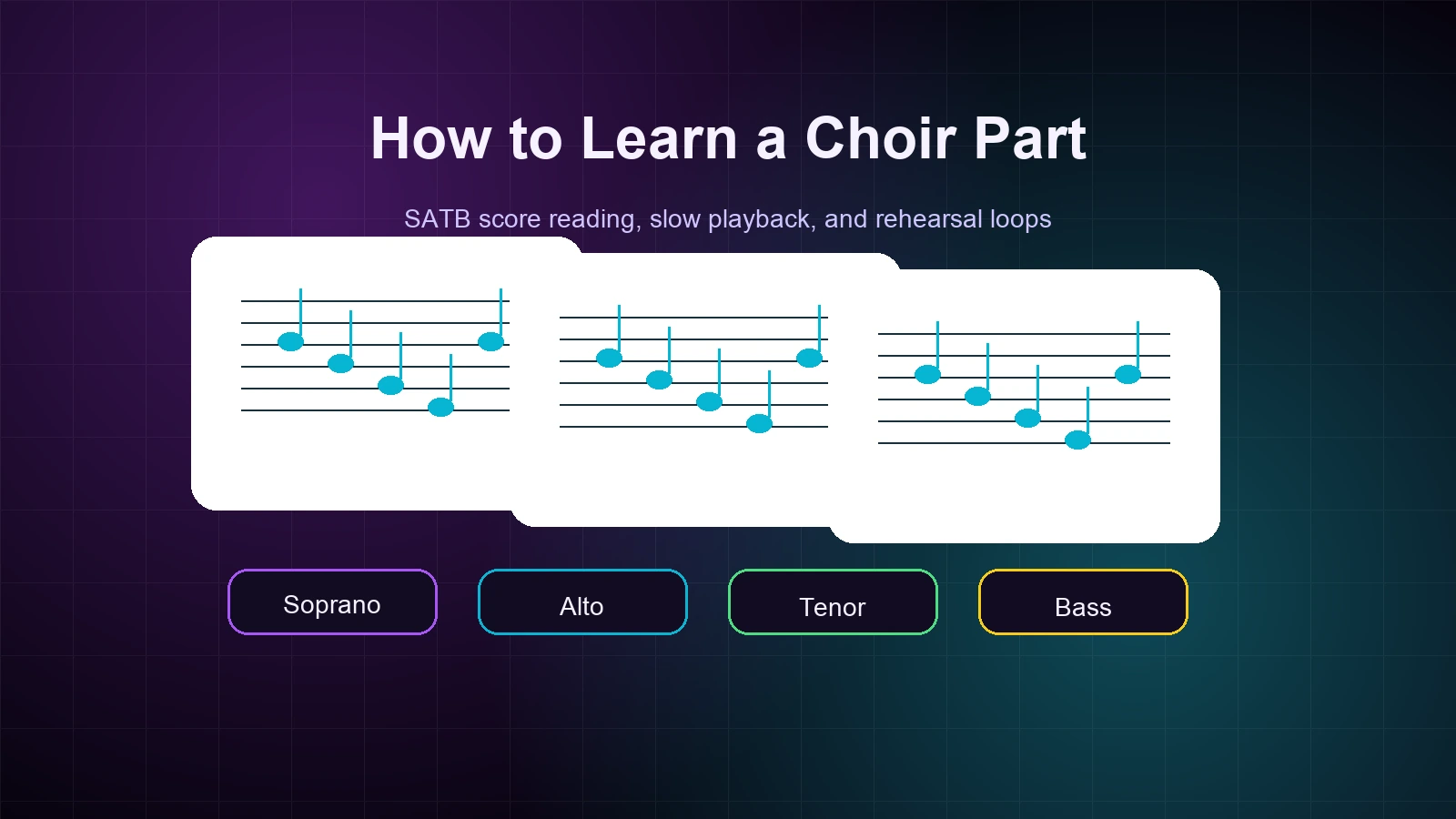
Turn a static score into editable MIDI
Contents
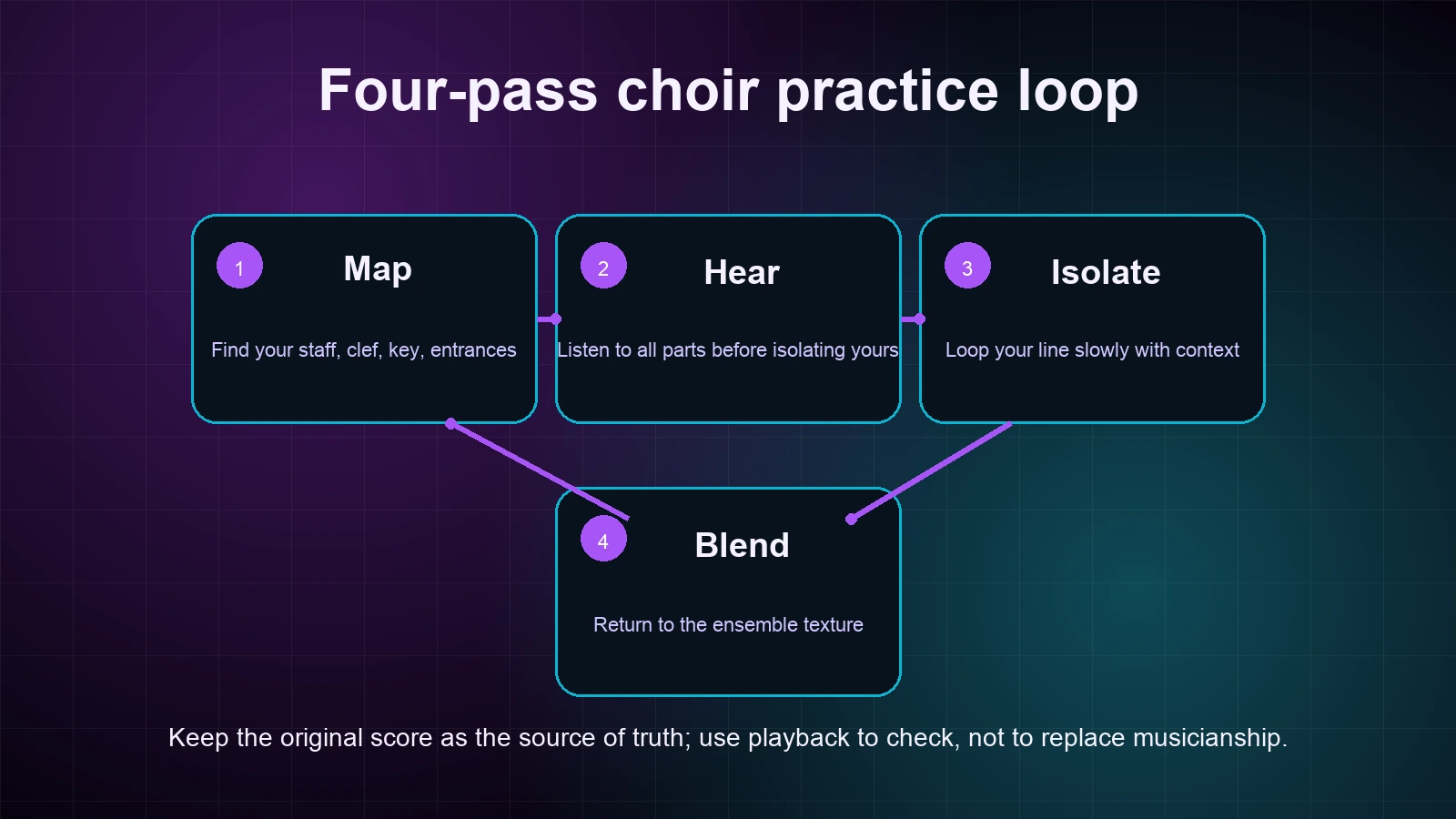
If you are figuring out how to learn a choir part, do not start by singing the whole piece from top to bottom. Start by finding your staff, hearing the full texture, isolating your line slowly, and then putting your part back into the ensemble sound. Choir practice works best when you treat your part as one line inside a shared score, not as a solo melody floating on its own.
This guide gives you a repeatable SATB practice loop for soprano, alto, tenor, bass, and divided choir parts. It also shows where slow playback, MIDI, and Melogen Sheet2MIDI can help when you have a clear PDF, scan, or photo of the choral score.
Start by mapping the score before singing
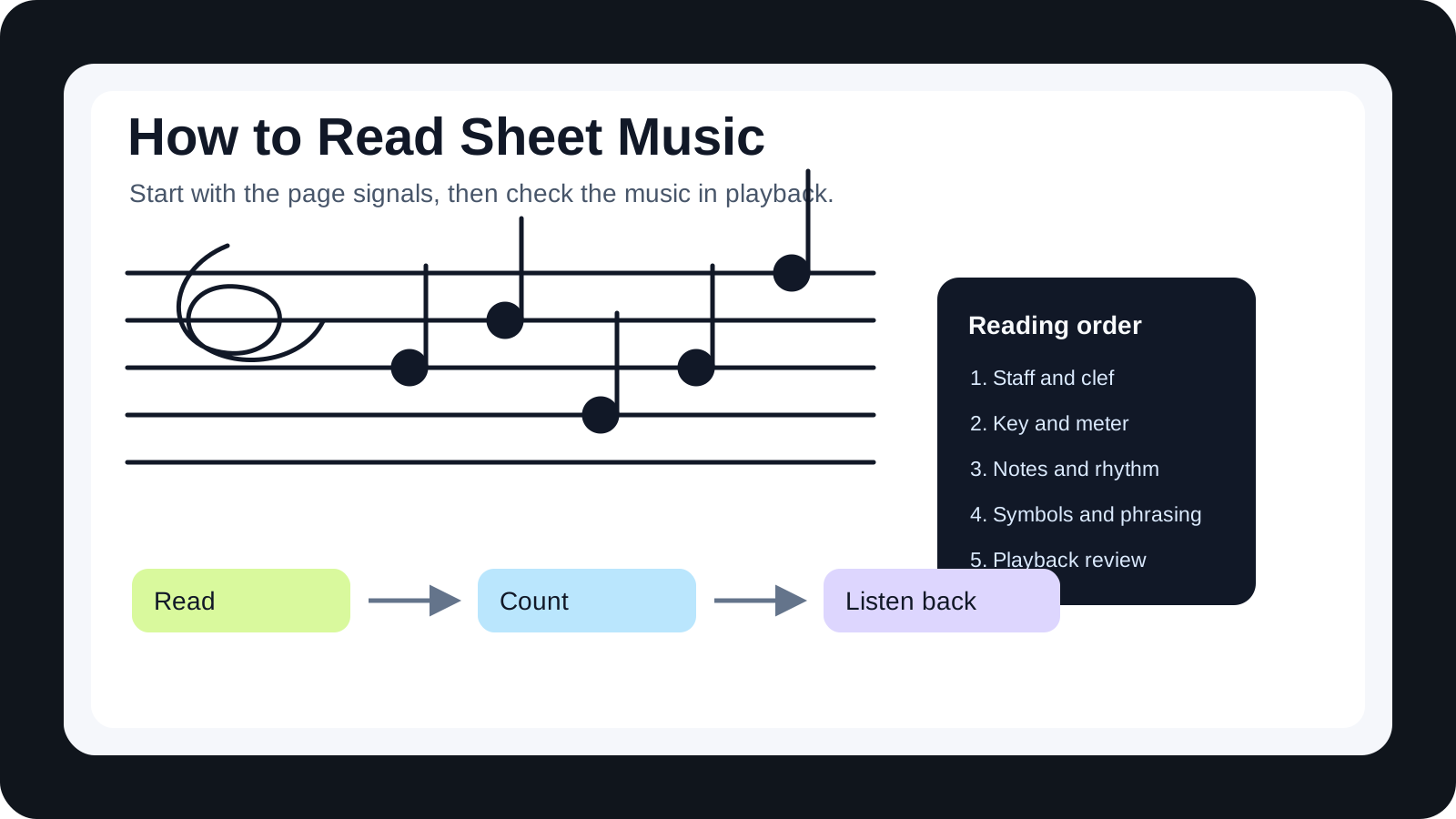
A choir score usually asks you to read several layers at once: staff position, clef, key signature, rhythm, lyrics, breathing, and the other voices around you. Before you sing, spend a few minutes mapping the page.
Find your vocal line first. In many SATB scores, soprano and alto are grouped on the upper staff, while tenor and bass sit on the lower staff. Sometimes each part has its own staff. Sometimes tenor is written in treble clef but sounds an octave lower. Do not assume the layout; confirm it on the first system.
Use this quick setup table before you rehearse:
| Checkpoint | What to confirm | Why it matters |
|---|---|---|
| Voice label | Soprano, alto, tenor, bass, or a divided part | You need the right line before pitch practice matters |
| Clef and octave | Treble, bass, or tenor-style notation | Tenor notation can confuse singers who read by pitch shape alone |
| Key signature | Sharps or flats used through the piece | Wrong key reading causes avoidable pitch errors |
| Entrances | Bars where your voice begins after rests | Most choir mistakes happen at entrances, not long held notes |
| Text underlay | Which syllable belongs to which note | Rhythm and diction are tied together |
If the score-reading basics are still shaky, pause and review how to read sheet music before you try to learn the whole choral line.
Hear the full choir texture first
It is tempting to solo your part immediately, but choir music is built from relationships. Your note may only make sense because the soprano has the third, the bass has the root, or the alto is holding a suspension against another voice. Listen to the full texture first so your ear knows where your line belongs.
The first listening pass should answer four questions:
- Where does my part enter?
- Which other voice gives me my starting pitch?
- Where does my line move with another part?
- Where does my line move against the harmony?
Do not worry about perfection yet. Follow the score, mark confusing entrances, and circle any bar where your part is silent for a long time before entering. These are the places that need deliberate practice later.
Isolate your line without losing the pulse
Once you know where your line sits, isolate it. Sing or hum below tempo. If text is getting in the way, practice the rhythm on a neutral syllable first, then speak the text in rhythm, then sing the line with the real vowels and consonants.
Here is the useful order:
- Hum the line slowly with a steady beat.
- Speak the text in rhythm without pitch.
- Sing the pitch pattern on one vowel.
- Add the text back only after pitch and rhythm are stable.
- Repeat the same phrase while listening for the surrounding voices.
This is especially important for inner voices. Alto and tenor lines often carry passing tones, suspensions, or harmonic glue rather than the obvious tune. If you only listen for melody, you may miss why your line feels strange. Learn the contour, then learn the role.
Fix entrances before long phrases
A choir part often fails at the first note after a rest. You know the phrase once you are inside it, but you miss the entrance because you did not hear the setup.
For every difficult entrance, practice the bar before it. Count the rest as actively as the sung notes. If another voice has your cue, mark it. If the accompaniment gives the pitch, sing your first note against that harmony. If there is no obvious cue, use the last chord before your entrance as the reference point.
Use this entrance checklist:
| If the problem is | Practice this | Keep checking |
|---|---|---|
| Late entrance | Count the rest out loud | The exact beat where you breathe |
| Wrong first pitch | Sing the previous chord tone first | Which voice gives your cue |
| Rushed text | Speak only the consonants in rhythm | Whether diction is forcing the tempo |
| Lost after a page turn | Mark the first word and interval | The note before and after the turn |
| Inner part feels unstable | Sing against soprano or bass | Whether you are hearing the harmony |
For rhythm-heavy passages, the same method from how to play tricky rhythms applies: count the smallest pulse, clap the attacks, then add pitch.
Turn a clean score into a practice reference
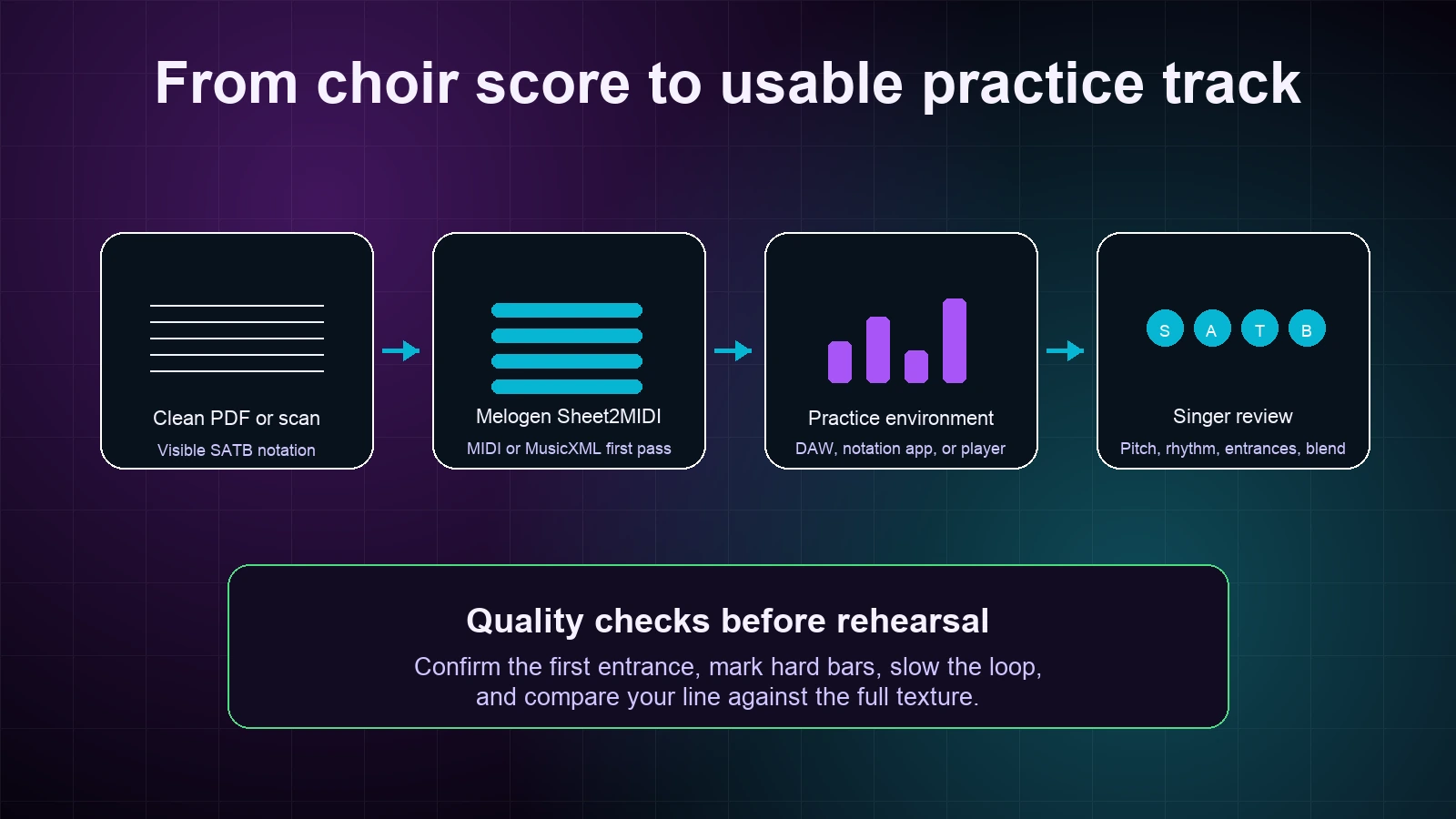
If you have a readable PDF, scan, or photo of the choral score, playback can help you check the line more quickly. Melogen Sheet2MIDI supports PDF, PNG, and JPG sheet music inputs and can produce MIDI or MusicXML output from visible notation. That makes it useful when you need a first-pass practice reference from a printed score.

Use the conversion as a rehearsal aid, not as the final authority. A choir score may have divisi, lyrics, piano reductions, cue notes, tempo changes, and dense voice leading. You still need to check the original score after conversion.
The practical workflow is:
- Use the cleanest score source you have.
- Convert a short section first, not the whole piece.
- Listen for obvious pitch or rhythm mismatches.
- Export or open the MIDI/MusicXML in a practice or notation environment.
- Loop only the hard bars.
- Return to the printed score and mark the musical decisions.
If your main task is the conversion itself, the dedicated guide on how to convert sheet music to MIDI goes deeper into source quality and cleanup.
Blend your part back into the ensemble
The last step is not singing your line alone. The last step is blending it back into the choir texture.
After your part is secure, practice in three wider circles:
- Your line alone, slowly and accurately.
- Your line against one anchor voice, often soprano or bass.
- Your line inside the full SATB texture.
Listen for tuning, vowel shape, consonant timing, and whether your line should lead or support the phrase. In choir music, being correct is only the first layer. The better question is: does your part help the chord, the text, and the phrase speak clearly?
Where Melogen fits
Melogen fits when your choir practice starts from visible notation and you need a browser-first way to hear and inspect it. Use Sheet2MIDI for a clean PDF, scan, or photo of the score, then use the MIDI or MusicXML output as a slow practice reference.
It will not replace the work of singing, listening, and blending. It helps most when you need to hear a difficult entrance, loop a short passage, or move a score into a DAW or notation app for rehearsal prep.
Create a playback reference from your choir score
Use Melogen Sheet2MIDI to turn a clear SATB score into MIDI or MusicXML, then loop the exact bars your part needs.
The practical takeaway
To learn a choir part, follow a small loop instead of guessing through the whole score. Map your line, hear the full texture, isolate your part slowly, fix entrances, and then blend back into the ensemble.
Use this final checklist before rehearsal:
- I know which staff and clef belong to my voice.
- I have marked my entrances after rests.
- I can speak the text in rhythm.
- I can sing my line slowly without the full choir.
- I know which voice or chord gives me each hard cue.
- I have checked the hard bars with playback when the score source is clear.
- I can return to the full texture without over-singing my part.
That is the real goal: not just memorizing notes, but becoming reliable inside the shared sound.
About the author
Zhang Guo
Composer - AI Product Manager
AI product manager and digital marketing consultant with a background in music. Creativity is the bridge between rhythm and logic, where musical intuition and mathematical precision can coexist in every meaningful product decision.
Follow on X