Chords for Bass Guitar: Shapes That Actually Work
Learn chords for bass guitar with playable shapes, voicing rules, groove checks, and a safe Melogen audio-to-MIDI practice workflow.
 Zhang Guo
Turn a static score into editable MIDI
Contents
Chords for bass guitar are real, but bass chords need a different mindset from guitar or piano chords. Start with small shapes: root and fifth, root and tenth, double-stops, and light triads in a higher register. If you copy six-string guitar voicings straight onto bass, the low end usually turns muddy before it turns musical.
The practical rule is simple: a bass chord should support the groove first and add harmony second. If the chord shape makes the rhythm weaker, use fewer notes.
Start with what a bass chord needs to do
Before you memorize shapes, decide what job the chord is doing. Bass chords are not only about naming harmony. They also control weight, space, and motion.
| Bass chord job | Best shape to try first | Why it works | Watch out for |
|---|---|---|---|
| Make the root stronger | Root + fifth | Stable and low-risk | Too many low notes can get heavy |
| Add color without mud | Root + tenth | Sounds fuller while staying open | Requires position shifts |
| Answer a vocal or guitar line | Double-stop | Small, melodic, and easy to phrase | Can sound thin if held too long |
| Fill a solo bass moment | Light triad | Shows the chord quality clearly | Better higher on the neck |
| End a section | Root + octave or fifth | Strong closure | Keep the attack clean |
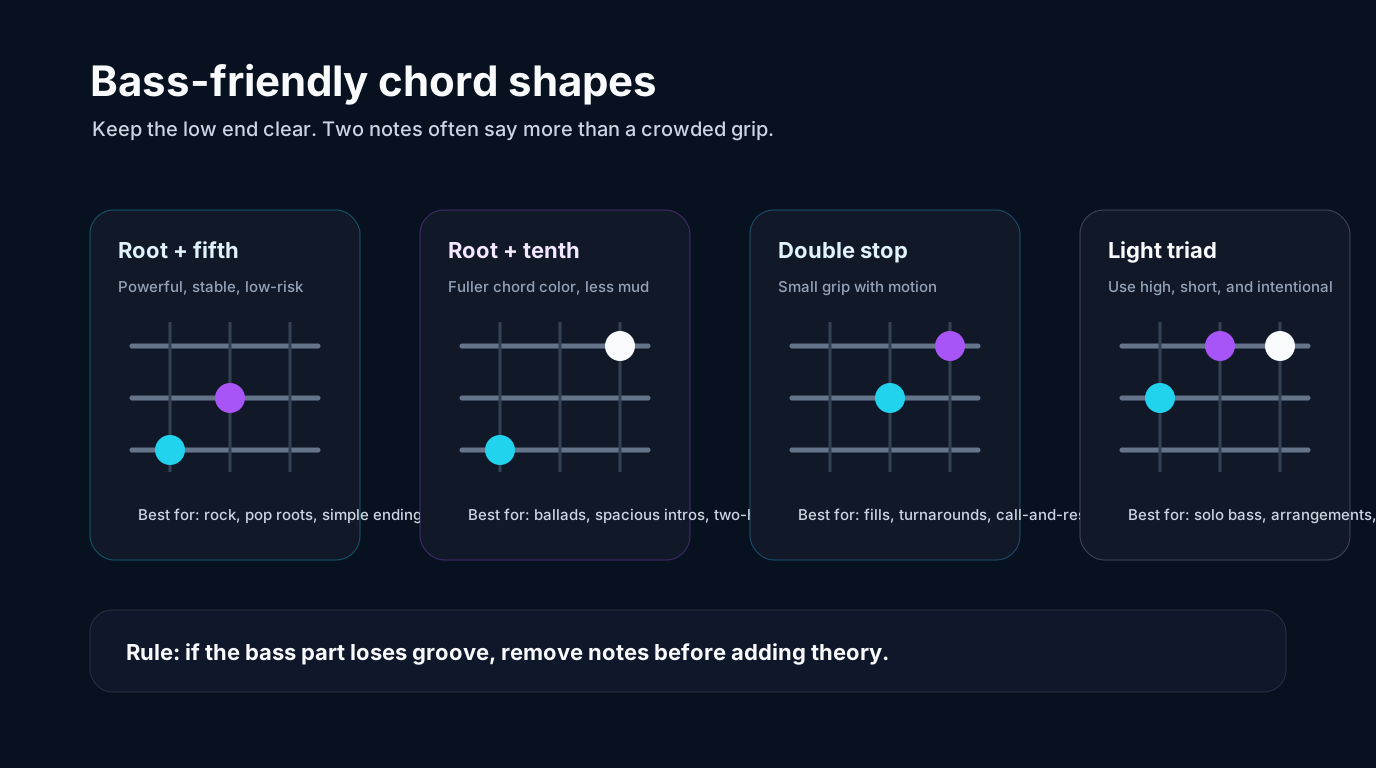
That table also explains why bass chord advice can feel contradictory. In a solo arrangement, a three-note chord may sound rich. In a dense band mix, the same shape may hide the kick drum and make the harmony feel less clear.
Build shapes from intervals, not guitar grips
The safest way to learn chords for bass guitar is to build them from intervals. Start with the root, then add one note that changes the sound.
Use this order:
- Play only the root in time.
- Add the fifth above the root.
- Try the octave when the line needs lift.
- Add the tenth instead of a low third when you want major or minor color.
- Use a compact triad only when the register is high enough to stay clear.
The tenth is often the most useful beginner discovery. A third tells listeners whether the chord is major or minor, but a low third can sound crowded on bass. Moving that third up an octave keeps the chord color while leaving more space in the low register.
If the page itself still feels confusing, keep the existing guide on how to read bass tab nearby. It explains the string-line and fret-number logic before you add chord shapes.
Keep rhythm ahead of harmony
Bass is a time instrument as much as a pitch instrument. A chord shape that sounds good alone can still fail if the attack is late, the note length is sloppy, or the low notes fight the drum pattern.
Use this quick check before adding a chord to a groove:
- Can you play the root rhythm without the chord?
- Does the chord attack land exactly where the root used to land?
- Does the drummer or backing track still feel clear?
- Does the shape release cleanly before the next bass note?
- Can you sing the top note of the chord as a melodic idea?
If the answer is no, simplify the shape. Bass chords usually work best as punctuation, a counterline, or a short texture change. They are weaker when they become constant background strumming.
Use audio or MIDI as a reference, not a chord authority
If your starting point is a recording, a rehearsal clip, or your own bass idea, Melogen can help you make a reference before you decide on the final bass chord shape. The current Music2MIDI workflow is positioned around AI transcription with optional stem separation, including bass stem handling and MIDI output. That is useful when you want to inspect the pitch movement before turning it into playable bass decisions.

The important boundary is honesty. A MIDI draft can reveal likely pitches, note starts, and rough timing. It does not know the best string choice, hand position, muting, or chord voicing for your bass. For cleaner solo recordings, an audio to MIDI converter can also help you move from sound to editable notes before you rewrite the result for the instrument.
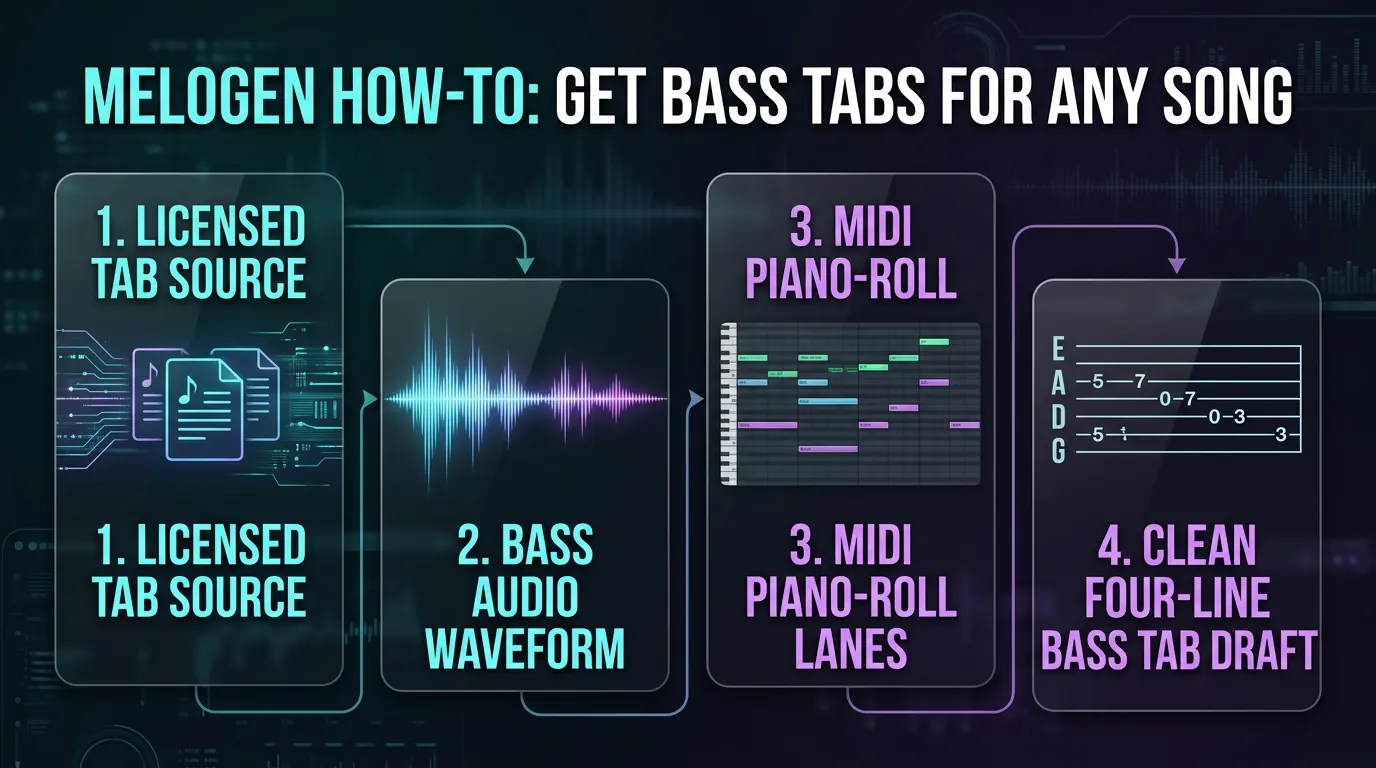
If your real goal is turning a bass line from a song into tab, the safer next read is Get Bass Tabs for Any Song, because it separates licensed sources, ear work, stem cleanup, and MIDI drafts.
Turn a reference into a playable bass chord
Once you have a chord idea from your ear, a score, a MIDI draft, or a teacher's example, do not copy it blindly. Bass needs a cleanup pass.
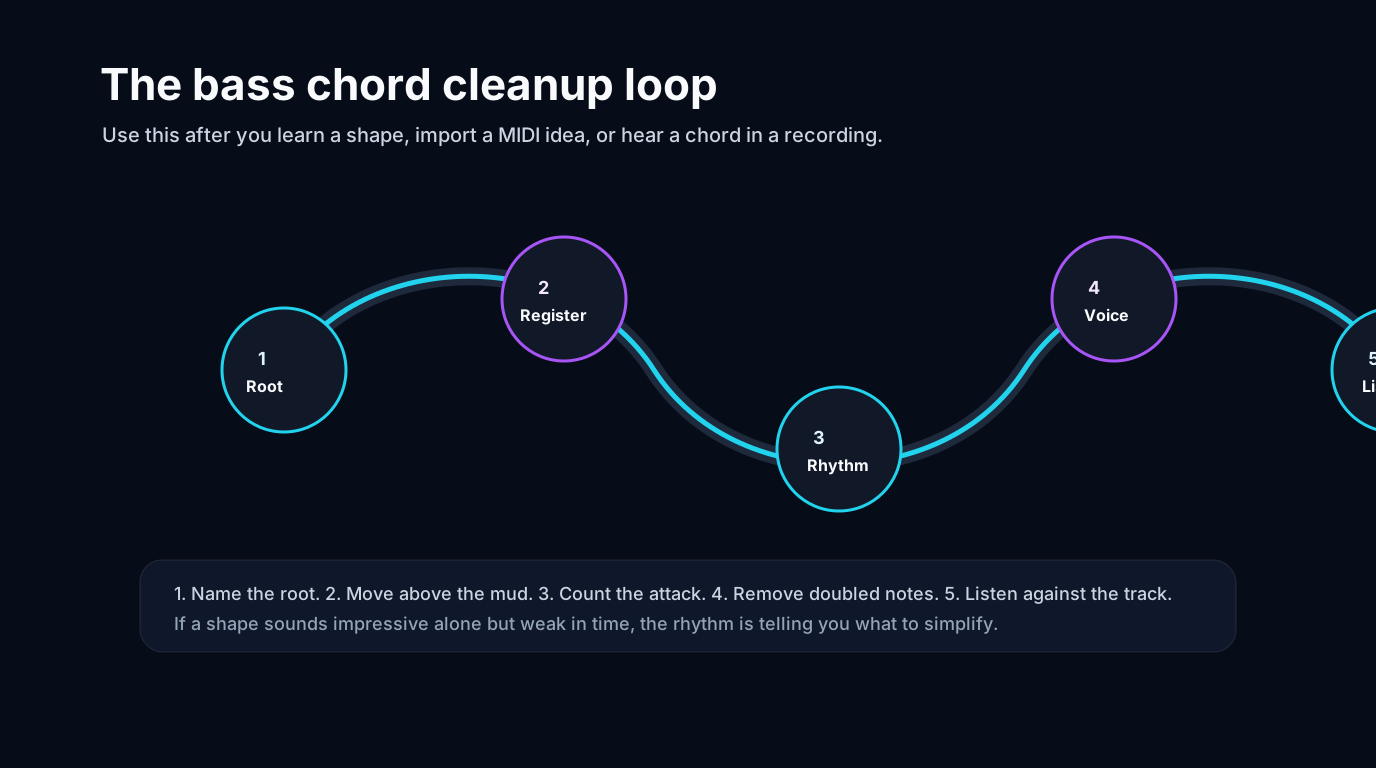
Use this loop:
- Root: confirm the bass note that anchors the chord.
- Register: move extra chord tones above the muddy range.
- Rhythm: play the shape with a metronome before adding fills.
- Voice: remove doubled notes that do not change the harmony.
- Listen: compare the shape against drums, guitar, keys, or the original track.
This is where many beginner chord shapes improve quickly. The problem is often not that the theory is wrong. The problem is that the voicing is too low, the release is too long, or the rhythm does not leave enough space.
The broader MIDI for Guitarists article is useful if you want to understand the difference between pitch data and fretboard decisions. The same idea applies to bass: MIDI can suggest what happened, but the bassist still decides how to play it.
Practice chords in small musical situations
Do not practice bass chords as isolated diagrams forever. Put each shape into a musical job.
| Practice situation | Shape to use | Goal |
|---|---|---|
| Slow rock ending | Root + fifth | Land cleanly without blurring the final beat |
| Ballad intro | Root + tenth | Add major or minor color without crowding the low end |
| Funk fill | Double-stop | Answer the groove without stepping on the main line |
| Solo bass arrangement | Light triad | Show harmony when no other chord instrument is present |
| Songwriting demo | Root + octave | Make the section feel bigger without changing harmony |
Start at a tempo where you can release the chord cleanly. The release is as important as the attack. If a chord rings too long, it can cover the next bass note and make the part feel late even when your fingers were on time.
Check the bass line before you choose the chord shape
Use Melogen Music2MIDI or Audio to MIDI to create a reference from clean audio, then decide the final bass chord voicing yourself.
The practical takeaway
Chords for bass guitar work when they respect the instrument's job. Keep the low end clear, use intervals before dense grips, and make rhythm the first test.
Before you keep a bass chord shape, ask:
- Does the root still feel solid?
- Are the extra notes high enough to stay clear?
- Does the chord improve the groove?
- Can you release it cleanly?
- Does the shape still work with the rest of the band?
If those checks pass, the chord belongs. If not, remove a note, move the color tone higher, or return to the root rhythm. On bass, clarity is not a compromise. It is the sound.
About the author
Zhang Guo
Composer - AI Product Manager
AI product manager and digital marketing consultant with a background in music. Creativity is the bridge between rhythm and logic, where musical intuition and mathematical precision can coexist in every meaningful product decision.
Follow on X