Classical Guitar Composers: Essential Names to Know
Explore classical guitar composers by era, style, beginner pieces, and practice path so your listening turns into smarter score study.
 Zhang Guo
Turn a static score into editable MIDI
Contents
Classical guitar composers are easier to understand when you stop treating the repertoire as one long list of names. Start with a few anchor figures: Fernando Sor, Mauro Giuliani, Francisco Tarrega, Agustin Barrios, Heitor Villa-Lobos, and Leo Brouwer. Each one teaches a different job: form, technique, tone, melody, color, rhythm, or modern texture.
This guide is not a complete encyclopedia. It is a practical route for players, teachers, and arrangers who want to know which composers to hear first, what each one is useful for, and how to move from listening into score study without getting lost.
Start with the anchor composers
The classical guitar repertoire has many important names, but a small map is more useful at the beginning than a huge catalog. Start here:
| Composer | Era or style area | What to listen for | Useful practice job |
|---|---|---|---|
| Fernando Sor | Classical era | Clear forms, elegant phrases, balanced studies | Clean left-hand shifts and musical sentence shape |
| Mauro Giuliani | Classical era | Virtuosic patterns, bright idiomatic writing | Arpeggios, scale flow, and concert-style energy |
| Francisco Tarrega | Romantic guitar tradition | Tone, rubato, lyrical phrasing | Sound control and expressive melody |
| Agustin Barrios | Late Romantic / Latin American | Song-like lines, color, poetic character | Melody over accompaniment and flexible time |
| Heitor Villa-Lobos | 20th century | Texture, rhythm, bold guitar color | Etude logic, modern sonority, right-hand variety |
| Leo Brouwer | Modern / contemporary | Rhythm, dissonance, atmosphere | Modern timing, articulation, and color control |
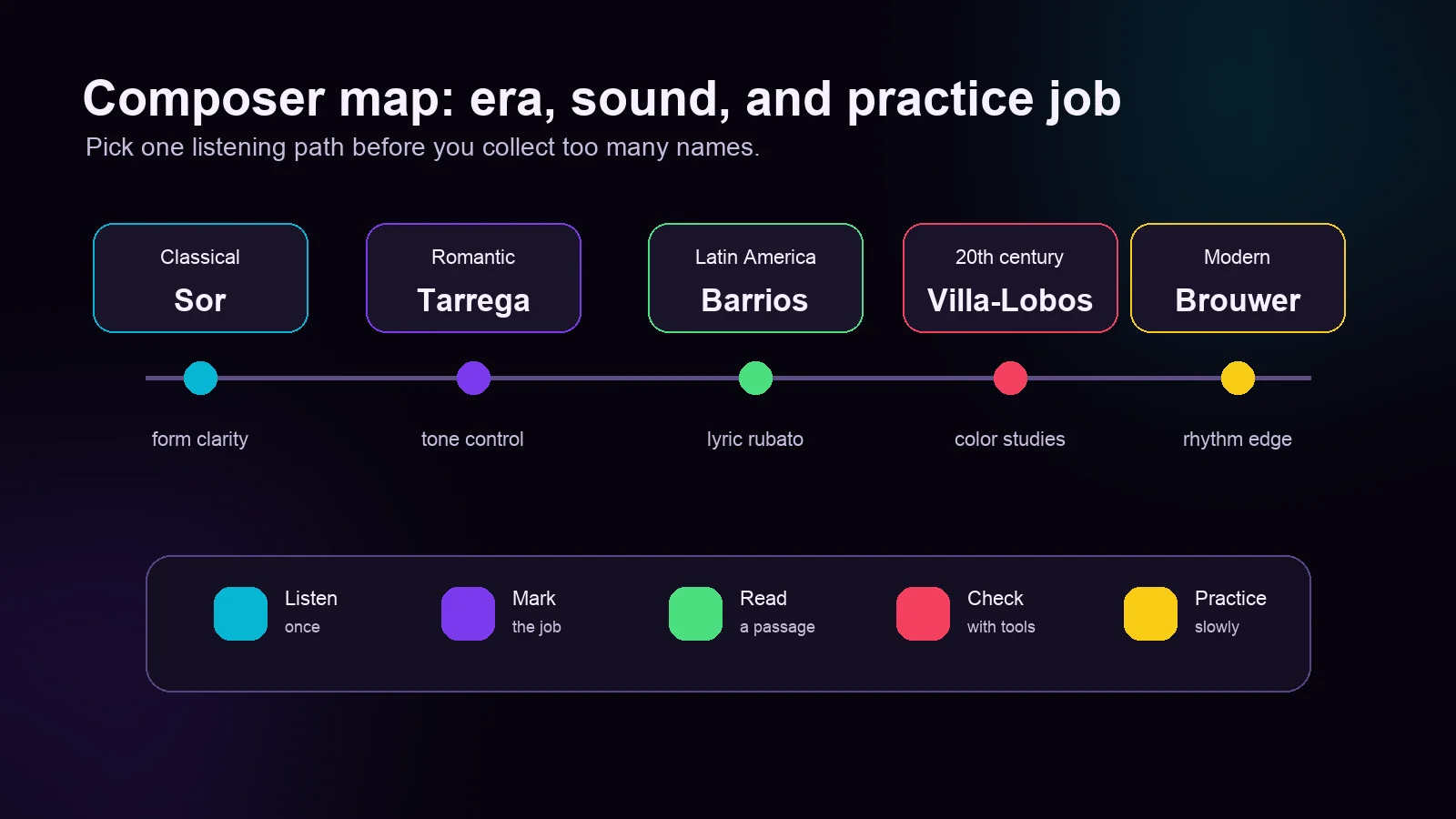
This map keeps the names attached to musical behavior. Sor is not just "old." He is useful for clarity. Tarrega is not just famous. He is useful for tone. Brouwer is not just modern. He changes how rhythm and color sit under the hands.
Match each composer to a learning goal
If you are a player, the question is not only who wrote famous pieces. It is which composer helps the next weakness in your playing.
| If your goal is... | Start with... | Why |
|---|---|---|
| Cleaner phrase shape | Sor | The writing exposes balance, cadence, and small formal gestures. |
| More fluent right-hand patterns | Giuliani | The patterns often feel technical without losing musical direction. |
| Better tone and rubato | Tarrega | The music rewards slow sound work and flexible timing. |
| Singing melody on guitar | Barrios | The writing often asks melody and accompaniment to breathe together. |
| More color and larger textures | Villa-Lobos | The etudes and preludes stretch the instrument's palette. |
| Modern rhythm and atmosphere | Brouwer | The music makes articulation, silence, and timing feel structural. |
That approach is more useful than ranking composers. Classical guitar repertoire is not a ladder where one name is always better than another. It is a toolbox. Use the composer who teaches the musical problem you are actually solving this month.
If you are still sorting the instrument itself, the guide to types of guitar gives the broader family map before you narrow down to classical technique and repertoire.
Understand the historical path without memorizing dates
You do not need a music-history exam to hear the differences. A rough timeline is enough:
- Classical-era guitar writing often values clarity, form, and balanced phrase structure.
- Romantic guitar writing leans toward tone color, lyrical melody, and expressive timing.
- Latin American repertoire often brings dance, song, folklore, and more flexible rhythmic character into the guitar tradition.
- 20th-century works expand texture, harmony, idiomatic studies, and the instrument's percussive possibilities.
- Modern and contemporary writing may use sharper rhythm, dissonance, atmosphere, and extended color.
Listen for what changes under the hands. Does the piece ask for clean classical balance? A singing top line? A tremolo texture? A percussive accent? A strange silence? Those details tell you more than the date alone.
Use beginner-friendly repertoire without flattening the music
Beginner-friendly does not mean musically shallow. Many classical guitar composers wrote studies, preludes, or shorter pieces that teach one technical job at a time.
Here is a simple practice filter:
- Choose one composer.
- Choose one small piece or study.
- Name the main job before playing: tone, shift, arpeggio, rhythm, melody, or color.
- Mark the two hardest bars.
- Practice slowly enough that the musical job stays audible.
The trap is collecting too many pieces at once. It feels productive, but it often keeps the player from hearing what each composer teaches. One Sor study played with clean phrase shape will usually teach more than skimming five pieces with the same mistakes.
For notation-first guitar work, the companion guide on how to read guitar sheet music explains staff reading, string choice, and fretboard mapping in more detail.
Where Melogen fits after listening and score study
Melogen is not a music-history shortcut, and it should not replace careful listening. It can help when you move from hearing a piece to building a playable reference, especially if your source is a recording, a clean score image, or a practice excerpt.
The current AI Guitar Tab Generator page is built around a browser-based guitar workflow for songs, audio files, and YouTube links, with controls for tuning, capo, focus mode, and complexity. That is useful when the first practical need is a guitar-first reference, not a finished edition.

Use that kind of workflow carefully with classical repertoire:
- Start from listening and score reading, not from blind conversion.
- Use generated references to check orientation, not to replace fingering judgment.
- Compare the output against the score and the recording.
- Fix phrasing, position choices, and tone decisions yourself.
If the source is standard notation rather than audio, a score-first route such as Sheet2MIDI may be more appropriate than a tab-first route. If the goal is tab literacy, the guide on how to read guitar tabs is the better next read.
Create a guitar-first reference before deeper cleanup
Use Melogen AI Guitar Tab Generator when you need a playable starting point from audio or a link, then refine fingering and phrasing yourself.
The practical takeaway
Classical guitar composers become less intimidating when each name has a job. Start with Sor for clarity, Giuliani for pattern fluency, Tarrega for tone, Barrios for song-like line, Villa-Lobos for color, and Brouwer for modern rhythm.
Before you add another name to your list, ask:
- What do I want this composer to teach me?
- Which small piece or study will expose that skill?
- Can I hear the difference before I try to play it?
- Do I need notation, tab, audio, or MIDI to support the next practice step?
That last question is where workflow tools can help. Let the composer teach the music. Let Melogen help with the reference path only when it makes the next practice session clearer.
About the author
Zhang Guo
Composer - AI Product Manager
AI product manager and digital marketing consultant with a background in music. Creativity is the bridge between rhythm and logic, where musical intuition and mathematical precision can coexist in every meaningful product decision.
Follow on X