Types of Guitar: Families, Uses, and How to Choose
Compare the main types of guitar by sound, role, tuning, and learning fit so you can choose the right starting point for practice and notation.
 Zhang Guo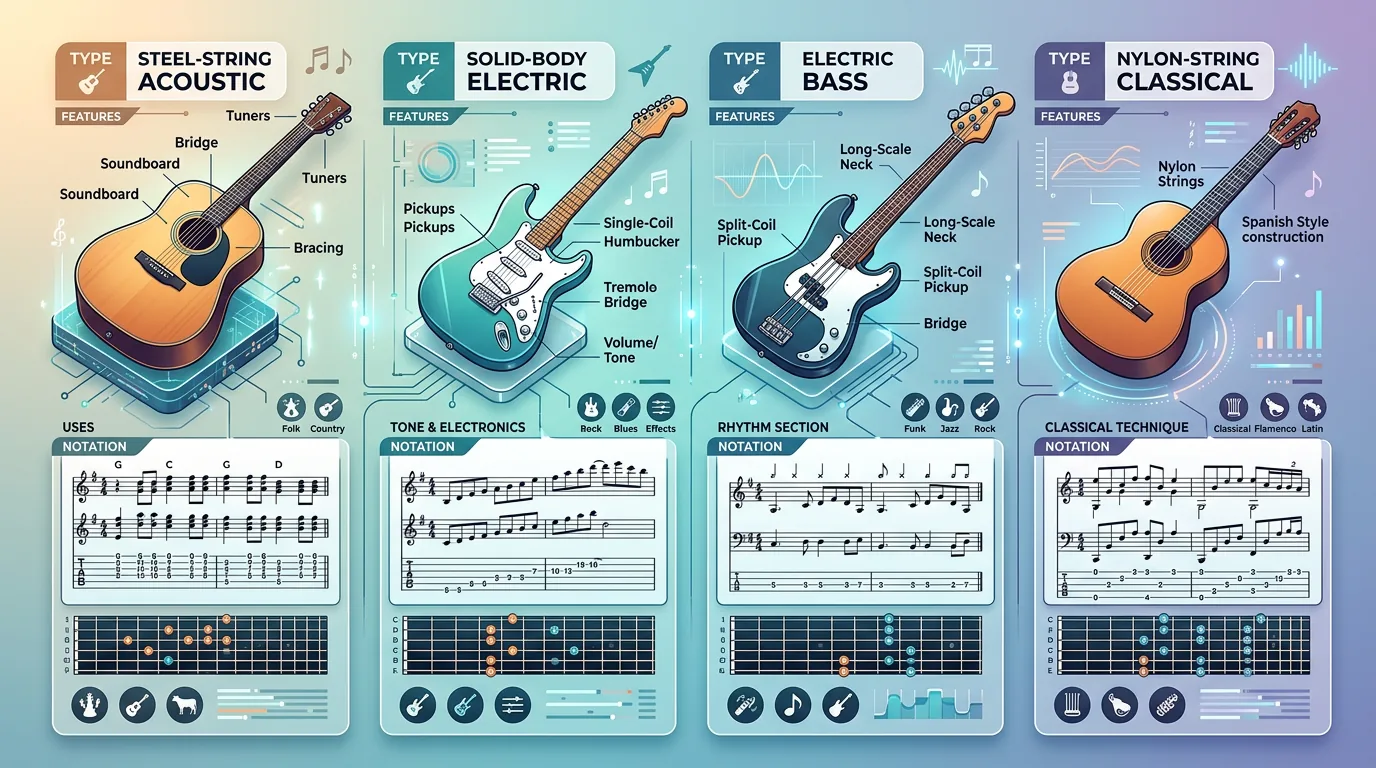
Turn a static score into editable MIDI
Contents
The main types of guitar are not just acoustic versus electric. For most musicians, the more useful split is: classical, steel-string acoustic, solid-body electric, semi-hollow or hollow electric, bass, 12-string, resonator, baritone, and travel guitars. Each one solves a different musical job, feels different under the hands, and changes what practice materials make sense.
That is why this guide starts with function instead of history. If you are choosing your first guitar, adding a second one, or trying to understand why one instrument makes a riff feel easy while another feels awkward, the question is not "Which guitar is best?" The real question is which guitar matches your sound, repertoire, tuning, and learning workflow.
Start with the main guitar families
The quickest way to understand types of guitar is to group them by body design, string setup, and musical role. That keeps you from comparing instruments that are built for different jobs in the first place.
| Guitar type | Usual strings | Core sound and feel | Best fit | Watch for |
|---|---|---|---|---|
| Classical guitar | 6 nylon | Warm, rounded, lower tension | Classical, fingerstyle, beginner comfort | Neck feels wider and the attack is softer |
| Steel-string acoustic | 6 steel | Brighter, louder, more projection | Singer-songwriter, folk, strumming, general practice | Higher tension can feel tougher for brand-new players |
| Solid-body electric | 6 steel | Focused, amplified, flexible with effects | Rock, pop, metal, blues, lead playing | Needs an amp or interface to hear its full character |
| Semi-hollow or hollow electric | 6 steel | Airier resonance, smoother sustain | Jazz, blues, indie, cleaner tones | Feedback control matters at higher volume |
| Bass guitar | Usually 4, sometimes 5 or 6 | Low-register foundation, different role in the mix | Bass lines, rhythm section work | Reading and fingering logic differ from standard guitar roles |
| 12-string guitar | 12 paired strings | Bigger shimmer, chorus-like texture | Strummed accompaniment, fuller acoustic texture | More tension and more demanding setup/tuning |
| Resonator guitar | 6 steel | Metallic, punchy, strong projection | Blues, roots, slide playing | Distinct tone that can feel specialized |
| Baritone guitar | Usually 6 | Lower tuning, deeper range than standard guitar | Heavy riffs, low-register textures, alternate voicings | Scale length and tuning change how shapes feel |
| Travel guitar | Usually 6 | Compact and portable over full-body resonance | Practice on the move, writing, portability | Smaller body can mean less acoustic fullness |
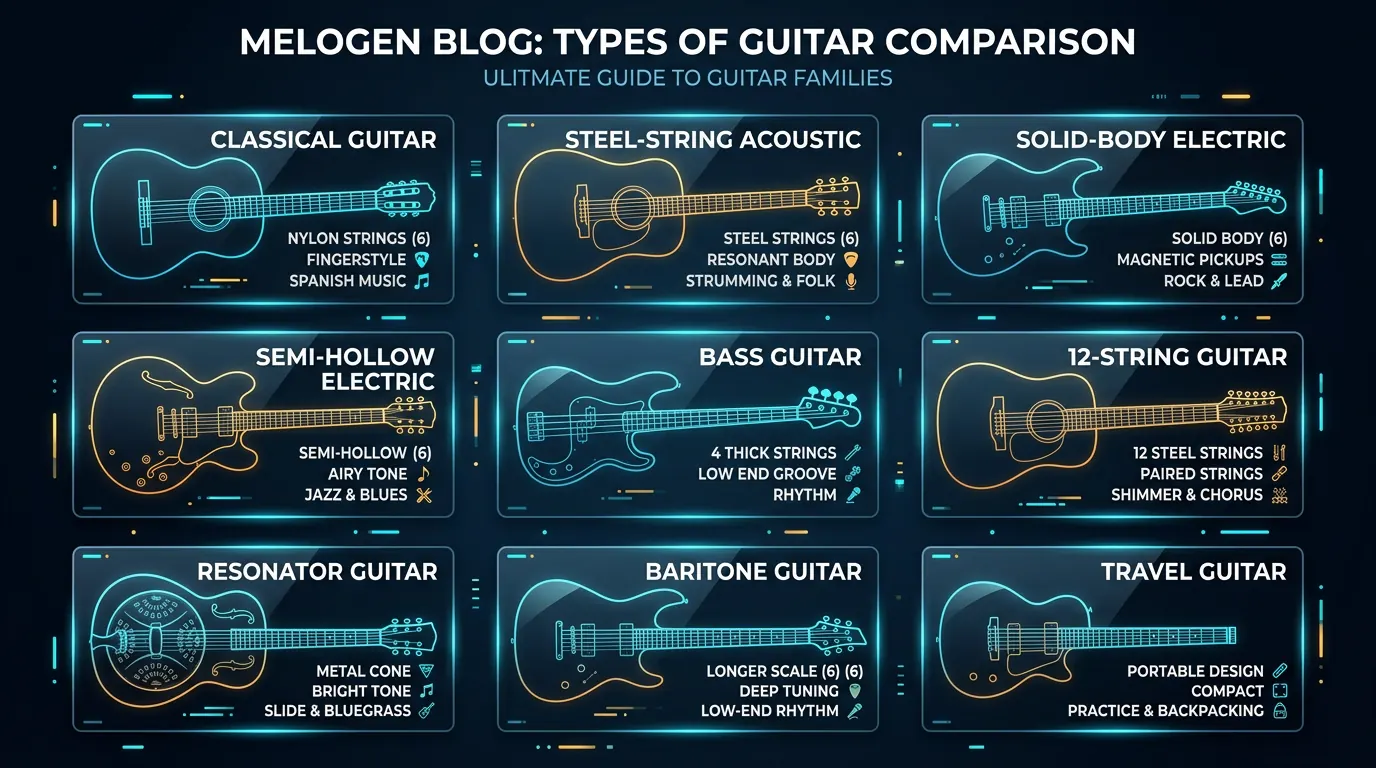
This is the practical distinction that matters most: some guitars are built to carry harmony and song accompaniment, some are built to project leads or amplified tones, and others are built to cover a different register or texture. Once you see that, the category names stop feeling random.
Match the guitar type to the music you actually want to play
A guitar choice becomes much clearer when you start from repertoire.
If you want to sing and strum, a steel-string acoustic usually makes the most sense. If you want classical repertoire, fingerstyle studies, or a softer left-hand feel at the beginning, a classical guitar is usually the better entry point. If your real goal is riffs, bends, power chords, pedals, or lead lines, a solid-body electric gets you there faster than trying to force an acoustic into that job.
The same logic applies once you move past the basics:
- Choose a semi-hollow or hollow electric when cleaner articulation, jazz voicings, or an airier response matters more than hard-gain versatility.
- Choose a 12-string when the arrangement needs width and shimmer more than note-for-note technical agility.
- Choose a bass guitar when your job is groove, root motion, and low-end architecture rather than chord-led accompaniment.
- Choose a baritone guitar when the arrangement needs lower tuning and heavier range without fully switching instruments.
The catch: beginners often buy toward aspiration instead of workflow. That is not always wrong, but it helps to be honest about the first six months. A guitar that supports your everyday practice songs is almost always better than a guitar that matches a dream repertoire you cannot realistically start on yet.
Understand what changes in tuning, tabs, and notation
Different guitar families do not just sound different. They change how you read, tune, and organize practice.
For many standard six-string guitars, the anchor remains E A D G B E. That includes most steel-string acoustics and most solid-body electrics. If you need a quick orientation on open strings and first-position note names, the guide to electric guitar string notes is the most direct companion page.
But the reading workflow changes once the instrument type changes:
| Situation | What stays stable | What changes |
|---|---|---|
| Standard acoustic or electric guitar | Six strings, common TAB logic, common beginner chord vocabulary | Tone, body feel, projection, need for amplification |
| Bass guitar | Fretted string logic still helps | Different range, role, and reading expectations |
| 12-string guitar | Chord shapes can feel familiar at first | Paired strings change feel, tuning time, and texture |
| Baritone guitar | Shape logic can transfer | Lower register changes tension, voicing, and riff feel |
| Alternate tunings or capo use | Interval logic still matters | String names and shape expectations shift immediately |
If your current bottleneck is TAB symbols, string lines, and rhythm cues, use the separate how to read guitar tabs guide. If your bottleneck is standard notation and fretboard mapping, the stronger follow-up is how to read guitar sheet music. This page stays one level higher: choosing the instrument family before you worry about the exact reading method.
Avoid the beginner mistakes that make the wrong guitar feel harder than it is
A lot of "Maybe guitar is not for me" moments are actually instrument-fit problems.
Common mismatches look like this:
- Buying a heavy solid-body electric for a player who mostly wants couch practice with no amp nearby.
- Buying a steel-string acoustic for someone whose first goal is gentle classical study or fingerstyle comfort.
- Buying a specialized resonator or baritone because it looks inspiring, then realizing most early learning material is written for a more standard setup.
- Treating a 12-string like a neutral first instrument when the extra tension and paired strings add complexity immediately.
A better first filter is simple:
- Name the music you want to play this month, not "someday."
- Decide whether you care more about unplugged practice, amplified tone, or lower-register range.
- Check whether your practice materials are mostly chords, tabs, notation, or song-first learning.
- Pick the guitar that reduces friction in that workflow.
That last point matters more than people expect. The right guitar makes your learning material feel aligned. The wrong one makes every chart, song, or fingering decision feel like a workaround.
Use Melogen as a bridge from songs to guitar practice
Once you have the right guitar family in mind, the next practical question is how to get playable material onto the stand. That is where Melogen can help, especially for players who start from songs, demos, or video links rather than a clean printed score.
The current AI Guitar Tab Generator product page describes a browser-based beta that turns songs, audio files, and YouTube links into readable guitar tabs. The page currently lists support for MP3, WAV, M4A, FLAC, and YouTube links, and it surfaces guitar-specific setup controls such as tuning, capo position, focus mode, and complexity level.

That matters because different guitar types create different practice needs:
- A solid-body electric player may want a first-pass riff or lead tab from a song.
- A steel-string acoustic player may care more about chord-plus-strum guidance.
- A baritone or alternate-tuning player needs to keep tuning assumptions visible instead of guessing from generic tab habits.
Melogen is strongest here as a first-pass bridge, not as a replacement for musicianship. Use it to get a playable reference, then slow the part down, compare it to the recording, and adjust the details that depend on phrasing, tuning choice, or instrument-specific feel.
Build a first-week decision and practice loop
If you are still deciding among guitar types, use a one-week loop instead of trying to solve everything in one afternoon.
- Day 1: Name the style you want to play most right now.
- Day 2: Decide whether you need unplugged practice, amplified tone, or low-register range.
- Day 3: Watch where your learning material actually starts: songs, tabs, notation, or chord sheets.
- Day 4: Compare two realistic guitar families instead of browsing every possible type.
- Day 5: Test whether your likely first songs feel natural on that setup.
- Day 6: Generate or find one simple practice reference and notice whether the guitar type supports that workflow.
- Day 7: Keep the guitar that makes the next week of practice feel easier, not more complicated.
That loop is deliberately boring, and that is the point. Good instrument choices usually come from reducing friction, not from chasing the most impressive label.
Where Melogen fits
Melogen should sit after you know what instrument family you are practicing on, not before. The guitar type tells you what kind of material will help:
- For song-first players, use Melogen's guitar-tab workflow to get a readable starting point.
- For score-first players, a notation or Sheet2MIDI workflow will usually make more sense than forcing everything into guitar tab immediately.
- For players switching between guitar families, keep tuning and register visible so your reference material stays honest.
That is the useful distinction: choosing a guitar family is an instrument decision. Melogen helps with the material and workflow that come after that decision.
Generate a guitar-first reference before you refine the part
Use Melogen AI Guitar Tab Generator when your source is a song, audio file, or YouTube link and you need a playable first pass before detailed cleanup.
The practical takeaway
The best way to understand types of guitar is to stop treating them as a single ladder from beginner to advanced. They are different tools for different musical jobs.
Before you choose, ask:
- Do I want unplugged practice, amplified tone, or a lower register?
- Am I learning mostly from songs, tabs, or notation?
- Do I need a broad all-purpose guitar, or a more specialized sound?
- Will this guitar make the next month of practice easier?
If you answer those questions honestly, the right family usually becomes obvious. Then use Melogen to turn your source material into a cleaner first-pass practice workflow instead of guessing your way through every new song.
About the author
Zhang Guo
Composer - AI Product Manager
AI product manager and digital marketing consultant with a background in music. Creativity is the bridge between rhythm and logic, where musical intuition and mathematical precision can coexist in every meaningful product decision.
Follow on X