Classical Music for Beginners by Era and Listening Path
Learn classical music eras, forms, and listening cues with a practical beginner path, plus when Melogen helps you hear notation clearly.
 Zhang Guo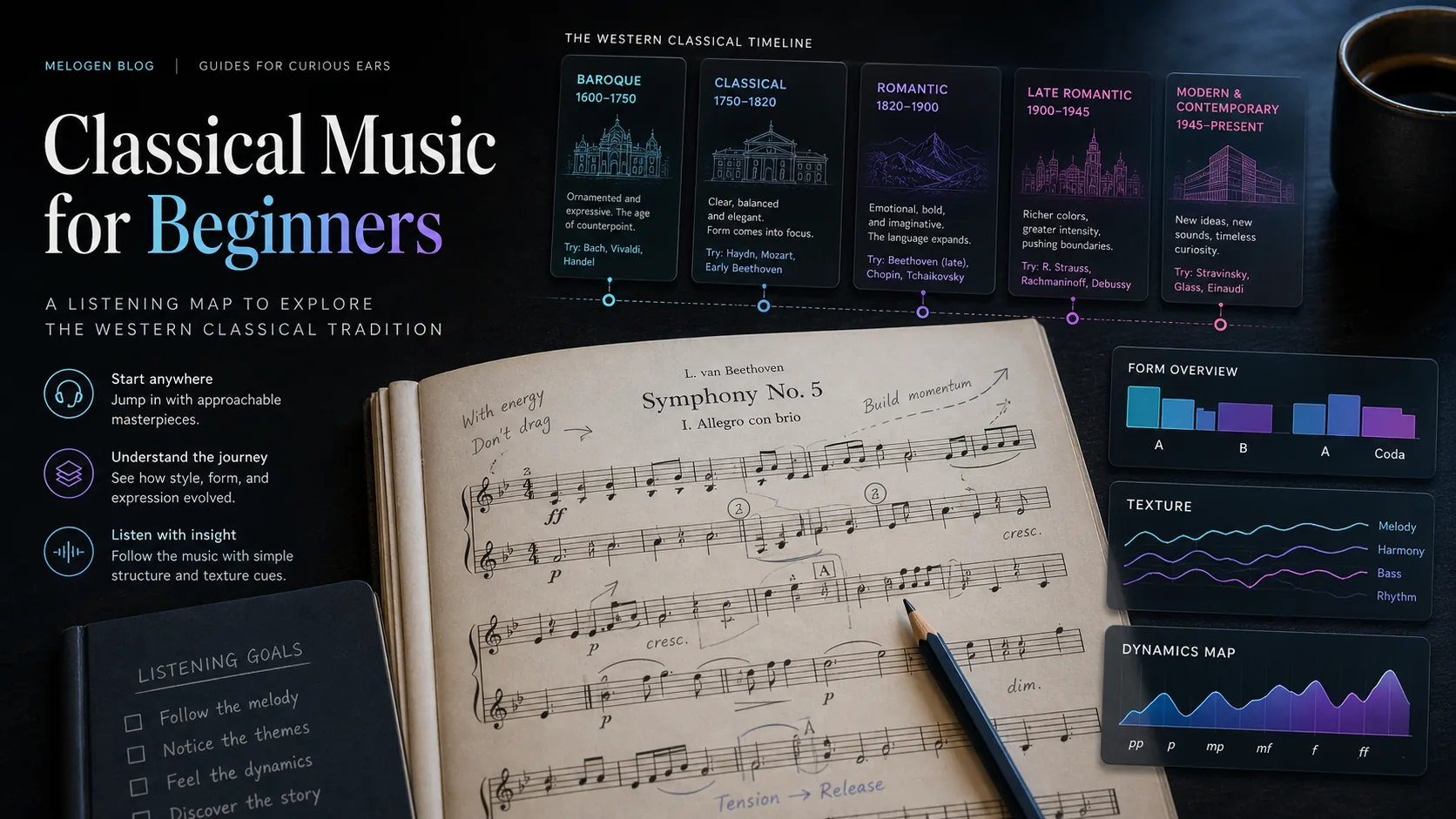
Turn a static score into editable MIDI
Contents
Classical music for beginners is easier when you stop treating it as one giant museum. Start with a few eras, a few listening cues, and a short path of pieces that help your ear notice melody, rhythm, texture, and form.
You do not need to memorize every composer before you can enjoy the music. A better first goal is to recognize what kind of musical world you are hearing: balanced Classical-period phrases, Baroque motion, Romantic color, or a modern piece that is deliberately breaking older rules.
Start with eras, not a giant playlist
The word classical is used two ways. In everyday speech, it often means Western notated concert music across many centuries. In music history, the Classical period is one specific era between the Baroque and Romantic periods. Beginners get less confused when those meanings are separated early.
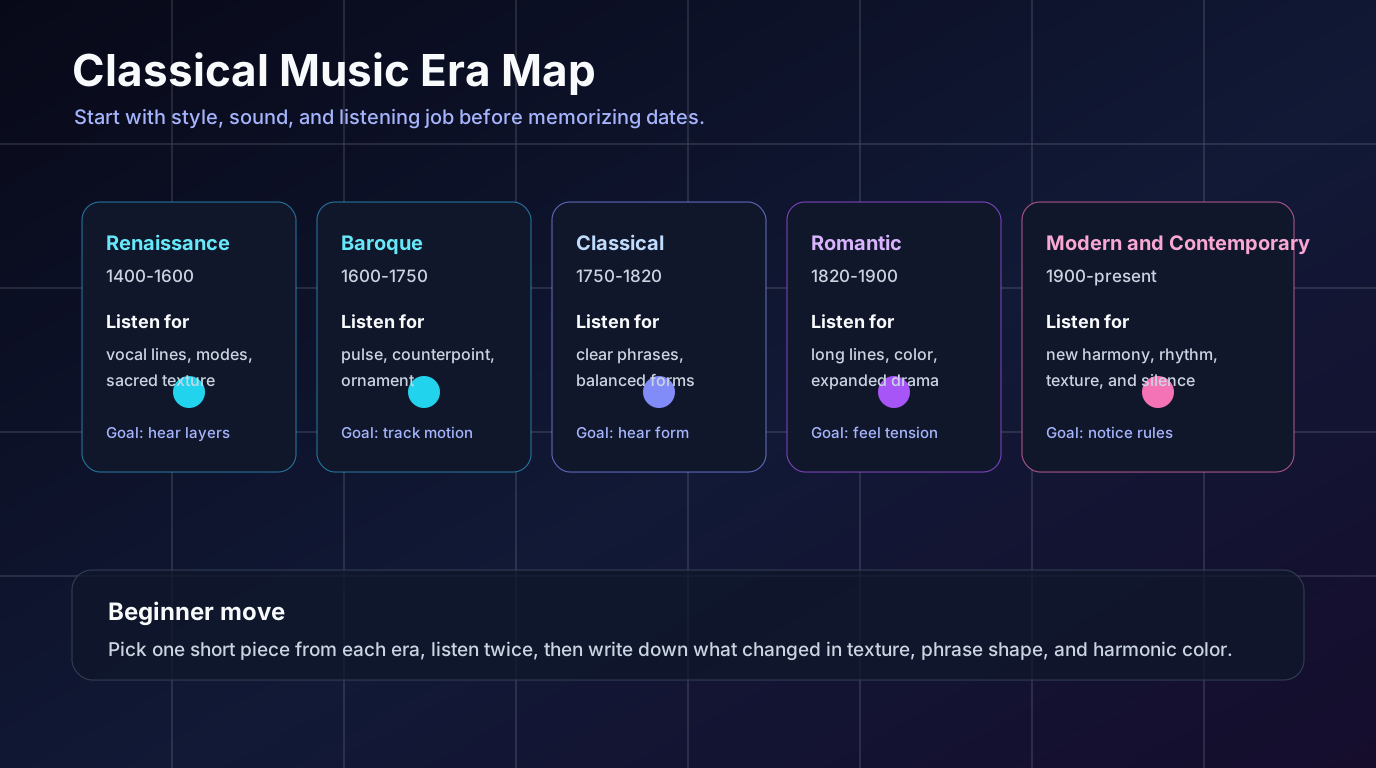
Use eras as listening landmarks, not as a school exam. The dates are useful, but the sound is more useful.
| Era | Approximate years | Beginner listening cue | Try listening for |
|---|---|---|---|
| Renaissance | 1400-1600 | Vocal layers and modal color | How lines weave instead of one tune dominating |
| Baroque | 1600-1750 | Pulse, sequences, ornament, counterpoint | A steady engine under decorative lines |
| Classical period | 1750-1820 | Clear phrases and balanced forms | Question-and-answer shapes and clean cadences |
| Romantic | 1820-1900 | Expanded harmony, color, drama | Long emotional arcs and richer orchestration |
| Modern and contemporary | 1900-present | New rules, new textures, new rhythm | What the composer is choosing to organize instead of a simple key |
The competitor page from PlayScore also uses the era path as the entry point. Melogen's information gain is to make that path more practical: what to listen for, how to pair listening with a score, and how to use playback or structure tools only after the musical question is clear.
Listen for four layers first
The fastest way into an unfamiliar piece is not trivia. It is attention. Pick one layer and follow it for a minute.
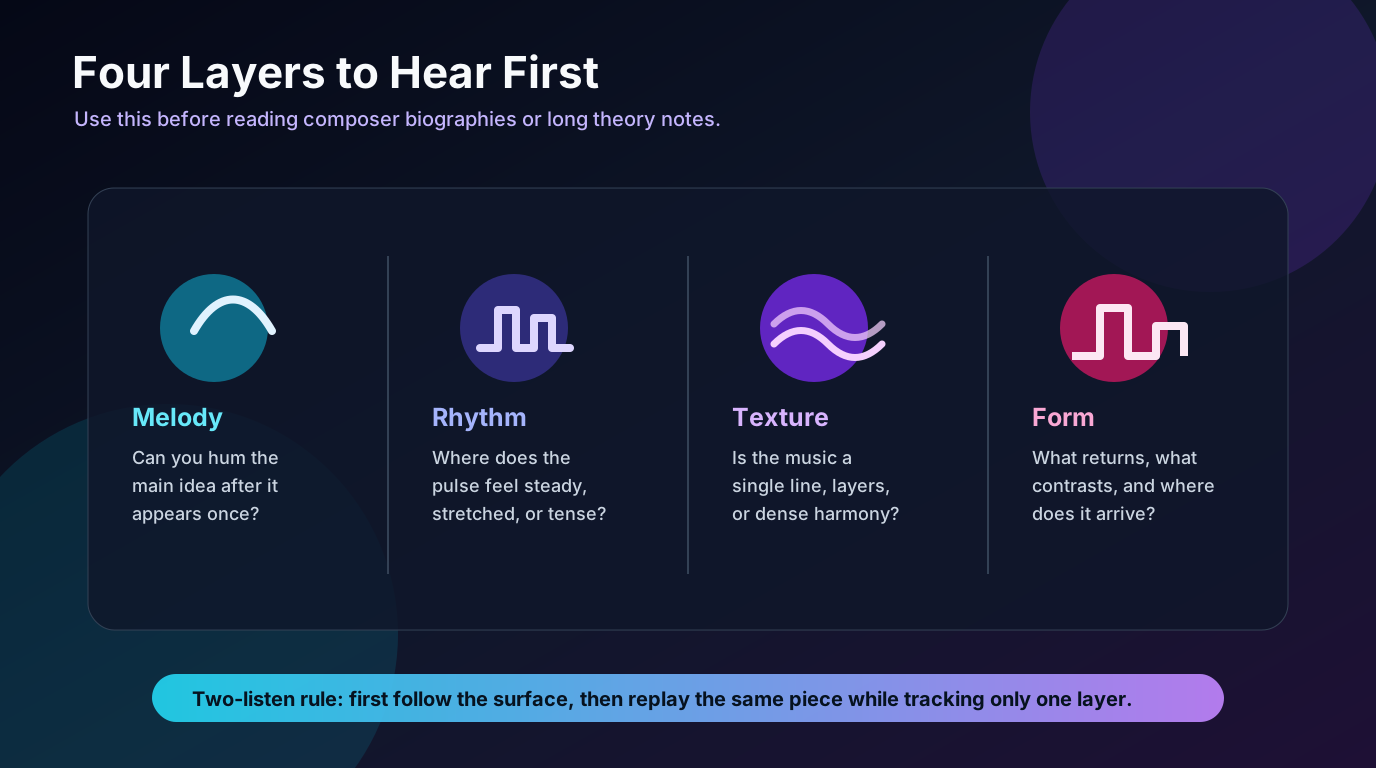
Use this order when a piece feels too dense:
- Follow the melody. Can you hum or point to the main idea?
- Feel the rhythm. Is the pulse steady, dancing, stretched, or interrupted?
- Notice the texture. Is one line in front, or are several lines equally active?
- Track the form. What returns, what contrasts, and where does the music arrive?
This matters because beginners often ask, "Do I like classical music?" before they know what they are hearing. A Bach prelude, a Mozart movement, a Chopin nocturne, and a Stravinsky ballet excerpt are not trying to do the same job. The better question is: what is this piece asking my ear to follow?
Build a first listening path
Do not start with ten-hour playlists. Start with short pieces or single movements, then expand from the sound you actually enjoy.
Here is a practical first path:
| Step | Listening job | Good starting point |
|---|---|---|
| 1 | Hear a clear melody and phrase | Mozart, Eine kleine Nachtmusik, first movement |
| 2 | Hear steady motion and counterpoint | Bach, Cello Suite No. 1 Prelude |
| 3 | Hear dramatic form and return | Beethoven, Symphony No. 5, first movement |
| 4 | Hear color and atmosphere | Debussy, Clair de lune |
| 5 | Hear modern rhythm and shock | Stravinsky, The Rite of Spring excerpts |
These are not the only correct pieces. They are simply useful because they make different listening jobs obvious. If one of them works for you, go sideways: try another piece by the same composer, then another composer from the same era.
If you want a more composer-focused branch, the Melogen guide to classical guitar composers is a useful example of narrowing a broad tradition into a more playable instrument path.
Use a score when your ear needs a map
Classical music is not only sound. Much of it is written music, and the page can show details the ear misses on a first pass: repeated motives, entrances, rests, dynamics, and phrase boundaries.
You do not need advanced reading skills to benefit from a score. Start with simple landmarks:
- Where does the first theme begin?
- Which instrument or hand carries the melody?
- Where do dynamics grow or relax?
- Does a passage repeat exactly, or does it return changed?
- Are the rhythms simple, dotted, syncopated, or running quickly?
If the staff still feels unfamiliar, read Melogen's how to read sheet music guide before trying to analyze a full score. That parent guide explains staff, clef, key, rhythm, and symbols in the order a beginner should actually read them.
Use Melogen as a study bridge
Melogen fits best when you have visible notation and want help moving from page to playback or from score to structure. The local Sheet2MIDI product surface supports JPG, PNG, and PDF sheet music input, then exports MIDI and MusicXML. That is useful when you want to hear a clean first pass, inspect timing in a DAW, or open the result in notation software.
Use it like this:
- Choose a short passage, not a whole symphony.
- Read the basic score signals yourself first.
- Convert a clear scan or PDF only after you know what you are checking.
- Listen for mismatches in rhythm, pitch, voices, or repeats.
- Return to the score and make the musical decision yourself.
For a deeper study pass, music structural analysis explains how form, sections, cadences, harmony, and motives can guide listening. Melogen's Structural Analysis page is the better product fit when the question is not "what notes are these?" but "how is this piece organized?"
Turn a short score into a clearer study pass
Use Melogen Sheet2MIDI when you have readable sheet music and want playback or editable MIDI before deeper listening and score study.
Keep the first month small
The best beginner routine is small enough to repeat. One focused movement teaches more than a huge playlist running in the background.
Try this four-week loop:
| Week | Focus | What to do |
|---|---|---|
| 1 | Eras | Listen to one short example from Baroque, Classical, Romantic, and Modern music |
| 2 | Melody and rhythm | Replay the same pieces while following only the main tune and pulse |
| 3 | Texture | Notice whether the music is a solo line, melody with accompaniment, or several equal lines |
| 4 | Form | Mark what returns, what changes, and where the strongest arrival happens |
Once that loop feels natural, add reading. Open a score, follow the first theme, and see whether your eye can confirm what your ear noticed. Then move to a new composer or a nearby genre.
The practical takeaway
Classical music for beginners should start with orientation, not pressure. Learn the eras as sound worlds. Follow one listening layer at a time. Use short pieces. Bring in a score only when it helps you hear more clearly.
Keep this checklist nearby:
- Era tells you the broad sound world.
- Melody gives your ear a thread.
- Rhythm tells you how the music moves.
- Texture shows how many musical layers are active.
- Form tells you what returns and what changes.
- Playback and analysis tools help most after you know what you are checking.
You do not need to understand every detail on the first listen. You need one clear handle. Once you have that, the next piece is less intimidating.
About the author
Zhang Guo
Composer - AI Product Manager
AI product manager and digital marketing consultant with a background in music. Creativity is the bridge between rhythm and logic, where musical intuition and mathematical precision can coexist in every meaningful product decision.
Follow on X