Coolest Instrument to Play and Actually Stick With
Choose the coolest instrument to play by sound, practice friction, portability, and workflow, with a realistic musician-first comparison.
 Zhang Guo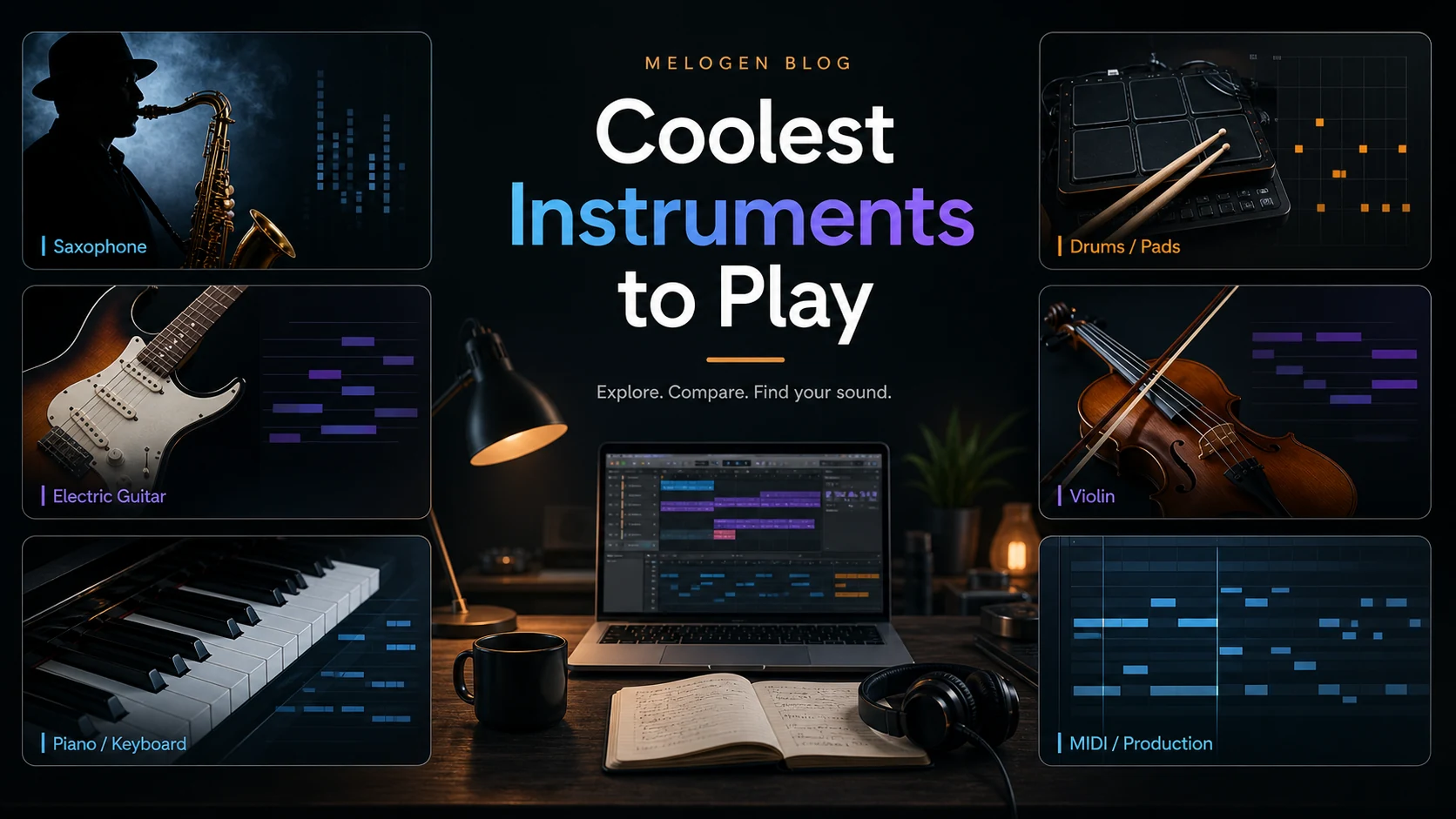
Turn a static score into editable MIDI
Contents
The coolest instrument to play is the one that makes you want to practice after the first week. For some players that is electric guitar because the sound feels immediate. For others it is saxophone, drums, piano, violin, bass, synth, or even voice because the instrument matches their body, routine, taste, and creative workflow.
So the better question is not "Which instrument looks coolest?" It is which instrument will still feel cool when you are tired, repeating basics, and trying to turn real music into progress. This guide compares instruments by sound identity, learning friction, portability, practice materials, and how easily the instrument fits a modern notation, audio, or MIDI workflow.
Start with the coolest instruments people actually keep playing
Most "coolest instrument" lists stop at vibe. Vibe matters, but it is not enough. The useful shortlist combines stage presence with realistic practice paths.
| Instrument | Why it feels cool | Best fit | Practice reality | Workflow note |
|---|---|---|---|---|
| Electric guitar | Riffs, effects, visual identity, band energy | Rock, pop, metal, blues, indie | Beginner chords arrive quickly, but tone control takes time | Tabs, recordings, and MIDI references can all help |
| Saxophone | Strong voice-like lead sound | Jazz, funk, pop, worship, solo lines | Breath support and embouchure matter early | Works well with lead sheets and backing tracks |
| Drums or electronic pads | Physical groove and instant rhythm impact | Bands, production, worship, hip-hop, EDM | Coordination grows slowly; volume and space matter | MIDI drums make home practice easier |
| Piano or keyboard | Full harmony under two hands | Songwriting, theory, classical, production | Reading both hands is the long game | Excellent bridge into MIDI and arrangement work |
| Violin | Expressive lines and dramatic sound | Classical, folk, film, worship, pop strings | Intonation is demanding at first | Sheet music and slow practice references matter |
| Bass guitar | Groove, weight, and control of the band | Funk, rock, pop, jazz, worship | The role looks simple until timing gets exposed | Audio references and chord charts are useful |
| Trumpet | Bright lead power and clear ensemble role | Jazz, marching, worship, orchestral, salsa | Breath, range, and endurance need patience | Transposition awareness becomes important |
| Flute | Agile melodic sound with portability | Classical, folk, worship, film, school bands | Tone control takes more work than it first appears | Clean notation is the best practice source |
| Synthesizer or MIDI controller | Sound design and production freedom | Electronic music, scoring, pop production | It can distract you if patches replace practice | MIDI workflow is the whole point |
| Cello | Deep tone and emotional range | Classical, film, chamber, singer-songwriter texture | Size and cost matter, but the sound rewards patience | Great with notation and slow playback |
There is no universal winner here. Electric guitar is cool if you want riffs. Saxophone is cool if you want a voice-like lead. Drums are cool if your body thinks in groove. Piano is cool if you want harmony, writing, and control over the whole song.
Use four lenses before you choose
The strongest instrument choice usually passes four checks: sound, practice, portability, and workflow. If one of those fails badly, the instrument can still be impressive but hard to keep.
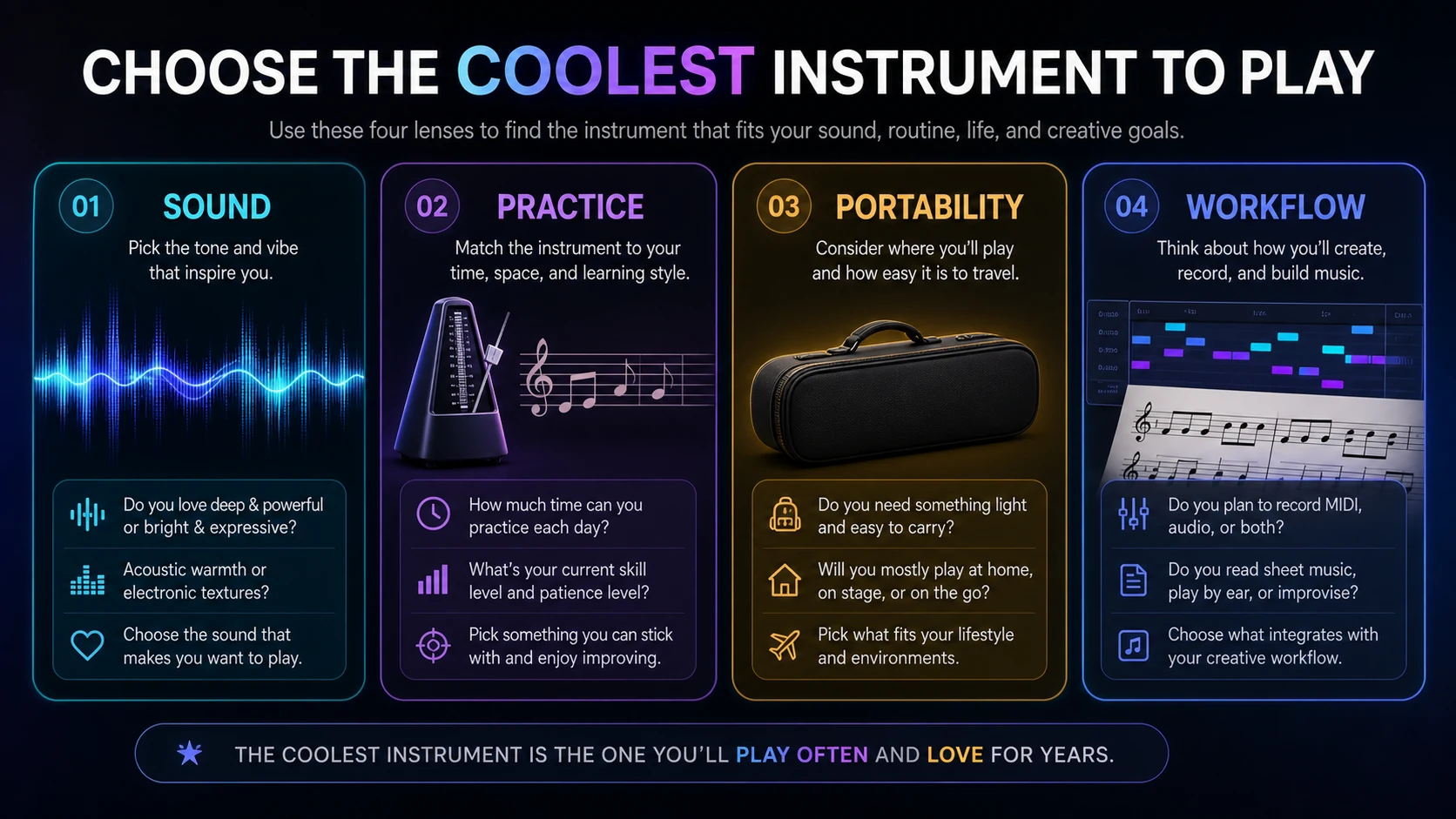
Sound is the emotional hook. If you do not love the sound, practice will feel like homework.
Practice is the friction test. Ask whether you can realistically practice the instrument in your home, at your volume level, with your schedule.
Portability changes how often you play. A ukulele, flute, melodica, or small MIDI controller can follow you around. A drum kit, cello, or acoustic piano needs more planning.
Workflow matters more than modern learners expect. If you want to write, record, arrange, or learn from songs, the instrument's relationship to tabs, notation, audio, and MIDI should influence the decision.
Match the instrument to your musical personality
Use this as a faster filter than scrolling endless rankings.
| If you want to feel like... | Start with | Why |
|---|---|---|
| A riff-driven performer | Electric guitar | It gives fast access to hooks, effects, and recognizable parts |
| A melodic solo voice | Saxophone, trumpet, flute, violin | These instruments carry lines that people notice immediately |
| A groove architect | Drums, electronic pads, bass guitar | They control time, pulse, and the physical feel of the music |
| A songwriter or arranger | Piano, keyboard, guitar | They let you hear harmony and structure while you build a song |
| A producer | Synthesizer, MIDI controller, drums, keyboard | The instrument connects directly to sound design and DAW work |
| A score-first musician | Piano, violin, flute, trumpet, cello | Written music and structured practice materials are easy to find |
| A portable practice person | Ukulele, flute, melodica, compact MIDI keyboard | Lower setup friction means more small practice sessions |
This is where "cool" becomes personal. The coolest instrument for a producer may be a MIDI controller because it opens drums, bass, pads, and orchestration. The coolest instrument for a singer-songwriter may be guitar because it travels well and supports songs quickly. The coolest instrument for a film-score fan may be cello because one line can carry the whole mood.
Think about reading, tabs, and MIDI early
An instrument is not only a sound source. It also determines the kind of learning material you will use.
Guitar players often begin with chord sheets, tabs, and song tutorials. If that is your lane, the existing guide to types of guitar is a better next step than trying to compare every instrument at once.
Keyboard players usually benefit from a cleaner note map. If you like piano but want alternatives, the guide to instruments like a piano compares acoustic piano, digital piano, organ, synth, harpsichord, melodica, and more by touch and sound behavior.
Band and orchestral players need to care about written pitch, concert pitch, range, and clefs. That is where transposing instruments becomes useful, especially for trumpet, saxophone, clarinet, and horn families.
The point is simple: the instrument chooses your practice language. Guitar might mean tabs. Piano might mean grand staff. Drums might mean grooves and notation grids. Synth might mean MIDI clips and sound patches. Choose the path you are willing to read every week.
Where Melogen fits after you choose
Melogen is most useful after the instrument decision turns into a practical source problem: you have a score, image, PDF, or musical idea and need a first-pass reference you can inspect.
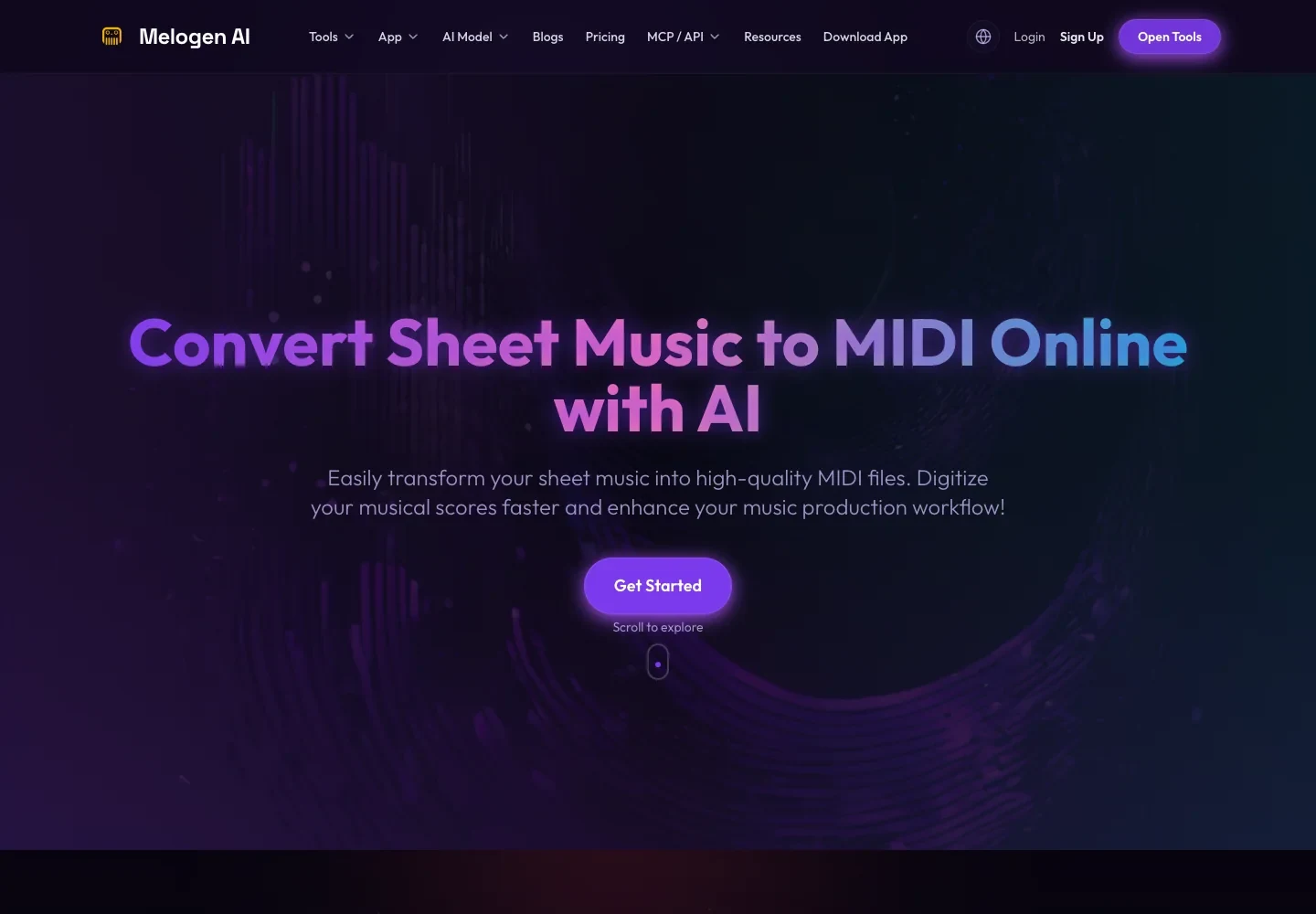
The local Sheet2MIDI page supports visible sheet music inputs such as JPG, PNG, and PDF, then turns recognized notation into editable MIDI for a DAW or music workflow. That is helpful when the cool instrument you chose still needs real practice material.
Examples:
- A piano or keyboard learner can convert a clean practice score and compare playback with hand practice.
- A violin, flute, trumpet, or cello learner can use MIDI playback to hear rhythm and note movement before slowing down hard passages.
- A producer can turn a written sketch into MIDI, then decide whether the part belongs on keys, strings, brass, or synth.
- A guitarist can use notation or audio references as a first pass, then adapt the part to the fretboard.
Melogen will not decide your instrument for you. It helps with the material that comes after the choice: readable notation, editable MIDI, and a practical way to hear what the page is asking you to play.
Turn a clean score into a playable first pass
Use Melogen Sheet2MIDI when your next step is hearing or editing visible notation before practicing it on your chosen instrument.
Try a one-week instrument test
Before buying the instrument that looks the coolest, test the daily reality as much as possible.
- Listen to three songs where the instrument is doing the job you want.
- Watch a beginner lesson and notice whether the first steps feel exciting or irritating.
- Check whether you can practice at home without annoying everyone around you.
- Find one beginner score, tab, chord sheet, or groove exercise you can actually understand.
- Ask what the first month costs after the instrument: case, reeds, strings, sticks, stand, cable, interface, lessons, or maintenance.
- Decide whether you want to play alone, in a band, in a DAW, in an ensemble, or mainly for songwriting.
- Try to imagine the boring day, not the fantasy performance. If you still want to pick it up, that is a strong sign.
This test protects you from two common mistakes: choosing the loudest personality instrument when you need quiet daily practice, or choosing the most convenient instrument when your ear is clearly in love with something else.
The practical takeaway
The coolest instrument to play is not decided by the internet. It is decided by the overlap between sound, identity, routine, and workflow.
If you want the fastest emotional spark, start with the sound you love. If you want the highest chance of sticking with it, add the boring filters: practice space, learning material, cost, portability, and how the instrument connects to notation, audio, or MIDI.
Use the shortlist like this:
- Pick electric guitar or bass if riffs, bands, and groove are the pull.
- Pick saxophone, trumpet, flute, violin, or cello if a melodic voice is the pull.
- Pick drums or electronic pads if rhythm is the pull.
- Pick piano, keyboard, synth, or MIDI controller if harmony, writing, production, or arrangement is the pull.
Then stop researching for a while. Choose one instrument, build a first-week practice loop, and make the sound real.
About the author
Zhang Guo
Composer - AI Product Manager
AI product manager and digital marketing consultant with a background in music. Creativity is the bridge between rhythm and logic, where musical intuition and mathematical precision can coexist in every meaningful product decision.
Follow on X