Transposing Instruments: Concert Pitch Guide
Learn transposing instruments, concert pitch, written pitch, common instrument rules, and a practical MusicXML or MIDI cleanup workflow.
 Zhang Guo
Turn a static score into editable MIDI
Contents
Transposing instruments are instruments whose written notes do not sound at the same pitch. A B-flat clarinet player reads a written C, but the note that comes out is concert B-flat. A horn in F reads a written C, but it sounds concert F.
That sounds like a notation trick until you have to scan a score, prepare a part, export MusicXML, or check MIDI playback. Then the practical question becomes simple: what does the ensemble need to hear, and what should each player read?
This guide gives you the parent map. It explains concert pitch, written pitch, the common transposition directions, where octave instruments need extra care, and how to use MusicXML or MIDI as a cleanup check without letting the software make the musical decision for you.
What Transposing Instruments Mean
A non-transposing instrument reads and sounds the same note name. Piano, flute, oboe, violin, and many voices are usually treated this way in standard notation. If the page says C, the sounding pitch is C.
A transposing instrument reads one note name and sounds another. The notation lets a player use familiar fingerings across instruments in the same family. That is why a B-flat clarinet, A clarinet, E-flat alto sax, and F horn can all read parts that look normal to the player even though the ensemble hears different concert pitches.
The two terms to keep separate are:
| Term | Meaning | Who usually cares |
|---|---|---|
| Concert pitch | The pitch the audience, piano, conductor score, or DAW actually hears | Conductor, arranger, producer, playback check |
| Written pitch | The note printed in the player's part | Instrumentalist, copyist, notation editor |
| Transposition interval | The distance between written pitch and sounding pitch | Anyone preparing or correcting parts |
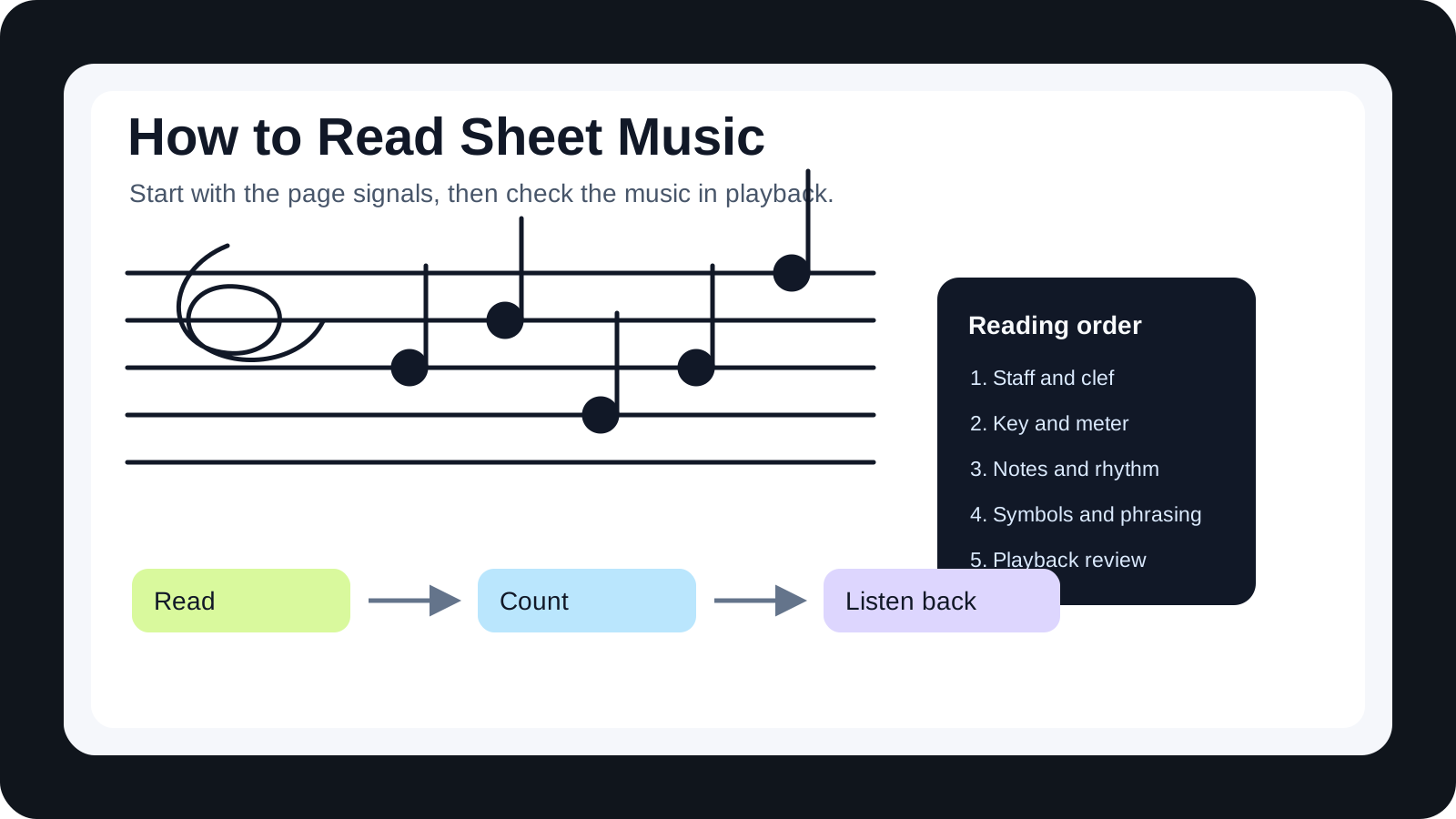
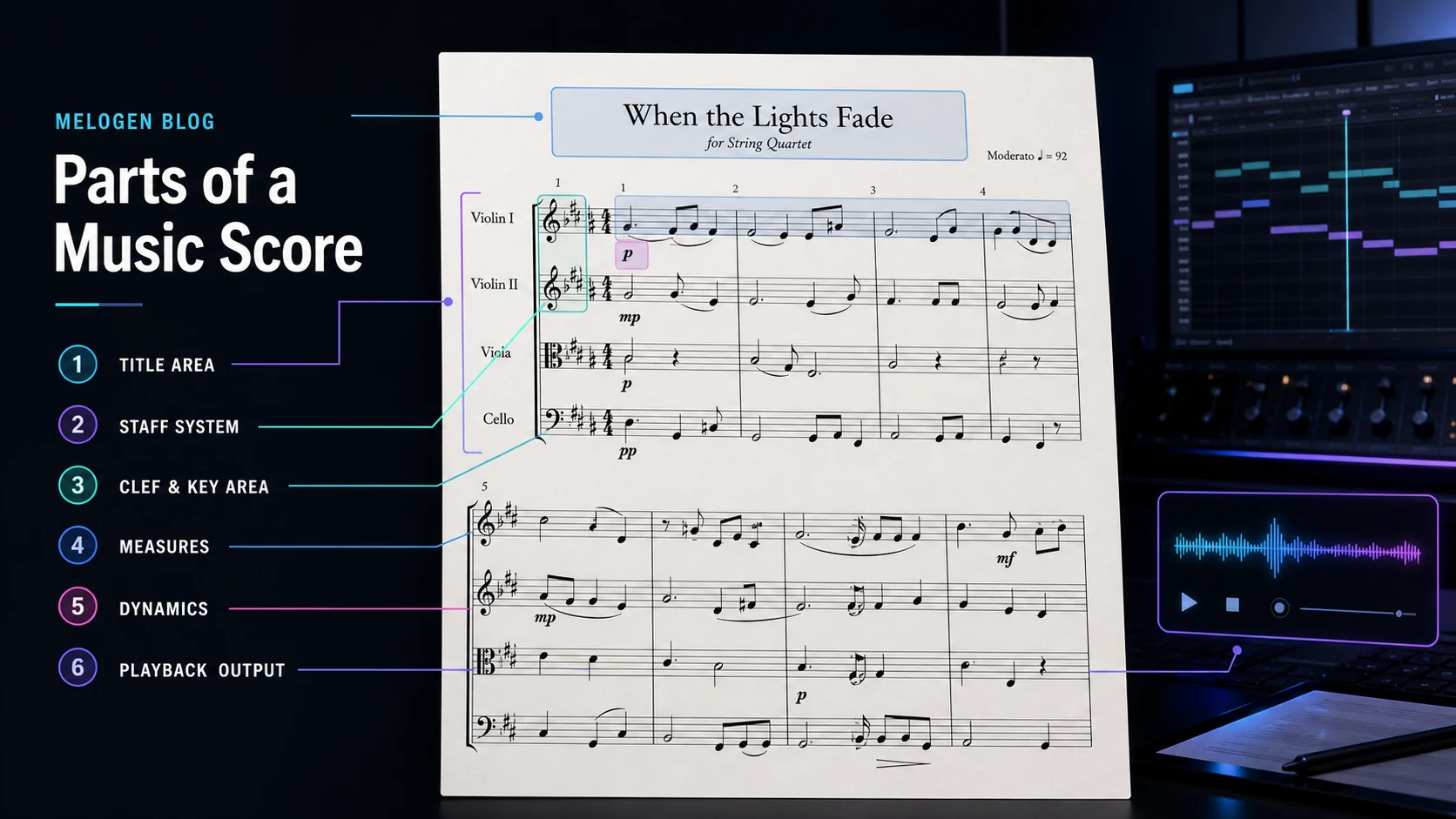
If you are still building the basic notation map, start with Melogen's how to read sheet music guide first. Clef, staff, rhythm, and key signatures are still the foundation. Transposition adds one more layer: written note versus sounding note.
Common Transposing Instruments and Rules
Most practical transposition work starts with one question: when this instrument reads written C, what concert pitch sounds?
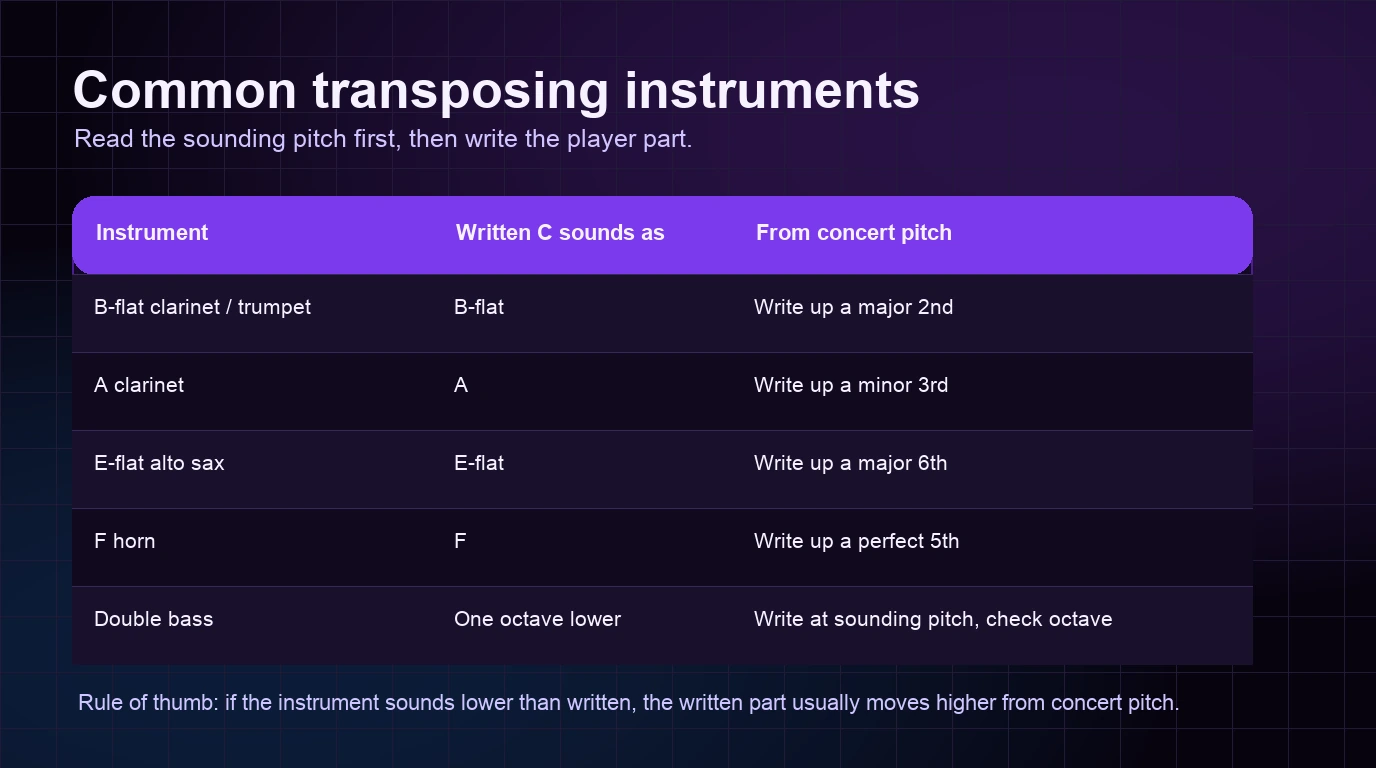
Use this table as a first-pass reference:
| Instrument | Written C sounds as | From concert pitch to player part | Common warning |
|---|---|---|---|
| B-flat clarinet | Concert B-flat | Write up a major second | Do not forget the key signature |
| B-flat trumpet | Concert B-flat | Write up a major second | Same written direction as B-flat clarinet |
| A clarinet | Concert A | Write up a minor third | Common in orchestral and chamber parts |
| E-flat alto saxophone | Concert E-flat | Write up a major sixth | Easy to confuse with down-a-minor-third thinking |
| F horn | Concert F | Write up a perfect fifth | Check old scores and clef conventions carefully |
| Double bass | Sounds one octave lower than written | Usually write at sounding note name, then check octave | Octave displacement matters more than key |
The direction in the third column is the one arrangers often need: you have a concert-pitch melody and need to create a part the instrumentalist can read.
Concert Pitch vs Written Pitch
The easiest way to avoid mistakes is to name the direction before moving notes.
If you are going from a concert score to a B-flat clarinet part, write the part up a major second. Concert C becomes written D. Concert F major becomes written G major. When the clarinet plays that written D, the ensemble hears concert C.
If you are going the other way, from a B-flat clarinet part into a concert-pitch score, undo the transposition. Written D becomes concert C. Written G major becomes concert F major.
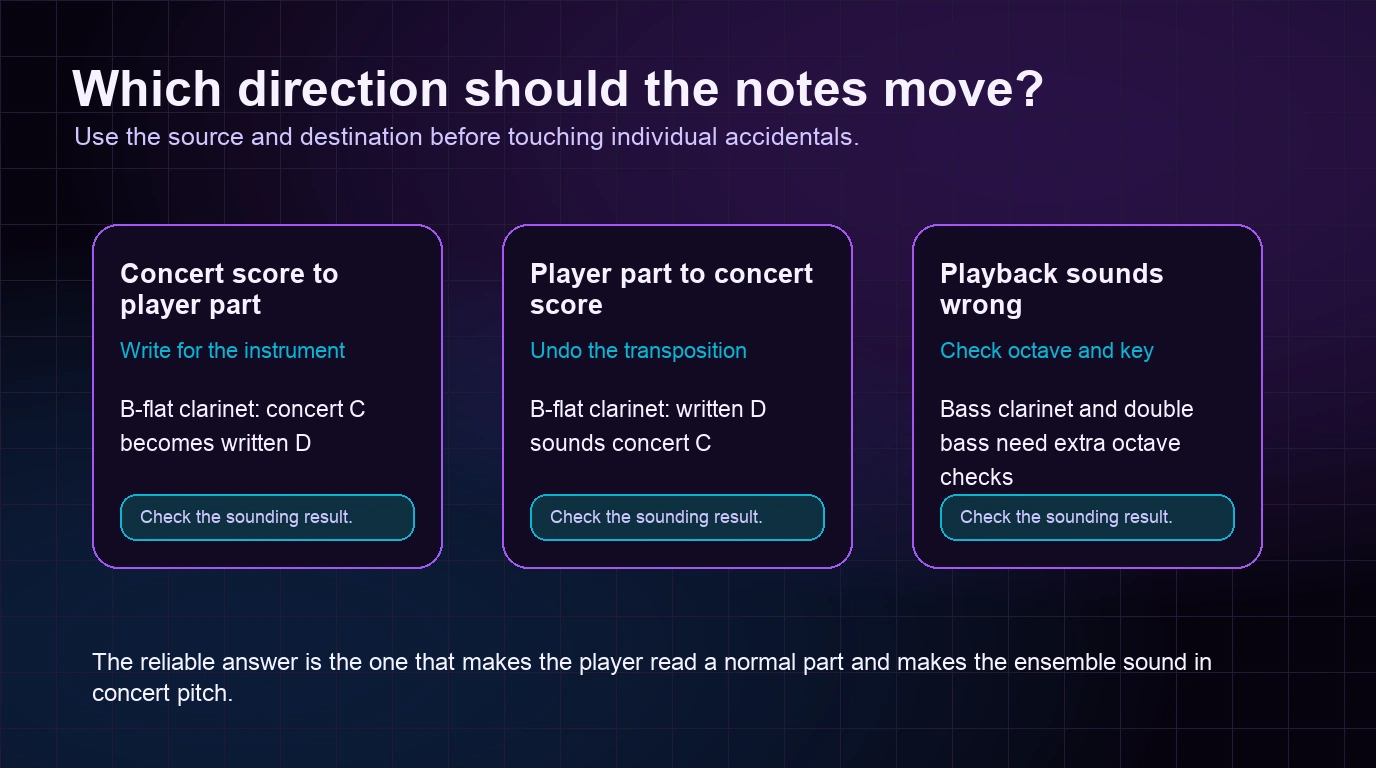
This is where many wrong parts come from. Someone transposes the notes but leaves the key signature behind. Or they fix the key signature but miss accidentals. Or they import a transposed part into a DAW and think the MIDI is wrong when the file is simply written for a transposing instrument.
The reliable check is not the note name alone. It is the sounding result. Put the part against a concert-pitch reference, play it slowly, and ask whether the harmony lands where the ensemble expects.
How to Transpose Without Losing the Key
Use a small sequence instead of editing note by note.
- Confirm the source. Is it already a player part, or is it concert pitch?
- Confirm the instrument. B-flat clarinet, A clarinet, alto sax, horn in F, and double bass do not share the same rule.
- Move the key signature first.
- Move the melody or part by the same interval.
- Proofread accidentals that fall outside the key.
- Check octave placement for bass clarinet, double bass, piccolo, guitar, and other octave-displaced parts.
- Audition against a concert-pitch reference.
Here is a simple B-flat clarinet example:
| Concert pitch source | Written B-flat clarinet part | Why |
|---|---|---|
| C major | D major | The player reads one whole step higher |
| Concert C | Written D | Written D sounds concert C |
| Concert F | Written G | Written G sounds concert F |
For a horn in F, the move is larger. A concert C becomes written G. For an A clarinet, concert C becomes written E-flat. The exact interval matters, but the workflow is the same: source, instrument, key, notes, accidentals, octave, playback.
Melogen's clarinet transposition guide goes deeper on B-flat, A, E-flat, and bass clarinet cases. Treat that as a child guide for clarinet-specific cleanup; this page is the broader parent map.
When MusicXML or MIDI Helps
Transposition is a musical decision, but file formats can make the checking process faster.
MusicXML is usually better when you need notation structure. It preserves measures, clefs, voices, key signatures, dynamics, and other score details that matter when you open the file in MuseScore, Dorico, Sibelius, Finale, or another notation editor.
MIDI is better when you need to hear whether the sounding pitches land correctly. It will not preserve engraving in the same way, but it makes wrong registers, wrong keys, and bad playback obvious very quickly.
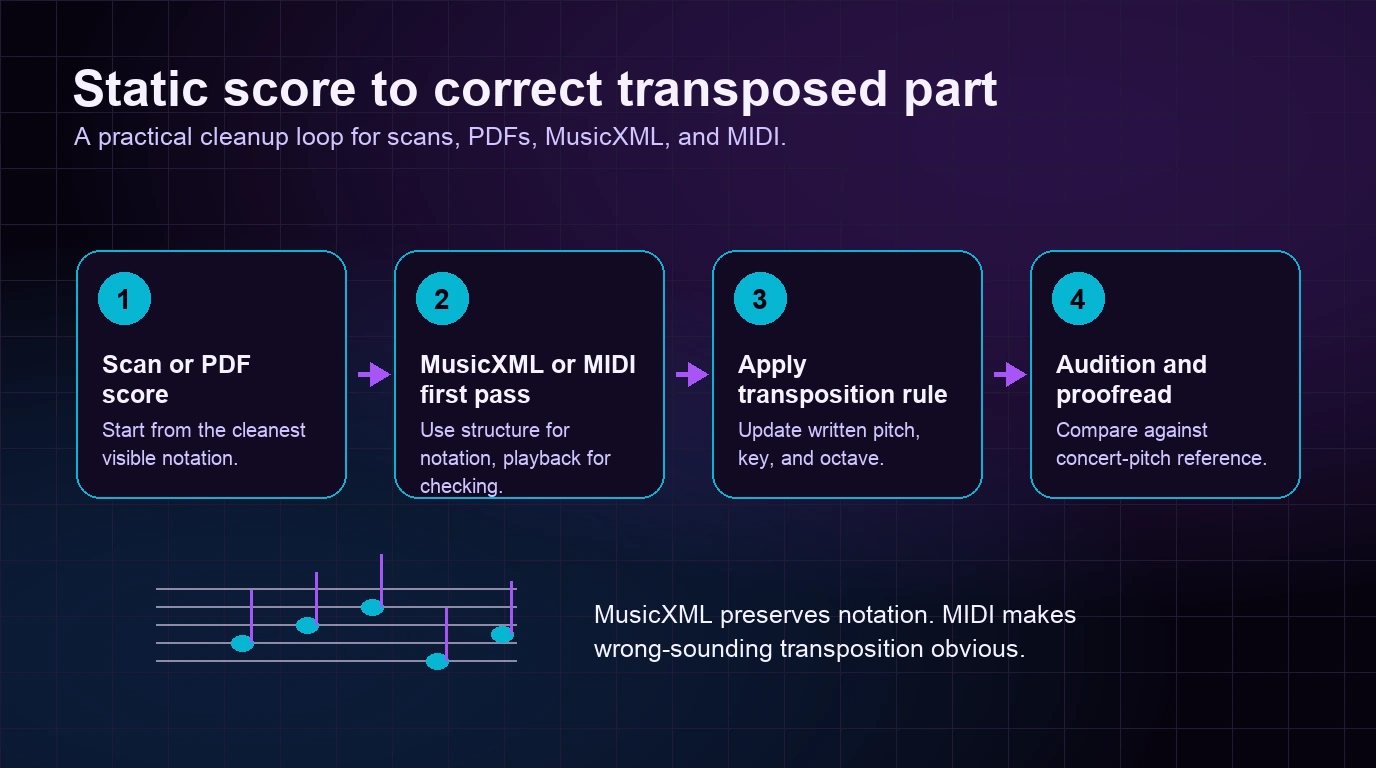
Use the format that matches the next check:
| Your next task | Better first file | What to check |
|---|---|---|
| Prepare a clean player part | MusicXML | Key signature, clef, voices, layout, accidentals |
| Hear whether the part sounds in the right key | MIDI | Pitch, register, harmony, entrances |
| Import a scanned score into notation software | MusicXML | Measures, staves, articulations, text |
| Build a DAW mockup | MIDI | Track split, octave, instrument assignment |
If the format choice is still unclear, read the MIDI vs MusicXML comparison. For transposing instruments, MusicXML tends to be safer for print and part preparation, while MIDI is the faster truth test for sound.
Common Mistakes to Check
The mistake is rarely one isolated note. It is usually one layer of the score being treated as if it were another.
The most common errors are:
- Reading a player part as if it were concert pitch.
- Moving notes but forgetting to move the key signature.
- Fixing the key signature but missing local accidentals.
- Ignoring octave displacement for double bass, guitar, piccolo, or bass clarinet.
- Assuming all staves in a scanned score share one key signature.
- Judging a MIDI import before asking whether the source was a transposed part.
Be especially careful with older scores, school-band parts, and mixed-instrument PDFs. A conductor score may show transposed parts, concert-pitch parts, or a mix depending on the edition and use case. Before you clean anything, look at the instrument names and key signatures across staves.
Where Melogen Fits
Melogen is useful when the score is trapped in a static file and you need an editable first pass. If you have a PDF, scan, or photo, the goal is not to ask the tool to make final orchestration choices. The goal is to move the notation into a format where you can inspect it.
Use PDF to MusicXML when you want to open the score in notation software and correct written parts, key signatures, measures, and layout. Use Sheet2MIDI when playback is the fastest way to hear whether the transposition landed correctly.
Move a static score into editable notation first
Use Melogen PDF to MusicXML or Sheet2MIDI for the first pass, then finish transposition, key signatures, and octave checks in your notation editor or DAW.
The important boundary: Melogen helps you get from static notation to editable material. It does not replace the musical judgment of knowing which instrument reads which part. Keep the transposition rule visible while you review the output.
Frequently Asked Questions
Why do transposing instruments exist?
They let players keep familiar fingerings and written patterns across instruments whose sounding pitch is different. The instrument design changes the sound; the written part keeps the player workflow manageable.
Is guitar a transposing instrument?
Guitar is commonly written one octave higher than it sounds, so it is an octave-transposing instrument. The note names are usually the same, but the sounding octave is lower than written.
Are all clarinets transposed the same way?
No. B-flat clarinet, A clarinet, E-flat clarinet, and bass clarinet need different checks. The B-flat clarinet rule is common, but it is not the whole clarinet family.
Should I transpose before or after scanning sheet music?
If the source is only available as a PDF or image, scan or convert it first, then transpose in an editable notation or DAW environment. That gives you a clearer place to check key signatures, accidentals, and playback.
The Practical Takeaway
Transposing instruments are not confusing because the theory is impossible. They are confusing because written pitch and sounding pitch get mixed together during copying, scanning, exporting, and playback.
Start with the source. Decide whether you are reading concert pitch or a player part. Name the instrument. Move the key signature and notes in the correct direction. Then listen against a concert-pitch reference.
That small workflow keeps the score musical: the player gets a readable part, the ensemble hears the intended key, and your MusicXML or MIDI file becomes something you can actually trust.
About the author
Zhang Guo
Composer - AI Product Manager
AI product manager and digital marketing consultant with a background in music. Creativity is the bridge between rhythm and logic, where musical intuition and mathematical precision can coexist in every meaningful product decision.
Follow on X