Fingerings for Trumpet With Chart and Practice Tips
Learn fingerings for trumpet with a beginner chart, valve patterns, note-reading checks, and a practical Sheet2MIDI practice workflow.
 Zhang Guo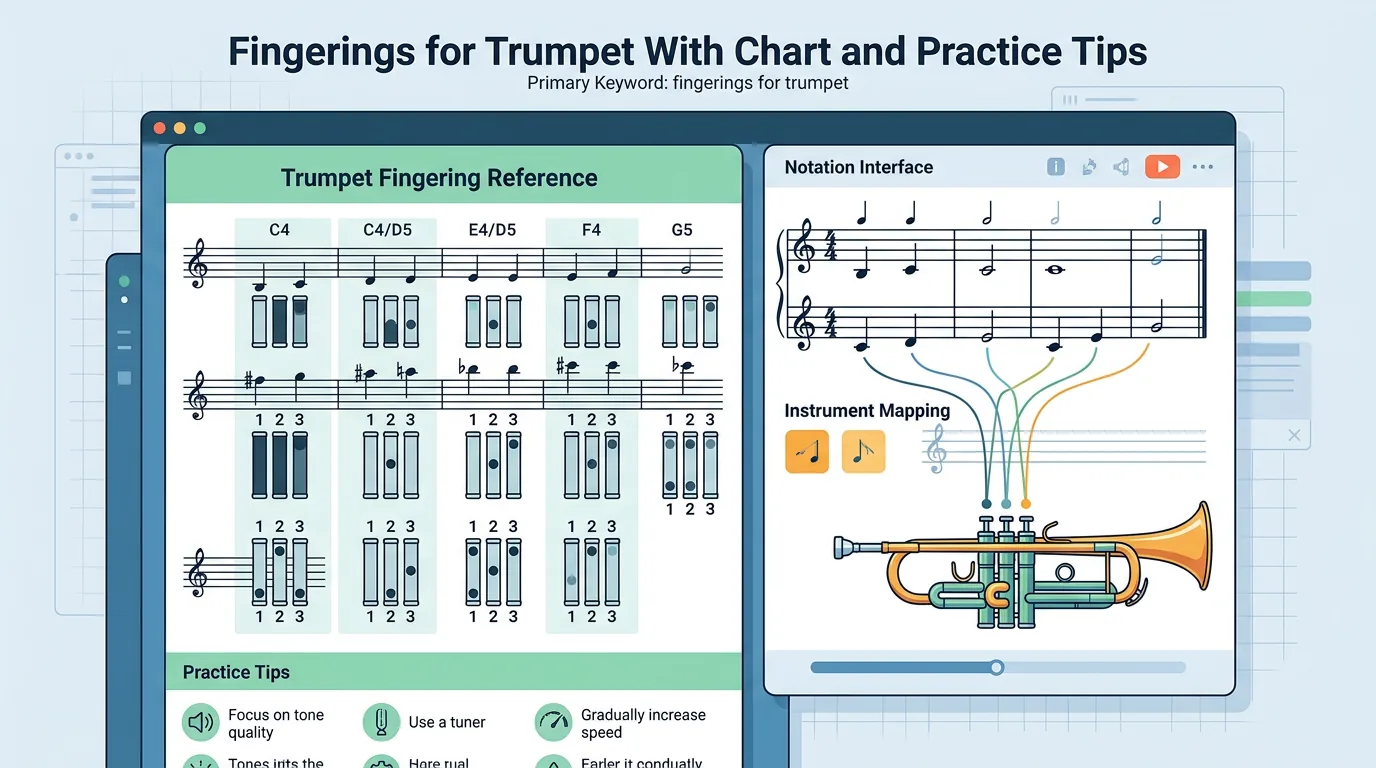
Turn a static score into editable MIDI
Contents
Fingerings for trumpet start with one question: what written note is on the page, and which valve combination gets you close enough to play it in tune? For most beginner B-flat trumpet music, you read the written note, choose the valve pattern, keep the rhythm steady, then use your ear and a tuner to clean up pitch.
The chart below gives the common starting fingerings. It is not a substitute for listening, because trumpet intonation changes with range, volume, mouthpiece, and player setup. It is the map you use before the real practice begins.
Start with written pitch before concert pitch
Most school, band, and method-book trumpet parts for B-flat trumpet are written as transposed trumpet parts. That means a written C sounds as concert B-flat. When you are learning fingerings, stay with the written note on the trumpet part. If you mix written pitch and concert pitch too early, the valve chart starts to feel random.
Use this order when a note appears:
- Name the written note.
- Check the octave and staff position.
- Choose the common valve pattern.
- Count the rhythm before you play.
- Listen for pitch and adjust with air, embouchure, slides, or alternate fingerings when needed.
That order matters because valves only answer one part of the problem. A correct fingering with a late entrance still sounds wrong. A correct fingering with tense air can land sharp, flat, or on the wrong partial.
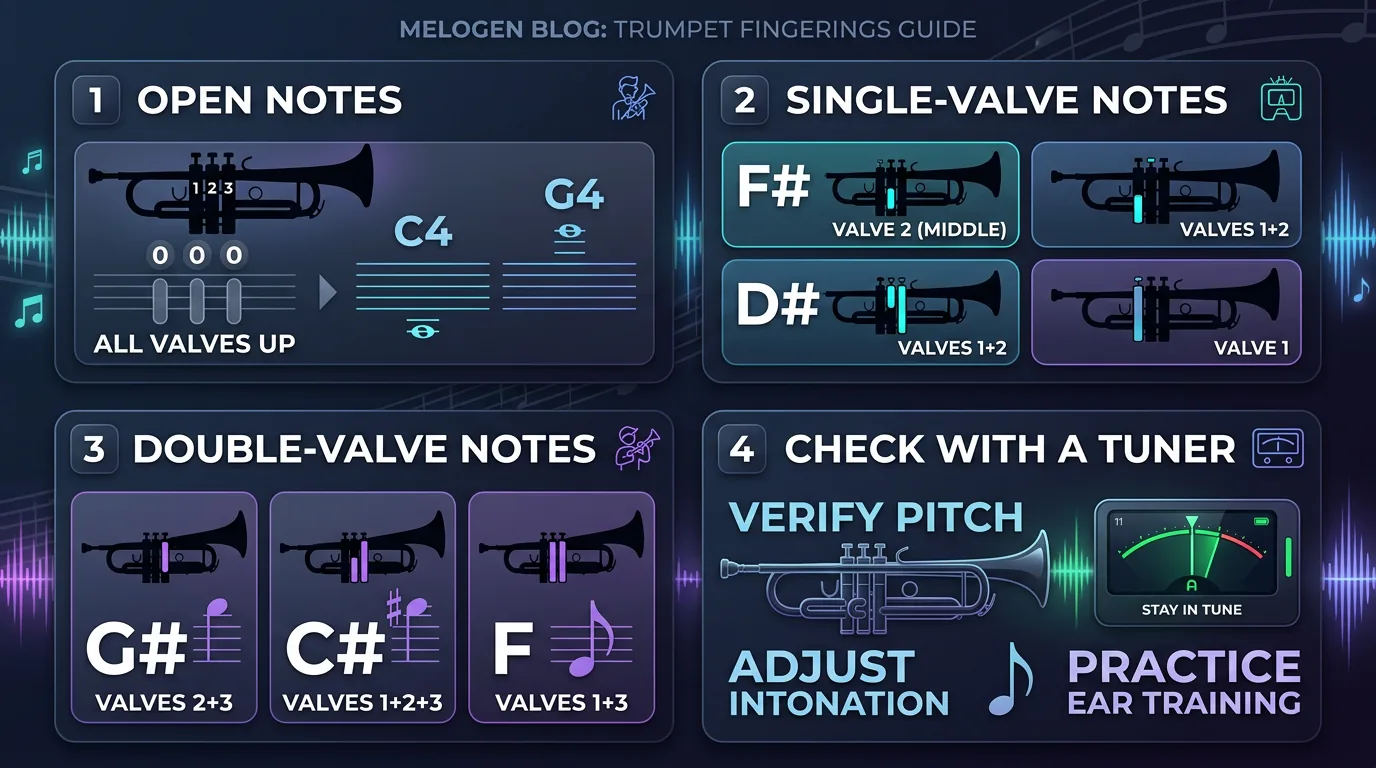
Read the basic trumpet fingering chart
Use this as a beginner reference for common written notes on B-flat trumpet. 0 means open, with no valves pressed. 1, 2, and 3 refer to the first, second, and third valves from the player's left to right.
| Written note | Common fingering | What to watch |
|---|---|---|
| Low F-sharp | 1-2-3 | Often needs slow air and a relaxed setup |
| Low G | 1-3 | Check the third-valve slide if it sounds sharp |
| Low G-sharp / A-flat | 2-3 | Keep the tone centered, not squeezed |
| A | 1-2 | Same valve shape returns in higher octaves |
| B-flat | 1 | Common first valve note in beginner lines |
| B | 2 | Easy to overblow if the next note is C |
| C | 0 | Open fingering, but pitch still needs support |
| C-sharp / D-flat | 1-2-3 | Use a tuner; this fingering can need slide help |
| D | 1-3 | Third-valve slide often matters here |
| E-flat | 2-3 | Match the pitch to the key, not only the chart |
| E | 1-2 | Keep fingers light and fast |
| F | 1 | Do not let the note sag after long rests |
| F-sharp / G-flat | 2 | Same fingering shape as B, different partial |
| G | 0 | Open note, but easy to crack if air is tense |
This chart covers the core pattern a beginner sees constantly. Higher notes reuse many of the same valve combinations on different partials. That is why hearing the target pitch matters: the same valves can speak as more than one written note.
Learn the pattern instead of memorizing one note at a time
Trumpet valves lower the open instrument in predictable steps. The second valve lowers by a half step, the first valve by a whole step, and the third valve by about a step and a half. In practice, you do not calculate every note while playing, but this logic helps the chart make sense.
| Pattern | Examples | How to practice it |
|---|---|---|
| Open | C, G | Play long tones and match pitch with a tuner |
| Single valve | B with 2, B-flat with 1, F with 1 | Move slowly between open and one-valve notes |
| Two valves | A with 1-2, E-flat with 2-3 | Keep both fingers moving together |
| Three valves | C-sharp with 1-2-3, low F-sharp with 1-2-3 | Listen carefully; these notes often need extra pitch attention |
The useful goal is not to recite a full chart from memory. It is to see a written note, feel the valve shape, and keep time. For broader note-reading basics, keep a general how to read sheet music guide nearby while you practice.
Keep rhythm ahead of finger speed
Beginners often blame fingerings when the real issue is rhythm. If you do not know where the beat lands, even the right valves arrive late. Before playing a new line, clap or count the rhythm once, then finger the notes silently while keeping the pulse.
Use this quick check:
| Signal | Read first | Beginner action |
|---|---|---|
| Key signature | Which notes are sharp or flat | Mark the first accidental that changes a familiar fingering |
| Time signature | Beat grouping | Count one empty measure before playing |
| Repeated notes | Same fingering, new attack | Keep the finger still and focus on tonguing |
| Stepwise motion | Small note movement | Notice repeated valve shapes |
| Leaps | New partial risk | Hear the target note before pressing harder |
If you already practice sight reading, connect this article with the trumpet sight-reading routine. Sight reading and fingerings are not separate skills. One gives you the note map; the other forces that map to stay in time.
Use alternates only after the basic chart is stable
Alternate fingerings can help with tuning, fast passages, or awkward slurs. They can also confuse a beginner who has not stabilized the main chart. Start with the common fingering first. Then change only when you know why the alternate helps.
Good reasons to consider an alternate:
- A note consistently plays out of tune with the standard fingering.
- A fast passage needs a smoother finger motion.
- A slur speaks more cleanly with a different valve choice.
- Your teacher asks for an alternate in a specific register or ensemble context.
Bad reasons:
- The standard fingering feels boring.
- A chart online listed a shortcut without context.
- You are trying to fix rhythm with a different valve pattern.
For C-sharp and D, third-valve slide control can matter more than memorizing a clever alternate. For open notes, air support and pitch center matter more than changing valves, because there are no valves to blame.
Turn written exercises into playback references
Once the fingering chart is familiar, practice with short written exercises. The best material is clean, legal, and simple enough that you can check one problem at a time. Teacher handouts, public-domain method examples, and your own notation are safer than random downloads.
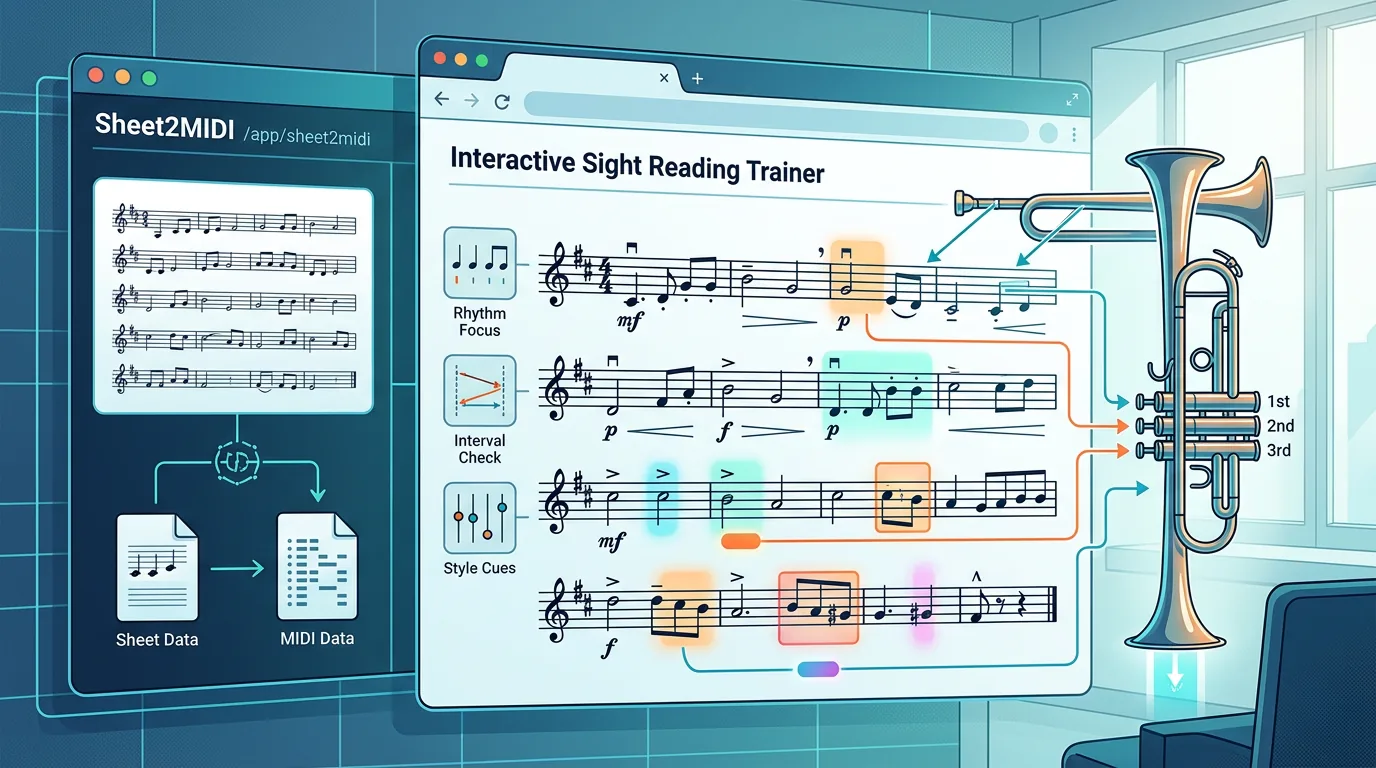
Melogen's Sheet2MIDI workflow supports sheet music images and PDFs such as JPG, PNG, and PDF files, then turns recognized notation into MIDI you can review and download. For trumpet practice, that MIDI is not a finished performance. It is a steady reference for rhythm, note direction, rests, and measure-by-measure cleanup.

Use it this way:
- Scan or export a short exercise you are allowed to use.
- Convert the page into a MIDI reference.
- Listen for rhythm and note direction before playing.
- Finger the line silently with the playback.
- Play one pass on trumpet, then fix one measure.
If your source is a full score or you need a broader conversion workflow, the guide to converting sheet music to MIDI explains how to treat recognition as a first pass rather than a final musical answer.

Build a first-week fingering routine
Do not practice the whole chart as one giant memory task. Practice a small slice every day and connect it to rhythm.
| Day | Focus | Exercise |
|---|---|---|
| 1 | Open notes | Long tones on C and G, then name them on the staff |
| 2 | Single valves | Move between C, B, B-flat, and F |
| 3 | Two-valve shapes | Practice A, E, and E-flat slowly |
| 4 | Low notes | Add low G, low F-sharp, and C-sharp with tuner checks |
| 5 | Rhythm plus valves | Count four-bar lines before playing |
| 6 | Simple sight reading | Read one short beginner line without stopping |
| 7 | Review pass | Write down the three notes you still miss most often |
Keep the review specific. "I am bad at trumpet fingerings" is too vague to help. "I mix up A and B-flat" or "I rush C-sharp after rests" gives you something to fix.
Make a trumpet exercise easier to check
Use Melogen Sheet2MIDI for a first playback pass from clean sheet music, then return to the trumpet and fix the rhythm, pitch, and valve choices yourself.
The practical takeaway
Fingerings for trumpet are easiest when you keep the process small: read the written note, choose the common valve pattern, count the rhythm, then listen. The chart gives you a starting point, but pitch and timing still decide whether the note actually works.
For the next week, practice one tiny loop: name the note, finger it silently, count the beat, play once, and correct one measure. That routine turns the chart from a static reference into a playing skill.
About the author
Zhang Guo
Composer - AI Product Manager
AI product manager and digital marketing consultant with a background in music. Creativity is the bridge between rhythm and logic, where musical intuition and mathematical precision can coexist in every meaningful product decision.
Follow on X