Guitar Chord Progressions That Actually Work
Learn guitar chord progression basics with common patterns, practice rules, songwriting checks, and a Melogen guitar-tab workflow.
 Zhang Guo
Turn a static score into editable MIDI
Contents
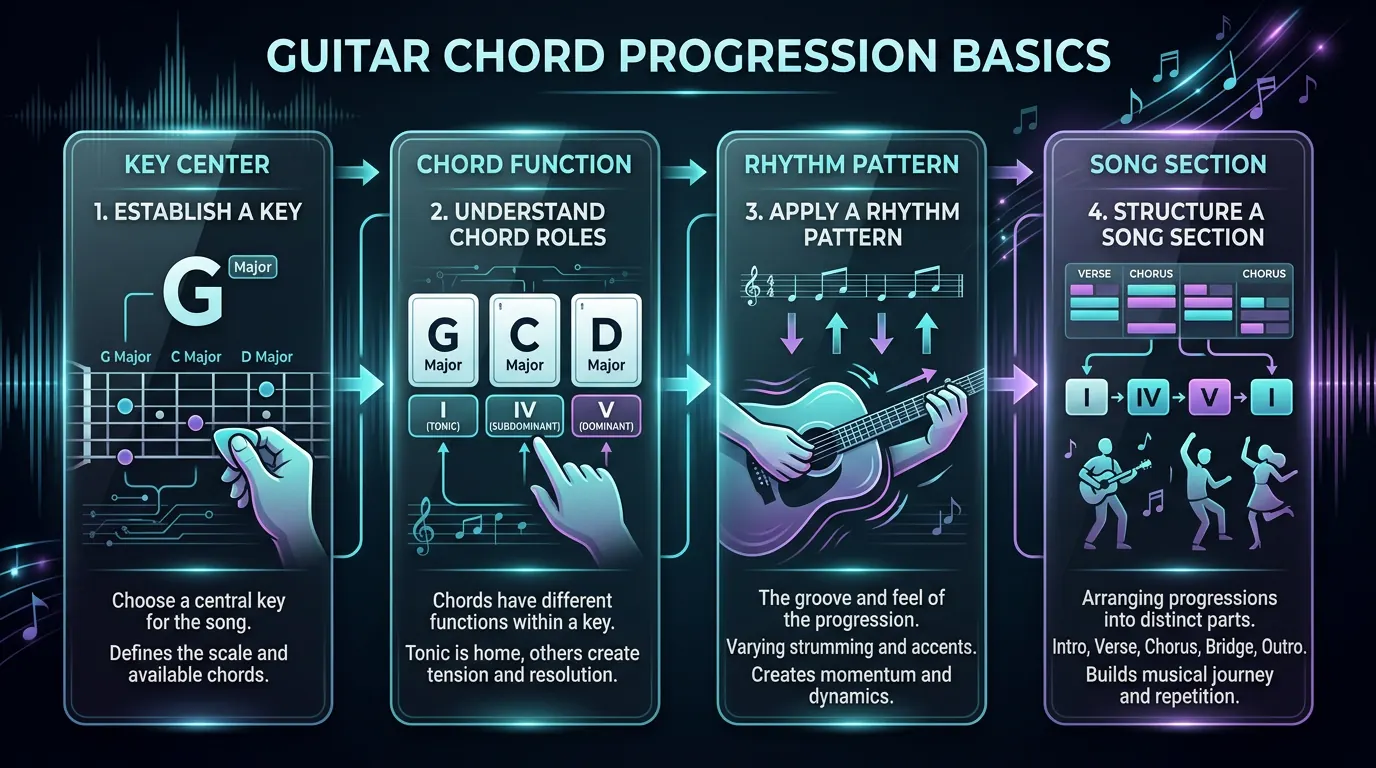
A good guitar chord progression is not just a row of chord names. It is a small decision system: choose a key, decide which chords feel stable or tense, give the right hand a pulse, then place the loop inside a verse, chorus, bridge, or practice sketch.
If you are stuck on progressions, the problem is usually not that you need hundreds of new chords. It is that you need a smaller set of patterns you can hear, move, and revise. This guide gives you that framework: common progressions, when they work, how to practice them on guitar, and how to use a Melogen guitar-tab workflow when your starting point is a song or audio reference.
Name the real decision the reader is making
When someone searches for a guitar chord progression, they may mean three different things:
- a common loop they can play right now
- a way to write a new section
- a way to identify the chords in a song they already hear
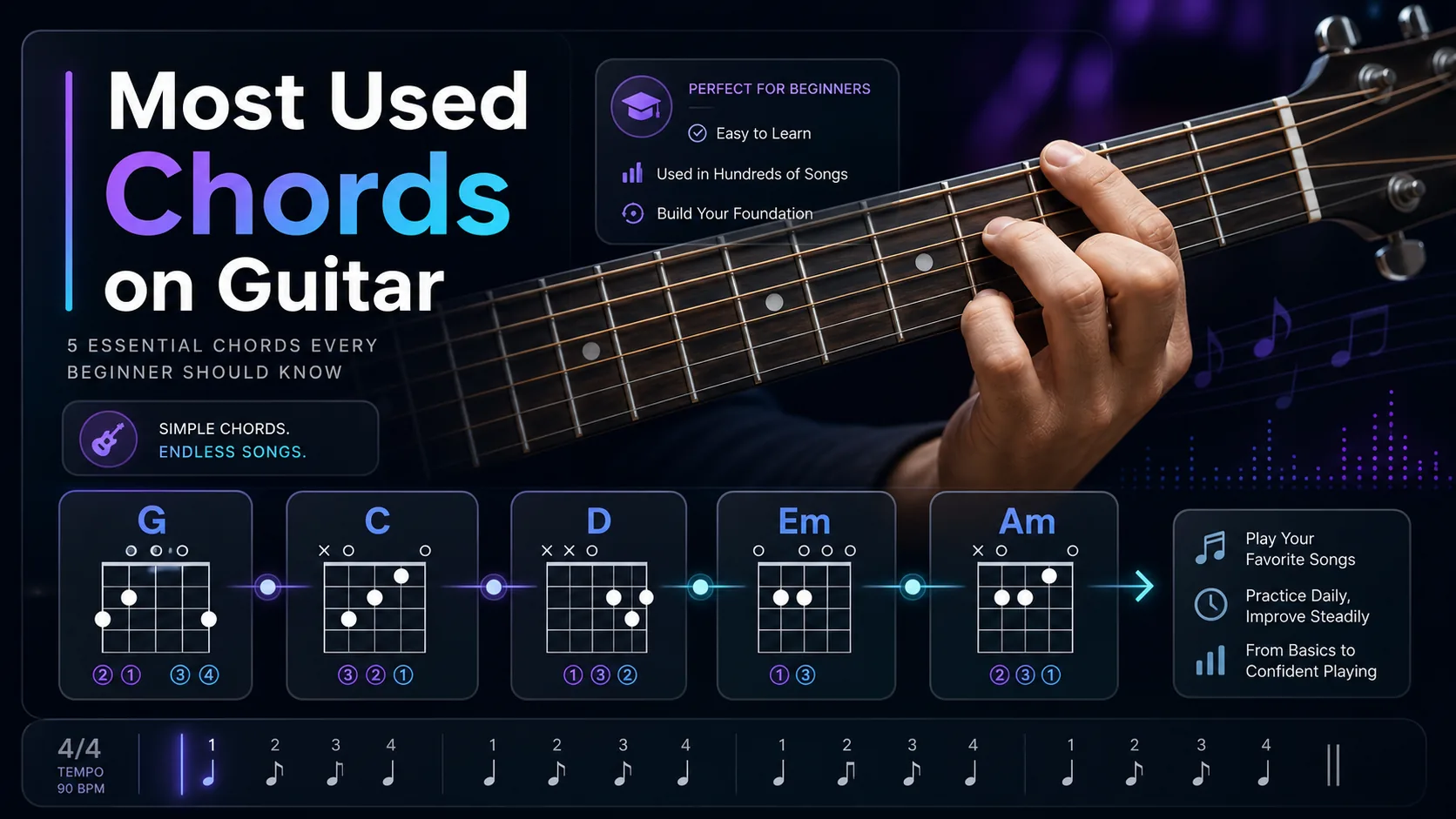
Those jobs overlap, but they are not identical. A beginner who wants a playable loop should start with easy open shapes. A songwriter should ask whether the section needs tension or release. A cover player should focus on hearing the bass movement and matching the strumming feel before polishing voicings.
Use this quick map:
The useful question is not "What is the best progression?" It is "What job does this progression need to do?" Once you name the job, the choices get much smaller.
Compare the options with a simple framework
Most guitar progressions are easier to understand with Roman numerals. In the key of G, I is G, V is D, vi is Em, and IV is C. That lets you move the same pattern to another key without relearning the logic from scratch.
Here are the starter patterns worth knowing:
| Progression | In G major | Best use | What it feels like |
|---|---|---|---|
I-V-vi-IV | G-D-Em-C | pop chorus, big arrival, singable hooks | familiar, balanced, emotional |
vi-IV-I-V | Em-C-G-D | verse-to-chorus lift, softer openings | reflective, then rising |
I-IV-V | G-C-D | folk, blues, rock basics | direct, stable, easy to hear |
I-V-IV-V | G-D-C-D | simple practice loop or bridge | circular, bright, repeatable |
ii-V-I | Am-D-G | jazzier movement or turnaround | directional, resolved |
i-VI-III-VII | Em-C-G-D | minor-key pop and cinematic loops | moody, wide, modern |
Do not treat the table as a ranking. Treat it as a menu. If the part needs to feel settled, start with I-IV-V or I-V-IV-V. If the chorus needs lift, try I-V-vi-IV. If the verse should begin with a darker color, start on vi or use a minor-key loop.
If you are still building basic chord vocabulary, the guide to chords for bass guitar is useful for hearing how roots and harmony support each other, even though bass and six-string guitar play different roles.
Use if/then workflow rules instead of abstract advice
The fastest way to make progressions useful is to connect each choice to a musical action.
Use these rules when you are writing or learning:
| If the section needs... | Try this first | Then check |
|---|---|---|
| a clear beginner loop | I-IV-V | Can you play it cleanly with downstrokes only? |
| a pop chorus lift | I-V-vi-IV | Does the melody land strongly over I or IV? |
| a softer verse | vi-IV-I-V | Does the first chord leave room for the vocal? |
| a blues or rock base | I-IV-V with dominant shapes | Does the strum pattern create enough energy? |
| a more finished turnaround | ii-V-I | Does the final I feel like arrival? |
Then add guitar-specific checks. A progression that looks good on paper can still feel awkward under the hand. Try it with open chords, then try a capo position, then try partial barre or triad shapes higher on the neck. The best progression for a song is often the one that keeps the musical idea clear while staying playable at tempo.
Rhythm matters just as much as the chords. The same G-D-Em-C loop can feel like a ballad, a pop chorus, or a driving folk pattern depending on where the accents land. If the loop feels dull, change the right hand before you change every chord.
Where Melogen is the better route
Melogen is useful when your chord-progression question starts from sound instead of a blank page. The current AI Guitar Tab Generator page is built around songs, audio files, and YouTube links. The local product copy says it supports MP3, WAV, M4A, FLAC, and YouTube links, and it includes guitar-specific controls such as tuning, capo, focus mode, and complexity.
That makes it a good first-pass tool when you are asking:
- What chord loop is this song using?
- Is the main riff built around the same harmony as the chorus?
- Can I get a readable guitar-first reference before I rewrite the part?
- Should I practice the whole song or focus on chords plus tabs?

Use the output as a working reference, not as the final musical answer. A chord-progression draft still needs listening, voicing choices, rhythm checks, and sometimes a different capo or key. If your source is a full audio recording, the broader MIDI for guitarists guide explains when audio, hardware, and transcription workflows make sense. If you are writing at the keyboard first, the related piano guide on how to compose a song on piano starts one step earlier with motif and section planning.
What to do next if the answer is still unclear
If a progression still does not feel right, do not keep adding chords. Diagnose the weak layer.
Use this checklist:
- Key: Can you name the key center and the home chord?
- Function: Which chord feels stable, which chord creates motion, and which chord wants to resolve?
- Shape: Are the chord grips playable at the song tempo?
- Rhythm: Does the strumming pattern carry the section, or is it flattening everything?
- Melody: Does the melody land on notes that fit the chord underneath?
- Section role: Is this loop for a verse, chorus, bridge, intro, or practice drill?
If the problem is harmonic, simplify to three chords and rebuild. If the problem is rhythm, keep the chords and change the strum. If the problem is vocal range, transpose before rewriting the progression. If the problem is guitar comfort, try a capo or a different voicing.
One practical test: record a 30-second phone demo with only the progression and a hummed melody. If the section works in that rough form, it will usually survive better production. If it already feels vague, more arrangement will not fix the core loop.
Generate a guitar-first reference before you refine the part
Use Melogen AI Guitar Tab Generator when your source is a song, audio file, or YouTube link and you need a playable first pass before detailed cleanup.
The practical takeaway
A guitar chord progression works when it supports the section, not when it looks clever in isolation. Start with a small pattern, name the harmonic job, test the strum, and check whether the melody has somewhere natural to land.
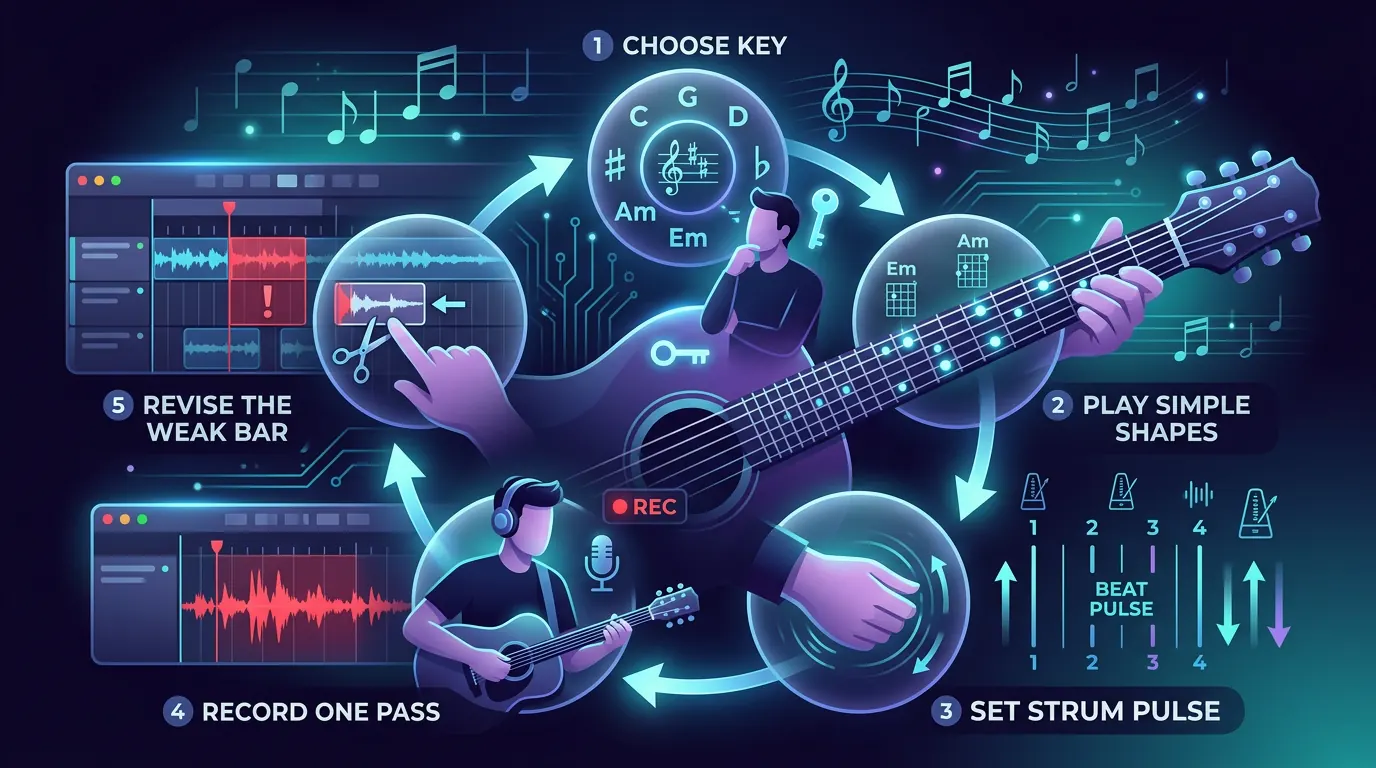
Keep this short practice path:
- Pick one key.
- Choose one progression pattern.
- Play it with simple open chords.
- Add one strumming pulse.
- Record one pass.
- Change only one layer at a time.
If you are learning from an existing song, use a guitar-first reference workflow to identify the chord movement faster, then bring the judgment back to your hands and ears. The goal is not to collect more progressions. It is to make one progression feel clear, playable, and useful inside real music.
About the author
Zhang Guo
Composer - AI Product Manager
AI product manager and digital marketing consultant with a background in music. Creativity is the bridge between rhythm and logic, where musical intuition and mathematical precision can coexist in every meaningful product decision.
Follow on X