Guitar Duets for Better Rehearsal and Performance
Learn how to choose guitar duets, divide two-guitar roles, prepare scores, rehearse timing and balance, and build a reliable performance.
 Zhang Guo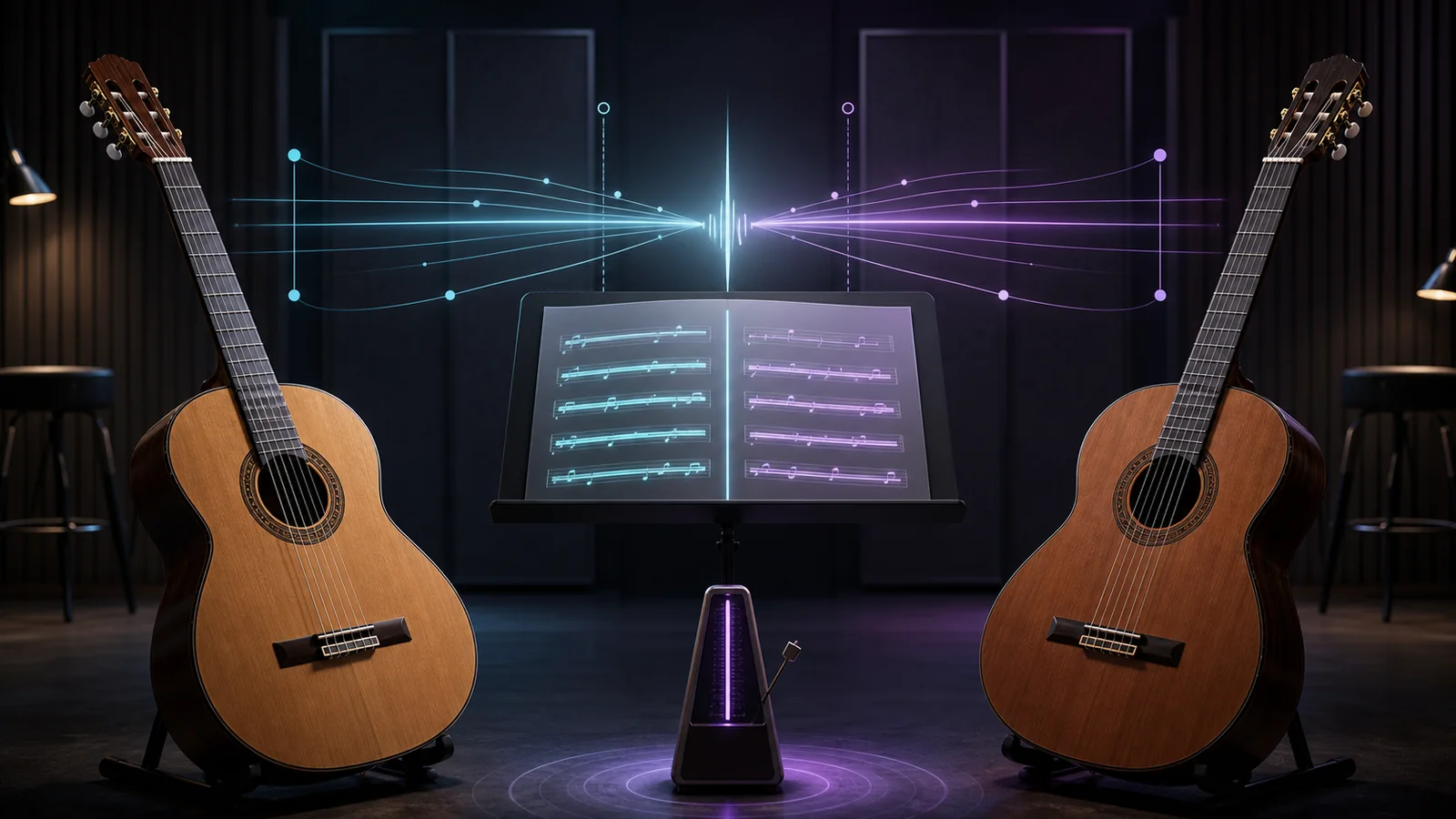
Turn a static score into editable MIDI
Contents
Guitar duets turn two separate parts into one musical system. One guitarist may carry the tune while the other supplies bass and harmony, or the two players may trade phrases, imitate each other, and share the same rhythmic weight. The notation tells you what to play, but a convincing duet also depends on role clarity, a shared pulse, compatible tone, and planned cues.
This guide explains how to choose a two-guitar piece, read the relationship between the parts, prepare the score, practice alone without losing the partner's context, and run rehearsals that produce a reliable performance. It works for classical guitar duets, acoustic arrangements, teacher-student pieces, and two-part ensemble music.
What counts as a guitar duet?
A guitar duet is music written or arranged for two guitar parts. It is not defined by both players strumming the same chords. The parts need a meaningful relationship: melody against accompaniment, question against answer, interlocking rhythm, imitation, counterpoint, or shared harmony.
Most guitar duets use one of three textures:
| Duet texture | Guitar 1 often does | Guitar 2 often does | Main rehearsal risk |
|---|---|---|---|
| Melody and accompaniment | Carries the tune or upper voice | Supplies bass, chords, or repeated figures | Accompaniment covers the melody or rushes |
| Complementary parts | Plays one layer of a larger rhythmic pattern | Fills the gaps or completes the harmony | Each part sounds incomplete alone, so entrances feel uncertain |
| Equal-part dialogue | Trades motifs, phrases, or leading roles | Answers, imitates, or briefly takes the lead | Players fail to hand over the phrase naturally |
These roles can change inside one piece. Mark every important handoff instead of labeling one guitarist "lead" and the other "rhythm" for the entire work.
If standard notation still slows you down, review how to read guitar sheet music before adding the extra coordination of a second part.
Choose a duet both players can actually rehearse
The best duet is not necessarily the most famous or technically impressive one. Choose a piece whose individual parts are manageable and whose ensemble problems can be solved within the time available.
Assess the two parts separately before you commit:
| Question | Easier pairing | More demanding pairing |
|---|---|---|
| Technical level | Both parts sit below each player's maximum | One or both parts are at the player's limit |
| Rhythmic relationship | Shared attacks and clear accompaniment patterns | Syncopation, independent rhythms, or frequent imitation |
| Register | Parts stay in distinct ranges | Voices cross or compete in the same register |
| Tempo control | Stable pulse with few transitions | Rubato, fermatas, tempo changes, or exposed pauses |
| Rehearsal access | Both players can meet consistently | Most preparation must happen separately |
| Score layout | Two parts are easy to see and cue | Separate pages, awkward turns, or unclear rehearsal marks |
For a first duet, a piece with clear phrases and moderate tempo is usually more productive than a fast showpiece. Both players should have enough spare attention to listen outward. If all attention goes to left-hand shifts or right-hand patterns, ensemble timing will be the first thing to disappear.
The instrument pairing matters too. Two nylon-string guitars tend to blend naturally, but a nylon-string and steel-string guitar can also work if the arrangement and dynamics account for their different attack and sustain. Check tuning reference, capo position, amplification, and seating before the first full run.
Find repertoire without skipping the rights check
Start with the musical job: student recital, sight-reading session, wedding arrangement, classical program, or informal acoustic performance. That narrows the level, duration, and texture more effectively than browsing an undifferentiated list of titles.
Public score libraries can help you inspect real two-guitar repertoire. The IMSLP category for two guitars groups works written for that instrumentation. The Mutopia Project page for Ferdinando Carulli's Duet in G, for example, identifies it as a guitar duet and provides score and MIDI downloads under the license displayed on that page.
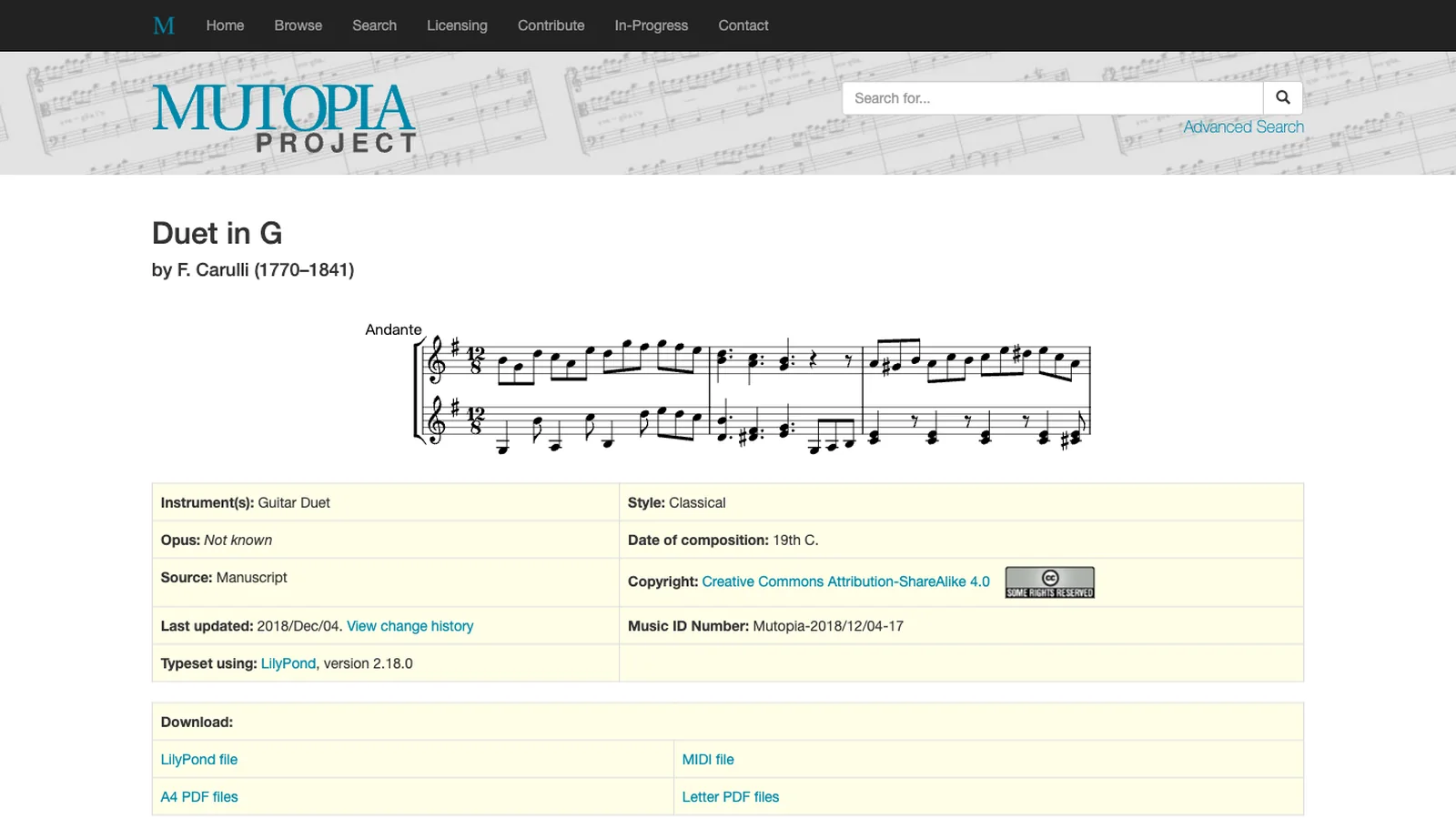
Do not assume that an old composition makes every available file unrestricted. A composition, a particular arrangement or edition, and a sound recording can have different rights. The U.S. Copyright Office overview of musical works and sound recordings explains the distinction between the underlying musical composition and a recorded performance. Confirm the status, license, attribution terms, and local jurisdiction for the exact score or arrangement you plan to copy, distribute, record, or perform.
For contemporary songs, use an authorized edition or create an arrangement only when you have the necessary permission. Rights research is part of score preparation, not a detail to leave until upload day.
Map the musical roles before the first run
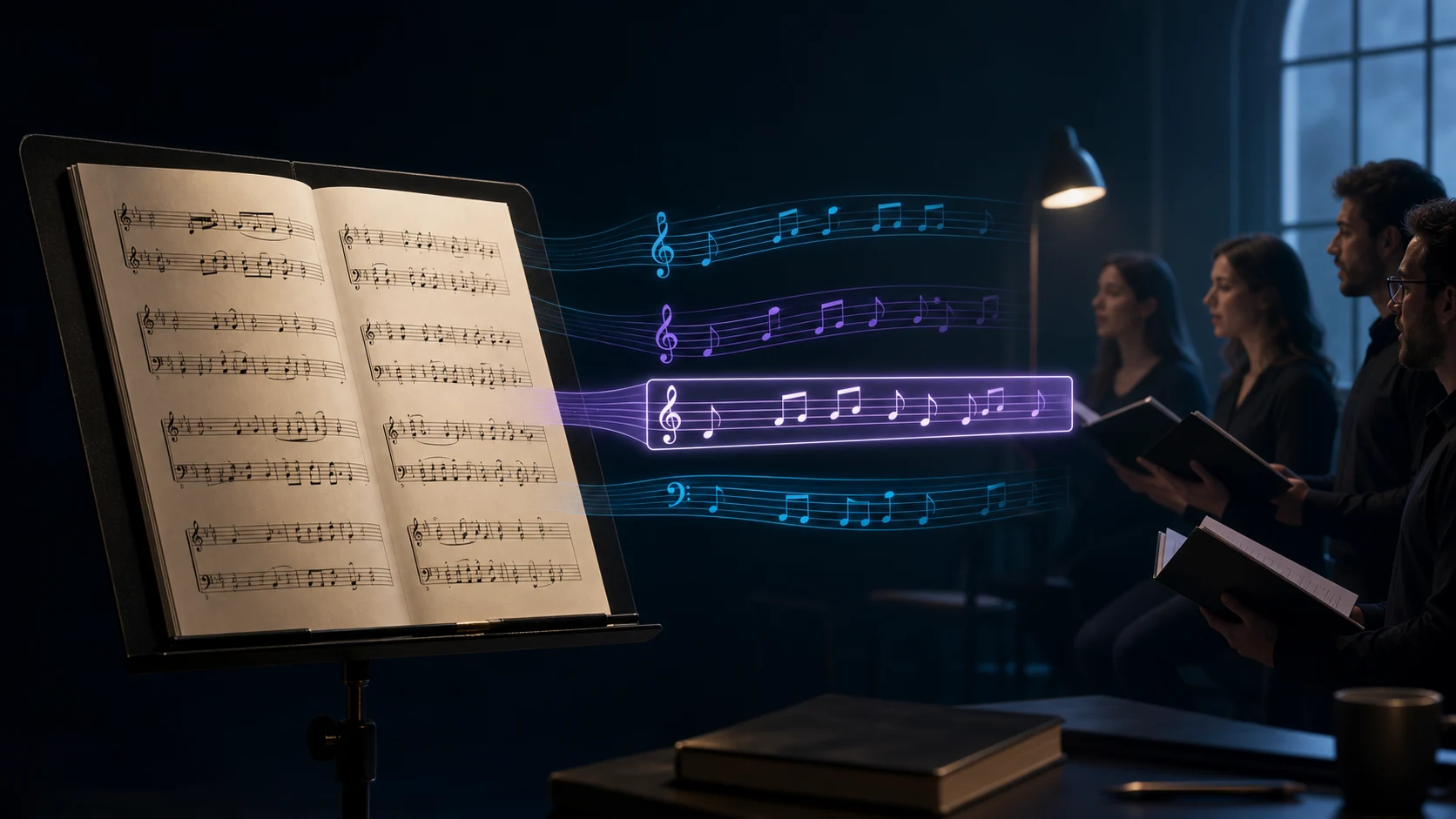
Read both parts together without playing. Circle the places where the musical responsibility changes. You are looking for more than notes: identify who establishes the pulse, who shapes the phrase, and who gives the next reliable cue.
Mark these six items in both scores:
- Melody ownership. Note every bar where the tune moves from one part to the other.
- Pulse anchors. Find repeated bass notes, chord patterns, or subdivisions that stabilize the beat.
- Entry cues. Mark the note, breath, gesture, or harmonic change that precedes an entrance.
- Voice crossings. Identify places where the parts share a register and can mask one another.
- Tempo events. Agree on ritardandos, fermatas, pickups, and returns to tempo.
- Recovery bars. Choose obvious downbeats where both players can rejoin after a mistake.
The markings should match. If Guitar 1 expects a visual cue while Guitar 2 expects the bass line to continue automatically, the disagreement will appear in performance as hesitation.
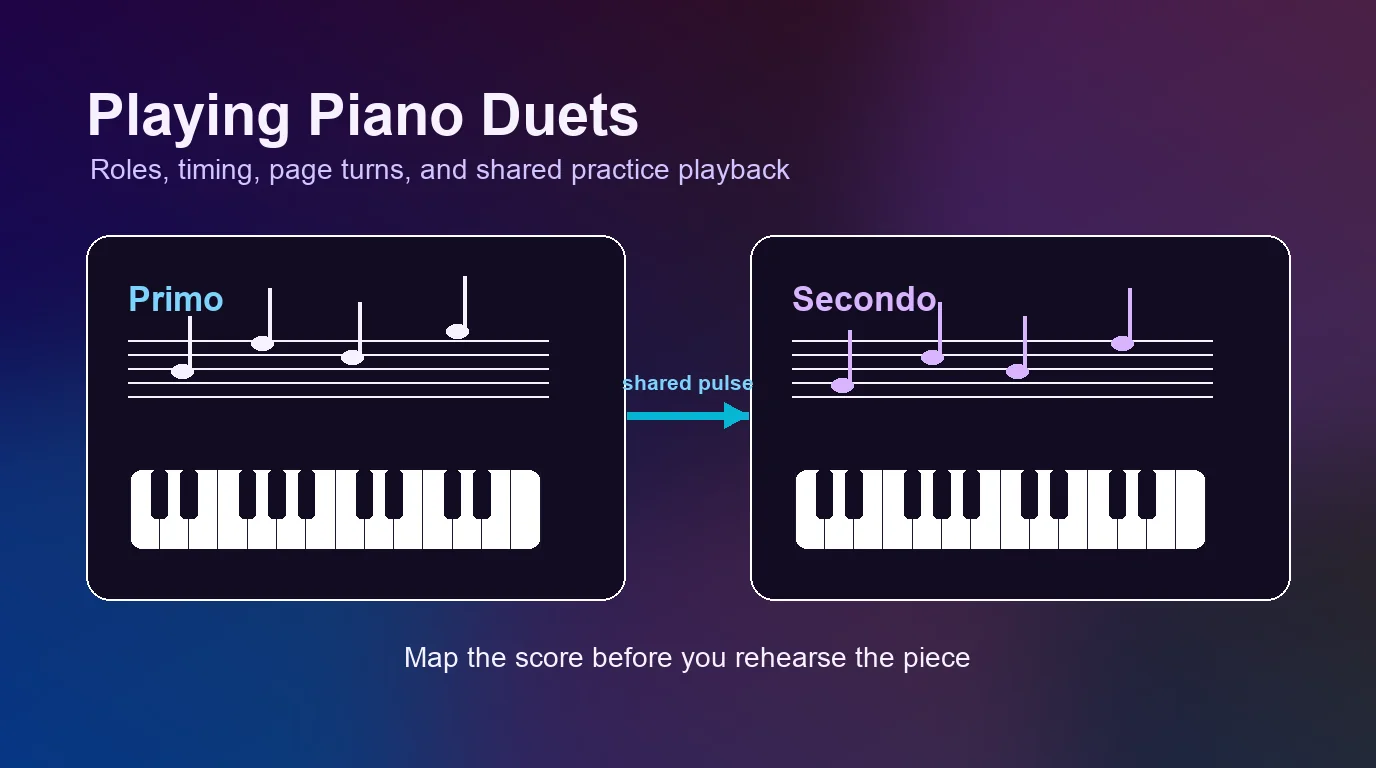
Players who are new to two-part coordination may also benefit from the role-mapping approach in playing piano duets. The instruments differ, but the ensemble questions—who leads, who supports, and where the shared pulse lives—are closely related.
Prepare each part without turning it into a solo
Individual practice is necessary, but it can create the wrong habits if you treat your part as complete by itself. A melody player may stretch phrases without accounting for the accompaniment. An accompaniment player may over-project because the repeating pattern sounds empty alone. Both habits become harder to undo after repetition.
During solo practice, keep the missing part present in one of these ways:
- Count the partner's rests and entrances aloud.
- Sing the other part's cue before your own entrance.
- Tap the partner's rhythm while fingering your notes.
- Write the important bass or melody notes above your staff.
- Record a simple cue track at a steady tempo.
- Start from several recovery bars instead of always beginning at bar one.
Practice transitions, not only difficult measures. In a duet, the bar after a hard passage often fails because both players relax at different moments. Run one or two bars into and out of every technical problem.
Use an eight-bar rehearsal loop
Full run-throughs reveal endurance and structure, but they are inefficient for repairing ensemble problems. A short loop keeps both players focused on the same musical relationship.
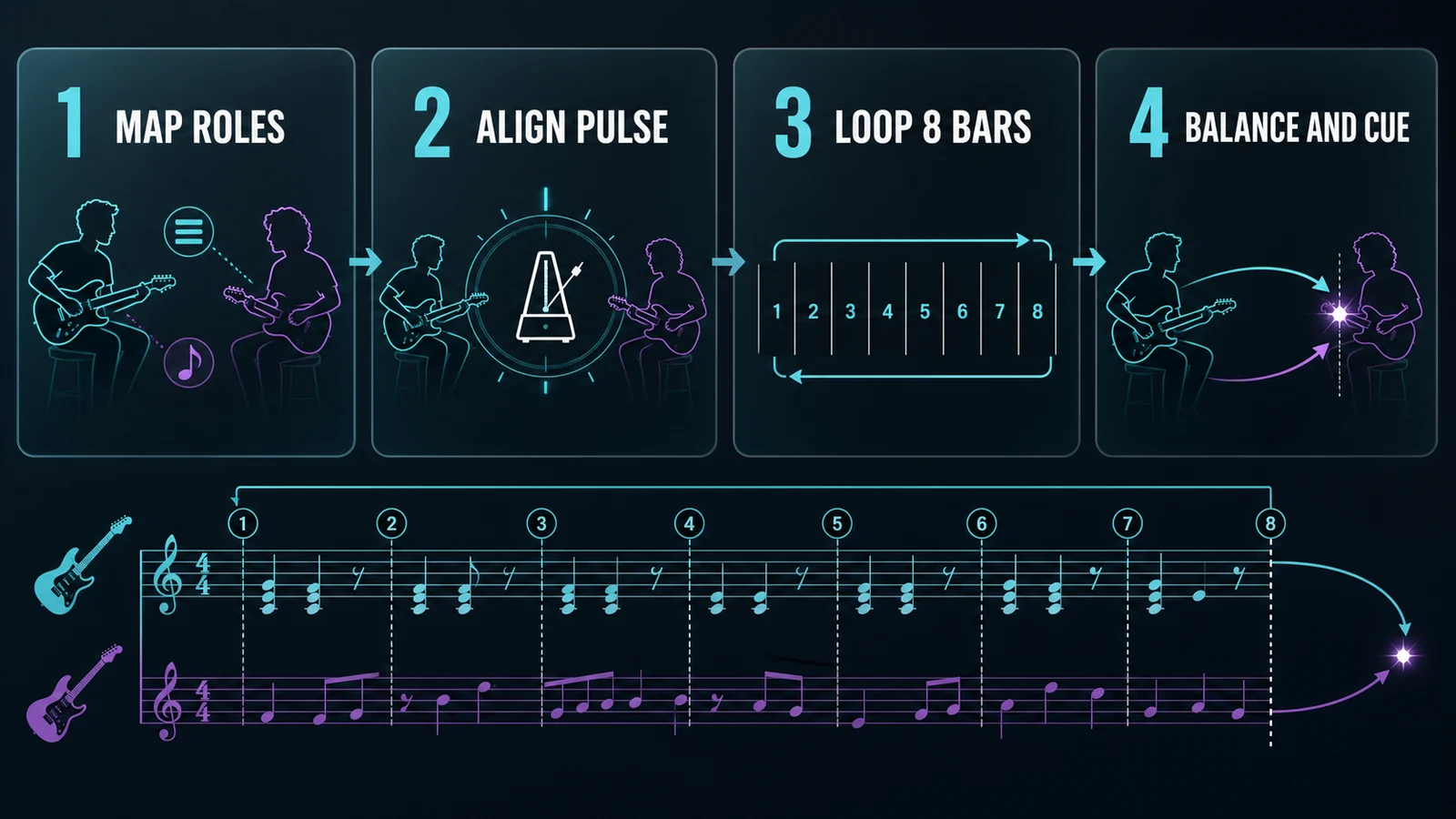
Use this four-step cycle:
- Map the roles. State who has melody, pulse, bass, and cue responsibility in the selected passage.
- Align the pulse. Count or tap the rhythm together before playing. Remove rubato until the attacks are dependable.
- Loop eight bars. Repeat a short musical unit below tempo, including at least one bar before and after the problem.
- Balance and cue. Restore dynamics, phrase shape, eye contact, and physical gestures only after the rhythm holds.
Three clean repetitions are more useful than ten uncontrolled ones. After the third clean pass, change one variable at a time: raise the tempo, add dynamics, restore articulation, or widen the phrase. If the passage breaks, return to the last stable version rather than restarting the whole piece.
Solve timing before polishing tone
Two guitarists can produce beautiful individual tone and still sound disconnected. Timing problems usually come from a hidden disagreement about subdivision, note length, or who owns a transition.
Diagnose the exact failure:
| What you hear | Likely cause | Focused fix |
|---|---|---|
| Chords land almost together | Players feel the beat but not the same subdivision | Count eighth notes or tap attacks together |
| One part pulls ahead in repeated figures | Pattern is running on muscle memory | Accent the shared downbeats and reduce tempo |
| Entrances after rests are late | The resting player stopped tracking the other part | Count through the rest and mark the cue note |
| Ritardando becomes a stop | Nobody owns the rate of slowing | Assign one visual leader and agree on subdivisions |
| Final releases are untidy | Players coordinate attacks but not note endings | Rehearse releases and breathing without the full phrase |
Use a metronome to establish a common reference, then remove it and test whether the players can maintain the pulse together. The goal is not mechanical playing. It is enough rhythmic agreement that expressive timing becomes intentional rather than accidental.
Balance two guitars by musical function
Balance is not simply "both guitars at the same volume." The foreground should change with the score. Melody usually needs more presence, but bass movement, inner counterpoint, or a rhythmic response may briefly become the listener's focus.
Try a balance-only pass at a comfortable tempo. Each player names the other part's most important line after the run. If Guitar 1 cannot describe what Guitar 2 was doing, Guitar 1 was probably listening only to itself.
Adjust balance with several tools:
- Move the accompaniment closer to the sound hole for a rounder attack.
- Reduce nail emphasis or chord density when the melody occupies the same register.
- Match articulation where the parts form one gesture.
- Contrast articulation deliberately where the score creates dialogue.
- Agree on note endings so one guitar does not blur the other's entrance.
- If amplified, set acoustic balance first and use gain only for the remaining room problem.
Record a rehearsal from several feet away. The audience perspective often reveals balance problems that are difficult to hear from the chairs.
Use score playback as a reference, not a performance model
Playback can help when the source is visible notation and one guitarist needs to hear how the parts align before the next rehearsal. It is useful for checking entrances, testing a short passage below tempo, or hearing the partner's rhythm while practicing alone.

With Melogen Sheet2MIDI, you can upload a clear PDF, JPG, or PNG score and create a first-pass MIDI reference. Start with a short section and inspect the result before relying on a full score. Clean notation, straight pages, and readable staves give the conversion a better source.
Use the result for limited rehearsal jobs:
- Hear both written parts together at a steady tempo.
- Check whether an entrance aligns with the other guitar's pattern.
- Loop a difficult section before the next joint rehearsal.
- Move the MIDI into a practice or DAW workflow for tempo changes.
- Catch obvious source or recognition problems before using the reference.
A MIDI file does not decide guitar fingering, tone, voicing, breath, rubato, or balance. Verify the notes against the score and make the performance decisions with the other guitarist. For a detailed conversion workflow, see how to convert sheet music to MIDI.
Create a timing reference from your duet score
Use Melogen Sheet2MIDI for a first-pass MIDI reference, then return to the guitars to solve tone, balance, cues, and expression together.
Run the final rehearsal in performance conditions
Once the musical details are stable, rehearse the conditions around them. Use the same chairs, stands, page layout, footstools or supports, amplification, and physical spacing you expect in performance. Decide who tunes first, who gives the initial breath, and what happens between movements.
Run the piece without stopping. When it ends, write down only the three most important corrections. Repair those passages in short loops, then make one more complete run. Constant stopping teaches the players to expect a reset; performance practice teaches them to recover inside the music.
Before the last run, confirm:
- Both guitars use the same tuning reference.
- Capo positions and transpositions match the score.
- Page turns and digital-screen behavior are tested.
- The opening tempo and visual cue are agreed.
- Melody handoffs and final releases are marked.
- Recovery bars are known by both players.
- Recording or distribution plans respect the score's rights and license.
Guitar duet questions
Which guitar should play the melody?
Follow the score or arrangement rather than assuming Guitar 1 always leads. In many duets, the melody moves between players. Mark every handoff and change the balance so the active line remains clear.
Should both guitarists use the same type of guitar?
No. Matching instruments can blend easily, but mixed nylon-string, steel-string, acoustic-electric, or amplified setups can work. Rehearse attack, sustain, register, and volume so the musical roles remain audible.
How should two guitarists count in?
Choose one player to give a visible breath or small motion that communicates both tempo and character. A spoken count can help in rehearsal, but the physical cue should be clear enough for performance.
Can MIDI playback replace the missing guitarist?
It can provide a temporary rhythm and pitch reference, but it cannot reproduce the partner's listening, tone, timing choices, or response. Use playback to prepare for ensemble rehearsal, not to substitute for it.
The practical takeaway
Strong guitar duets begin with role clarity. Choose music both players can control, verify the exact score and rights, mark melody handoffs and recovery bars, prepare each part with the partner's cues in mind, and repair ensemble problems in short loops.
Then move beyond correct notes. Share the pulse, shape the phrase together, listen for the other guitar's function, and practice recovery under performance conditions. That is what turns two prepared parts into one convincing duet.
About the author
Zhang Guo
Composer - AI Product Manager
AI product manager and digital marketing consultant with a background in music. Creativity is the bridge between rhythm and logic, where musical intuition and mathematical precision can coexist in every meaningful product decision.
Follow on X