Playing Piano Duets With Better Timing and Flow
Playing piano duets gets easier when you map roles, rehearse timing, solve page turns, and use playback without losing the shared pulse.
 Zhang Guo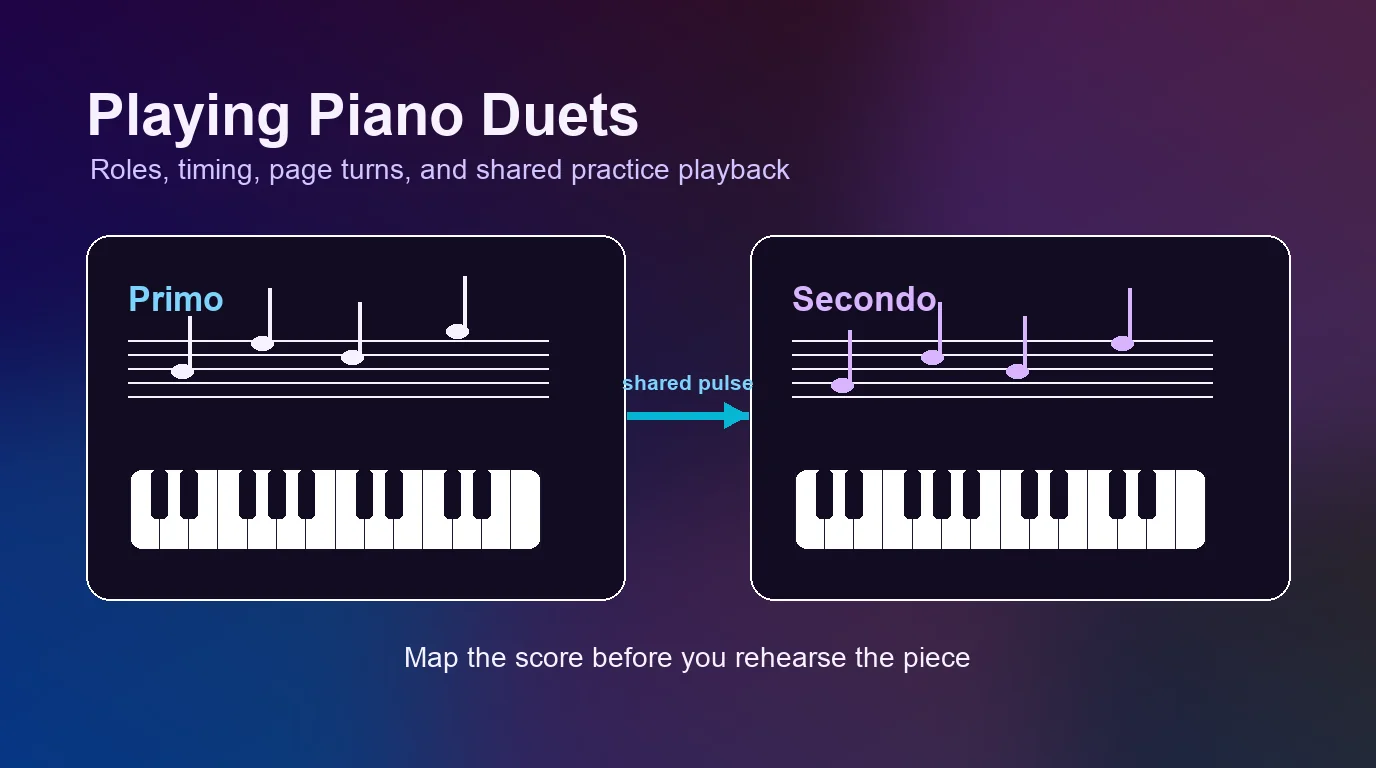
Turn a static score into editable MIDI
Contents
Playing piano duets works best when both players treat the score as one shared rhythm system, not two separate solo parts. Before you rehearse the whole piece, decide who carries the melody, who anchors the harmony, where the cues happen, and how you will recover if one player slips.
This guide gives pianists a practical rehearsal workflow for four-hands music, student duets, teacher-student parts, and casual duet reading. The goal is simple: map the roles, protect the pulse, rehearse page turns, and use playback only where it helps the two players return to the same musical conversation.
Start by naming the two jobs
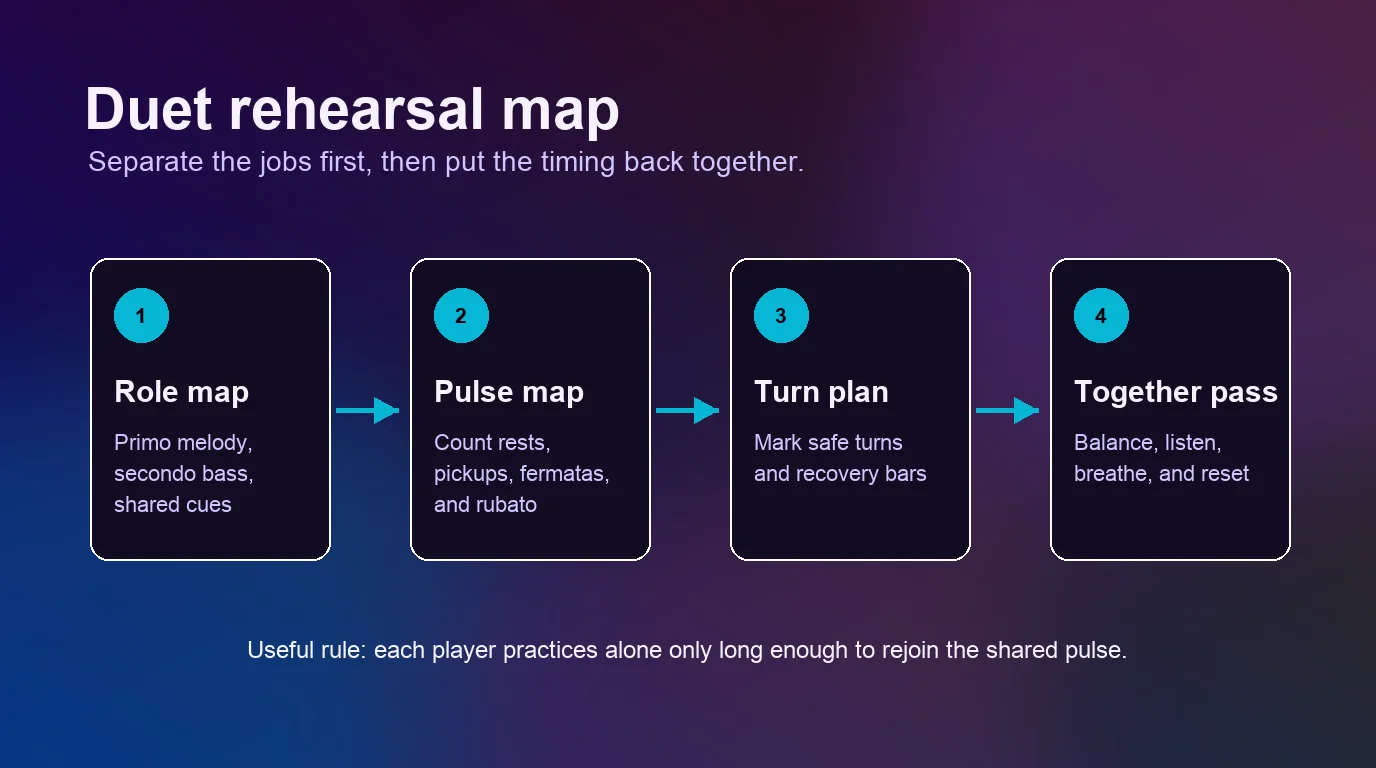
A piano duet usually divides the keyboard into two practical jobs. The primo part often sits higher and may carry the melody, while the secondo part often sits lower and may carry bass, harmony, pulse, or accompaniment patterns. That is a useful starting point, but do not assume it stays true for the whole piece.
Mark three things before you play:
| Score question | What to mark | Why it matters |
|---|---|---|
| Who has the melody? | Bars where the tune moves from one part to the other | The accompaniment player must get out of the way |
| Who owns the pulse? | Repeated bass, chord, or rhythm patterns | The other player should listen into that part |
| Where do parts cross? | Shared hand space, close intervals, or register changes | The duet can feel messy even when the notes are correct |
| Where are the cues? | Pickups, rests, fermatas, tempo changes, page turns | These are the places where ensemble usually breaks |
If the notation basics still feel uncertain, review the score-reading fundamentals before the duet rehearsal. A duet adds another player on top of the usual clef, rhythm, fingering, and page-layout work.
Count the shared pulse before adding expression
The fastest way to make a piano duet sound unstable is to add rubato before both players agree on the beat. Even expressive duet music needs an underlying shared pulse, especially around pickups, repeated accompaniment figures, phrase endings, and handoffs between melody and accompaniment.
Start with counting, not feeling. Clap or tap the hard bars while both players speak the beat out loud. Then play under tempo with no pedal and no extra expression. It may sound dry, but it exposes whether the rhythm is actually aligned.
Use this order when timing is unreliable:
- Count the measure together without playing.
- Tap both rhythms on the fallboard or your knees.
- Play only the first note of each beat.
- Add the full rhythm below tempo.
- Add dynamics and phrase shape only after the beat is shared.
For bars with syncopation, ties, or awkward rests, the same method from how to play tricky rhythms applies: reduce the passage to pulse, attacks, and recovery points before you put the notes back in.
Practice alone without rehearsing the wrong relationship
Solo practice is still necessary. Each player should know the notes, fingering, rhythm, and basic shape before the first full duet run. The mistake is practicing alone so long that the part starts to feel like a complete solo piece.
When you practice alone, add context on purpose. Sing or play the other part's cue before your entrance. Count the rests that happen before your first note. Mark where the partner has the melody. If a passage depends on the other player's bass line, do not only memorize your right-hand pattern. Learn what you are leaning against.
A useful solo-practice checklist:
- I can start after a rest without guessing.
- I know whether my part leads or supports the phrase.
- I have marked any bar where hands may collide.
- I know the partner cue before each tricky entrance.
- I can play my part slowly without using pedal to hide rhythm problems.
This keeps the part ready for ensemble instead of polished in isolation.
Plan page turns and recovery bars early
Page turns can break a duet even when both players know the music. Four-hands scores often have dense page layouts, and one player may not have a free hand at the obvious turn. Do not wait until the final rehearsal to solve this.
Mark page turns in the score before the first serious run. If the turn is unsafe, decide whether to photocopy a page, use a tablet layout, memorize two measures, or assign one player to handle the turn. If one player drops out briefly to turn, the other player needs to know whether to keep time, wait, or breathe into the next phrase.
Also choose recovery bars. These are agreed places where both players can jump back in if something falls apart. Good recovery bars usually have a strong downbeat, a new phrase, a clear harmony, or a texture reset.
| Problem | Decide before rehearsal | Good recovery signal |
|---|---|---|
| Unsafe page turn | Who turns and what can be omitted | First bar after the turn |
| One player loses count | Whether to continue or stop | Next phrase entrance |
| Tempo rushes | Who gives the pulse back | Bass pattern or repeated chord |
| Hands collide | Which player moves first | Marked fingering or register cue |
| Pedal blurs texture | Who controls pedaling | Harmony change or bass movement |
If you are preparing unfamiliar material, sight-reading exercises can help you separate reading skill from duet coordination. The better each player reads, the easier it is to listen outward.
Use playback as a rehearsal reference
Playback helps when the score is clear and both players need a neutral timing reference. It is especially useful before the first rehearsal, when one player wants to hear the other part, or when a passage keeps falling apart at the same entrance.
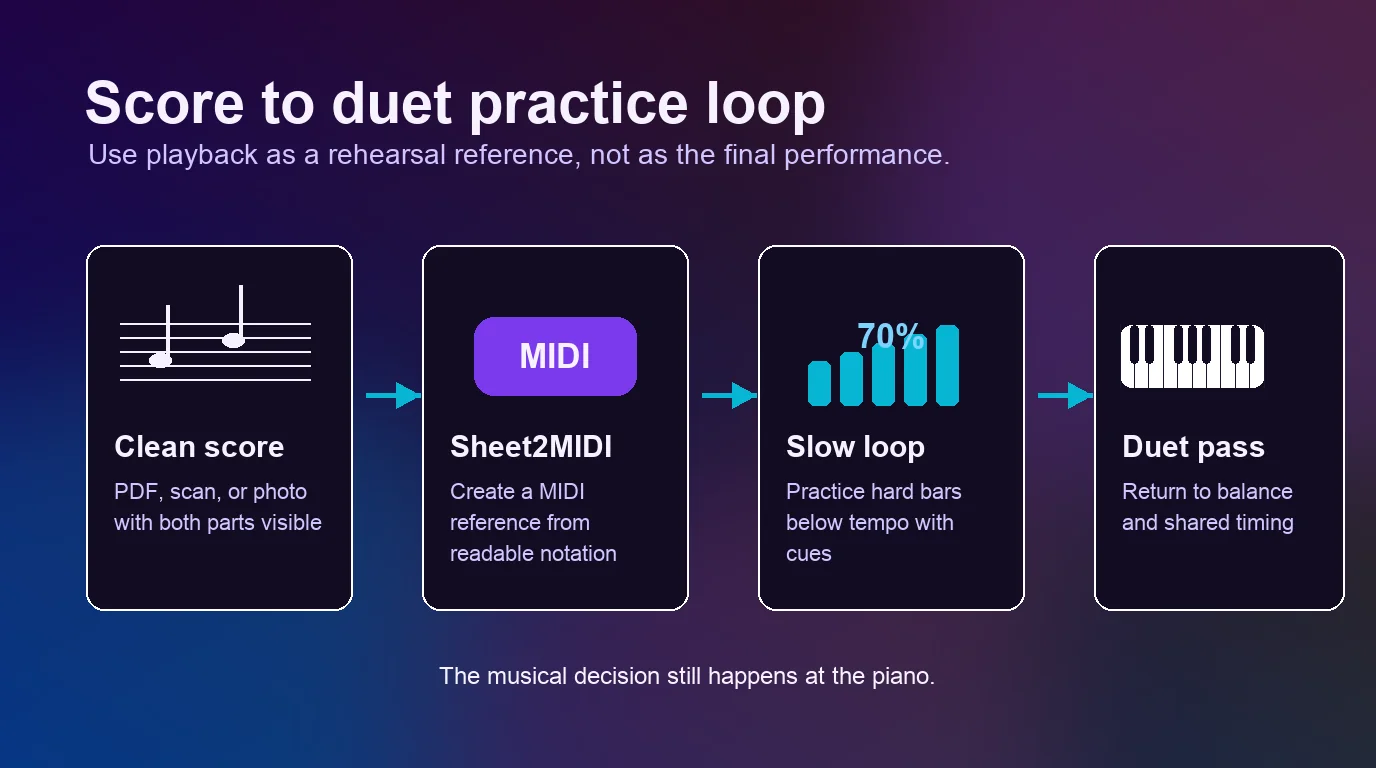
Use playback carefully. A MIDI reference can show pitch, rhythm, and structure, but it will not solve balance, touch, pedaling, rubato, or physical coordination at the keyboard. Treat it as a rehearsal map, not a performance model.
The practical playback loop is:
- Start with the cleanest score file you have.
- Convert a short section before processing the whole piece.
- Listen to both parts together.
- Solo or lower one part only long enough to check entrances.
- Loop the difficult bars below tempo.
- Return to the acoustic duet and make the musical decisions there.
If the main task is conversion quality, use the fuller guide on how to convert sheet music to MIDI before building a practice reference.

Where Melogen fits
Melogen fits the duet workflow when the source is visible notation and you need a quick way to hear the structure before rehearsing with another player. Open Sheet2MIDI, upload a clean PDF, JPG, or PNG score, and use the MIDI result as a first-pass reference for rhythm, entrances, and part interaction.
It is most useful for these jobs:
- Checking whether the two parts line up rhythmically.
- Hearing the secondo part while the primo player practices.
- Slowing a difficult bar before the next joint rehearsal.
- Moving the score into a DAW or practice environment for looped playback.
- Spotting obvious source problems before a teacher-student rehearsal.
It is not a replacement for duet listening. Once the part is mapped, both players still need to agree on touch, timing, pedal, phrase direction, and physical space at the keyboard.
Turn duet sheet music into a practice reference
Use Melogen Sheet2MIDI to create a first-pass MIDI reference from a clear duet score, then rehearse timing and balance at the piano.
Rehearse together in focused passes
The first together run should not try to fix everything. Choose one focus per pass so both players listen for the same thing.
Use this rehearsal sequence:
- Rhythm pass: count clearly, stay under tempo, and ignore most expression.
- Cue pass: test entrances, pickups, rests, and page turns.
- Balance pass: decide which part leads each phrase.
- Touch pass: match articulation, voicing, pedaling, and release.
- Performance pass: play through without stopping, then mark only the biggest fixes.
Keep the conversation concrete. Instead of saying "that felt messy," name the bar, the cue, and the job. For example: "At bar 28, secondo needs to hold the pulse while primo breathes into the pickup." That kind of instruction improves the next run immediately.
The practical takeaway
Playing piano duets becomes easier when both players prepare for ensemble from the beginning. Do not only learn notes. Learn roles, pulse, entrances, page turns, recovery points, and the places where one part depends on the other.
Before the next duet rehearsal, check:
- Both players know who has the melody in each section.
- Hard entrances have clear cues.
- Page turns and recovery bars are marked.
- Tempo is stable before expression is added.
- Playback has been used only to clarify timing, not replace listening.
- The final musical decisions happen together at the piano.
That is the point of duet playing: two people sharing one pulse, one score, and one musical shape.
About the author
Zhang Guo
Composer - AI Product Manager
AI product manager and digital marketing consultant with a background in music. Creativity is the bridge between rhythm and logic, where musical intuition and mathematical precision can coexist in every meaningful product decision.
Follow on X