Guitar Picking Patterns for Cleaner Practice Routines
Learn guitar picking patterns with thumb, finger, and pick workflows, slow-practice checks, and a Melogen tab reference for cleaner parts.
 Zhang Guo
Turn a static score into editable MIDI
Contents
Guitar picking patterns are repeatable right-hand motions that decide which string speaks on each beat. They can be played with a flatpick, thumb and fingers, or a hybrid approach, but the useful practice question is the same: which string is the anchor, which notes fill the space, and can the pattern stay even when the chord changes?
Do not start by collecting dozens of patterns. Start with one clean cycle, count it slowly, make the bass and treble notes land in the right places, then move it across a few chords. This guide gives you a practical way to build that routine without turning every exercise into a tab-hunting session.
Start with the job of each picking hand finger
The easiest way to understand guitar picking patterns is to separate bass duty from treble duty. In many beginner fingerpicking patterns, the thumb handles a low string while the index, middle, and ring fingers answer on higher strings. With a flatpick, the same idea becomes a controlled path through bass strings and treble strings.
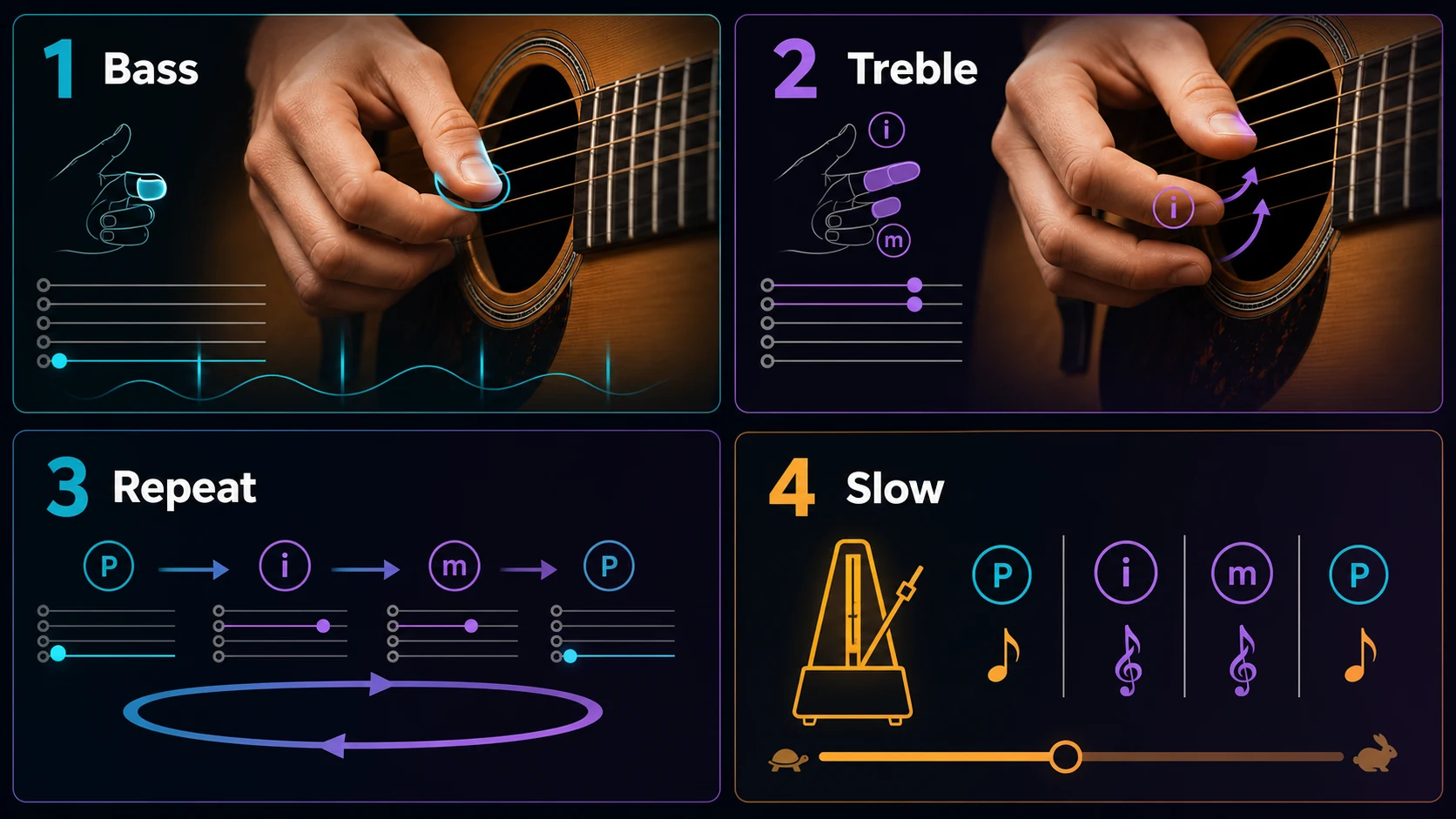
Use this table before practicing a new pattern:
| Pattern role | Fingerstyle version | Flatpick version | Beginner check |
|---|---|---|---|
| Bass anchor | Thumb on string 6, 5, or 4 | Downstroke on the lowest target string | The bass note lands on the beat |
| Inner string | Index or middle finger | Small alternate stroke | The hand does not jump too far |
| Treble answer | Middle or ring finger | Upstroke or light downstroke | The top note rings cleanly |
| Reset motion | Thumb returns to the next bass note | Pick returns to the next start point | The next cycle starts on time |
The pattern is not only about finger names. It is about distance. A good beginner pattern keeps the hand close enough to repeat without panic.
Count the pattern before chasing speed
Most guitar picking patterns become easier when you count the subdivision first. A simple 4/4 pattern might divide the bar into eighth notes:
Count:  1   &   2   &   3   &   4   &
String: 5   3   2   3   4   3   2   3
Hand:   T   I   M   I   T   I   M   I
That tiny map gives you three pieces of information: where the pulse lives, which string speaks, and which finger or pick motion should play it. If you only copy the sound, the pattern may collapse when the chord changes. If you can count it, you can move it.
For a flatpick version, write the same idea as a string path:
Count:  1   &   2   &   3   &   4   &
Pick:   D   U   D   U   D   U   D   U
String: 5   3   2   3   4   3   2   3
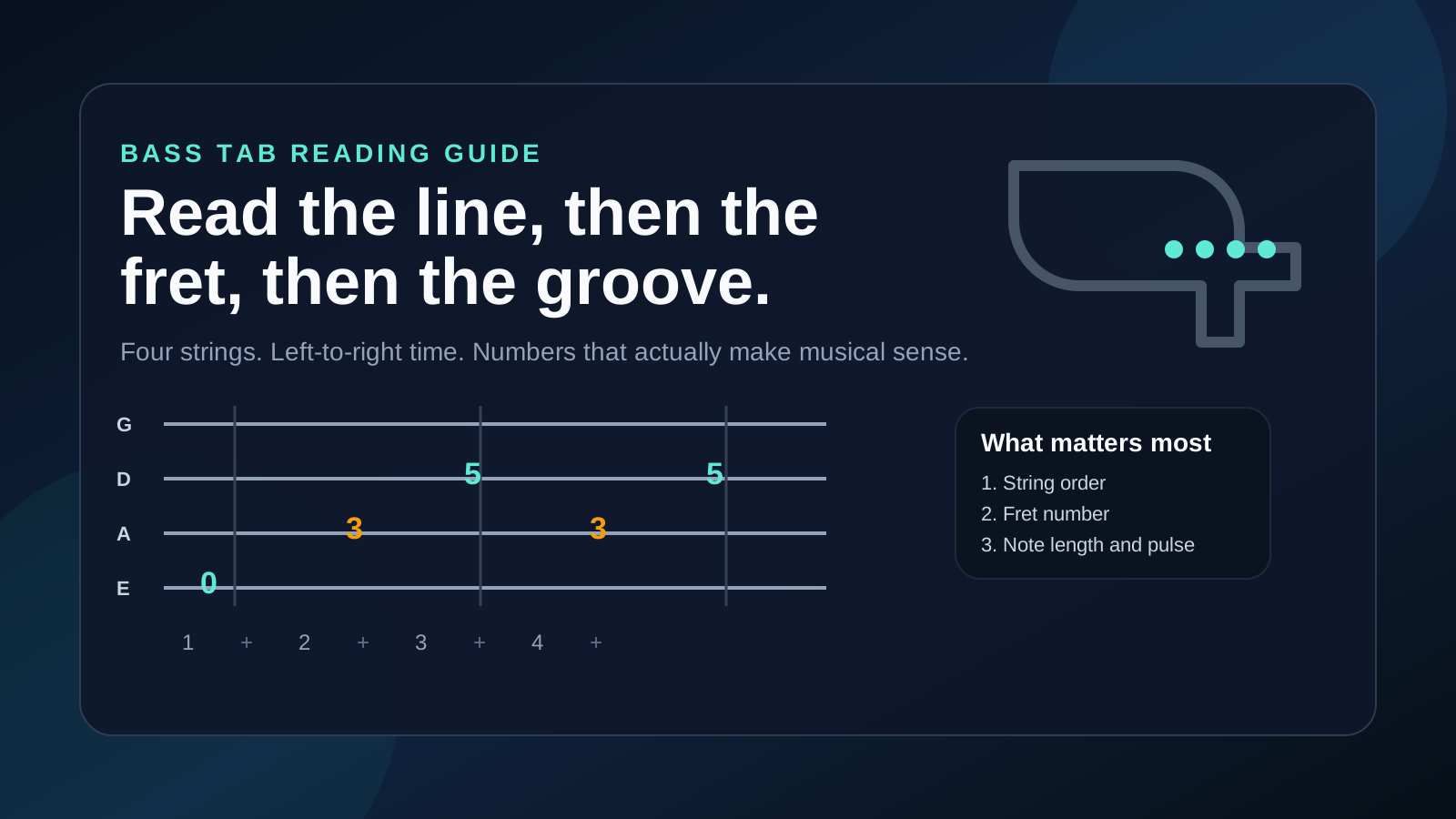
Keep the written map short. One bar is enough at first. If you need help reading fret numbers, string lines, and tab symbols around the pattern, use the companion guide on how to read guitar tabs before adding more notes.
Choose the right first pattern
The best first picking pattern is not the fanciest one. It is the one that keeps the thumb or pick path obvious while your fretting hand changes chords.
Try these beginner-friendly shapes:
| Pattern | Count feel | Works well for | Watch out for |
|---|---|---|---|
| Bass then two treble notes | 1 & 2 & | Slow ballads and simple verse parts | Do not rush the treble answer |
| Alternating bass | 5-3-4-3 or 6-3-4-3 | Folk and country-style accompaniment | The thumb must know the chord root |
| Four-note arpeggio | Low, middle, high, middle | Clean chord outlines | Let each note ring without smearing |
| Pinch then fill | Bass plus top string together, then inner notes | Strong downbeat emphasis | Balance the pinch so it is not too loud |
| Travis-style start | Alternating bass with syncopated treble | More advanced fingerstyle practice | Slow it down before adding melody |
If you are also learning songs, connect the pattern to material that is technically realistic. The guide to easiest acoustic guitar songs is useful when you need simple chord movement before you add a more detailed picking hand.
Keep picking patterns separate from strumming patterns
Picking and strumming use the same rhythmic brain, but they solve different hand problems. A strumming pattern asks when the whole chord is brushed. A picking pattern asks which string speaks inside the chord.
That difference matters when you practice. If you treat picking like slow strumming, your hand often becomes too wide and the notes blur together. If you treat strumming like picking, the groove can feel stiff because the arm stops moving.
Here is the useful boundary:
| If the source shows | You are probably reading | Main skill |
|---|---|---|
D U D U, arrows, or slash marks | Strumming pattern | Keep the wrist moving through played and silent slots |
| String numbers or tab lines | Picking pattern or riff | Move cleanly between specific strings |
| Chord names over lyrics | Harmony roadmap | Decide whether to strum, pick, or simplify |
| Standard notation stems | Rhythm and pitch | Translate the rhythm into a guitar-friendly motion |
When your source is all arrows and rhythm marks, the article on how to read strumming patterns is the better next step. Stay here when the problem is string order, thumb balance, and repeated picking cycles.
Practice the loop before the song
Do not test a new picking pattern on a difficult song first. Mute the strings, run the right hand alone, then add one chord. The pattern should survive a small chord change before you trust it in a full verse.

Use this six-pass routine:
- Count one bar out loud without the guitar.
- Tap the bass beats with your thumb or pick hand.
- Mute the strings and play the picking pattern with no chord pressure.
- Add one easy chord and keep the same motion.
- Add a two-chord change, such as Em to C or G to D.
- Record one slow pass or compare it against a simple tab reference.
The last step is not about perfection. It is about noticing whether the bass note, treble answer, and reset point stay aligned. If one note always arrives late, shrink the pattern until that spot becomes boring.
Use Melogen when the pattern starts from a song
Melogen fits when your source is a song, audio file, or supported video link and you need a first-pass guitar tab reference before you refine the picking hand yourself. The local AI Guitar Tab Generator page describes a browser-based workflow that accepts MP3, WAV, M4A, FLAC, and YouTube links, then organizes chords, riffs, lead ideas, tuning, capo position, focus mode, complexity, and section splits.

Use it carefully:
- Start with a clean source you are allowed to use.
- Generate a first tab reference, preferably with the right tuning and capo setting.
- Find the bar where the picking pattern repeats.
- Write the string order and count separately from the generated tab.
- Practice the loop slowly before copying the full song tempo.
Melogen can help you locate a playable first reference faster. It does not remove the musical job of deciding tone, dynamics, finger choice, and whether the pattern should be simplified for your current level.
Create a tab reference before refining the picking hand
Use Melogen AI Guitar Tab Generator when your source is a song, audio file, or YouTube link, then slow the pattern down and clean the right-hand motion yourself.
Troubleshoot common picking pattern problems
Most picking-pattern issues are small timing or motion problems hiding inside a bigger song. Fix the small part first.
| Problem | What it usually means | Practical fix |
|---|---|---|
| Bass notes disappear | The thumb or pick path is not anchored | Practice bass notes alone for one minute |
| Treble notes rush | The hand is chasing the next string | Reduce the pattern to three strings |
| Chord changes break the loop | The fretting hand is too hard for the pattern | Use two easy chords until the rhythm stays even |
| Every note sounds the same | The bass and treble balance is flat | Play bass slightly stronger and treble lighter |
| The pattern works slowly but fails at tempo | The motion is too large | Use smaller finger or pick travel before speeding up |
If the pattern still feels unstable, remove one note. A four-note pattern played cleanly is more useful than an eight-note pattern that resets late every bar.
The practical takeaway
Guitar picking patterns get cleaner when you stop treating them as mysterious song fragments. Name the bass anchor, map the treble answer, count the subdivision, and practice one loop before the full song.
Before moving on, check the pattern with these questions:
- Can you count the full bar without touching the guitar?
- Can you name which string starts the cycle?
- Can you play the pattern on muted strings without speeding up?
- Can you add one chord without changing the picking hand?
- Can you explain how this differs from a strumming pattern?
If yes, the pattern is ready for a song section. If no, slow it down and make the loop smaller. Clean repetition is the point.
About the author
Zhang Guo
Composer - AI Product Manager
AI product manager and digital marketing consultant with a background in music. Creativity is the bridge between rhythm and logic, where musical intuition and mathematical precision can coexist in every meaningful product decision.
Follow on X