Music Composition History for Modern Musicians
Trace music composition history from medieval notation to modern AI workflows, with practical lessons for composers, arrangers, and producers.
 Zhang Guo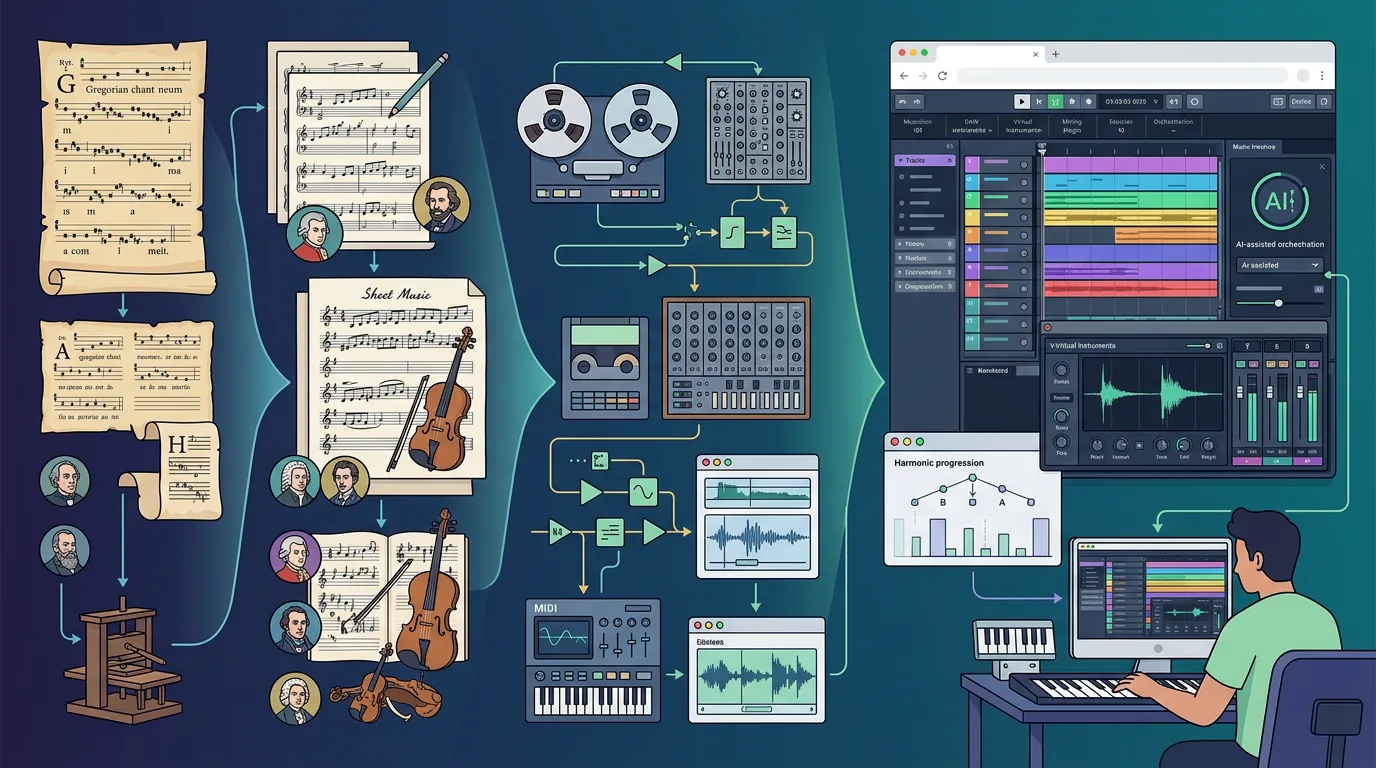
Turn a static score into editable MIDI
Contents
Music composition history is the story of how musicians learned to organize sound into repeatable ideas. Medieval composers protected chant and sacred text. Renaissance writers made independent voices fit together. Baroque composers turned bass lines into engines. Classical composers clarified form. Romantic composers stretched color and drama. Modern composers expanded the definition of musical material itself.
That history matters because every modern composer still faces the same core decisions: what should repeat, what should change, what should feel stable, and what should surprise the listener. The tools have changed from manuscript paper to notation software, DAWs, MIDI, MusicXML, and AI-assisted analysis, but the musical problems are older than the software.
Music composition history in one timeline
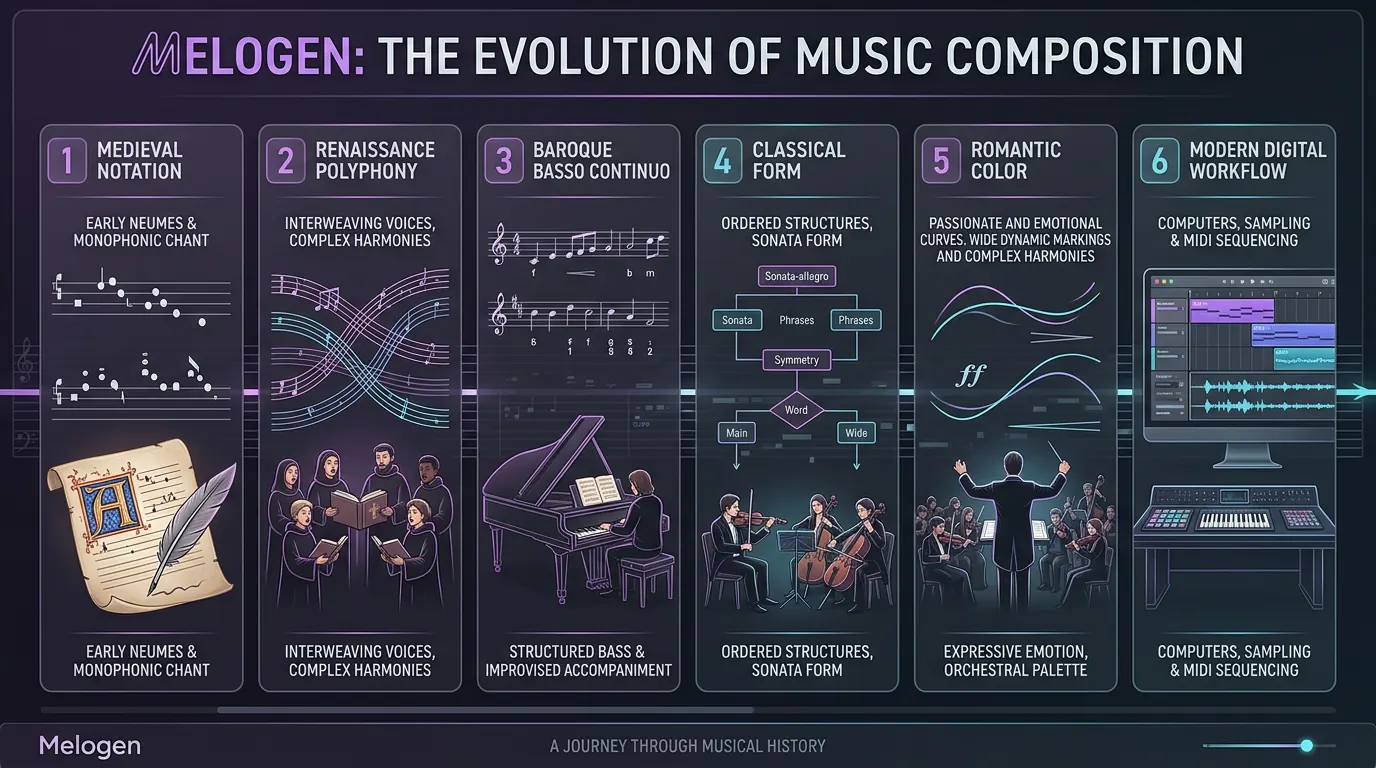
The useful way to read music composition history is by asking what each period made easier for composers to control. A short timeline keeps the eras from turning into trivia.
| Period | Approximate focus | What changed for composers | Modern lesson |
|---|---|---|---|
| Medieval | chant, early notation, sacred function | Music became easier to preserve and coordinate | Write ideas clearly enough that another musician can follow them |
| Renaissance | polyphony and vocal balance | Independent lines became a central craft | Treat each part as a real voice, not filler under a melody |
| Baroque | basso continuo, tonality, contrast | Harmony and bass motion began driving large spans | Give the music an engine, not only a surface tune |
| Classical | phrase balance and formal clarity | Sonata, symphony, quartet, and clean cadences shaped expectation | Make structure audible before adding complexity |
| Romantic | color, expansion, individuality | Harmony, orchestration, and personal expression grew wider | Use tension and color to serve the emotional arc |
| Modern and contemporary | new systems, electronics, sound design | Composers questioned tonality, form, noise, and technology | Decide what rule organizes the piece before the listener gets lost |
This is why a brief history of composition should not stop at names and dates. It should show how each era changed the composer's working choices.
For deeper background, Britannica's pages on medieval composition and the Classical period are useful references. The Library of Congress also keeps a broad music history resource guide for readers who want a longer listening path.
Medieval and Renaissance composers made notation social
Medieval composition was tied closely to church practice, chant, memory, and early notation. The main achievement was not "simple music." It was the gradual ability to preserve musical ideas, align performers, and combine voices in ways that could survive beyond one performance.
That matters to modern musicians because notation is still a social technology. A score is not only a private sketch. It tells another person how to enter, breathe, count, phrase, and stop. If you want the deeper notation backstory, the Melogen guide on who created music notation is the natural companion.
The Renaissance expanded the idea of independent lines. Instead of one dominant melody with passive support, composers developed polyphony where several voices could move with their own contour while still creating a coherent whole. Counterpoint became a way to make multiple lines feel intentional at the same time. Open Music Theory's counterpoint materials are a useful public primer if you want exercises beyond the historical overview.
The practical takeaway is simple: if a part exists, it should have a job. Even in a modern pop, film, or game cue, inner voices matter. A pad, bass movement, backing vocal, string line, or counter-melody can either clarify the harmony or blur it.
Baroque and Classical writing turned motion into form
The Baroque period made motion feel structural. Basso continuo, sequence, imitation, dance rhythm, ornament, and tonal direction gave composers ways to create forward drive. A listener could feel the music moving because harmony and bass motion created expectation.
The Classical period then made balance and proportion easier to hear. Phrases became clearer. Cadences carried more formal weight. Sonata form, theme-and-variation, rondo, quartet writing, and symphonic thinking all gave composers repeatable ways to create contrast, departure, return, and resolution.
Modern composers can learn from this without writing like Bach or Mozart. The lesson is that listeners need landmarks. A piece can be harmonically simple and still weak if the sections do not aim anywhere. A piece can be harmonically advanced and still clear if the listener can hear when an idea returns, transforms, or resolves.
Use this quick check when revising a draft:
- Can you name the main idea in one sentence?
- Does the bass or harmonic rhythm create motion?
- Does the second section answer, intensify, or contradict the first?
- Is there a return point the listener can recognize?
- Does the ending feel earned by something that happened earlier?
That checklist works for a piano miniature, a string cue, a worship arrangement, a beat, or a DAW sketch.
Romantic and modern composers changed the rules of color
Romantic composers widened the expressive range of harmony, orchestration, rhythm, tempo, and personal style. The point was not only bigger orchestras. The point was a stronger link between musical color and emotional identity. Harmony could delay arrival for longer. Orchestration could become part of the argument. A small motive could carry dramatic meaning across a large work.
Modern and contemporary composers pushed the question further. Some reduced tonality's role. Some built systems such as serialism. Some used folk material, jazz harmony, electronics, recorded sound, minimal processes, extended technique, or studio production as compositional material. Melogen's 12-tone technique guide shows one example of a modern system where pitch order becomes the organizing rule.
The important lesson is not that modern music has no rules. It is that the rule may change. A piece might be organized by a tone row, a texture, a loop, a production process, a rhythmic cell, a spectral color, or a repeated sample. The composer still needs to decide what the listener is supposed to follow.
What this history teaches a modern composer
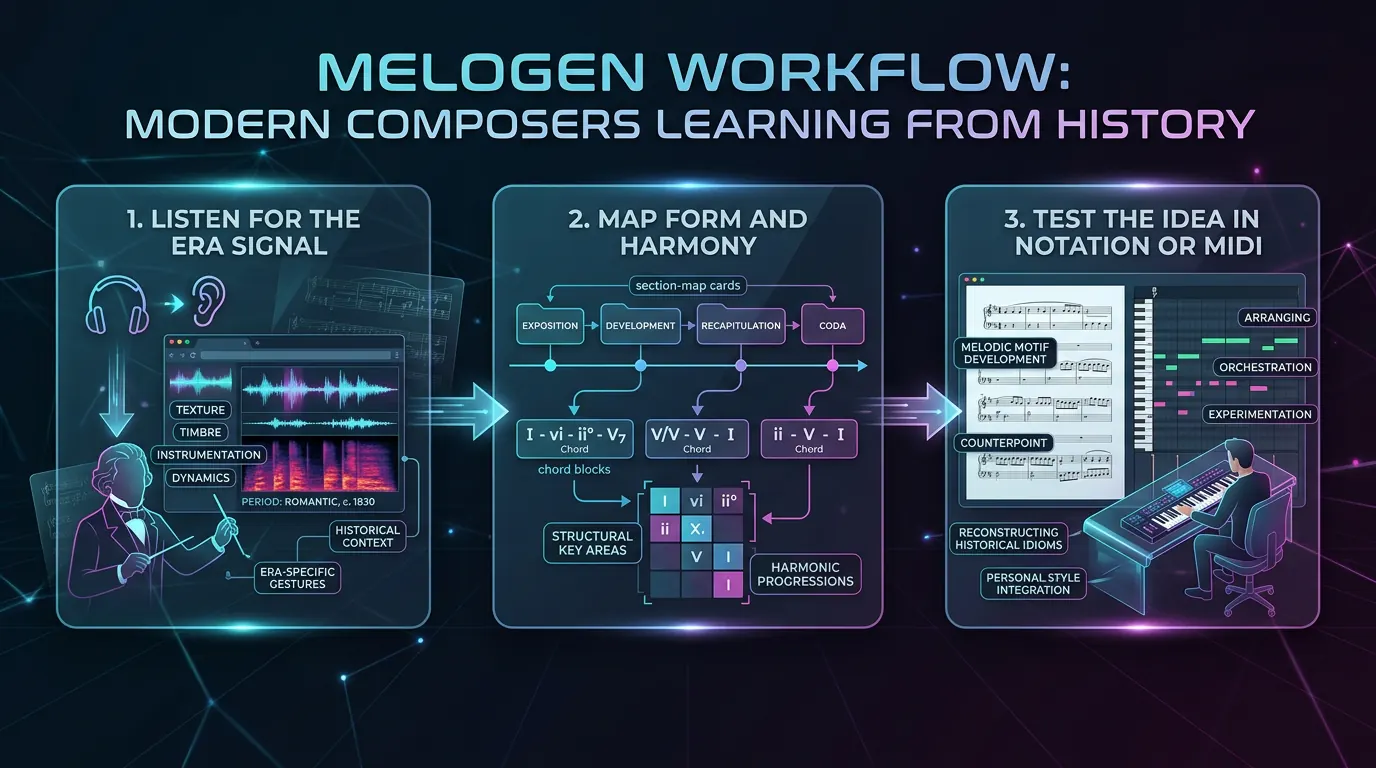
Composition history becomes useful when it turns into a workflow. Instead of asking "Which era should I imitate?", ask "Which historical problem am I solving right now?"
| If your draft feels weak because... | Borrow this historical lens | Try this revision move |
|---|---|---|
| The melody has no support | Renaissance voice thinking | Give the bass or inner voice a real contour |
| The music does not move | Baroque bass and sequence thinking | Clarify harmonic rhythm and repeated pattern logic |
| Sections feel random | Classical form thinking | Mark phrase lengths, cadences, contrast, and return points |
| The piece lacks identity | Romantic color thinking | Change register, texture, orchestration, or harmonic color with intent |
| The rules feel too familiar | Modern system thinking | Choose one new organizing rule and apply it consistently |
| The DAW sketch sounds busy | Structural-analysis thinking | Reduce the arrangement to sections, motives, and tension points |
This is also where a practical composition habit helps. Write a short idea, then analyze what it is already doing before you add more material. The Melogen article on how to compose a song on piano uses the same principle: start with a small seed, build sections, then check whether the structure actually supports the idea.
Where Melogen fits without overstating the product
Melogen does not replace composition history, ear training, score study, or taste. It helps after you have musical material that needs to become easier to inspect.
The current Melogen Structural Analysis page describes a score-first workflow for JPG, PNG, and PDF sheet music. The local product page states that the analyzer focuses on structure, tonality, harmony, form, key signatures, time signatures, harmonic progressions, cadences, melodic themes, formal sections, and exportable analysis results. That fits a modern composer when a draft has become a readable score or score image and the next question is structural: where are the sections, what is the tonal plan, and which moments carry the main musical tension?
It is not the right tool for every historical question. If you need a clean MusicXML file from a PDF, use a conversion workflow. If you need to hear an audio idea as MIDI, use an audio-to-MIDI workflow. If you need broader tool selection, the guide to technology for composing music separates notation, DAW, conversion, and analysis jobs.
Check the structure of a score draft
Use Melogen Structural Analysis when your composition is readable as a score and you want a faster map of form, harmony, cadences, and sections before the next revision.
The practical takeaway
The history of music composition is a set of working answers to recurring musical problems. Medieval and Renaissance practice teaches clarity of notation and independence of line. Baroque and Classical practice teaches motion, phrase, cadence, and form. Romantic practice teaches color and long-range expression. Modern practice teaches that a piece can be organized by rules beyond traditional tonality.
For a modern musician, the best use of that history is practical. When a draft feels stuck, do not only add more notes. Ask which layer is missing: line, bass motion, form, color, system, or structure. Then revise that layer deliberately.
About the author
Zhang Guo
Composer - AI Product Manager
AI product manager and digital marketing consultant with a background in music. Creativity is the bridge between rhythm and logic, where musical intuition and mathematical precision can coexist in every meaningful product decision.
Follow on X