How Does a Guitar Create Sound From Strings to Tone
Learn how a guitar creates sound through string vibration, resonance, pickups, speakers, and what changes when guitar audio becomes MIDI.
 Zhang Guo
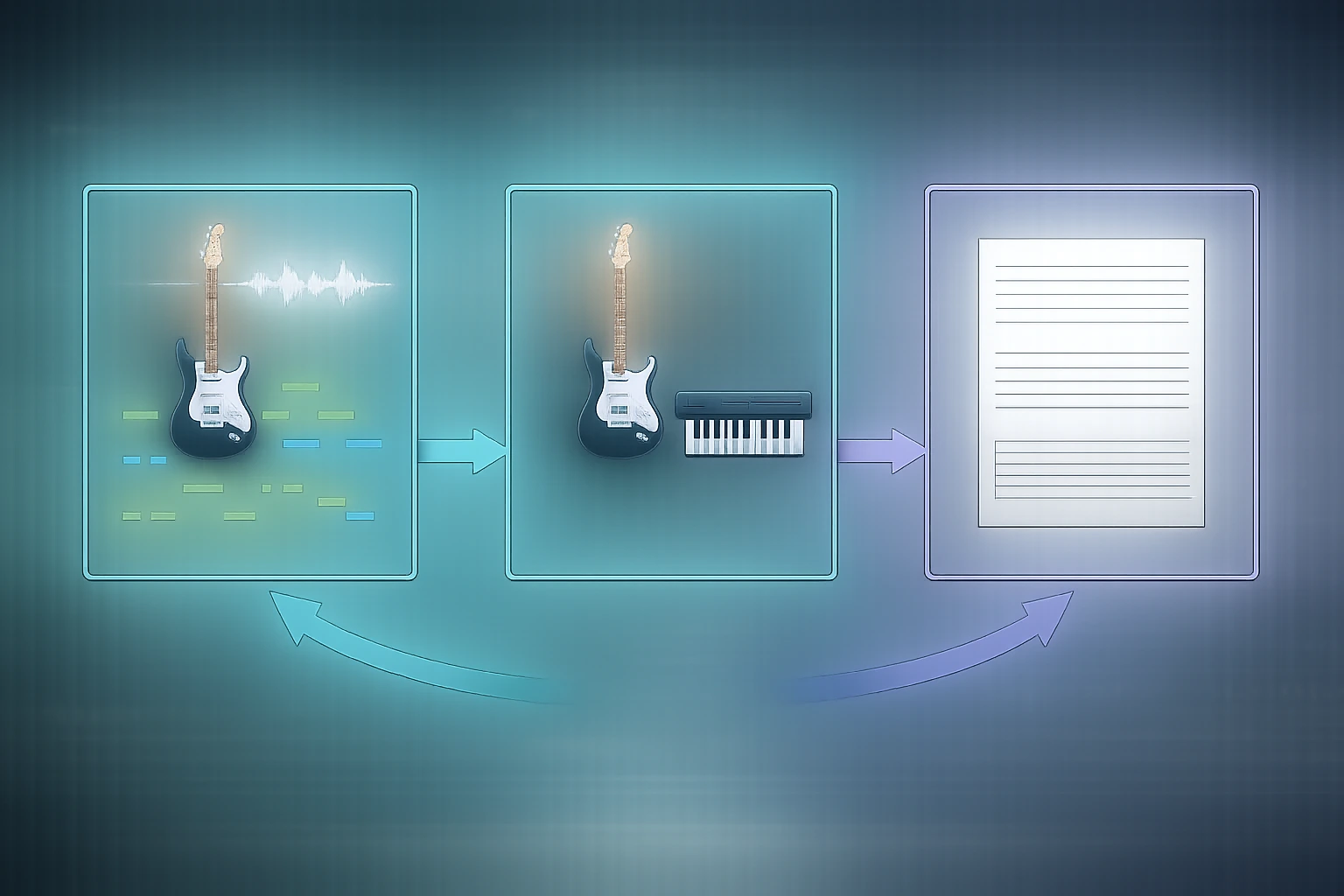
Turn a static score into editable MIDI
Contents
If you are asking how does a guitar create sound, start with the string. A guitar string makes sound because it vibrates after you pluck, pick, strum, tap, or bend it. That vibration moves energy through the instrument, and the final sound depends on how the guitar turns that small motion into moving air.
The short version is simple: the string starts the vibration, the guitar body or pickup captures it, and something larger moves enough air for you to hear it. Acoustic guitars rely on the bridge, top, body, and sound hole. Electric guitars rely on pickups, electronics, an amplifier, and a speaker.
Start with the vibrating string
When a string is pulled away from rest and released, it snaps back and vibrates around its resting position. That motion is fast, but it is not random. The length, tension, thickness, and material of the string decide the main pitch.
That is why tuning matters so much. In standard guitar tuning, the open strings are E, A, D, G, B, and E from low to high. If those starting pitches are wrong, every chord shape and fretboard note shifts with them. For the note map behind that setup, use the guide to electric guitar string notes as the practical companion.
The string also vibrates in smaller segments at the same time. Those smaller patterns create overtones, which help explain why the same note can sound warm on one guitar and bright on another. The pitch may be the same, but the harmonic mix is different.
Follow the acoustic and electric sound paths
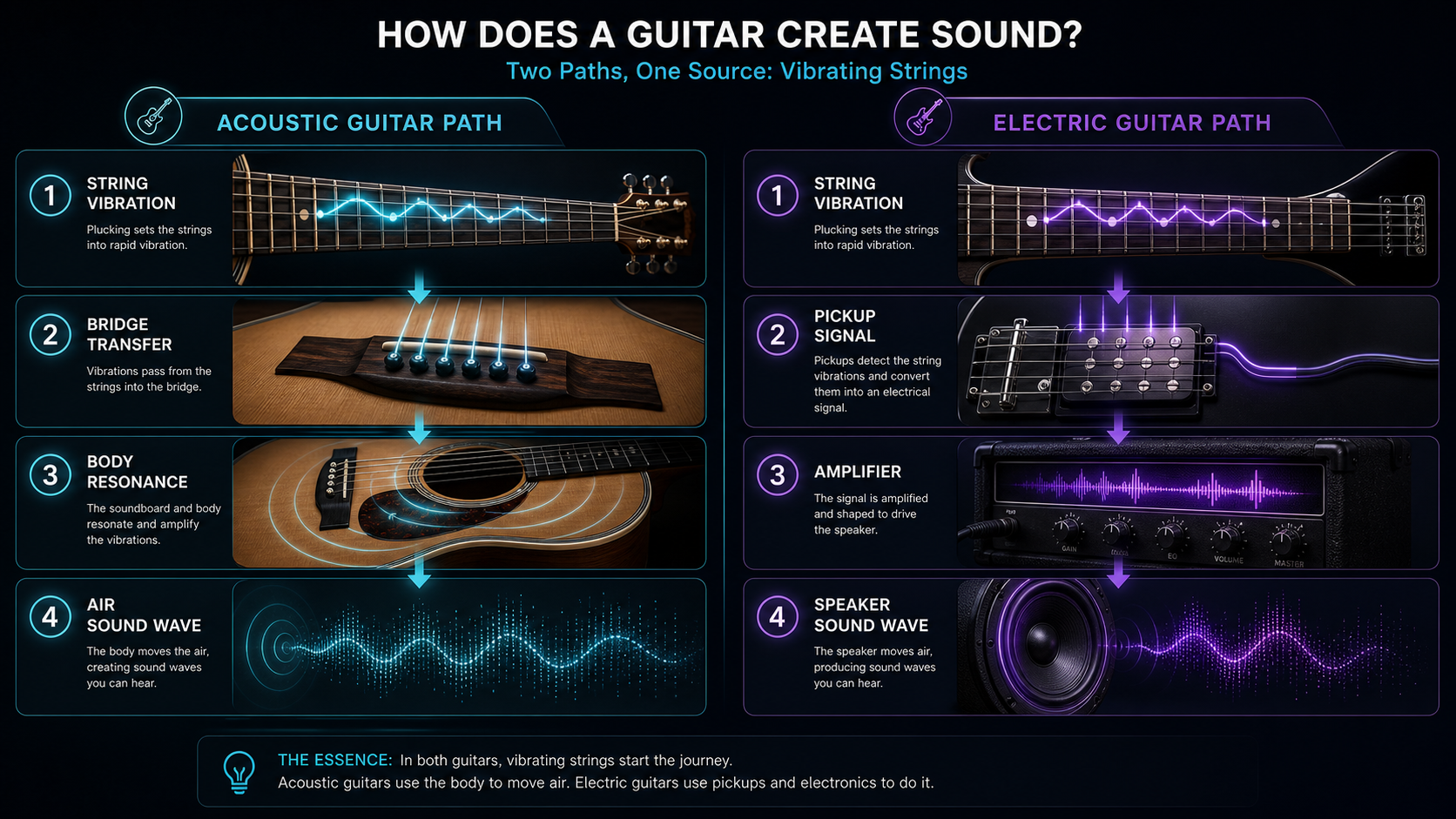
Acoustic and electric guitars begin with the same source: vibrating strings. The difference is how the instrument makes those vibrations loud enough and shaped enough to become a finished tone.
| Sound path | What happens | What shapes the result |
|---|---|---|
| Acoustic guitar | String vibration passes through the bridge into the top and body | Body size, wood, bracing, soundboard response, room sound |
| Electric guitar | String vibration is sensed by pickups and sent as an electrical signal | Pickup type, pickup height, tone controls, pedals, amplifier, speaker |
| Hybrid workflow | The same performance can be recorded, analyzed, or converted later | Source clarity, timing, noise, effects, and cleanup choices |
On an acoustic guitar, the string by itself is quiet. The bridge transfers its vibration into the soundboard, and the body resonates so a larger surface can move air. The sound hole helps the air inside the body interact with the room.
On an electric guitar, the body still affects feel and sustain, but the main loudness path is electronic. Magnetic pickups sense string motion, turn it into an electrical signal, and send that signal to pedals, an amplifier, and a speaker. The speaker is what finally moves air in the room.
Know what changes guitar tone
Guitar tone is not one ingredient. It is a chain of small decisions.
The same pitch can change because of:
- where you pluck the string
- whether you use a pick, fingers, nails, or palm muting
- how hard the string is attacked
- string gauge and age
- acoustic body shape or electric pickup position
- amplifier, speaker, pedals, and room sound
- how cleanly the note starts and stops
This is why two guitars can play the same written note and still sound different. A classical guitar, steel-string acoustic, solid-body electric, and bass guitar each solves a different musical job. If you are comparing instrument families, the guide to types of guitar gives the broader map.
For beginners, the practical lesson is not to memorize every tone variable at once. Start with the big three: string, playing position, and output path. If those are stable, the smaller details become easier to hear.
Connect the sound to recording and MIDI
Once the sound leaves the guitar, it can be recorded as audio. That audio file contains the final pressure-wave result: the note attack, harmonic color, noise, decay, room tone, and any amplifier or effects chain.
MIDI is different. MIDI does not store the guitar's acoustic air movement. It stores note and timing instructions that another instrument or plugin can play back. That distinction matters when guitarists use transcription tools, DAWs, or notation workflows.
If you convert a clean guitar recording into MIDI, the result is a first-pass map of pitches and timing. It can help with arranging, editing, or sketching ideas, but it will not automatically preserve every pick scrape, bend detail, palm mute, amp breakup, or room reflection.
Use this quick check before expecting a guitar recording to become useful MIDI:
| Check | Why it matters |
|---|---|
| Is the guitar isolated? | Solo or clean stems convert more predictably than full mixes |
| Are bends and slides central? | Expressive pitch movement may need manual cleanup |
| Is the rhythm clear? | Strong attacks give the transcription more usable timing clues |
| Is the tone heavily distorted? | Dense harmonics can make pitch detection harder |
| Is MIDI really the goal? | A tab, chord chart, or audio reference may be better for practice |
For the broader decision, read MIDI for guitarists. It separates audio-to-MIDI, hardware MIDI guitar, and practice-reference workflows so you do not force every guitar task into the same format.
Where Melogen fits without overstating it
Melogen does not turn a guitar body into a finished acoustic tone, and it should not be treated as a replacement for your ear, instrument setup, or amplifier choices.
Its useful role comes after you have a source:
- If your source is a song, audio file, or YouTube link, the current AI Guitar Tab Generator workflow is designed to create a guitar-first reference from supported audio or link inputs.
- If your source is a clean recording and you need editable notes, an audio-to-MIDI workflow can give you a draft to inspect in a DAW.
- If your source is printed notation, a score-first route such as Sheet2MIDI usually makes more sense than forcing guitar audio tools onto a page.

The honest fit is practical: use Melogen to create a first-pass reference, then finish the musical judgment yourself. Check tuning, rhythm, string choice, bends, voicing, and whether the result feels playable on the guitar you actually use.
Create a guitar-first reference from your source
Use Melogen AI Guitar Tab Generator when you start from a song, audio file, or YouTube link and need a playable first pass before deeper cleanup.
Build a quick listening checklist
If you want to hear how a guitar creates sound instead of only reading about it, run a short listening test.
- Pluck one open string near the bridge, then near the neck.
- Play the same fret softly, then with a stronger attack.
- Compare a muted note with an open ringing note.
- Switch pickups if you are on electric guitar.
- Record one note cleanly and look at the waveform decay.
- Ask whether the next step needs audio, MIDI, tab, or notation.
That last question is the workflow bridge. A guitar sound starts as vibration, but your next tool depends on the format you need after the sound is captured.
The practical takeaway
A guitar creates sound by turning string vibration into moving air. Acoustic guitars use the bridge, soundboard, body, and sound hole to amplify that motion. Electric guitars use pickups, electronics, amplifiers, and speakers to make the vibration audible.
The tone you hear is the full chain: string, touch, instrument, pickup or body, output path, and room. When you move into digital work, keep the format boundary clear. Audio captures the sound. MIDI captures a note map. Tab captures a playable guitar reference. The best workflow starts by choosing which of those jobs you actually need.
About the author
Zhang Guo
Composer - AI Product Manager
AI product manager and digital marketing consultant with a background in music. Creativity is the bridge between rhythm and logic, where musical intuition and mathematical precision can coexist in every meaningful product decision.
Follow on X