How Many Musical Notes Are There in Real Music
Learn why music uses 7 letter names, 12 chromatic notes, repeating octaves, and MIDI note numbers so score cleanup makes sense.
 Zhang Guo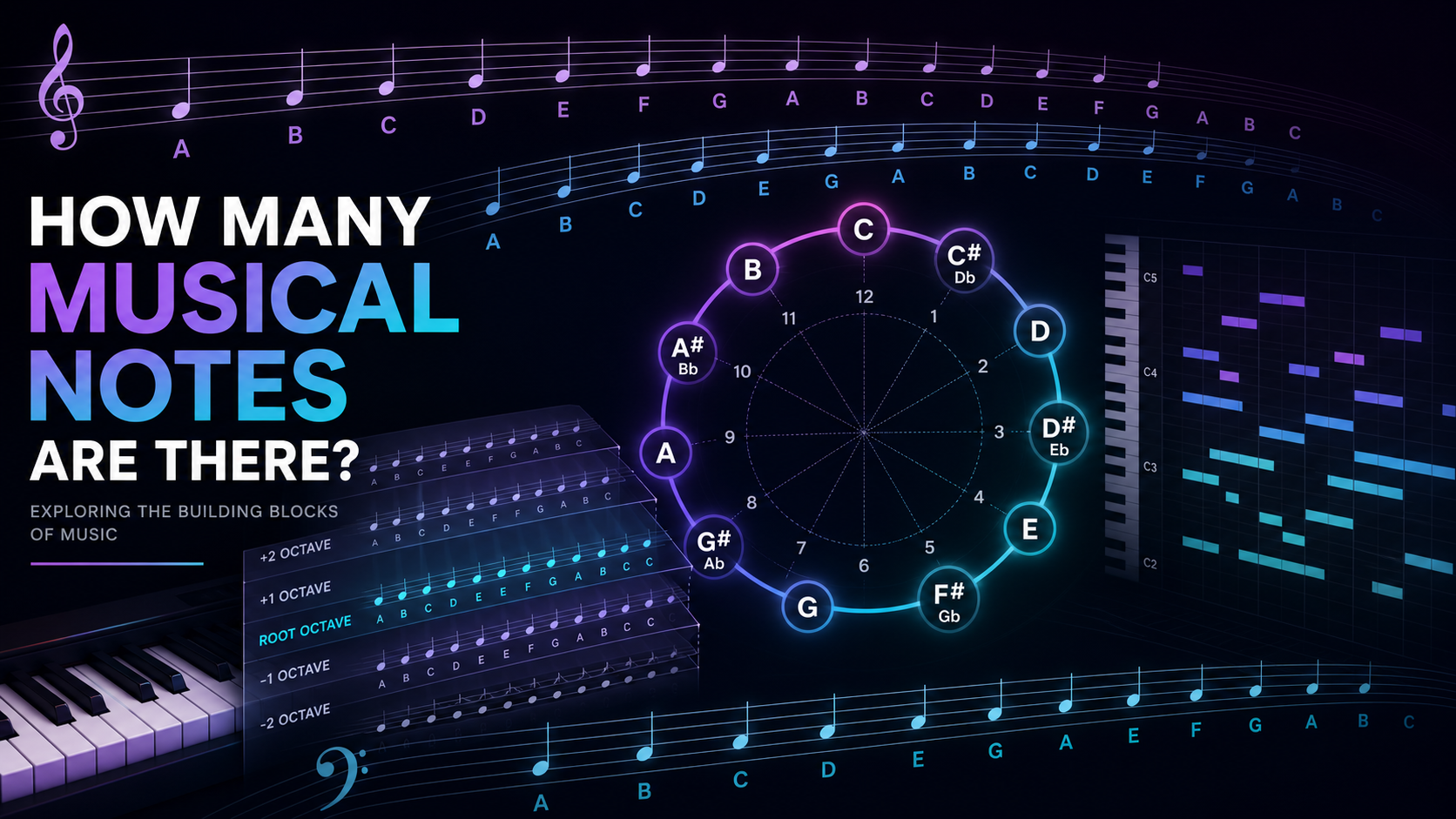
Turn a static score into editable MIDI
Contents
If you are asking how many musical notes are there, the honest answer depends on what you are counting. Western music commonly uses 7 natural letter names, 12 chromatic pitch classes, and many repeated pitches across octaves. In MIDI, the common data range contains 128 note numbers.
Those answers are not contradictions. They describe different layers of the same system. A beginner reading a staff needs the 7 letter names. A musician explaining scales and accidentals needs the 12 chromatic notes. A pianist, singer, producer, or MIDI editor also needs octave labels because the same note name can appear low, middle, or high.
The useful answer has four layers
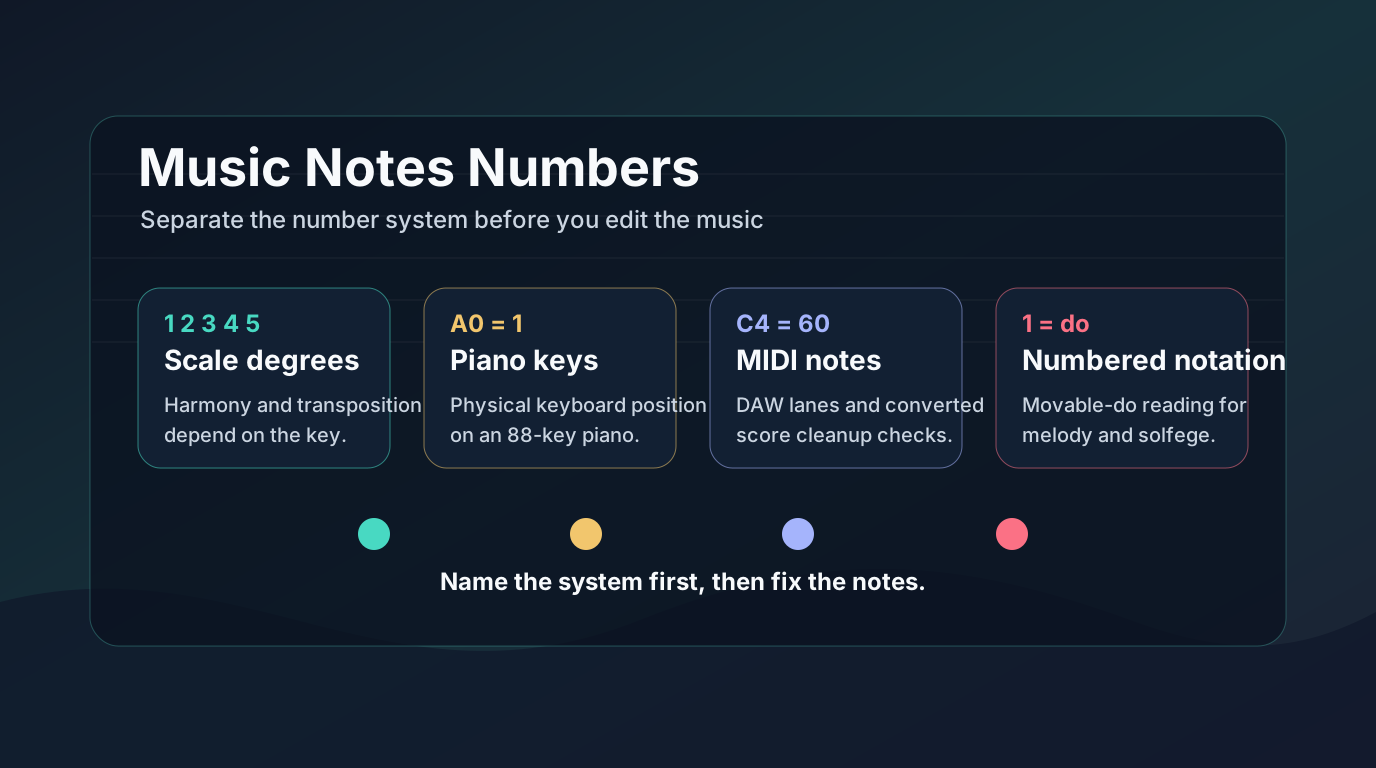
Before memorizing a number, ask what job the number has to do. The same written question can mean "How many letters are there?", "How many notes are in an octave?", "How many piano keys are there?", or "How many MIDI note numbers can a DAW store?"
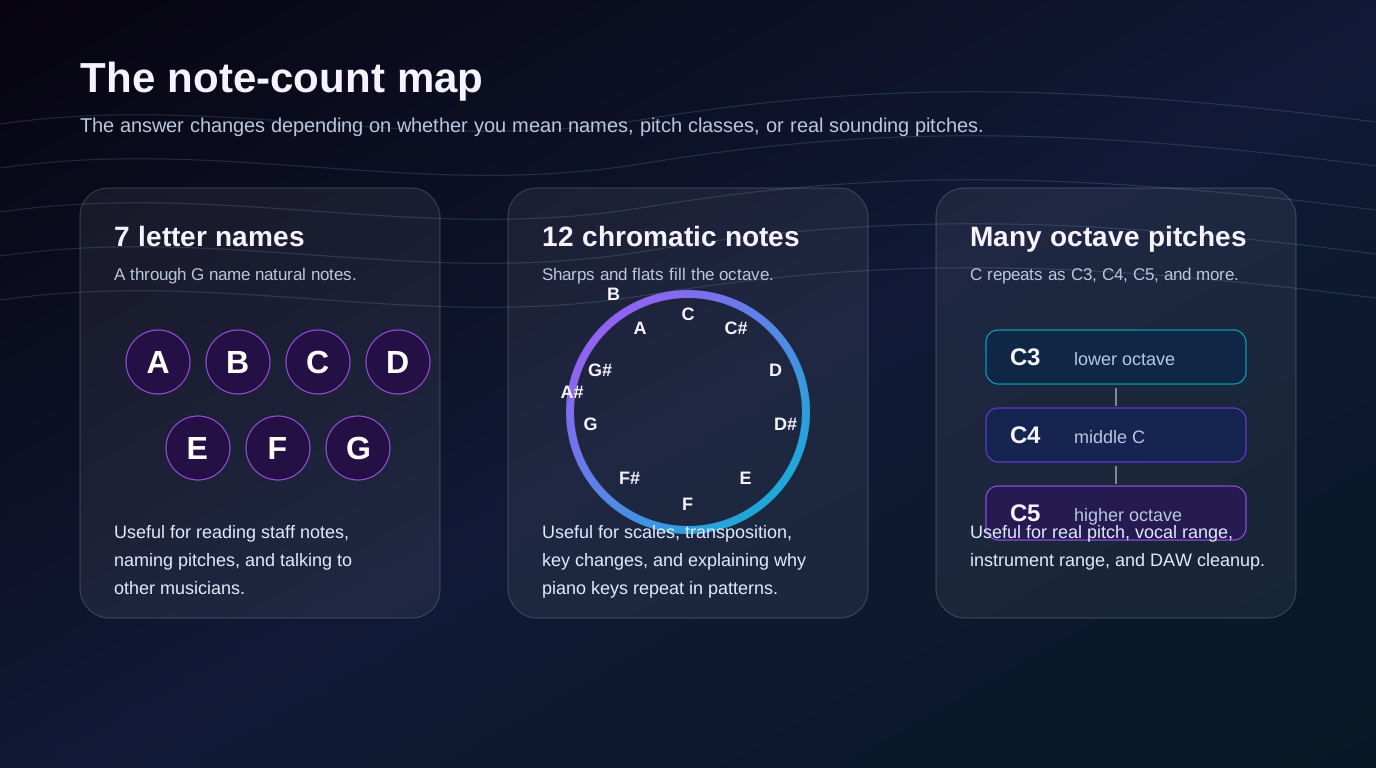
| Count | What it counts | Example | Use it when |
|---|---|---|---|
| 7 | natural letter names | A B C D E F G | learning staff note names |
| 12 | chromatic pitch classes | C, C#, D, D#, E, F, F#, G, G#, A, A#, B | explaining scales, keys, and semitones |
| Many | octave-labeled pitches | C3, C4, C5 | choosing the real register |
| 128 | MIDI note numbers | 0 through 127 | editing digital pitch data |
Most beginner confusion comes from mixing these layers. If a teacher says music has 7 notes, they are usually talking about natural letter names. If a producer says there are 12 notes, they are usually talking about the chromatic octave. If a MIDI editor shows note 60, it is using a fixed digital pitch number, not a letter name.
For a broader map of pitch, duration, rests, ties, and note values, use the guide to different music notes. This article stays focused on the note-count question.
Seven note names are the musical alphabet
The basic letter names are A, B, C, D, E, F, and G. After G, the sequence repeats. That repeat is why a staff can show many pitches while still using only seven natural letters.
This letter system is the first layer to learn because it appears everywhere: sheet music, note charts, chord names, melody lessons, piano diagrams, guitar fretboards, and music theory explanations. It gives musicians a shared language before rhythm, octave, and tuning details get involved.
The limitation is that seven letters do not name every pitch used in most Western music. Sharps and flats sit between many natural notes. A melody may move from C to C# to D, even though the basic letter map only shows C and D.
Use the seven-letter answer when the task is simple note naming:
- Read the clef.
- Find the line or space on the staff.
- Name the natural letter.
- Apply the key signature or accidental.
- Add octave information only if register matters.
If your real task is reading notation from a scanned page, the seven-letter layer is only the start. You still have to check key signature, accidentals, rhythm, ties, and rests before trusting a converted result.
Twelve chromatic notes complete the octave
In common Western equal-tempered music, the octave is divided into 12 semitones. Those 12 chromatic pitch classes are the notes you move through if you play every adjacent key on a piano from one C up to the next C.
Using sharps, that map is:
| Step | Note name |
|---|---|
| 1 | C |
| 2 | C# |
| 3 | D |
| 4 | D# |
| 5 | E |
| 6 | F |
| 7 | F# |
| 8 | G |
| 9 | G# |
| 10 | A |
| 11 | A# |
| 12 | B |
The same pitches can also be spelled with flats depending on the key. C# can be Db. D# can be Eb. F# can be Gb. G# can be Ab. A# can be Bb. The sound may match on a piano keyboard, but the spelling tells you something about key, scale direction, and musical function.
This is why the 12-note answer is better for explaining scales, transposition, and keyboard layout. It tells you how many distinct pitch classes exist before the pattern repeats in the next octave.
If your question came from MIDI, piano-roll editing, or numbered pitch charts, the related guide to music notes numbers goes deeper into number systems and cleanup mistakes.
Octaves make the same note name sound different
The letter C is not one single sound. C2, C3, C4, and C5 are all C, but they sit in different octaves. They share a pitch-class name, yet they do not occupy the same register.
This matters in real music because instruments and voices have ranges. A bass part, melody line, piano left hand, flute note, and DAW synth lane may all use note names, but the octave decides whether the result is playable, singable, or comfortable.
Think of it this way:
| If you are asking... | The practical answer is... |
|---|---|
| "What are the note names?" | 7 natural letters |
| "How many notes before the pattern repeats?" | 12 chromatic pitch classes |
| "Which exact pitch should sound?" | a note name plus octave |
| "Where is this on an 88-key piano?" | a physical piano key position |
| "Where is this in MIDI?" | a MIDI note number |
The piano key numbers guide is useful when you need the physical keyboard map. It separates letter names from the 88-key layout so Middle C, A0, and C8 do not get mixed together.
MIDI uses fixed note numbers
MIDI adds another layer: note numbers. In the common MIDI range, notes run from 0 to 127. Middle C is often treated as MIDI note 60, though octave labels can vary between software.
That means MIDI does not ask "How many note letters are there?" It stores pitch as numeric data. Move a MIDI note up by 1 and it rises by one semitone. Move it up by 12 and it rises by one octave.
This is useful when converted music lands in the wrong register. If the melody is correct but one octave too low, shifting the selected MIDI notes up by 12 is usually faster than editing every pitch one by one. But if the pitch names are wrong, an octave shift will only move the mistake somewhere else.
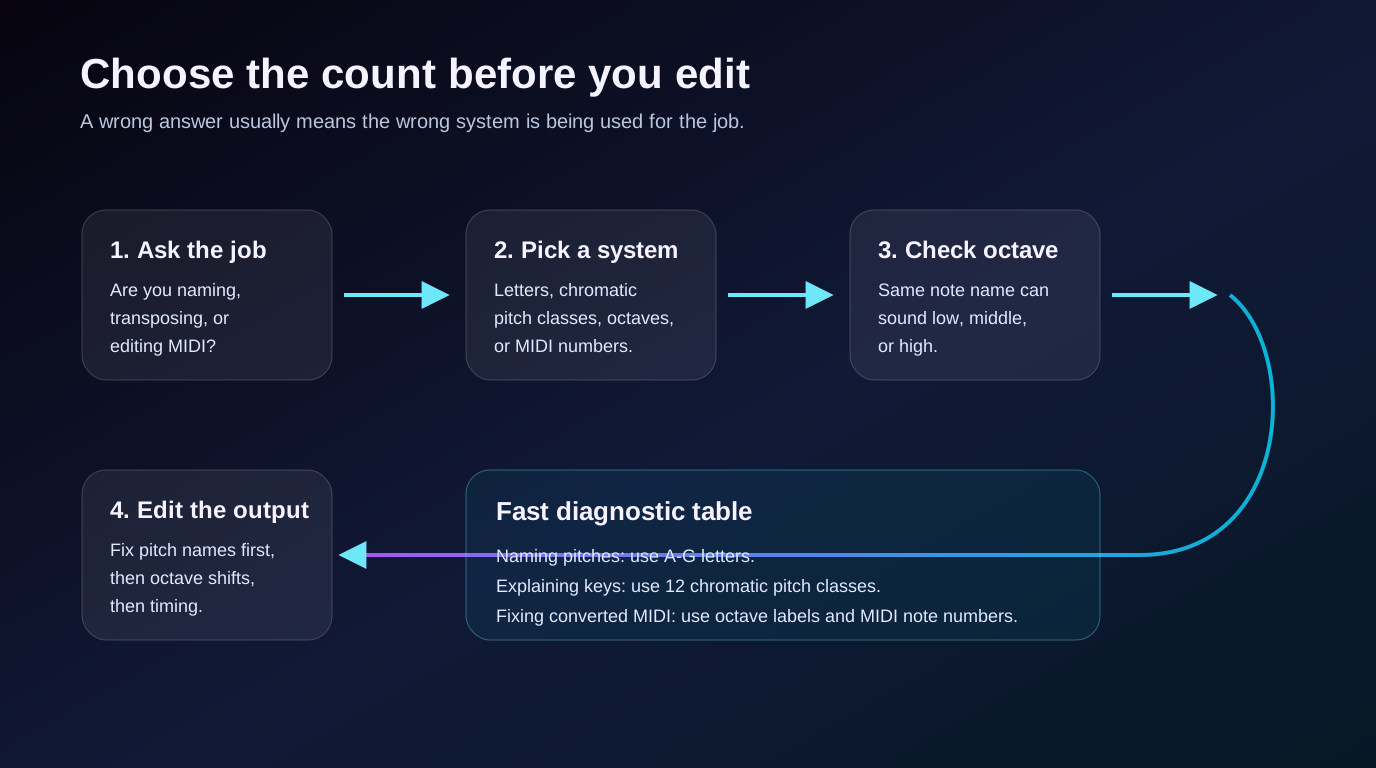
Use this order when reviewing a MIDI conversion:
- Confirm the melody uses the right letter names.
- Check accidentals against the key signature.
- Check whether the octave is correct.
- Fix wrong notes before quantizing timing.
- Adjust note length and expression after pitch is stable.
Where Melogen fits in the note-count workflow
Melogen is most useful after you know what kind of source you have. If your source is a readable score image or PDF, Sheet2MIDI can turn that notation into an editable MIDI starting point. The route supports common score image and document inputs such as JPG, PNG, and PDF, with MIDI output for DAW review.

The note-count layers help you review the result:
| Review layer | What to check after conversion |
|---|---|
| 7 letters | Are the basic note names right? |
| 12 chromatic notes | Are sharps, flats, and naturals handled correctly? |
| Octaves | Is the phrase in the right register? |
| MIDI numbers | Do the notes sit where your DAW expects them? |
| Timing | Do note starts and lengths match the score? |
This workflow keeps cleanup grounded. Do not start by dragging notes around randomly. First decide which count system is active, then fix the layer that actually failed.
Turn readable notation into editable MIDI
Use Melogen Sheet2MIDI for a first pass, then check letter names, chromatic notes, octaves, and MIDI note numbers before deeper editing.
FAQs
Are there 7 or 12 musical notes?
Both answers can be right. There are 7 natural letter names: A, B, C, D, E, F, and G. In common Western equal temperament, there are 12 chromatic notes in an octave when sharps and flats are included.
Why do notes repeat after G?
The letter-name system repeats because music uses octaves. After G, the next natural letter is A again, but it may sit in a higher or lower octave depending on the register.
How many notes are on a piano?
A standard full-size piano has 88 keys. Those keys repeat the same 12-note chromatic pattern across octaves, from the low bass range to the high treble range.
How many notes are there in MIDI?
The common MIDI note range has 128 note numbers, from 0 to 127. Those numbers represent fixed pitches, not musical letter names by themselves.
Do other music systems use more than 12 notes?
Yes. Some tuning systems, traditions, and experimental setups divide pitch differently. For everyday piano, guitar, sheet music, and DAW cleanup in this context, the practical default is the 12-note chromatic octave.
The practical takeaway
The answer to "how many musical notes are there" changes because music has layers. Use 7 for natural letter names, 12 for the chromatic octave, octave labels for real sounding pitch, and MIDI numbers for digital editing.
When you get confused, ask one cleanup question: what am I counting right now? That single question keeps note names, piano keys, pitch classes, and MIDI data from collapsing into one misleading number.
About the author
Zhang Guo
Composer - AI Product Manager
AI product manager and digital marketing consultant with a background in music. Creativity is the bridge between rhythm and logic, where musical intuition and mathematical precision can coexist in every meaningful product decision.
Follow on X