How to Arrange a Song for Piano Step by Step
Learn how to arrange a song for piano with melody, chords, texture, range, and a Melogen workflow for editable score review.
 Zhang Guo
Turn a static score into editable MIDI
Contents
If you want to learn how to arrange a song for piano, start by separating the song from the recording. The melody, chord movement, bass direction, and main rhythmic feel are the material. The full band texture, production effects, and vocal details are only clues for what the piano version should imply.
A good piano arrangement does not copy every sound. It keeps the listener's memory of the song intact while making the result playable under two hands. That means choosing what the piano must carry first, then deciding what can be simplified.
Start by mapping the song into piano jobs
Before you write notes, name the jobs the piano has to cover. Most song arrangements need five layers: melody, harmony, bass, rhythm, and texture. You do not need to play all five at full strength all the time, but you should know which layer is carrying the song in each section.
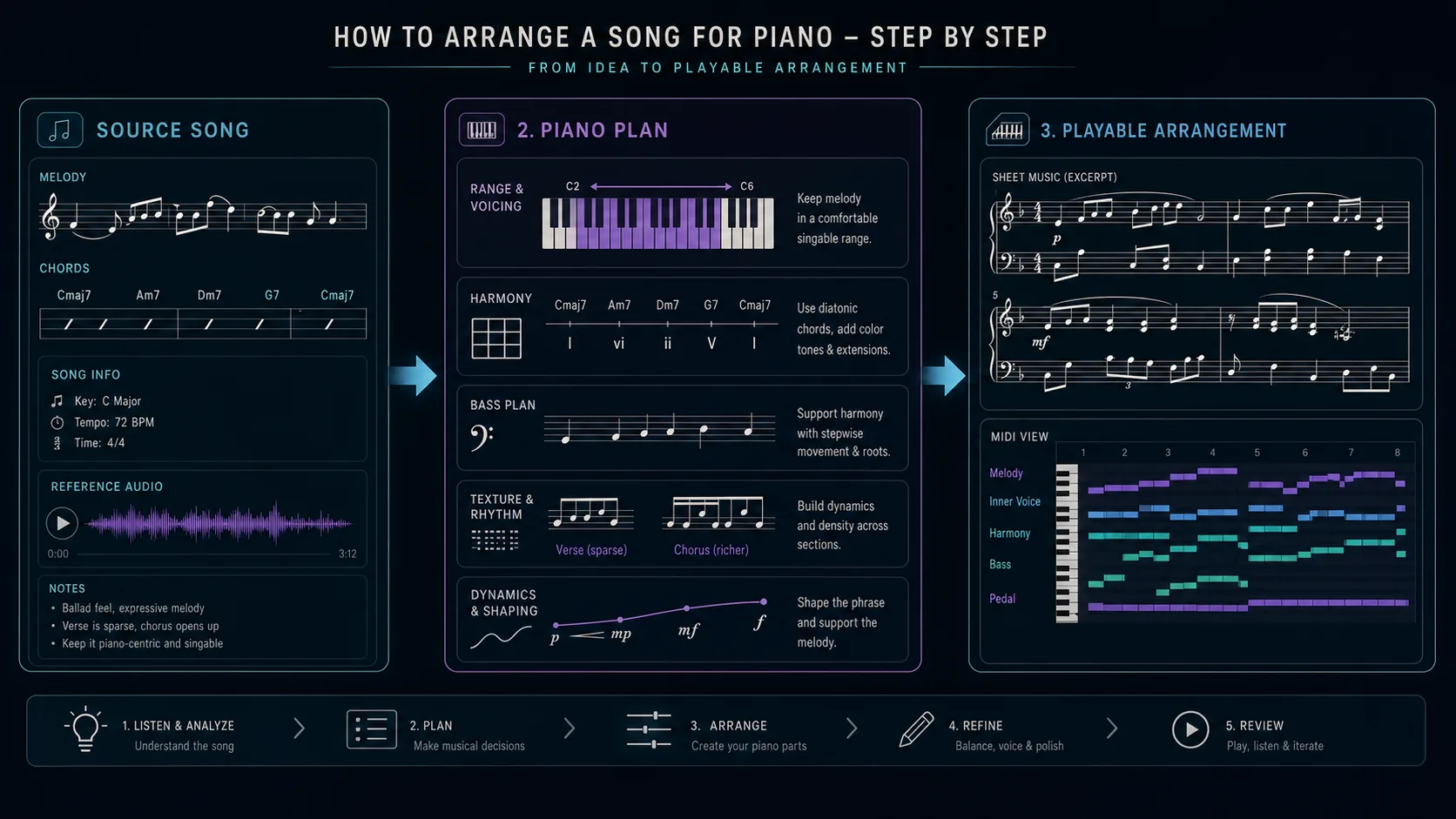
| Song layer | What to listen for | Piano decision |
|---|---|---|
| Melody | The line a listener would sing back | Keep it in a clear register |
| Chords | The harmonic path underneath the tune | Choose simple voicings first |
| Bass | Roots, stepwise motion, or repeated patterns | Put it on strong beats before adding movement |
| Rhythm | Groove, pulse, and syncopation | Translate the feel without overcrowding |
| Texture | Pads, guitar patterns, strings, or drums | Suggest the energy with spacing and register |
If the song already exists as a lead sheet, the guide to lead sheets for piano is the closest companion. If you are creating an original piece instead of arranging an existing one, the workflow for how to compose a song on piano starts one step earlier.
Write the melody before decorating the harmony
The melody decides the arrangement's center of gravity. Write it in a register where it can sing without strain, usually between middle C and the upper treble range for beginner and intermediate arrangements. If the original singer jumps across a wide range, keep the contour but smooth the most awkward leaps.
Use this quick melody pass:
- Find the first complete phrase.
- Mark the highest and lowest notes.
- Sing the phrase while tapping the pulse.
- Move it to a comfortable piano register.
- Remove ornament notes that only work because of the original voice or instrument.
Do not add full chords yet. A melody that is clear by itself will survive the next layers. A melody that only works when hidden in dense harmony usually needs rewriting before the arrangement grows.
Turn chords into playable voicings
After the melody is stable, add the chord progression in its simplest form. Start with roots and triads, then add sevenths, suspensions, or color tones only when they support the phrase.
The useful question is not "What is the fanciest voicing?" It is "What chord shape lets the melody stay on top?"
| If the song has... | Start with... | Add later only if... |
|---|---|---|
| Simple pop chords | Root plus triad tones | The section needs lift or color |
| Jazz-influenced chords | Shell voicings and guide tones | The melody leaves room for extensions |
| Guitar strumming | Broken chord patterns | The rhythm stays playable |
| Dense pads or strings | Wide, slow voicings | The melody still cuts through |
| Fast chord changes | Fewer notes per chord | The hand motion becomes reliable |
For many songs, the left hand can play roots on strong beats while the right hand carries melody and light chord tones. If that feels too empty, add inner notes between melody attacks. If it feels too heavy, remove the middle of the chord before changing the melody.
Build bass, rhythm, and texture in layers
Once melody and harmony work, make the arrangement feel like piano music. This is where many arrangements become too busy. Add one layer, listen, then decide whether the song actually needs the next one.
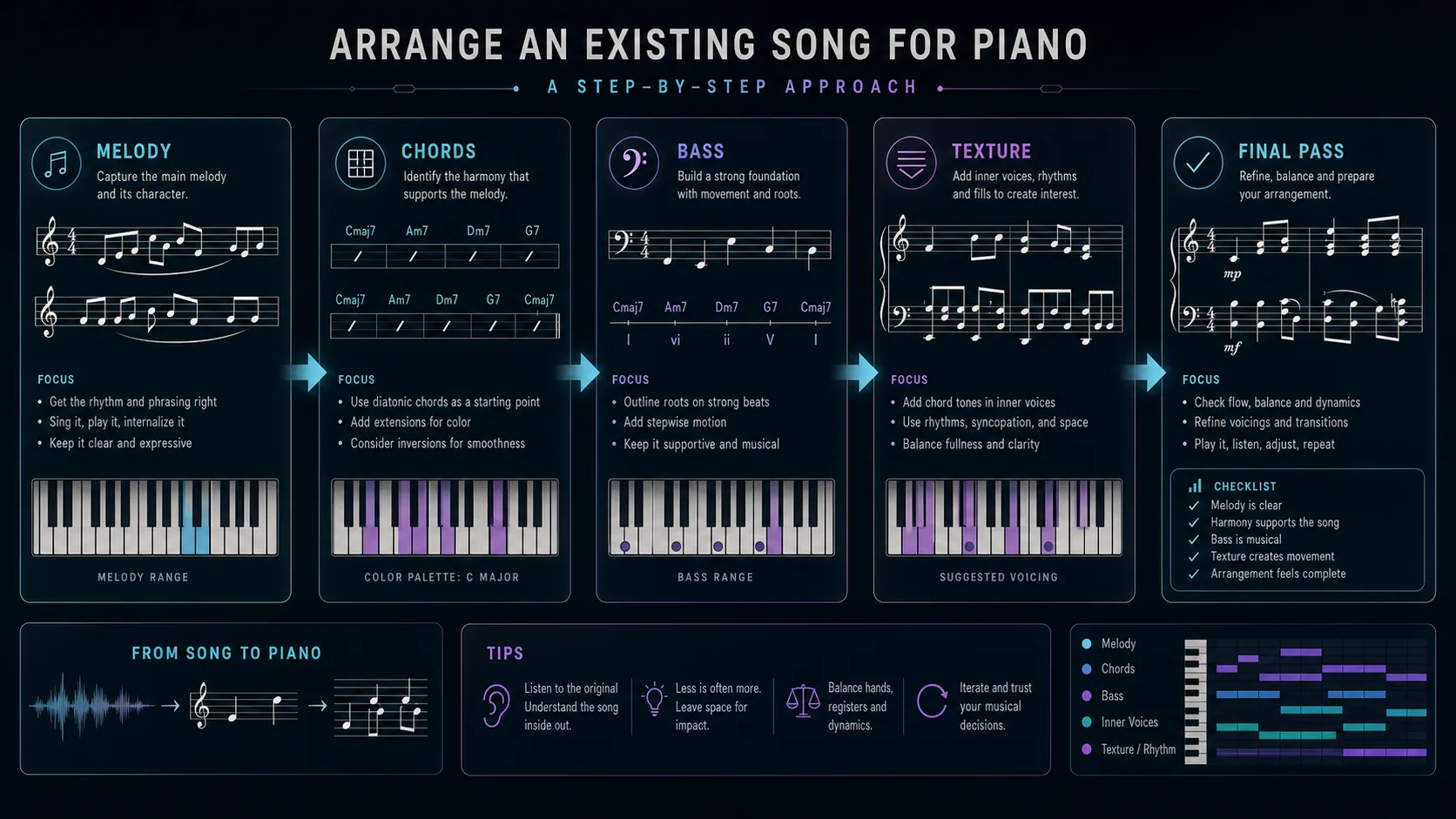
Use this five-step order:
- Melody: keep the main tune readable and singable.
- Chords: place stable harmony under important melody notes.
- Bass: outline roots, inversions, or stepwise motion.
- Texture: add broken chords, inner voices, or rhythmic figures.
- Final pass: adjust balance, transitions, dynamics, and hand comfort.
Texture should follow section energy. A verse might use single bass notes and light right-hand fills. A chorus may need octaves, fuller voicings, or a wider left hand. A bridge might thin out so the return feels stronger.
Keep the arrangement playable under real hands
A piano arrangement is finished only when it can be played musically, not merely when it looks complete. Check the hands before polishing notation.
| Check | What can go wrong | Practical fix |
|---|---|---|
| Range | Melody is too low or accompaniment is too high | Move the melody up or thin the left hand |
| Leaps | Left hand jumps faster than the tempo allows | Use inversions or keep roots on fewer beats |
| Rhythm | Both hands fight for the same subdivision | Let one hand sustain while the other moves |
| Density | Every beat is filled with notes | Save fullness for the chorus or final repeat |
| Pedal | Harmony blurs across chord changes | Pedal by chord, not by bar |
Record a slow pass, then listen without touching the keyboard. You will notice balance problems faster when your hands are not busy solving them.
Use Melogen when your source or draft needs structure
Melogen is most useful when your arrangement source is trapped in a static score, PDF, scan, or image, or when your piano draft needs a structure check before deeper editing. The local Sheet2MIDI route supports converting visible sheet music into editable MIDI, while PDF to MusicXML is the better bridge when the next step belongs in a notation editor.

Structural Analysis fits after you have a readable score or draft. It can help you inspect form, tonality, harmony, key signatures, time signatures, harmonic progressions, cadences, melodic themes, and formal sections. That does not replace arranging judgment, but it gives you faster clues about whether the section map is clear.
For a broader composing-tool view, the article on technology for composing music explains when notation software, DAWs, conversion, and analysis each make sense.
Check the structure before deeper cleanup
Use Melogen Structural Analysis when your piano arrangement exists as a readable score, or convert a static score first when you need editable MIDI.
The practical takeaway
Arranging a song for piano is an act of choosing. Keep the melody clear, support it with simple harmony, add bass motion only where it helps, and build texture section by section.
Before you call the arrangement finished, run this checklist:
- Can someone recognize the song from the melody alone?
- Do the chords support the tune instead of covering it?
- Does the left hand feel playable at tempo?
- Does each section have a clear texture level?
- Are the fullest moments saved for the places that need them?
- Can you explain what changed between verse, chorus, and bridge?
If the answer is yes, the arrangement is doing its job. It has turned the song into piano language without losing the reason the song worked in the first place.
About the author
Zhang Guo
Composer - AI Product Manager
AI product manager and digital marketing consultant with a background in music. Creativity is the bridge between rhythm and logic, where musical intuition and mathematical precision can coexist in every meaningful product decision.
Follow on X