How to Read Accordion Sheet Music With Stradella Bass
Read a two-bar accordion waltz, match bass and major-chord buttons to the lower staff, then coordinate the melody and accompaniment.
 Zhang Guo
Turn a static score into editable MIDI
Contents
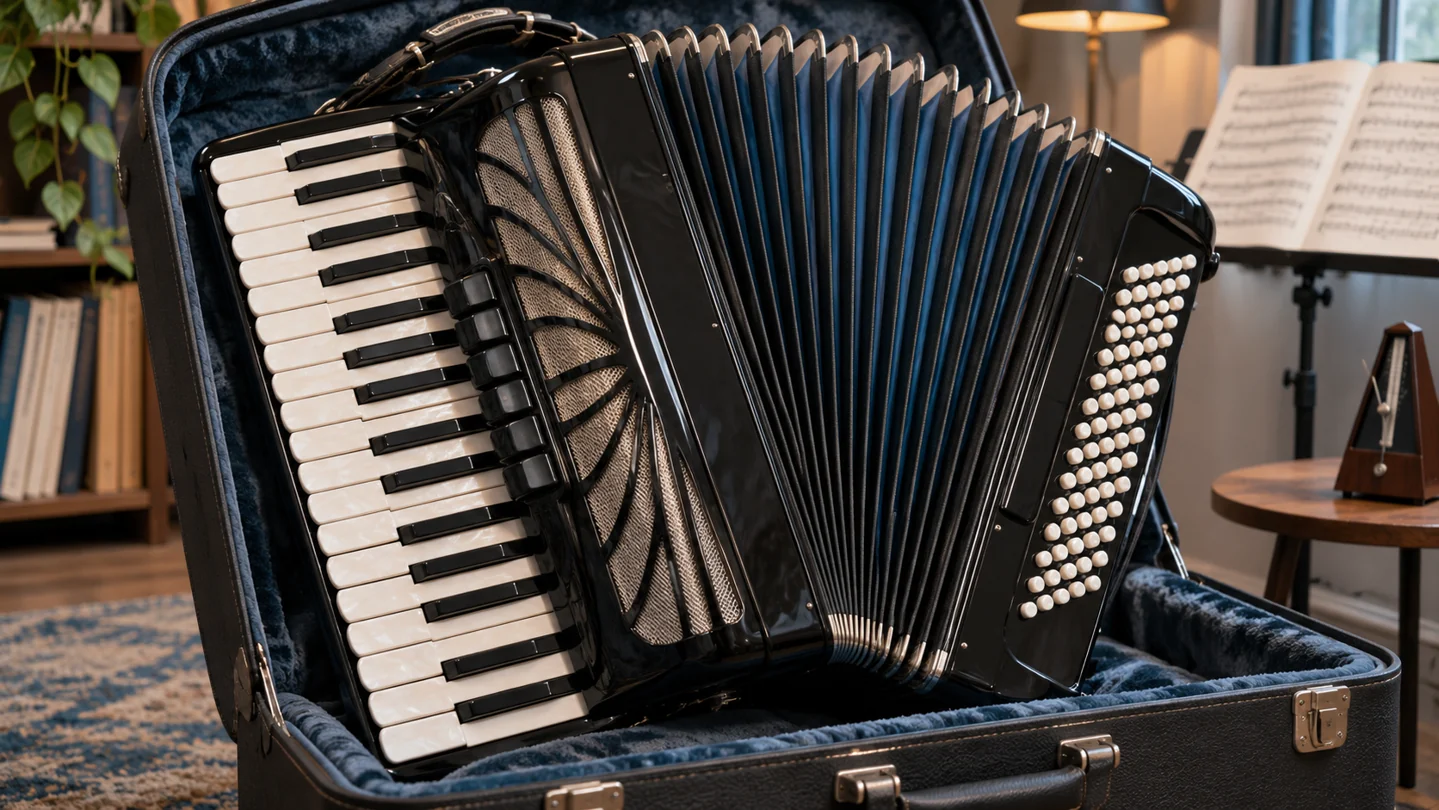
To learn how to read accordion sheet music on a piano accordion with standard Stradella bass, read the upper staff as a right-hand melody. On the lower staff, find out which symbols call for a single bass button and which call for a preset chord button. One written note may stand for a whole chord. The score's key or method book tells you how it labels that difference.
The two-bar waltz below uses a declared convention. It is written for standard bass, with the right hand on a piano keyboard. A free-bass part can ask the left hand to play individual pitches instead. Diatonic button accordions can also have different keyboard and bellows conventions.
Read the bass part on its own
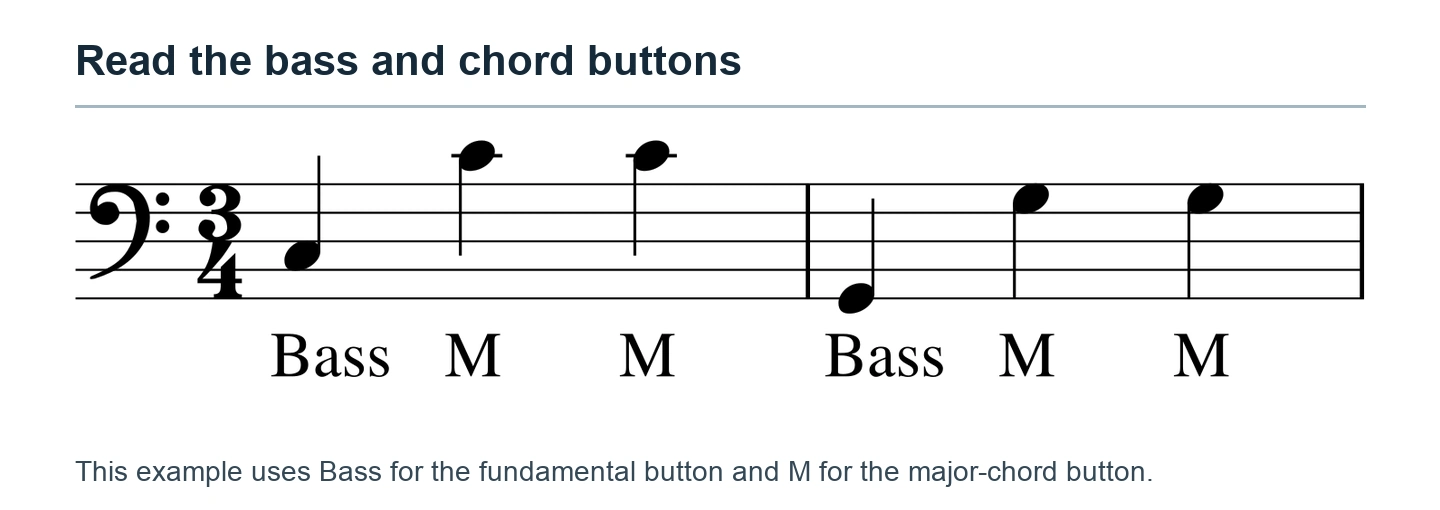
In this example Bass means the fundamental bass button named by the lower note. M means the major-chord button named by the upper note. Play the bass C once, then the C-major button twice. In bar two, move to G bass, then G major twice. Each button press takes one beat.
| Written event | What your left hand does | What you should hear |
|---|---|---|
| Low C labeled Bass | Press the C fundamental bass button | A bass tone on beat one |
| Higher C labeled M | Press the C-major chord button | The major chord on beats two and three |
| Low G labeled Bass | Move to the G fundamental bass button | A new bass tone at the start of bar two |
| Higher G labeled M | Press the G-major chord button | The G-major chord on beats two and three |
On many standard-bass instruments, the fundamental C button has a tactile mark and G is an adjacent fundamental bass in the circle-of-fifths layout. Find C by touch, then find the matching major-chord row. Work slowly enough to feel the move between rows. If the button label or layout on your instrument differs, use its own diagram.
Some editions mark the chord type once and carry it forward. Others print a chord name above a melody, use a different abbreviation, or write out several notes. Check a new score's notation key before deciding that a second C on the page means another single bass tone. AccordionChords' annotated bass examples compare several conventions.
Read the melody in three
The upper line uses ordinary treble-clef pitches. Bar one is E4, G4, C5. Bar two is B4, G4, D5. All six are quarter notes. Count one, two, three | one, two, three while playing just that line with your right hand. Take the jump from G to C without stretching beat two.
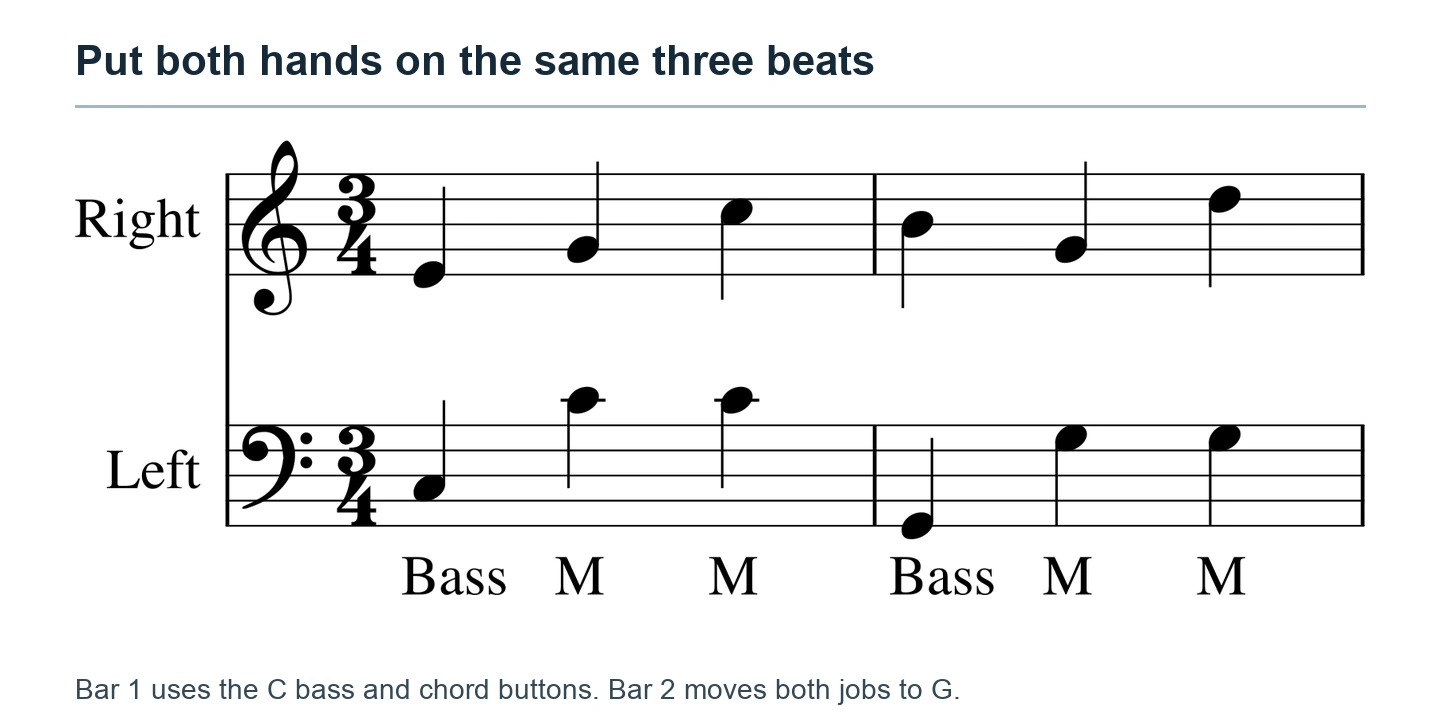
The vertical relationship matters. At the start of bar two, right-hand B arrives with left-hand G bass. On beat two, right-hand G arrives with the G-major button. If you delay the melody until after you have found the chord, the listener hears four events where the score asks for two simultaneous pairs.
Add the hands in stages
- Play the two bars with the left hand alone, saying “bass, chord, chord.”
- Keep only the bass on beat one of each bar and add the full right-hand melody.
- Add the chord on beat two. Repeat before adding beat three.
- Loop both bars and listen for an extra gap when moving from the C column to G.
This synthesized reference plays the example twice at 75 beats per minute. It expands each M into a major triad so you can hear the harmonic change. Your accordion's register and bass voicing may sound different while the attacks still line up.
Check a new accordion part
Find the meter and identify the left-hand system before reading the first measure. Locate one point where the bass changes root and one where the chord quality changes. Rehearse those transitions with your left hand, then add the melody on the same beat. Follow any printed bellows directions and give the phrase enough air to reach its end.
For a clean printed melody, Melogen Sheet2MIDI can provide a MIDI reference to compare with your right-hand line. A preset Stradella chord written as one head needs musical interpretation. Keep the printed convention beside you when checking the result.

Check the melody from an accordion part
Use a clean melody staff for a MIDI reference and read the Stradella button instructions from the score.
About the author
Zhang Guo
Composer - AI Product Manager
AI product manager and digital marketing consultant with a background in music. Creativity is the bridge between rhythm and logic, where musical intuition and mathematical precision can coexist in every meaningful product decision.
Follow on X