The Musician's Guide: How to Read Piano Sheet Music with Confidence
Unlock the language of the piano. This comprehensive guide covers staff basics, clefs, rhythms, and why reading music is a superpower for modern creators.
 Zhang Guo
Turn a static score into editable MIDI
Contents
If you are learning how to read piano sheet music, begin with the page layout before you try to play the whole piece. There is a specific kind of silence that happens when you sit down in front of a piano with a score you’ve never seen before. It can feel like standing at the edge of a vast, unfamiliar landscape. You see the clusters of black dots, the sweeping lines, and the strange symbols at the beginning of the page, and for a moment, it feels like a wall rather than a bridge.
I’ve been there. I remember being a young student, staring at a page of Chopin, feeling like I was trying to decode an ancient, encrypted transmission. I know how intimidating it can be to feel like a "real" musician while struggling with the basic literacy of our craft.
But here is the truth I’ve learned over years of producing and composing: reading music isn't about being academic or "correct." It is about communication. It is a way for a composer from three hundred years ago to whisper a melody directly into your hands. In this guide, I want to gently walk you through the architecture of piano sheet music. We aren't going to treat this like a cold textbook; we’re going to treat it like learning a new language—one that will eventually allow you to speak more clearly through your instrument.
The Foundation: The Staff and the Grand Staff
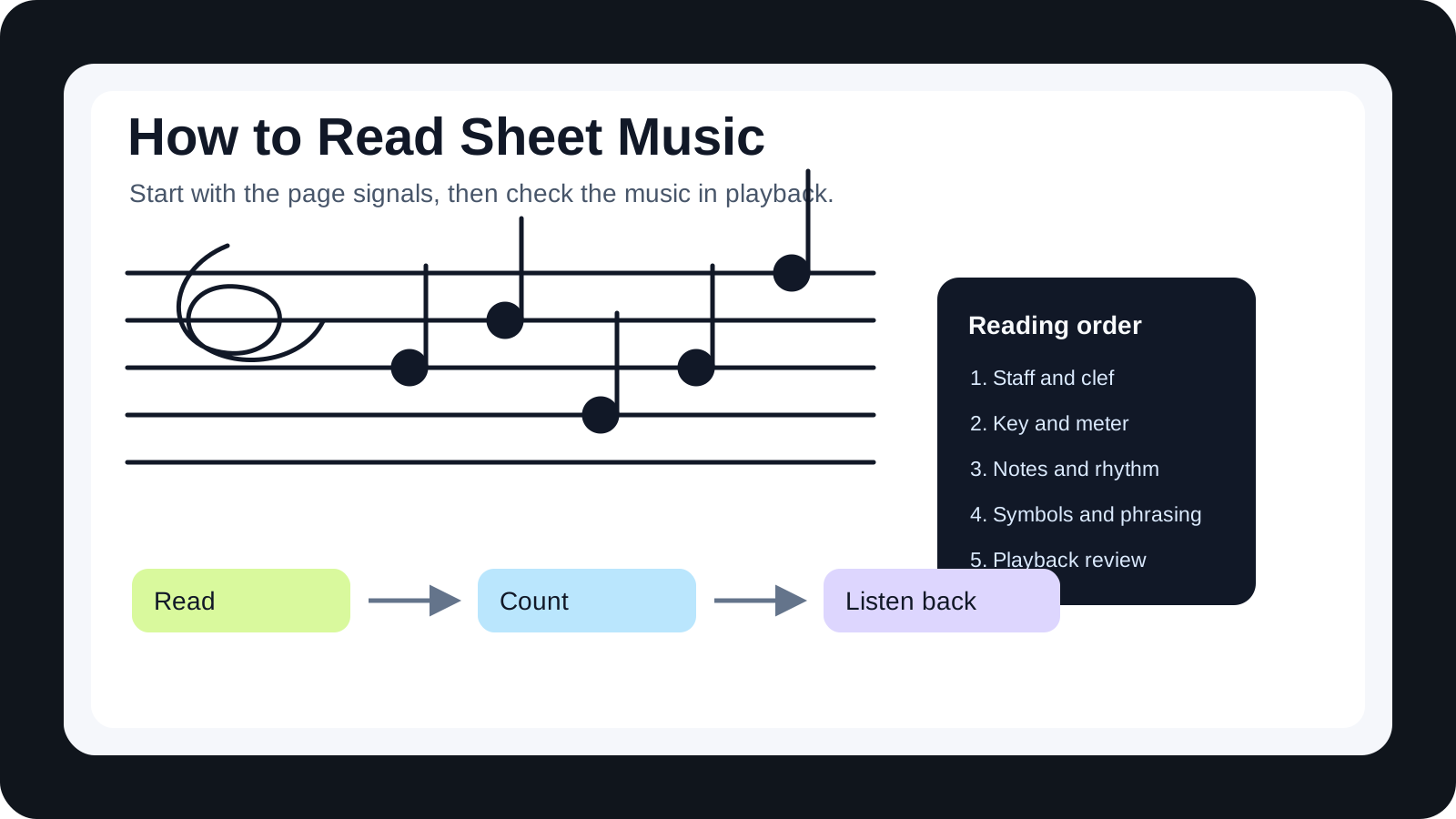
Before we can play a single note, we need to understand the paper it lives on. In music, we use a system of five horizontal lines and four spaces called the Staff.
Think of the staff as a ladder. The higher a note sits on the lines or spaces, the higher the pitch will sound. The lower it sits, the deeper the tone. We count these lines and spaces from the bottom up—the lowest line is Line 1, and the highest is Line 5.
On the piano, we have a unique challenge: our instrument covers a massive range of notes, from the deep growl of the bass to the high shimmer of the treble. To accommodate this, we use the Grand Staff. This is essentially two staves joined together by a vertical bracket on the left.
- The Top Staff is for the Treble Clef (usually played by your right hand).
- The Bottom Staff is for the Bass Clef (usually played by your left hand).
If you are curious about the deep historical evolution of this notation system, the Berklee College of Music provides an excellent, authoritative overview of how the Grand Staff became the universal standard we use today. When you see them joined together, you are looking at the full spectrum of the piano’s voice.
Treble Clef: The Voice of the Right Hand
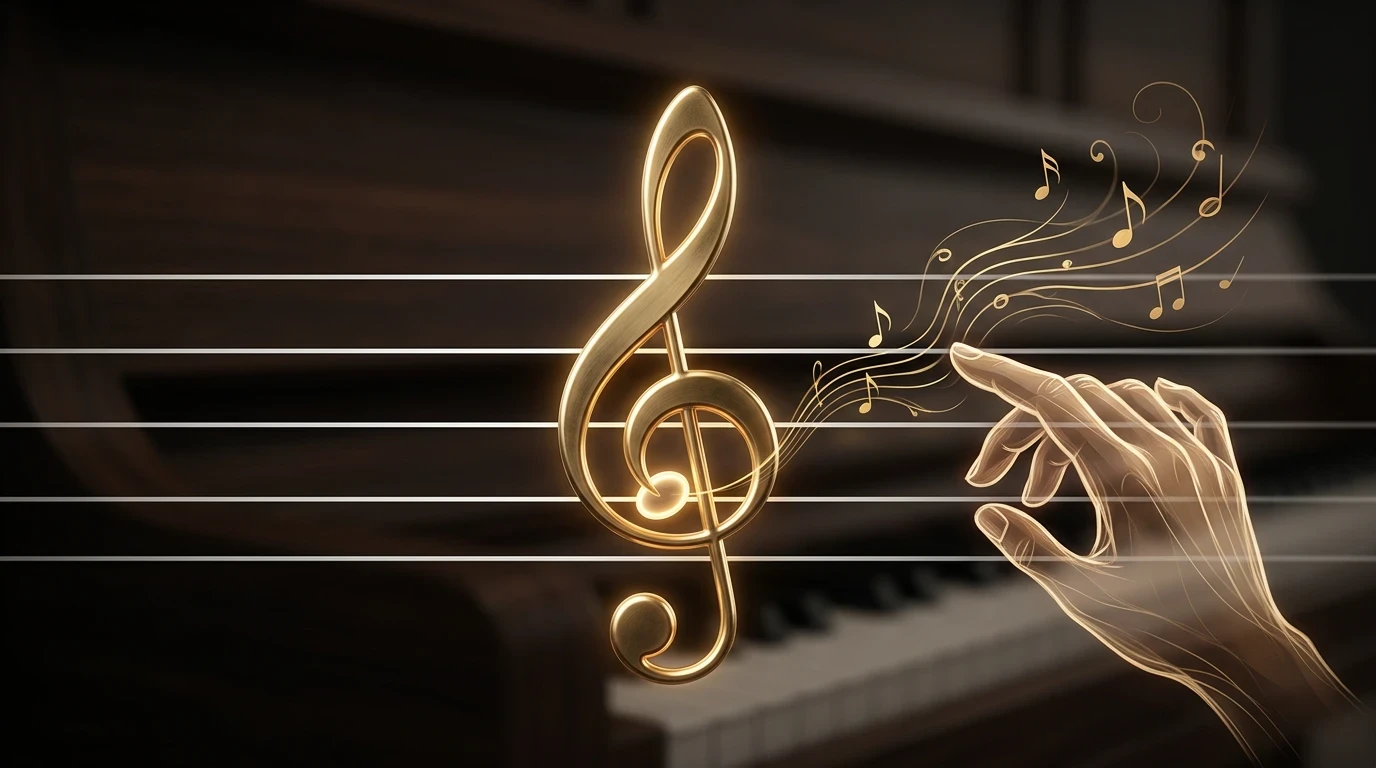
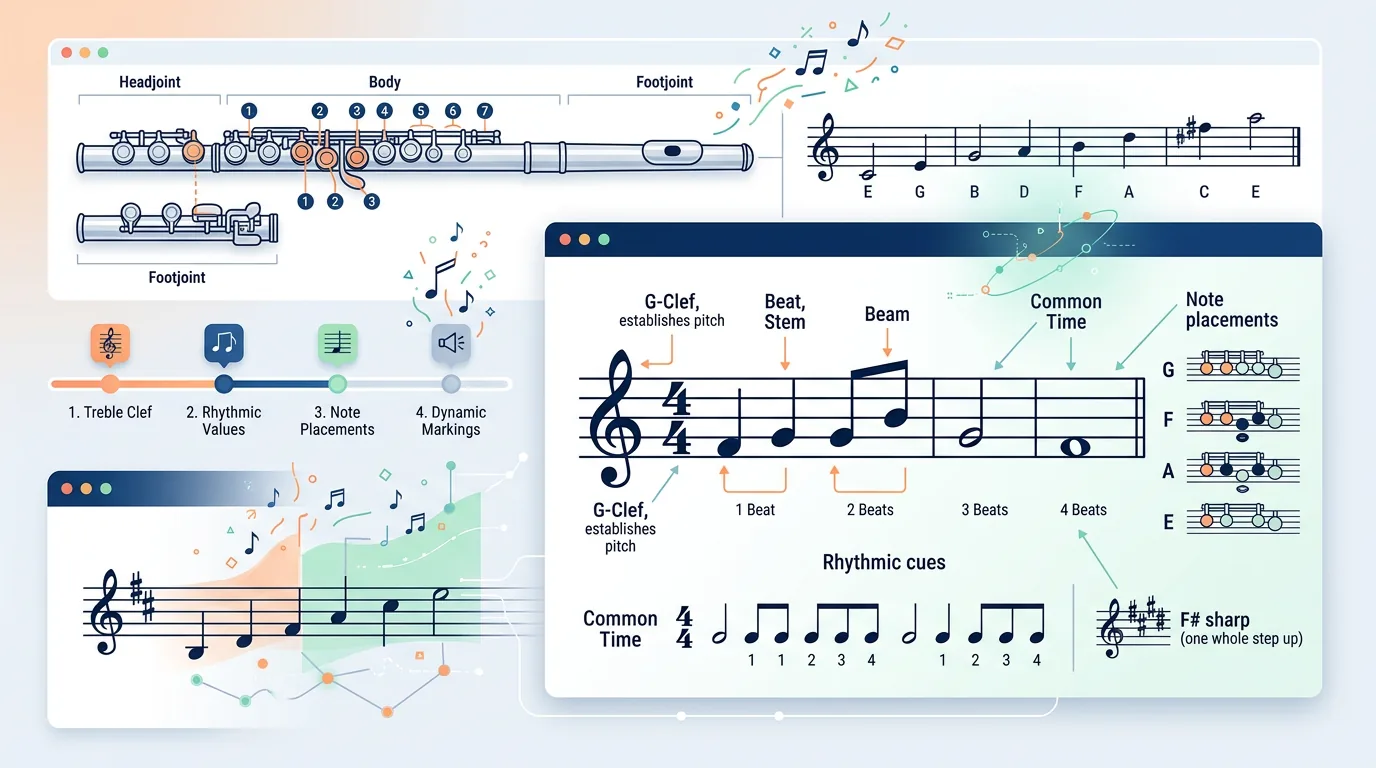
The Treble Clef is also known as the G-Clef. If you look closely at its elegant, swirling shape, the center of the bottom curve wraps specifically around the second line of the staff. That line represents the note G.
To remember the notes on the lines and spaces of the treble staff, musicians have used simple phrases for generations. They might feel a bit old-fashioned, but they work because they give your brain a soft place to land.
The Lines (Bottom to Top)
E – G – B – D – F A common way to remember this is: "Every Good Boy Does Fine."
The Spaces (Bottom to Top)
F – A – C – E This one is even simpler because it spells the word FACE.
When you see a note resting in the second space from the bottom, you know immediately it is an A. If it’s sitting on the very top line, it’s an F.
Bass Clef: The Anchor of the Left Hand
As we move to the lower staff, we encounter the Bass Clef, or the F-Clef. You’ll notice two small dots sitting on either side of the second line from the top. That line is F.
The notes here are different from the treble staff, which can be the most confusing part for beginners. It’s like switching from reading English to reading a closely related but distinct dialect.
The Lines (Bottom to Top)
G – B – D – F – A Try this phrase: "Good Boys Do Fine Always."
The Spaces (Bottom to Top)
A – C – E – G A classic mnemonic is: "All Cows Eat Grass."
I know it feels like a lot to memorize. But eventually, you stop reciting the phrases. Your eyes start to recognize the positions as shapes and feelings rather than letters.
Rhythm: The Heartbeat of the Music

If the staff tells us which note to play, rhythm tells us when and for how long. Without rhythm, music is just a static collection of sounds. Rhythm is what gives music its breath and its pulse.
Note values are represented by how the "dot" (the note head) looks and whether it has a "stick" (a stem) or a "flag."
| Note Name | Appearance | Duration (in 4/4 time) |
|---|---|---|
| Whole Note | Empty circle, no stem | 4 Beats (Hold for the whole measure) |
| Half Note | Empty circle with a stem | 2 Beats |
| Quarter Note | Filled-in circle with a stem | 1 Beat |
| Eighth Note | Filled-in circle with stem and flag | 1/2 Beat |
Understanding these durations is essential for the "feel" of a piece. If you are a producer working in a DAW (Digital Audio Workstation), you already understand this through the grid of your piano roll. Sheet music is simply a more ancient, more organic version of that same grid.
Time Signatures: Setting the Pulse

At the very beginning of a piece, right after the clef, you will see two numbers stacked on top of each other. This is the Time Signature.
- The Top Number tells you how many beats are in each measure (the sections divided by vertical lines).
- The Bottom Number tells you which note value gets one full beat.
The most common signature you will see is 4/4, often called "Common Time." This means there are 4 beats in a measure, and the Quarter Note (the 4) gets the beat.
If you see 3/4, it’s a waltz. You have 3 beats per measure. It feels like a circular, spinning movement (one-two-three, one-two-three). Learning to feel these pulses in your body is just as important as reading them on the page. If you are interested in how time signatures affect the broader arc of a song, you might enjoy our article exploring what is musical structure analysis.
Accidentals: The Black Keys and Color
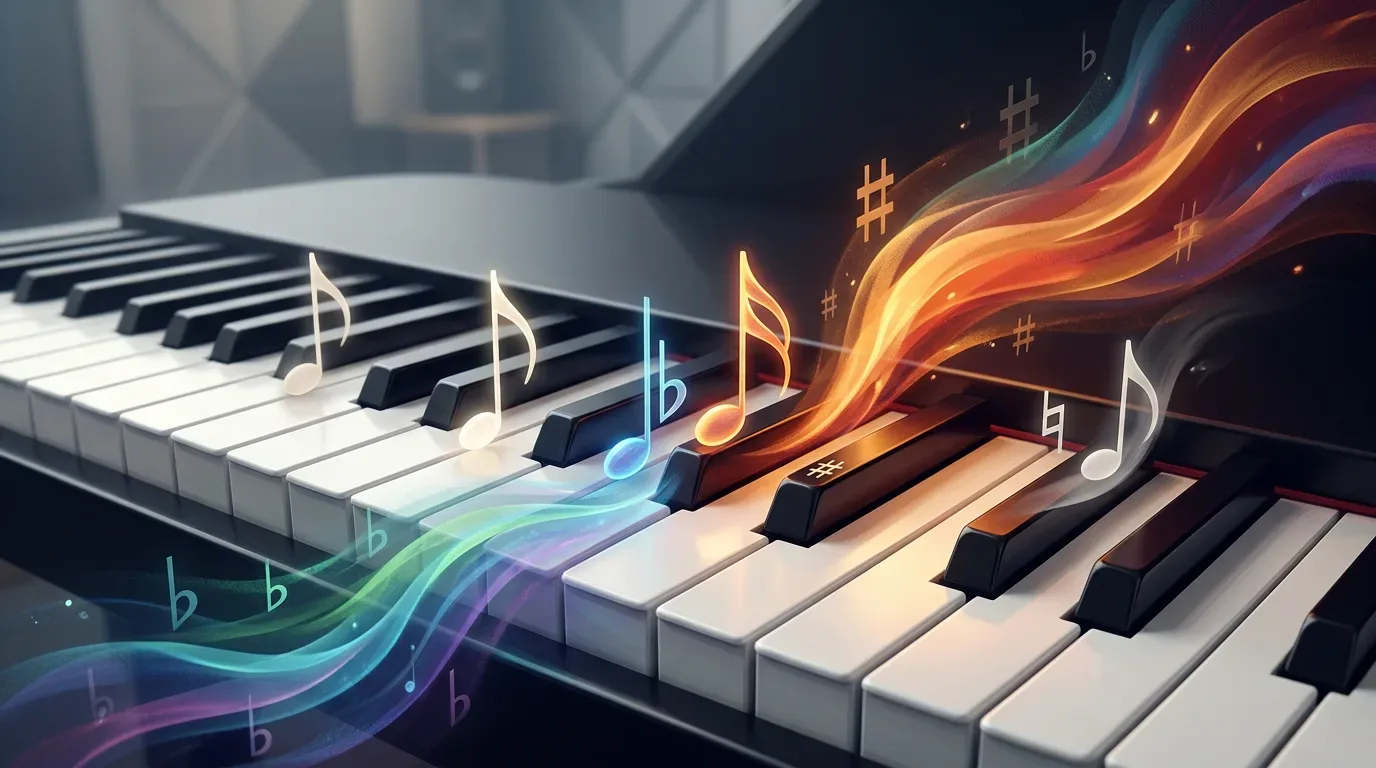
Music would be quite plain if we only used the white keys of the piano. To add "color" and emotion, we use sharps and flats, collectively known as Accidentals.
- Sharp (#): This tells you to play the very next note to the right (higher).
- Flat (b): This tells you to play the very next note to the left (lower).
- Natural (♮): This cancels a previous sharp or flat, returning the note to its "natural" white-key state.
These symbols are the "spices" of a composition. They create tension, resolve into beauty, and allow us to modulate between different emotional keys.
From Reading to Creating: The Modern Bridge

I understand that for many of us—especially those who grew up making music on computers or playing by ear—the process of sitting down and decoding sheet music can feel slow. In a world where we can drag and drop MIDI loops in seconds, why spend hours learning to read these lines?
Because literacy gives you access to the source code of music.
However, I also know that there are times when you have a physical score that you love, but you want to hear it in your studio environment. You want to see the MIDI data, change the instruments, or rearrange the chords without manually transcribing every single note. We have a dedicated guide on exactly how to convert sheet music to MIDI if you want to explore that specific workflow.
This is one of the reasons I appreciate the tools we are building at Melogen. If you find yourself with a beautiful piece of sheet music but don't have the time to transcribe it note-by-note, you can use the Sheet Music to MIDI feature. It’s not about replacing the skill of reading; it’s about creating a bridge between the physical page and your digital creativity.
Your First Week: An Actionable Practice Framework
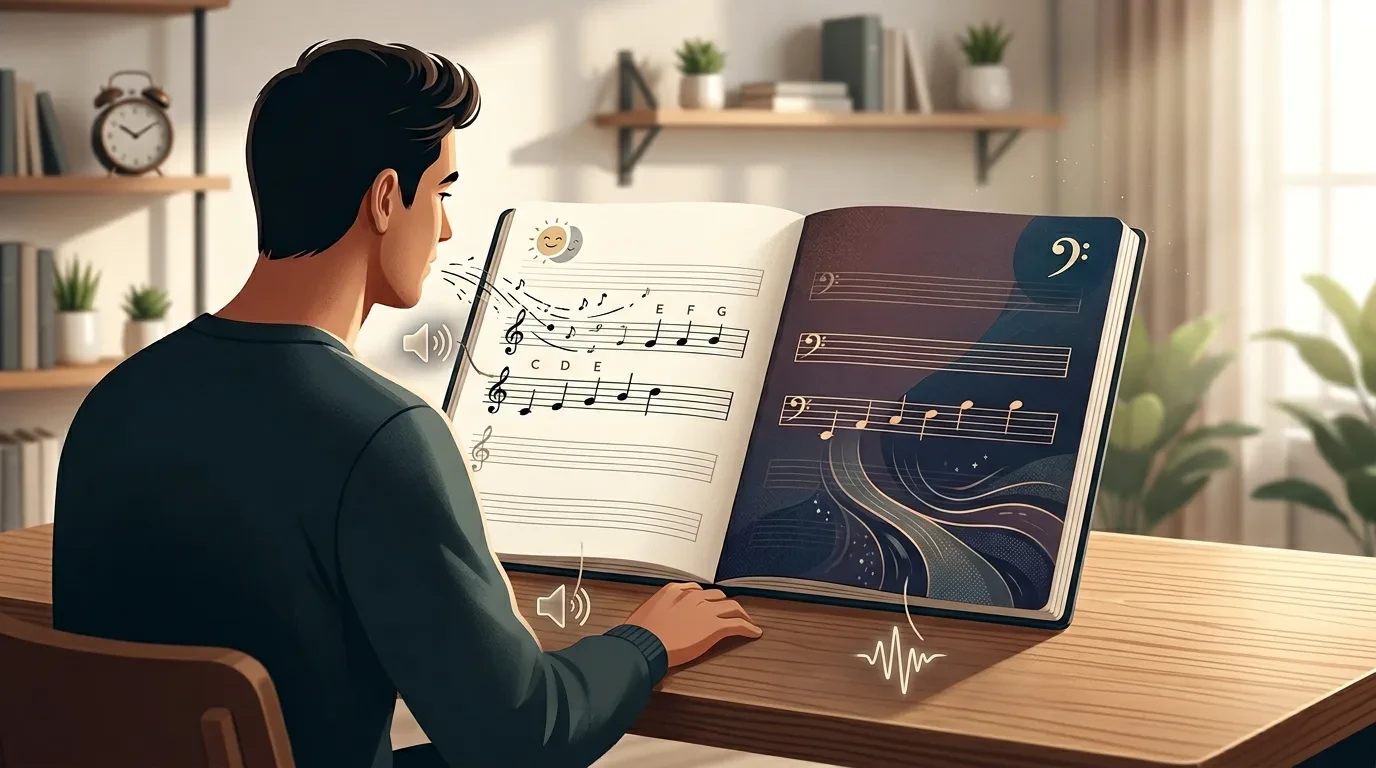
If you are ready to start this journey, please don't try to learn everything today. Treat it with the same kindness you would show a friend learning a new craft.
- Day 1-2: Focus only on the Treble Clef. Practice naming the notes on one page of simple music without playing them. Just say the letters out loud.
- Day 3-4: Do the same for the Bass Clef. Notice how the notes feel deeper, more grounded.
- Day 5: Find "Middle C" on the page and on your piano. Practice moving from Middle C into the treble and then back into the bass.
- Day 6-7: Look at a simple piece and try to clap the rhythm of the right hand while saying the note names. Don't worry about the piano yet. Just feel the heartbeat.
Hear a score after you read it
When a scanned piano score feels too dense, use Melogen Sheet2MIDI to create a playback reference, then return to the page and verify the musical details yourself.
Summary
Learning how to read piano sheet music is a journey of reclaiming a lost language. By understanding the foundation of the Grand Staff, the distinct roles of the Treble and Bass clefs, and the rhythmic heartbeat of note values and time signatures, you gain the ability to unlock any piece of music ever written. It is a slow process that requires patience and consistency, but the reward is a deeper connection to the history and the math of sound. Whether you are reading to perform a classic work or using digital tools like Melogen to translate paper into MIDI, remember that the goal is always the same: to move from the silence of the page to the beauty of the music. Take it one line at a time, breathe, and let the notes speak to you.
About the author
Zhang Guo
Composer - AI Product Manager
AI product manager and digital marketing consultant with a background in music. Creativity is the bridge between rhythm and logic, where musical intuition and mathematical precision can coexist in every meaningful product decision.
Follow on X