Letter Easy Piano Songs: Beginner Practice Guide
Learn easy piano songs with letters, public-domain practice picks, keyboard mapping, rhythm checks, and a safe path toward staff notation and MIDI.
 Zhang Guo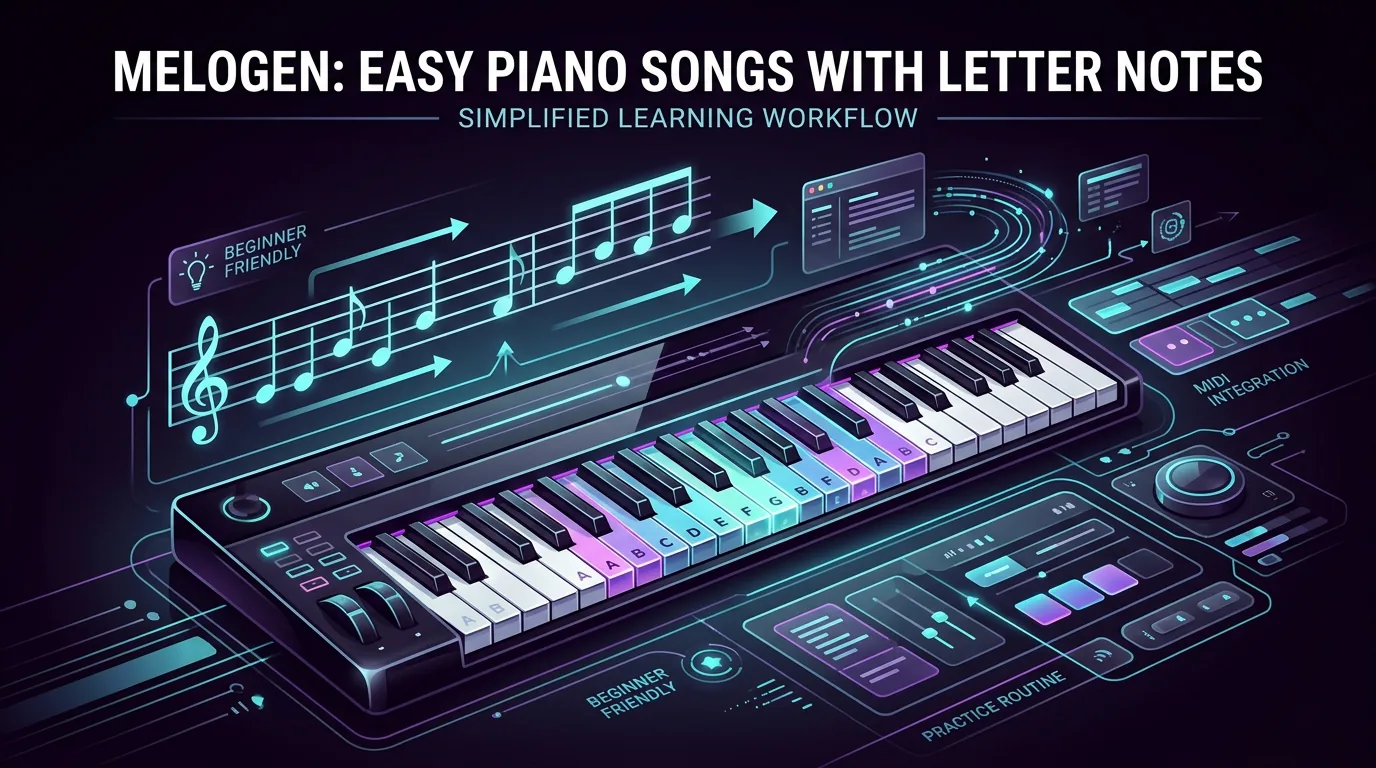
Turn a static score into editable MIDI
Contents
Easy piano songs with letters are useful when you need a fast way to connect a melody to the keyboard. If you searched for "letter easy piano songs," the practical goal is probably simple: find a song, see the note letters, and play a short phrase without getting lost on the keys.
Use letter notes as a beginner map, not as the whole destination. This guide gives you public-domain song starters, a keyboard-mapping routine, rhythm checks, and a clear path from letters into staff reading and MIDI practice.
Start with letters, then add rhythm
Letter notes show pitch names: C D E F G A B. They do not automatically show rhythm, fingering, dynamics, or hand coordination. A row of letters can help you find keys, but the music only starts to make sense when you know which notes are longer, which notes repeat, and where each phrase breathes.
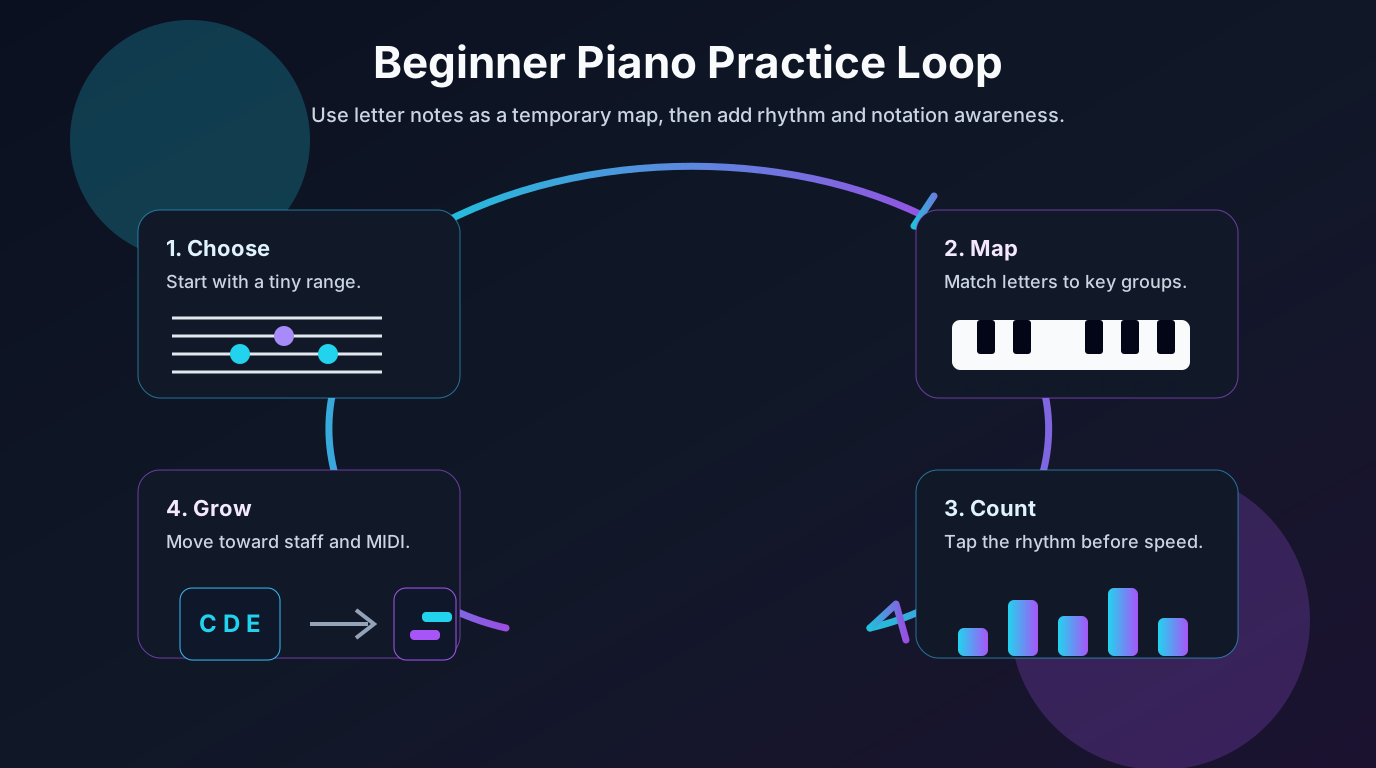
Use this first-pass routine:
- Choose a song with a small range.
- Say the letter names before playing.
- Map each letter to a white key.
- Clap or count the rhythm slowly.
- Play two bars, stop, and correct one mistake.
If the seven-note keyboard pattern is still new, read simple piano notes for beginners first. It gives you the C-D-E-F-G-A-B map before you add full songs.
Try these public-domain song starters
The examples below are short starter patterns, not complete arrangements. They work well because the melodies are traditional or public-domain, the ranges are small, and the patterns are easy to slow down.
| Song starter | Letter pattern to try | Why it helps | Practice check |
|---|---|---|---|
| Hot Cross Buns | E D C / E D C / C C C C / D D D D / E D C | Three-note control | Keep repeated notes even |
| Mary Had a Little Lamb | E D C D / E E E / D D D / E G G | Stepwise motion | Do not rush the repeated E notes |
| Twinkle, Twinkle, Little Star | C C G G / A A G / F F E E / D D C | Repeated phrases and one leap | Count the long notes fully |
| Ode to Joy | E E F G / G F E D / C C D E / E D D | Five-note reading | Keep each phrase relaxed |
| Row, Row, Row Your Boat | C C C D E / E D E F G | Simple upward motion | Sing or count before playing |
| London Bridge | G A G F / E F G / D E F / E F G | Direction changes | Watch the turn back down |
Do not use random copied PDFs for modern songs just because they include letters. For copyrighted pop, film, game, or musical-theater music, use a licensed songbook, app, teacher-provided material, or official arrangement. For a broader sourcing workflow, see the guide to free sheet music online.
Map each letter to the keyboard
Start near Middle C. Find a group of two black keys, then play the white key immediately to the left. That is C. Move right through D E F G A B, then the pattern starts again at C.
| Letter | Keyboard cue | Beginner reminder |
|---|---|---|
| C | Left of two black keys | Use it as the home base |
| D | Between two black keys | Check both black keys around it |
| E | Right of two black keys | End the first small group |
| F | Left of three black keys | Start the next group |
| G | Second white key in the three-black-key group | Keep moving one white key at a time |
| A | Third white key in that group | Do not restart the alphabet yet |
| B | Right of three black keys | The next white key returns to C |
Letter stickers can help for a week or two, but remove the training wheels gradually. Cover one label at a time, say the note name, and check yourself after you play.
Choose songs by range, not fame
The best letter-note song for a beginner is not always the most famous song. Choose the melody that fits your current hand, rhythm, and attention span.
| If the song has... | It is probably ready when... | If it feels too hard... |
|---|---|---|
| Three to five neighboring notes | You can say every letter without pausing | Shrink it to one phrase |
| One clear hand position | Your wrist stays relaxed | Mark the starting finger |
| Repeated notes | You can keep the beat steady | Clap before playing |
| A leap, such as C to G | You can look ahead before moving | Practice only the leap |
| Both hands | The left hand changes slowly | Play melody only first |
If you want more song-selection ideas beyond letter notes, use Good Songs on Piano as the broader skill-level filter.
Move from letters to notation and MIDI
Letter notes are a useful entry ramp, but they hide important information. Staff notation shows pitch height, rhythm, clef, bar lines, and phrase spacing. MIDI can then help you hear timing and check whether a phrase sits in the expected register.
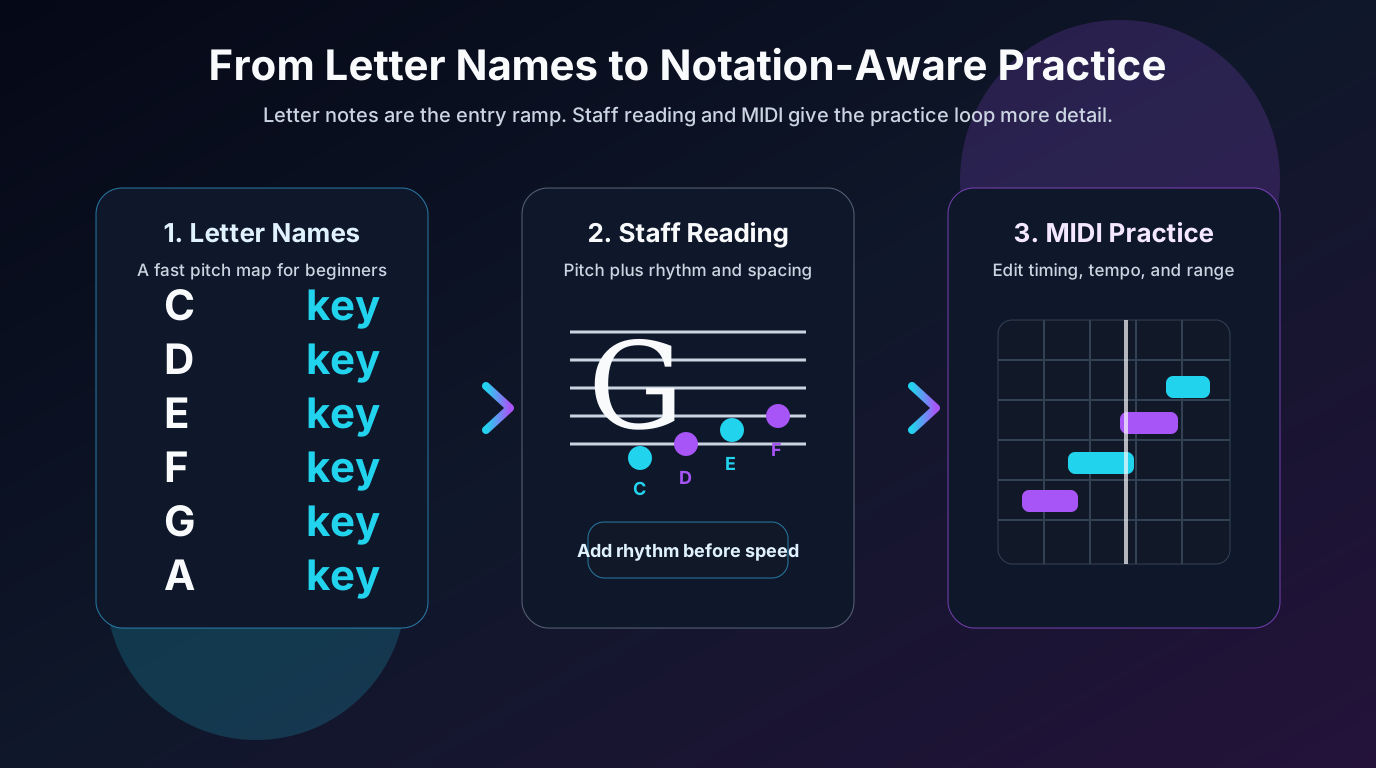
Use this progression:
- Play the letter pattern slowly.
- Find the same melody on a simple staff or beginner score.
- Circle repeated notes and steps before playing.
- Count rhythm separately from pitch.
- Use playback or MIDI only after you have tried to read the phrase yourself.
The goal is not to abandon letters instantly. The goal is to stop depending on them for every note. A good week of practice might be 70% letters, 20% staff checking, and 10% listening back.
Where Melogen fits
Melogen helps after you have a clean score source and want a playback reference. The Sheet2MIDI workflow supports PDF, JPG, and PNG sheet-music input and turns visible notation into editable MIDI that you can inspect in a piano-roll or DAW workflow.

Use it with a beginner-friendly boundary:
- Do not upload a blurry screenshot of letter names and expect musical context.
- Use a clean beginner score when you want MIDI playback.
- Listen for obvious pitch or timing issues.
- Return to the keyboard and fix one small phrase yourself.
Turn a clean score into a MIDI practice reference
Use Melogen Sheet2MIDI for the first playback pass, then return to the keyboard and make the musical corrections yourself.
The practical takeaway
Easy piano songs with letters work best when they stay small. Start with public-domain melodies, map the letters to nearby keys, count before playing, and move into staff notation as soon as the phrase is stable.
Keep this checklist nearby:
- Can you find C without counting from the edge of the keyboard?
- Can you say the letters before playing?
- Can you clap the rhythm without touching the keys?
- Is the melody short enough to repeat cleanly?
- Is your source lawful and readable?
- Can you connect the phrase to staff notation or MIDI after playing it?
If yes, the song is doing its job. If no, make the phrase smaller. A tiny pattern played with timing and awareness teaches more than a long letter-note list played by guesswork.
About the author
Zhang Guo
Composer - AI Product Manager
AI product manager and digital marketing consultant with a background in music. Creativity is the bridge between rhythm and logic, where musical intuition and mathematical precision can coexist in every meaningful product decision.
Follow on X