What is OMR? A Musician's Guide to Optical Music Recognition
Discover what Optical Music Recognition (OMR) is, how it works, and why this technology is changing how musicians archive, transpose, and interact with sheet music.
 Zhang Guo
Turn a static score into editable MIDI
Contents
If you are asking what is OMR, the short answer is that Optical Music Recognition turns printed or scanned music notation into editable musical data. Have you ever found a beautiful, faded piece of sheet music in a second-hand store and wished you could instantly hear how it sounds? Or perhaps you’ve been handed a complex orchestral score during a rehearsal, only to realize you need it transposed down a minor third by tomorrow morning.
For centuries, the only solution to these problems was time. You had to sit at the piano and manually input every single note, rest, and dynamic marking into a notation program—a process of tedious repetition that often drained the joy out of the music before you even played it.
This friction—the gap between the static paper and the fluid digital world—is exactly what Optical Music Recognition (OMR) was built to eliminate. In this guide, I want to demystify what OMR actually is, how it has evolved in recent years, and why it is quietly becoming one of the most essential tools for modern musicians, educators, and producers.
Defining OMR: The Bridge Between Paper and Data
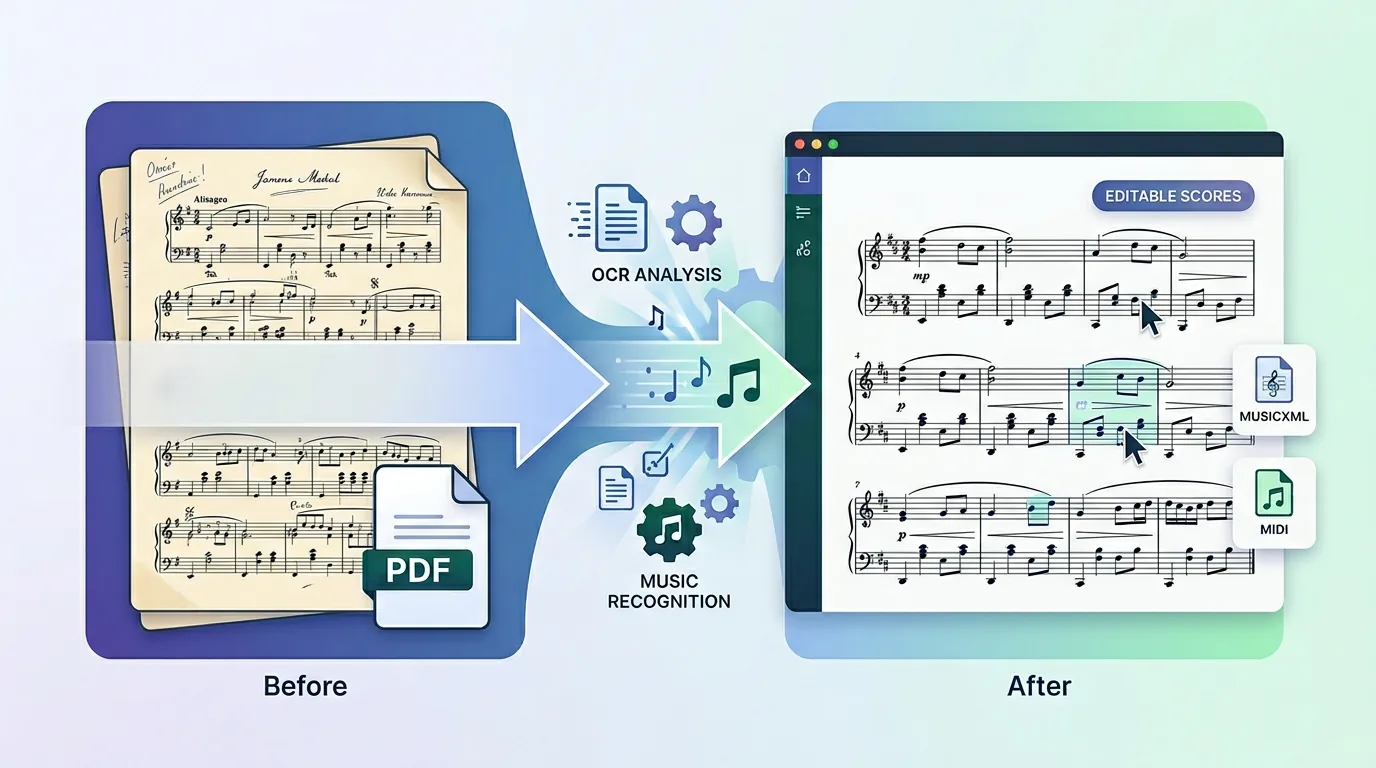
At its most basic level, Optical Music Recognition (OMR) is the technology used by computers to "read" musical notation from a physical document or a static image (like a PDF or a photograph) and translate it into a machine-readable format.
You are likely already familiar with OCR (Optical Character Recognition)—the technology your phone uses to scan a receipt or translate text from a menu. OMR is the musical equivalent, but it is exponentially more complex.
While text generally reads in a straight line from left to right, music is a two-dimensional language. A note’s meaning depends not only on what it looks like, but exactly where it sits on the staff, what clef is active at the beginning of the line, and what key signature dictates the entire piece. OMR doesn't just read symbols; it has to understand the relationships between them.
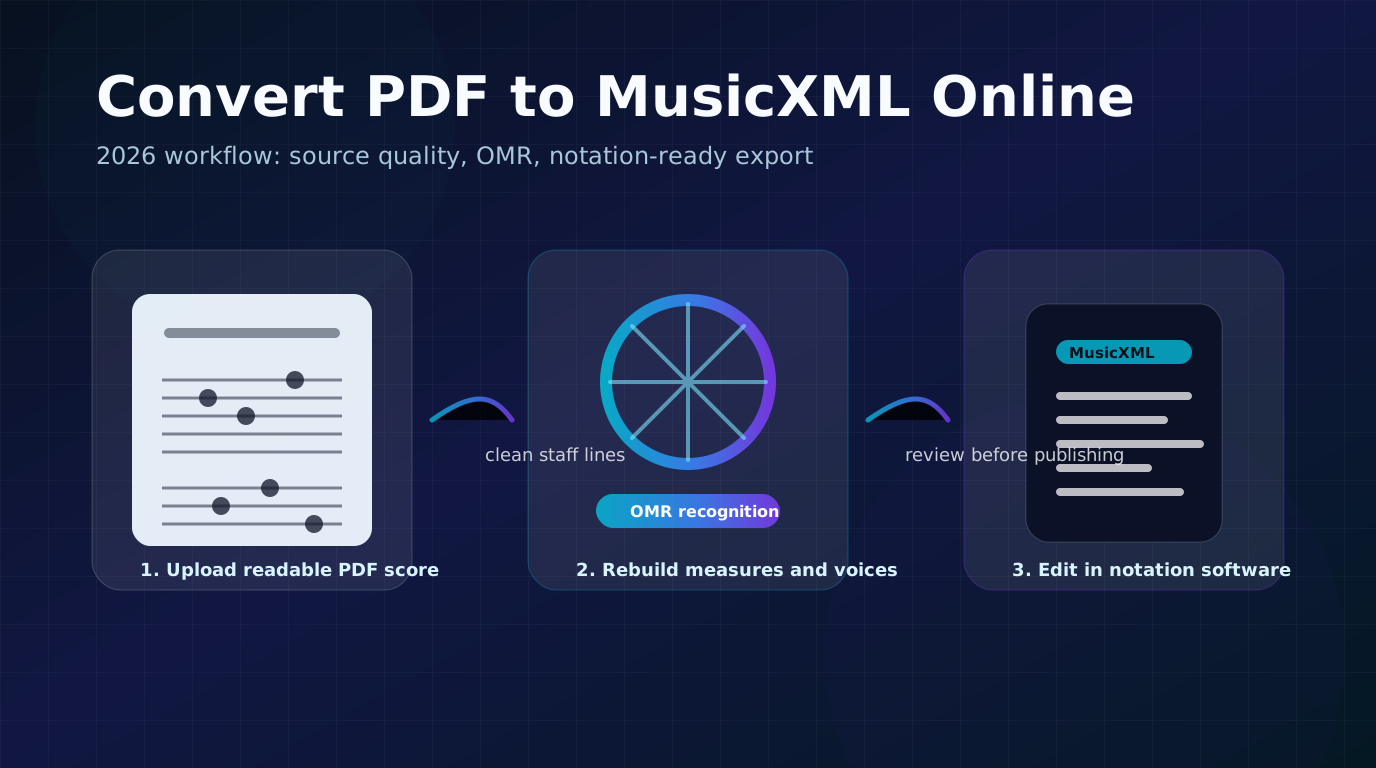
The ultimate goal of OMR is to convert a static image into a fluid, editable format like MusicXML or MIDI. Once the music is in these formats, it can be played back by a synthesizer, transposed instantly, or edited in software like Sibelius, Finale, or Dorico.
| Term | What it reads | What you can edit afterward |
|---|---|---|
| OCR | Printed or handwritten text | Words, paragraphs, and document layout |
| OMR | Staff notation, clefs, noteheads, rests, and rhythm | Notes, timing, transposition, playback, MIDI, or MusicXML |
| Manual entry | Whatever you type note by note | Everything, but only after you spend the time entering it |
How OMR Works: The Four Stages of Recognition
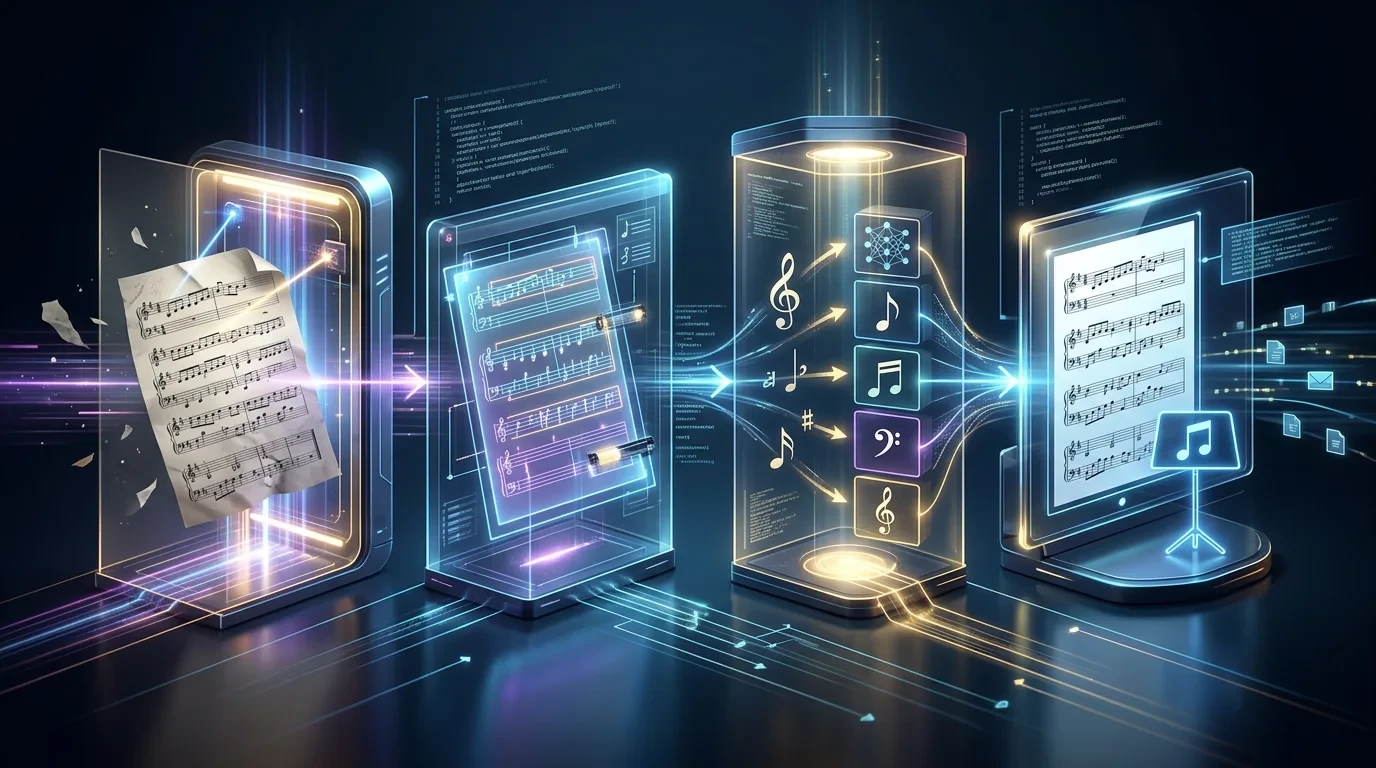
To appreciate what OMR does for our workflow, it helps to understand the quiet heavy lifting happening beneath the surface. Modern OMR systems generally operate through a pipeline of four distinct stages.
1. Preprocessing (Cleaning the Canvas)
When you upload a photo of sheet music, it is rarely perfect. The page might be tilted, the lighting might cast a shadow, or the ink might be faded. In this first stage, the OMR software "cleans" the image. It converts it to high-contrast black and white, straightens the page (deskewing), and most importantly, identifies and often temporarily removes the horizontal staff lines so it can isolate the actual musical symbols.
2. Symbol Recognition (The Vision Stage)
Once the canvas is clean, the AI acts as the eyes. Using advanced neural networks, the software scans the document to locate and classify every single object. It identifies the treble and bass clefs, distinguishes a quarter note from a half note, and spots the tiny accidentals (sharps and flats) hiding next to the chords.
3. Musical Reconstruction (The Logic Stage)
This is where the true magic happens. The software must now act as the brain, applying the rules of music theory to the symbols it found.
It calculates the pitch of a notehead based on its distance from the staff lines. It measures rhythm by grouping notes with their corresponding stems and beams, ensuring that the total duration of a measure aligns perfectly with the time signature. It is essentially solving a complex mathematical puzzle. If you are struggling to grasp how these elements interact visually, our beginner's guide on how to read piano sheet music offers a gentle breakdown of this exact logic.
4. Semantic Encoding (The Final Translation)
Finally, the OMR system takes all of this understood logic and packages it into a standard digital file format. It exports a MusicXML file that perfectly preserves the visual layout of the score, or a MIDI file that captures the performance data for your DAW (Digital Audio Workstation).
Real-World Use Cases: Why Musicians Need OMR
Understanding the technology is interesting, but understanding how it removes friction from your daily creative life is what truly matters. How are musicians actually using OMR today?
- Instant Transposition: Vocalists and accompanists frequently encounter sheet music that is slightly out of their comfortable vocal range. Instead of transposing by sight, OMR allows them to scan the music, load it into a notation editor, and press a button to shift the entire piece down a minor third.
- Auditioning Unfamiliar Scores: If you are handed a highly complex, dense orchestral score and want to understand the harmonic movement before you practice, OMR can scan the page and instantly play it back to you through virtual instruments.
- Archiving and Preservation: Choirs and orchestras often have filing cabinets full of deteriorating, out-of-print arrangements. OMR allows directors to digitize these fragile paper copies into permanent, editable digital files.
- Remixing and Sampling: For producers looking to sample classical works without dealing with audio copyright strikes, OMR can translate a public-domain Beethoven sonata directly into a MIDI file, ready to be assigned to modern synthesizers. If you are a producer looking to integrate this into your workflow, you can learn more in our detailed look at how to convert sheet music to MIDI.
The Limitations: Where AI Still Needs a Human Touch
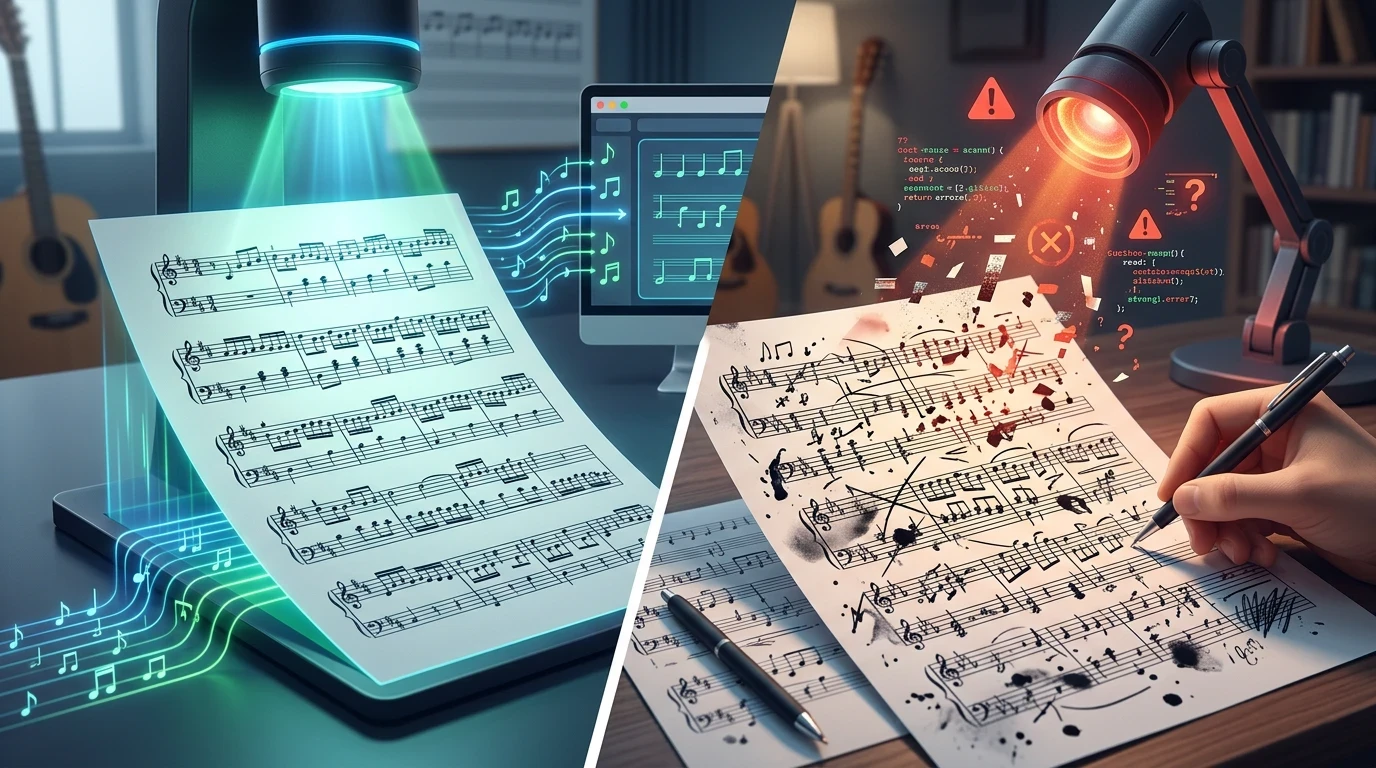
As much as I advocate for OMR, I also believe in setting honest expectations. We are dealing with artificial intelligence, not magic, and the technology still has boundaries.
The most significant limitation of OMR lies in handwritten scores. While AI models are incredibly adept at reading standard printed notation (like a published Bach sonata), human handwriting introduces a level of chaos that machines struggle to decode. A hastily scribbled eighth note can easily look like a smudge of ink to a computer.
Furthermore, extremely dense polyphony—where multiple independent voices, slurs, and dynamic markings overlap heavily on a single staff—can confuse the semantic logic of the software.
Because of these nuances, professional OMR workflows are always "AI-assisted." The software does 95% of the heavy lifting, saving you hours of manual entry, but it still requires the trained eye of a musician to proofread the final output and correct the remaining 5% of interpretive errors. If you are currently evaluating which software can handle this balance best, we have compiled a review of the best OMR software for musicians to help you choose the right tool for your specific needs.
Stepping Into the Future of Transcription
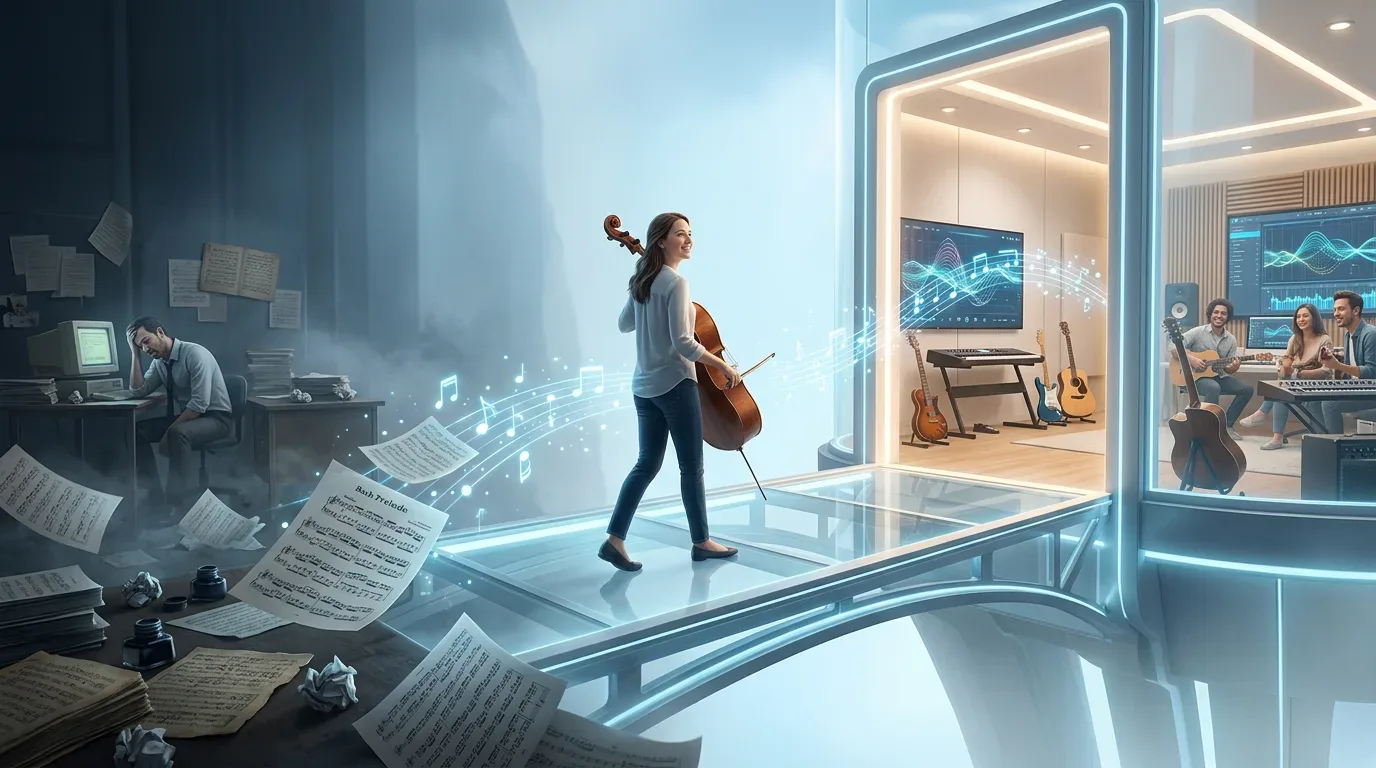
As musicians, our ultimate goal is to spend less time managing logistics and more time actually creating, playing, and feeling the music. The era of spending four hours manually inputting a Bach prelude into a computer is gently coming to an end.
If you have a stack of sheet music sitting on your piano or a PDF score waiting on your desktop, you don't have to wait to hear it. You can experience the power of modern OMR directly through your browser. We invite you to use the Melogen Sheet Music to MIDI converter. It is a quiet, powerful tool designed to respect your time and instantly translate your paper scores into fluid, workable digital audio.
Test OMR with a real score
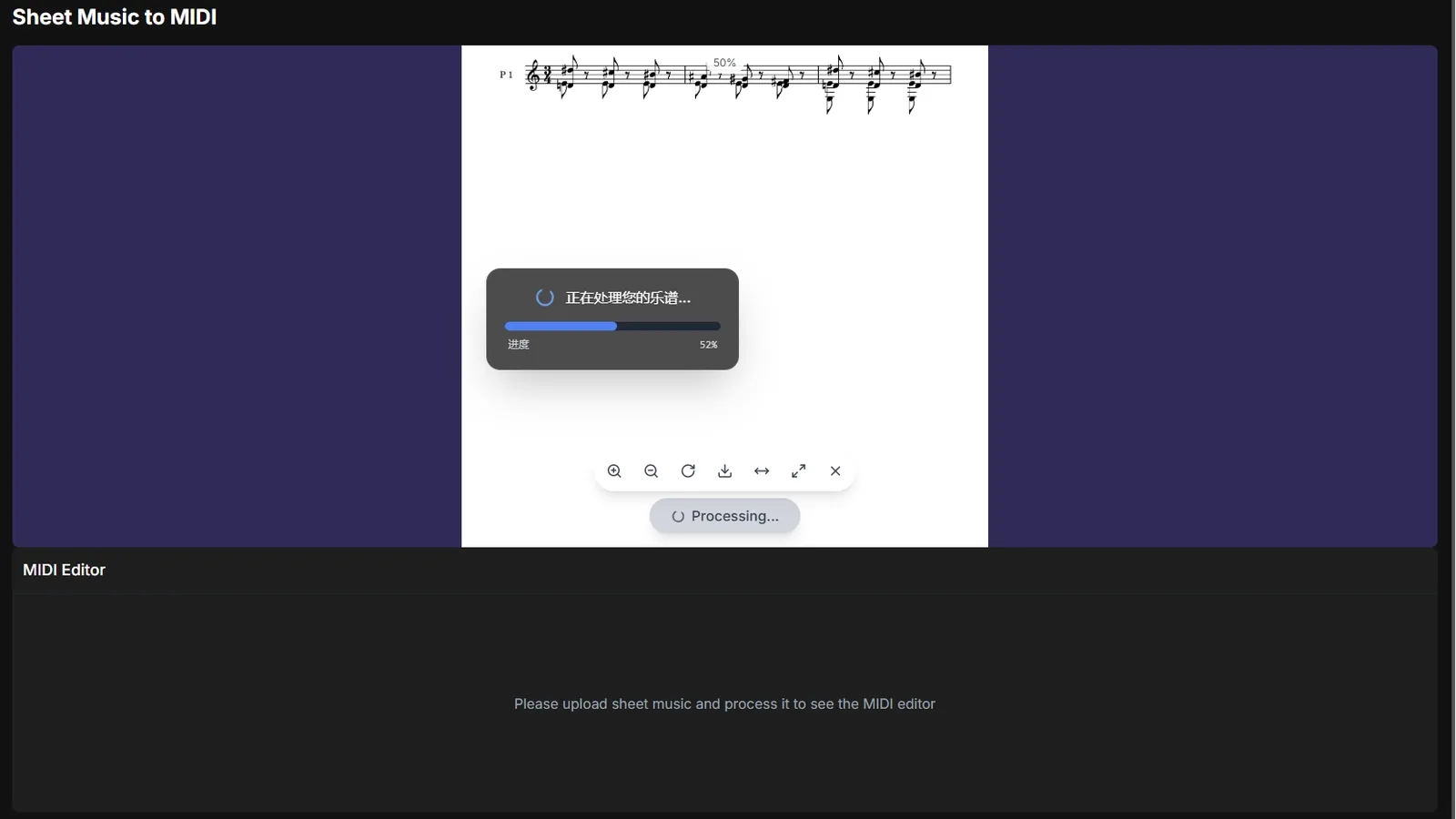
Upload a clean PDF, scan, or photo to Melogen Sheet2MIDI, then check the recognized notes before exporting MIDI or MusicXML for deeper editing.
Summary
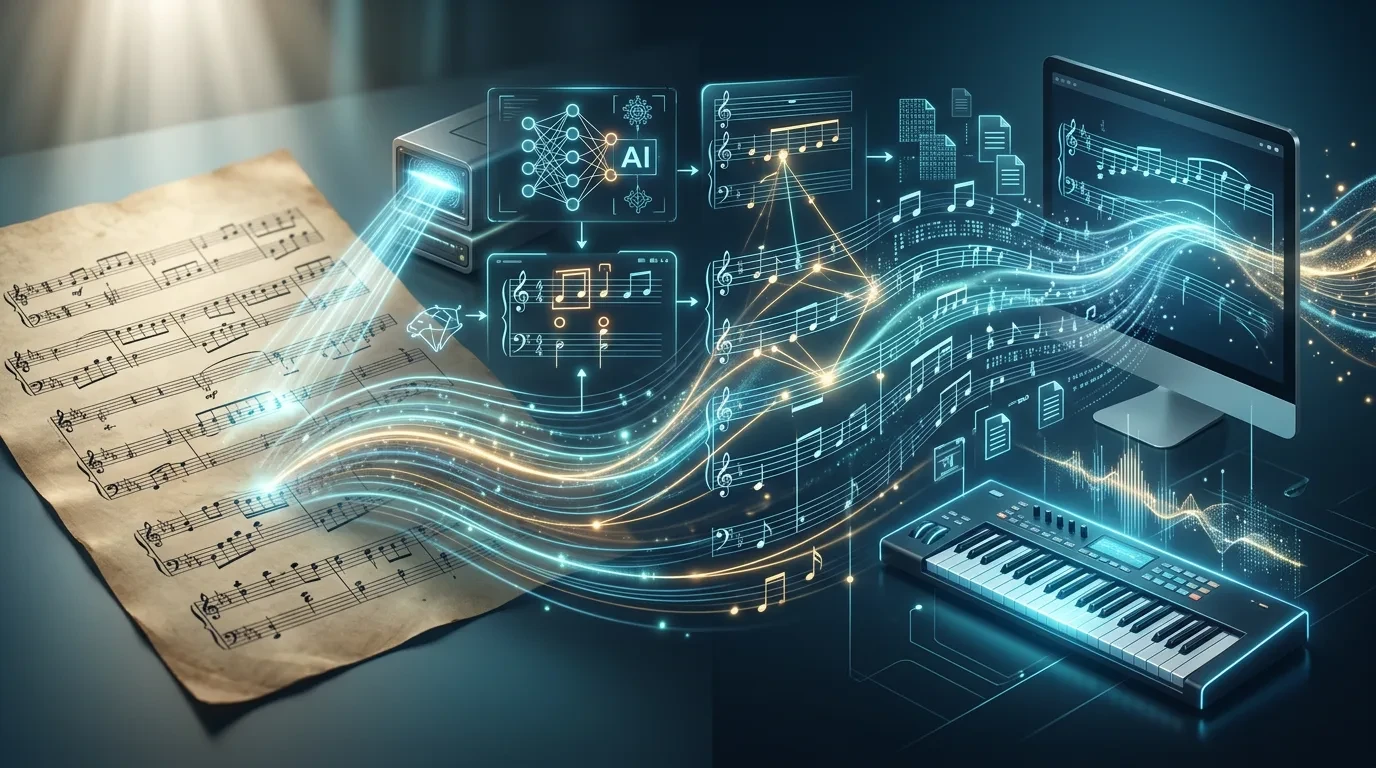
Optical Music Recognition (OMR) is a transformative technology that bridges the gap between physical sheet music and digital audio environments. By moving through four distinct stages—preprocessing the image, recognizing the musical symbols, reconstructing the logical relationships between notes, and encoding the data into formats like MusicXML or MIDI—OMR allows computers to "read" music. For modern musicians, this means the ability to instantly transpose scores, audition complex arrangements, and digitize fragile paper archives without hours of manual transcription. While the technology still requires human proofreading for dense or handwritten scores, it fundamentally removes the heavy friction of data entry. By embracing OMR, you reclaim your time, allowing you to focus on what truly matters: interacting with, editing, and feeling the music.
About the author
Zhang Guo
Composer - AI Product Manager
AI product manager and digital marketing consultant with a background in music. Creativity is the bridge between rhythm and logic, where musical intuition and mathematical precision can coexist in every meaningful product decision.
Follow on X