Note Solfege Explained for Singers and Readers
Learn note solfege with Do Re Mi syllables, movable Do, scale steps, practice checks, and a clear bridge from sheet music to playback.
 Zhang Guo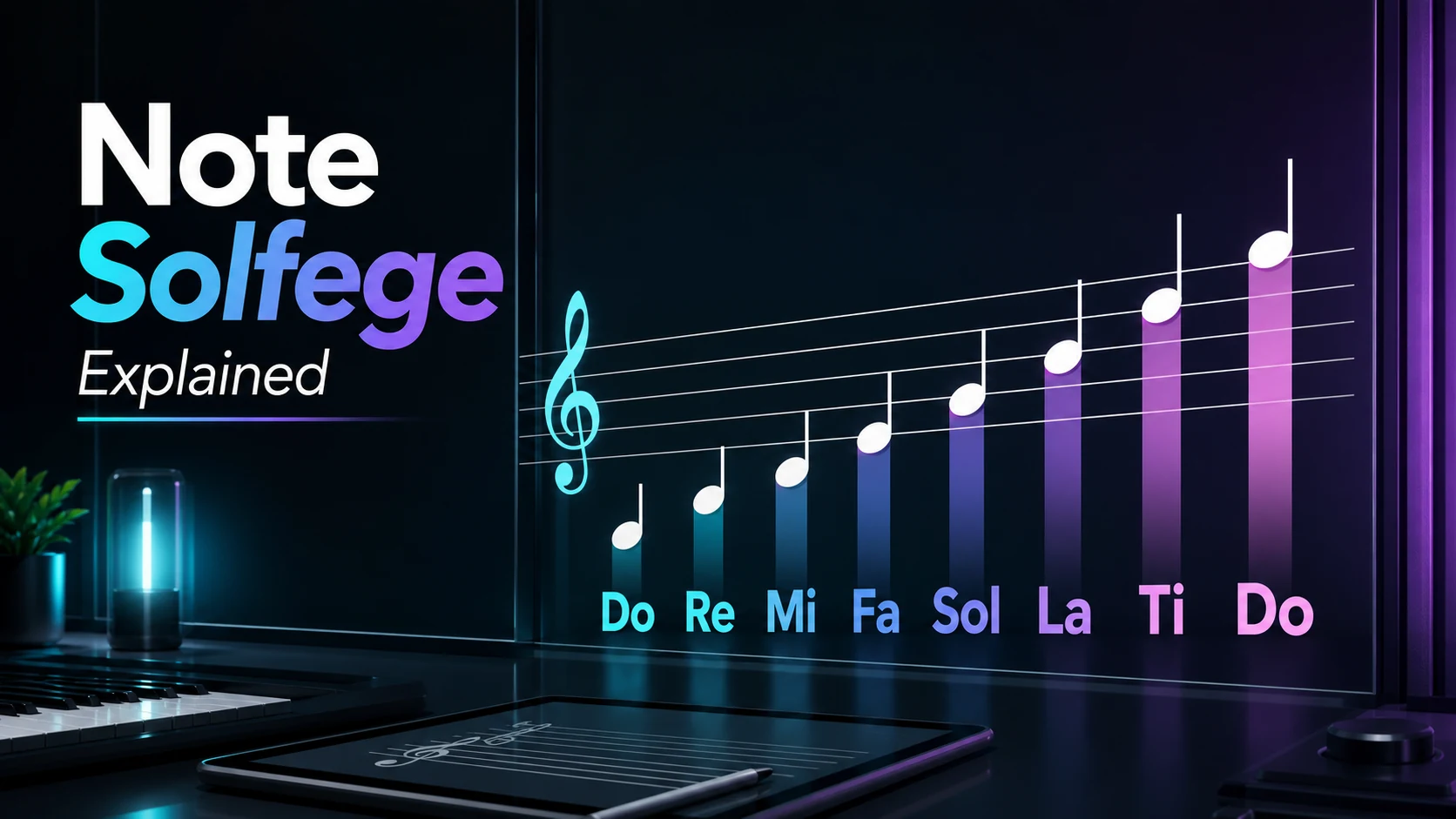
Turn a static score into editable MIDI
Contents
Note solfege is the practice of naming scale notes with syllables such as Do Re Mi Fa Sol La Ti Do. Instead of reading a melody only as letter names, solfege helps you hear where each note sits inside the key. Do feels like home, Sol feels strong and open, and Ti wants to resolve back to Do.
That makes solfege useful for singers, piano beginners, choir students, music teachers, and anyone trying to connect written notation to sound. The goal is not to replace staff reading. The goal is to add a listening map so the page, the voice, and the ear agree.
Define note solfege in plain language
Solfege gives each scale step a singable name. In a simple major scale, the syllables are:
| Scale step | Solfege syllable | Common listening role |
|---|---|---|
| 1 | Do | Home tone or tonic |
| 2 | Re | Step above Do |
| 3 | Mi | Stable third scale degree |
| 4 | Fa | Tension that often moves toward Mi |
| 5 | Sol | Strong fifth scale degree |
| 6 | La | Color tone above Sol |
| 7 | Ti | Leading tone that wants high Do |
| 1 again | Do | Octave resolution |
If you sing Do Re Mi, you are not just naming notes. You are hearing a pattern: home, upward step, and a stable third. That pattern can happen in C major, G major, F major, or another key. The sound relationship stays recognizable even when the letter names change.
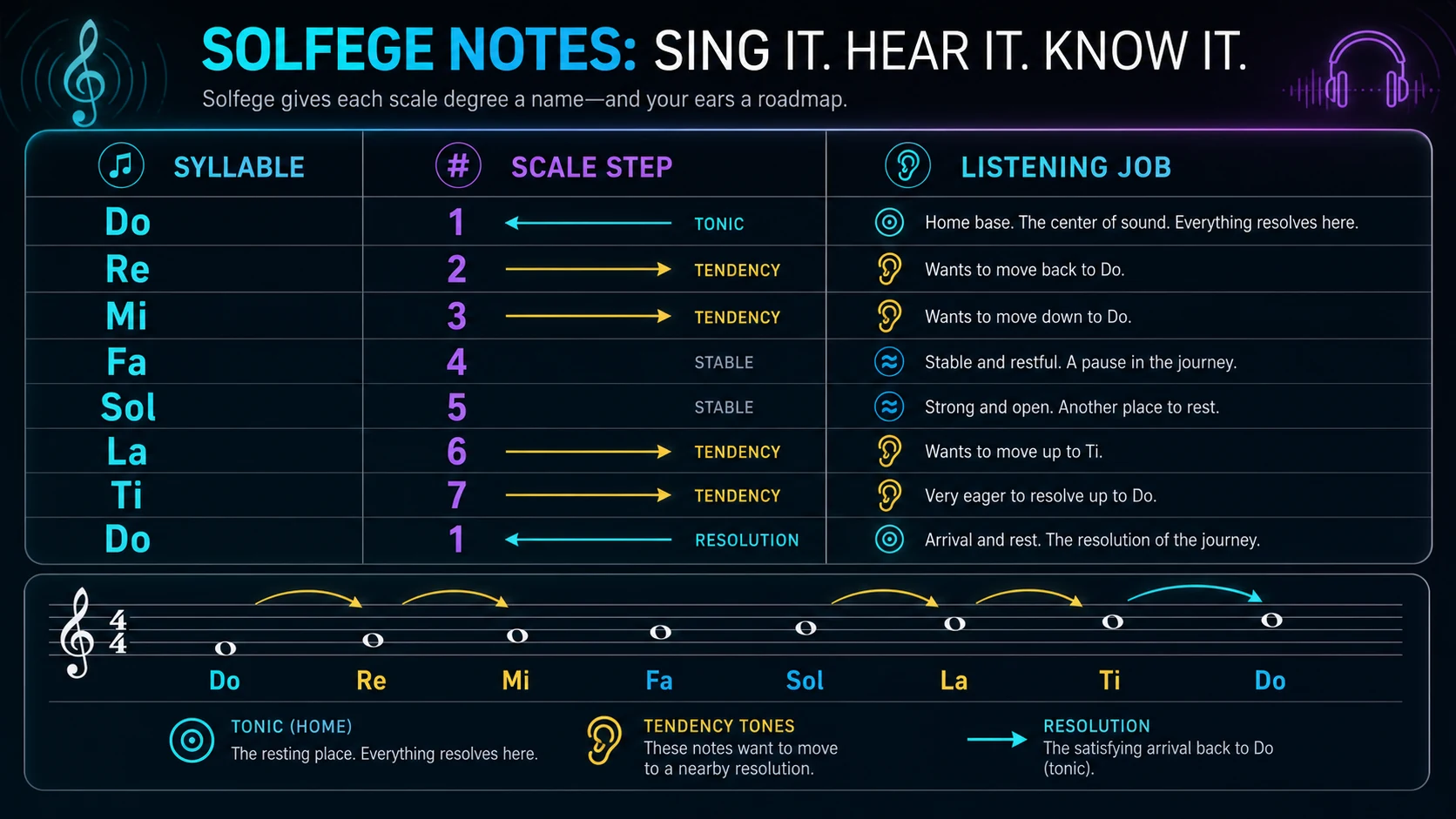
If note shapes and durations are still new, the guide to different music notes is the better first stop. Use this solfege article once you can separate pitch names from note values.
Choose movable Do or fixed Do before practicing
There are two common ways to use solfege, and they solve different jobs.
| System | What Do means | Best use | Main caution |
|---|---|---|---|
| Movable Do | The tonic of the current key | Ear training, transposition, melody shape | Do changes when the key changes |
| Fixed Do | The pitch C | Some conservatory and language traditions | The syllable names act more like fixed letter names |
Most beginner ear-training and classroom singing in English-speaking contexts uses movable Do. In C major, C is Do. In G major, G is Do. In F major, F is Do. The syllable names move because the key center moves.
Fixed Do works differently. Do usually means C, Re means D, Mi means E, and so on. That can be useful in traditions where syllables are used as note names, but it is less helpful if your main goal is hearing scale function.
For Melogen readers working with notation, MIDI cleanup, or DAW handoff, movable Do is usually the more practical lens. It helps you hear whether a phrase returns home, leans toward the dominant, or needs resolution before you inspect the exact MIDI notes.
Connect syllables to scale degrees
Solfege becomes much clearer when you connect it to scale degrees. Do is scale degree 1, Re is 2, Mi is 3, and so on. The numbers and syllables describe relationships inside the key.
Use this quick translation:
| If the melody does this | Solfege view | What to listen for |
|---|---|---|
| Starts and ends on the home note | Do to Do | A settled phrase |
| Climbs by step | Do Re Mi Fa | Smooth upward motion |
| Leaps to the fifth | Do to Sol | Strong open sound |
| Uses the leading tone | Ti to Do | Pull toward resolution |
| Moves around the sixth | Sol La Sol | A floating color above the fifth |
This is why solfege is so useful for transposition. A melody that starts Do Mi Sol keeps the same shape when the key changes. The letter names change, but the relationship stays the same.
The same idea appears in numbered notation and MIDI cleanup. If you see numbers in a chart or DAW, read music notes numbers so you do not confuse scale degrees with MIDI note numbers or physical piano key numbers.
Read solfege from written notation
To read solfege from a score, start with the key. The key tells you where Do lives. After that, the staff tells you which scale step each note occupies.
Use this order:
- Read the clef and key signature.
- Find the tonic note of the key.
- Treat that tonic as Do.
- Sing the melody slowly with solfege syllables.
- Add rhythm only after the pitch path is stable.
If the piece is in C major, the white-key scale is straightforward: C is Do, D is Re, E is Mi, F is Fa, G is Sol, A is La, and B is Ti. In G major, G becomes Do, A becomes Re, B becomes Mi, C becomes Fa, D becomes Sol, E becomes La, and F-sharp becomes Ti.
The key point is that Do follows the key center. If you accidentally keep Do fixed on C while the piece is in G major, your solfege will fight the melody instead of explaining it.
Practice solfege with voice, staff, and playback
Good solfege practice has four layers: the syllable, the voice, the written note, and the playback check. Skip the voice and solfege becomes theory trivia. Skip the notation and it becomes guessing by ear. Skip rhythm and the right syllables still land in the wrong place.
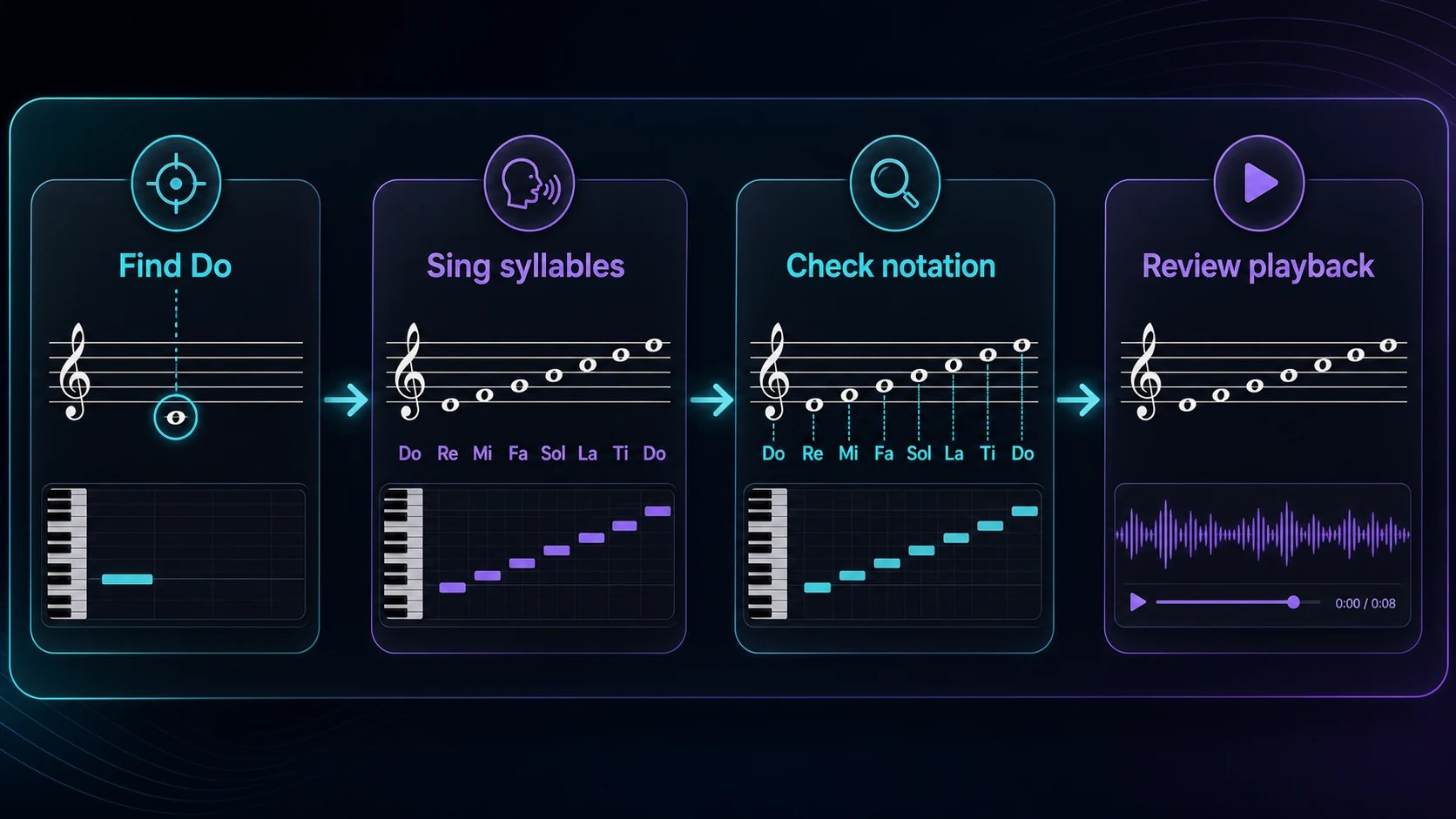
Try this loop with a short legal exercise or your own melody:
- Find Do in the key.
- Sing only the first two measures on solfege.
- Check the written note positions and rhythm.
- Play the phrase on a keyboard or playback reference.
- Mark one correction before moving on.
If you use hand signs, keep them in the right role. They can make pitch direction visible, but they do not replace the solfege system itself. The dedicated guide to solfege hand symbols explains the physical signs and practice loop in more detail.
Where Melogen fits without overstating the product
Melogen helps when your solfege exercise already exists as visible notation: a PDF, scan, or image of sheet music. The Sheet2MIDI workflow supports PDF, JPG, and PNG score inputs and gives you editable MIDI for playback and inspection.
That is useful after you try the phrase yourself. You can convert a clean exercise, listen back, and check whether your sung solfege matched the pitch direction and rhythm. The playback can reveal whether you missed a leap, rushed a dotted rhythm, or treated Ti like a stable note when it really wanted to resolve.
Use Melogen as the checking bridge, not as the teacher that replaces your ear:
| Practice need | Better first step | Where Melogen helps |
|---|---|---|
| Find Do | Read the key signature | Confirm the phrase in playback after you sing it |
| Hear the scale steps | Sing the syllables slowly | Compare your sung contour with MIDI output |
| Check rhythm | Count the measure first | Inspect whether note starts line up with the beat |
| Prepare a lesson | Choose a short clean score | Make a playback reference for students |
Turn a short solfege exercise into a playback check
Use Melogen Sheet2MIDI when you have readable notation and want a browser-based MIDI reference before refining the singing, rhythm, and ear-training decisions yourself.
The practical takeaway
Note solfege is a compact way to hear how melody works inside a key. Do gives you home. Re and Mi show the first steps away from home. Sol gives a strong anchor. Ti pulls back toward Do.
Use this checklist before you practice a new phrase:
- Did you find the key before naming Do?
- Are you using movable Do or fixed Do on purpose?
- Can you sing the syllables without rushing the rhythm?
- Can you connect each syllable to a written note?
- Did you check the phrase with playback only after trying it yourself?
When the syllable, staff position, voice, and playback agree, solfege stops being a memorized classroom sequence. It becomes a practical map for reading, singing, transposing, and checking music.
About the author
Zhang Guo
Composer - AI Product Manager
AI product manager and digital marketing consultant with a background in music. Creativity is the bridge between rhythm and logic, where musical intuition and mathematical precision can coexist in every meaningful product decision.
Follow on X