Parts of a Music Score Explained for Musicians
Learn the parts of a music score, from title and staves to clefs, measures, symbols, and cleanup checks before MIDI conversion.
 Zhang Guo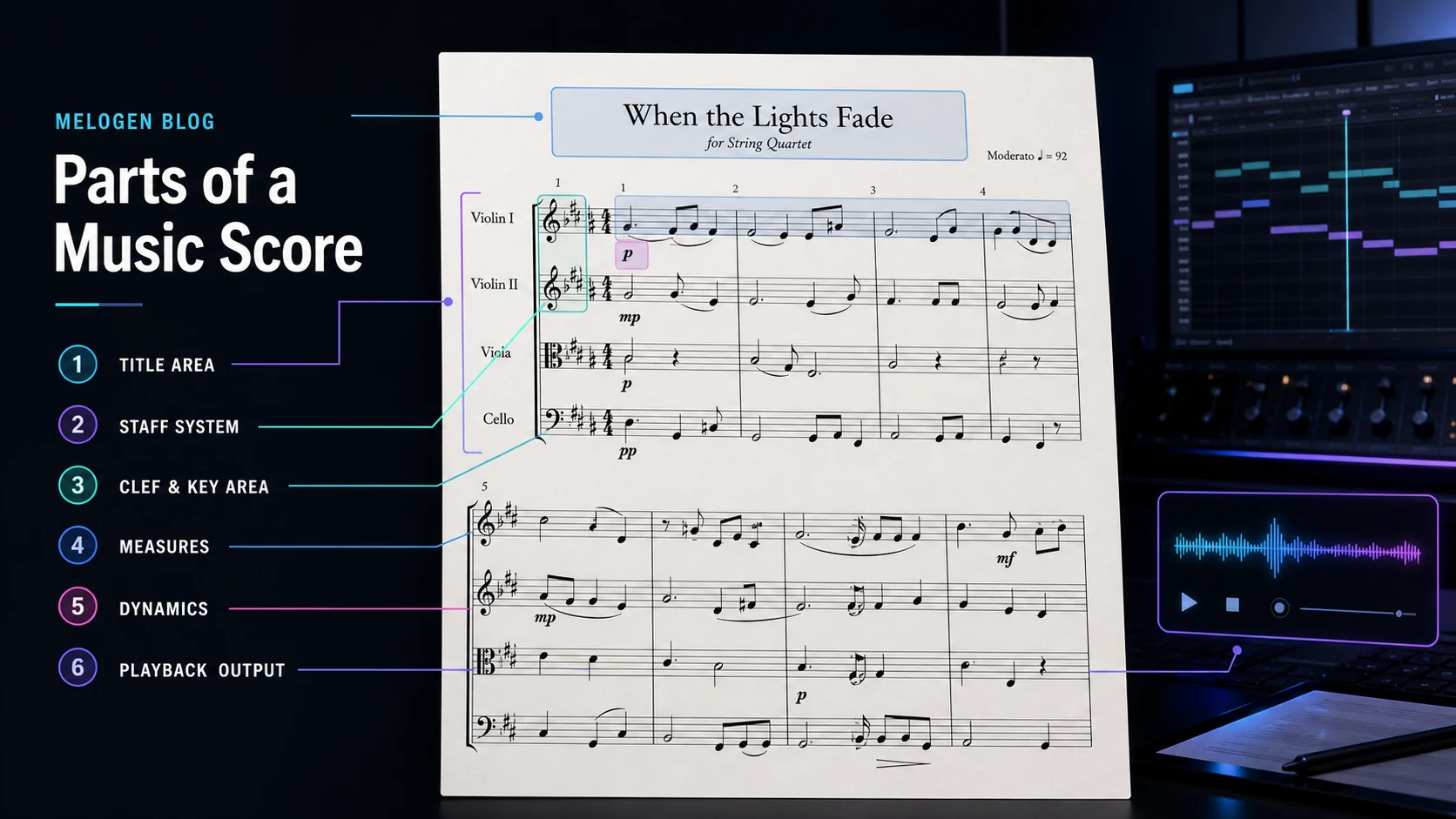
Turn a static score into editable MIDI
Contents
The parts of a music score are the page-level clues that tell you what the piece is, who plays it, how the music is organized, and how each note should be read. Start with the title area, staff systems, clefs, key signature, time signature, measures, note values, expression marks, and navigation signs before you try to decode every symbol one by one.
That order matters for practice, arranging, teaching, and conversion work. If you scan a score before you understand its structure, the MIDI may look confusing even when many notes were recognized correctly. If you read the score as a map first, cleanup becomes a set of musical checks instead of guesswork.
A music score is a map with layers
A music score is more than a page of notes. It is a layered map. The top of the page identifies the piece and often gives tempo, composer, arranger, or instrument information. The staff systems show which performers or hands play at the same time. The clefs, key signature, and time signature tell you how to interpret the notes that follow.
The useful mental model is simple:
| Layer | What it answers | Typical score parts |
|---|---|---|
| Identity | What is this piece and who is it for? | Title, subtitle, composer, arranger, instrument labels |
| Setup | How should the page be read? | Staff system, clef, key signature, time signature, tempo |
| Structure | Where does each musical unit begin and end? | Measures, bar lines, systems, rehearsal marks |
| Events | What sounds or silences happen? | Noteheads, stems, beams, rests, ties, dots |
| Performance | How should the notes feel? | Dynamics, articulations, slurs, accents, expression text |
| Navigation | What order should the music follow? | Repeats, endings, D.C., D.S., coda, segno |
This article focuses on the score as a whole page. If you need a deeper symbol-by-symbol reference, the guide to sheet music symbols and meanings is the better companion.
Start with the page-level information
Before you read the first measure, scan the title block and header area. This part of the score usually tells you the piece name, movement, subtitle, composer, arranger, lyricist, tempo mark, instrument, and sometimes the edition or source.
Do not skip this layer. It can change your expectations before you touch the notes. A string quartet score, a piano reduction, a lead sheet, and a full orchestral score may use similar notation symbols, but they ask the reader to think at different levels of detail.
Look for these page-level parts first:
- Title and subtitle, which identify the work or section.
- Composer, arranger, or source credit.
- Instrumentation or staff labels.
- Tempo text or metronome mark.
- Pickup measure, key, or style notes near the opening.
When the score is an excerpt, the page-level information may be incomplete. In that case, treat the first visible system as your setup point and be more careful about clef, key, and meter.
Read staff systems before individual notes
The staff system is the visible framework that holds the music together. A single melody may use one staff. Piano usually uses a grand staff. Ensemble scores stack multiple staves so you can see how parts align vertically.
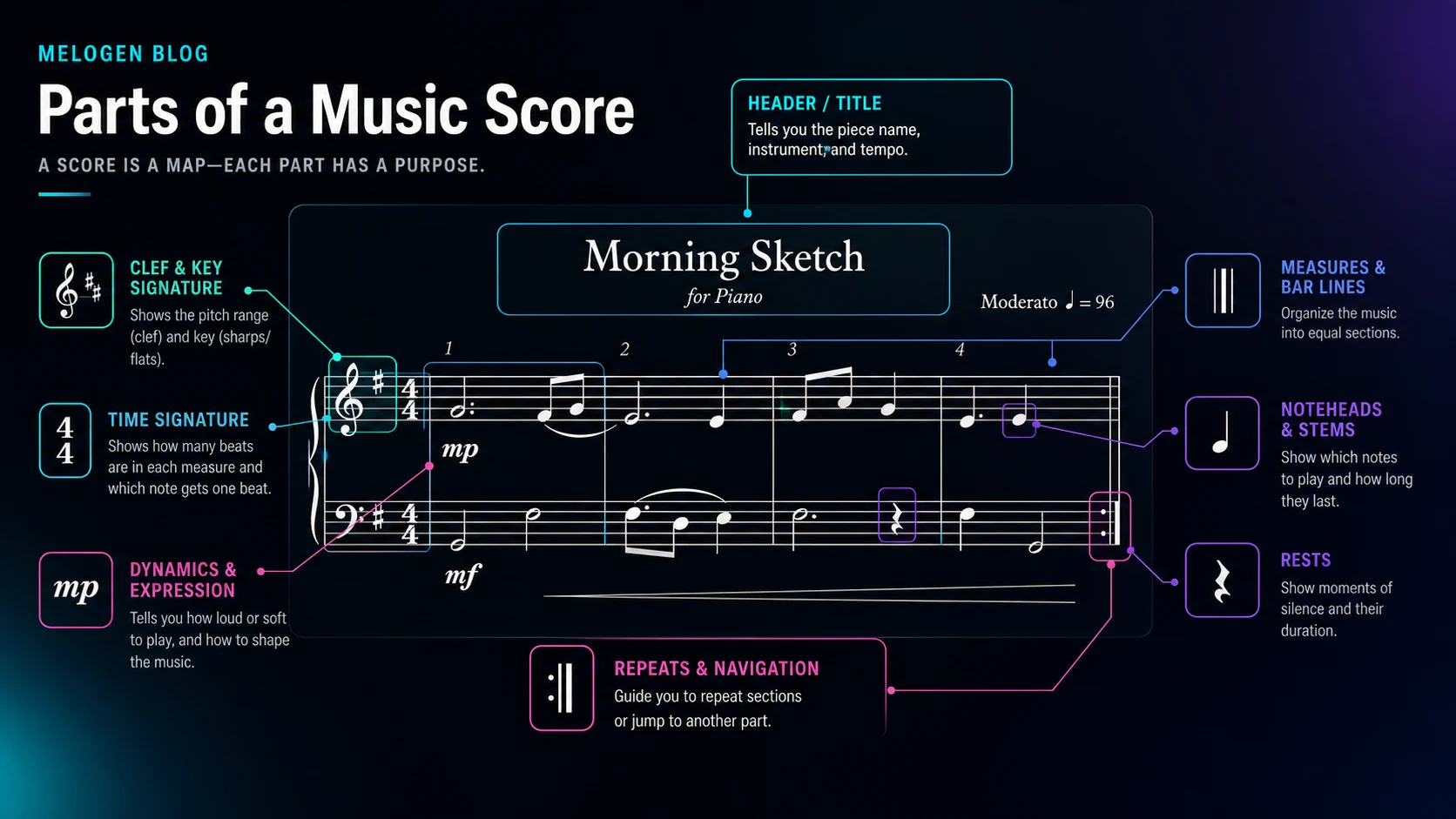
Start with the left edge of the system. The clef sets the pitch map. The key signature tells you which notes are sharp or flat by default. The time signature tells you how beats are grouped. Bar lines divide the music into measures so you can check rhythm in small sections.
Here is the difference between the most important setup parts:
| Score part | What it controls | First check |
|---|---|---|
| Staff or stave | The visual grid for pitch | How many staves are active in this system? |
| Clef | Which pitch each line or space means | Is this treble, bass, alto, tenor, or percussion clef? |
| Key signature | Default sharps or flats | Which notes change before local accidentals appear? |
| Time signature | Beat grouping and beat unit | How many beats should each measure contain? |
| Bar line | Measure boundary | Where does the count reset? |
| Staff label | Performer, hand, or instrument | Which part does this line belong to? |
If the five-line grid itself still feels abstract, the musical stave guide explains how staff lines, spaces, clefs, and ledger lines work together.
Treat notes, rests, and symbols as the event layer
Once the setup is clear, move into the event layer. Noteheads, stems, beams, rests, dots, ties, and accidentals tell you what happens inside each measure. They are the parts most readers notice first, but they make more sense after the staff and meter are active.
Use this order when a measure looks crowded:
- Count the measure against the time signature.
- Separate sounds from rests.
- Identify tied or dotted durations before playing faster.
- Check local accidentals after the key signature is clear.
- Only then add articulation and expression.
The order keeps you from solving the wrong problem. A note may look wrong because the clef was misread. A rhythm may sound wrong because a rest was skipped. A phrase may feel stiff because a slur or accent was ignored after the structure was already correct.
Expression and navigation marks finish the reading job
Dynamics, articulations, slurs, tempo changes, rehearsal marks, repeats, endings, D.C., D.S., coda, and segno signs do not always change the noteheads on the page. They change how the music is performed or how the page is followed.
These score parts are easy to miss because they may sit above the staff, between systems, or near a bar line instead of directly on a note. They matter most when the score is being practiced, arranged, or converted into a playback format.
Use this quick distinction:
| Mark type | Examples | What it changes |
|---|---|---|
| Dynamics | p, mp, f, cresc., dim. | Loudness and energy |
| Articulation | Staccato, accent, tenuto | Attack, length, emphasis |
| Phrasing | Slurs, phrase marks | Connection between notes |
| Navigation | Repeats, endings, D.C., D.S., coda | Playback order and form |
| Rehearsal aids | Letters, numbers, rehearsal marks | Communication during practice |
If a converted score sounds too short, too long, or out of order, navigation marks are often the first place to look. If it sounds mechanical after the pitch and timing are right, expression marks are the next layer to review.
Use score parts as a cleanup checklist
The parts of a music score can double as a quality-control checklist. This is useful when you are scanning a printed score, preparing a classroom handout, or converting a score into editable MIDI.
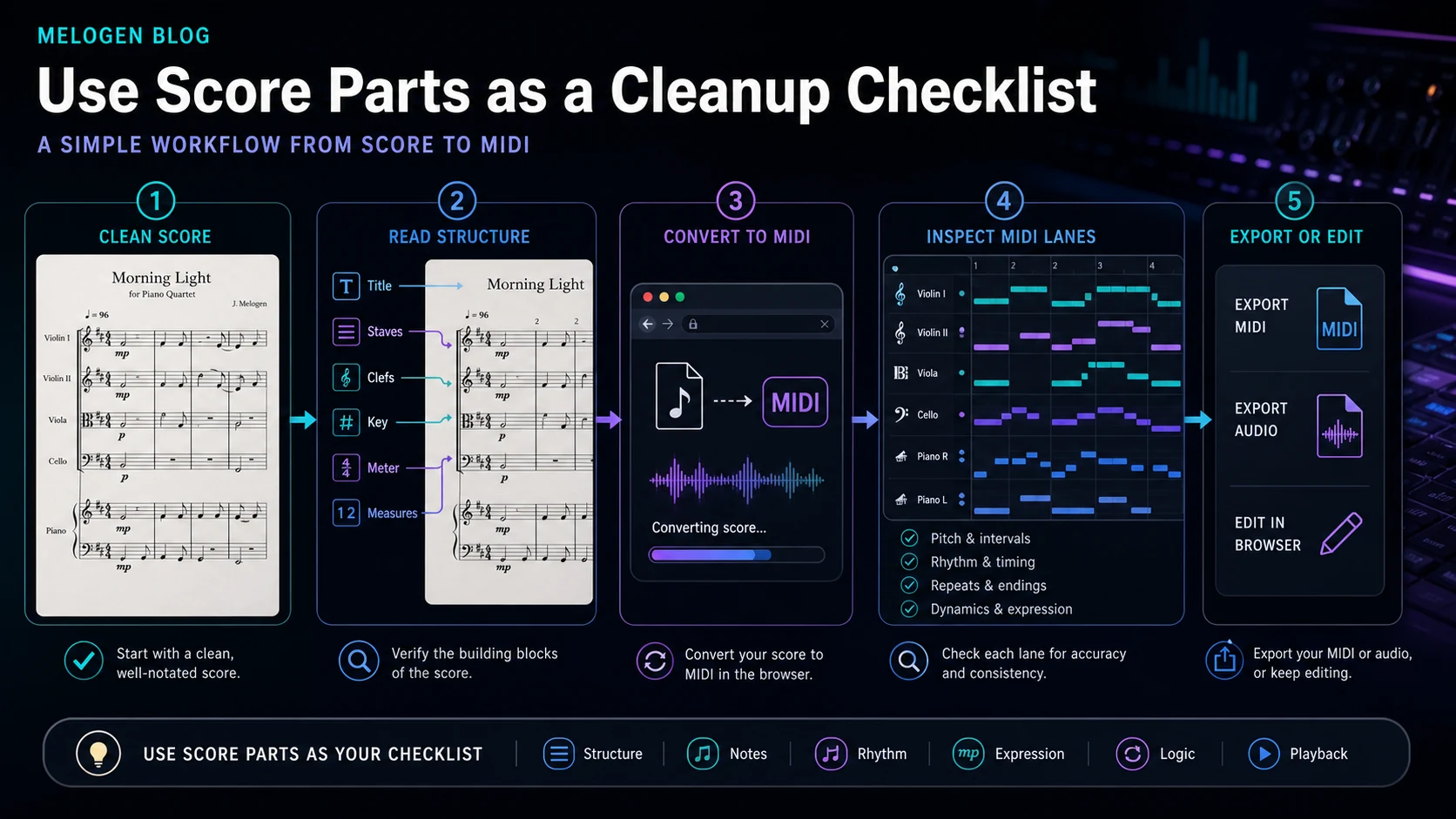
Work from large-scale structure to small detail:
| Cleanup layer | Ask this first | Common issue after scanning |
|---|---|---|
| Page identity | Is this the right score, part, or excerpt? | Wrong instrument or arrangement version |
| Staff system | Are all active staves present and aligned? | Missing staff, cropped system, wrong part order |
| Clef and key | Did the pitch map survive? | Notes shifted into the wrong register or key |
| Meter and measures | Do measures add up? | Broken bar count, missing rest, bad pickup measure |
| Note events | Are noteheads, rests, ties, and dots intact? | Choppy playback or wrong durations |
| Navigation | Did repeats and endings behave as expected? | Flattened or skipped sections |
| Expression | Does the performance layer matter for this use? | Dynamics and articulations need later editing |
Do not start by fixing isolated notes unless the large layers are already correct. One wrong clef can make an entire staff look broken. One missing repeat can make the form feel wrong even if every visible note is accurate.
Where Melogen fits in the workflow
Melogen is useful when you have readable notation and want a browser-based first pass into editable music data. The Sheet2MIDI page accepts sheet music images and PDFs, including JPG, PNG, and PDF inputs, and outputs MIDI for playback, DAW review, or further editing.
The score-parts checklist helps before and after conversion:
- Choose the cleanest score image or PDF you have.
- Check title, instrument labels, staff systems, clefs, key, meter, and measures.
- Upload the score to Sheet2MIDI.
- Review the output by staff range, rhythm, bar structure, and repeats.
- Continue cleanup in your DAW or notation editor.
For a full handoff from static notation into editable MIDI, use the guide on how to convert sheet music to MIDI. This article gives you the anatomy checklist; the conversion guide walks through the broader source-quality and export workflow.
Turn readable score parts into editable MIDI
Use Melogen Sheet2MIDI for a browser-first conversion pass, then check staves, clefs, measures, rhythm, repeats, and expression before polishing the result.
FAQs
What are the main parts of a music score?
The main parts are the title area, staff systems, clefs, key signature, time signature, measures, bar lines, notes, rests, dynamics, articulations, repeats, and other navigation marks. Larger ensemble scores also include staff labels, brackets, rehearsal marks, and part names.
What is the difference between a score and sheet music?
Sheet music is the broad term for printed or digital notation. A score usually means a complete notated view of the music, especially when multiple parts are aligned together. A single piano page can be called sheet music, while an orchestral score shows many instruments at once.
Which part of a score should beginners read first?
Beginners should read the staff, clef, key signature, and time signature before individual notes. Those setup parts explain how pitch and rhythm should be interpreted.
Why do score parts matter for MIDI conversion?
MIDI conversion depends on structure. If the clef, key signature, time signature, staff alignment, rests, ties, or repeats are misread, the output can sound wrong even when many noteheads are recognized.
The practical takeaway
The parts of a music score work best when you read them in layers. Page identity first. Staff system next. Clef, key, and meter before note-level detail. Expression and navigation after the structure is clear.
Use that same order when you convert a score. A good first pass is not only about recognizing notes. It is about preserving the map that makes those notes musical.
About the author
Zhang Guo
Composer - AI Product Manager
AI product manager and digital marketing consultant with a background in music. Creativity is the bridge between rhythm and logic, where musical intuition and mathematical precision can coexist in every meaningful product decision.
Follow on X