Sight Reading Exercises for Better Music Practice
Use sight reading exercises with a repeatable practice loop for rhythm, pitch, tempo, and playback checks before rehearsal or exams.
 Zhang Guo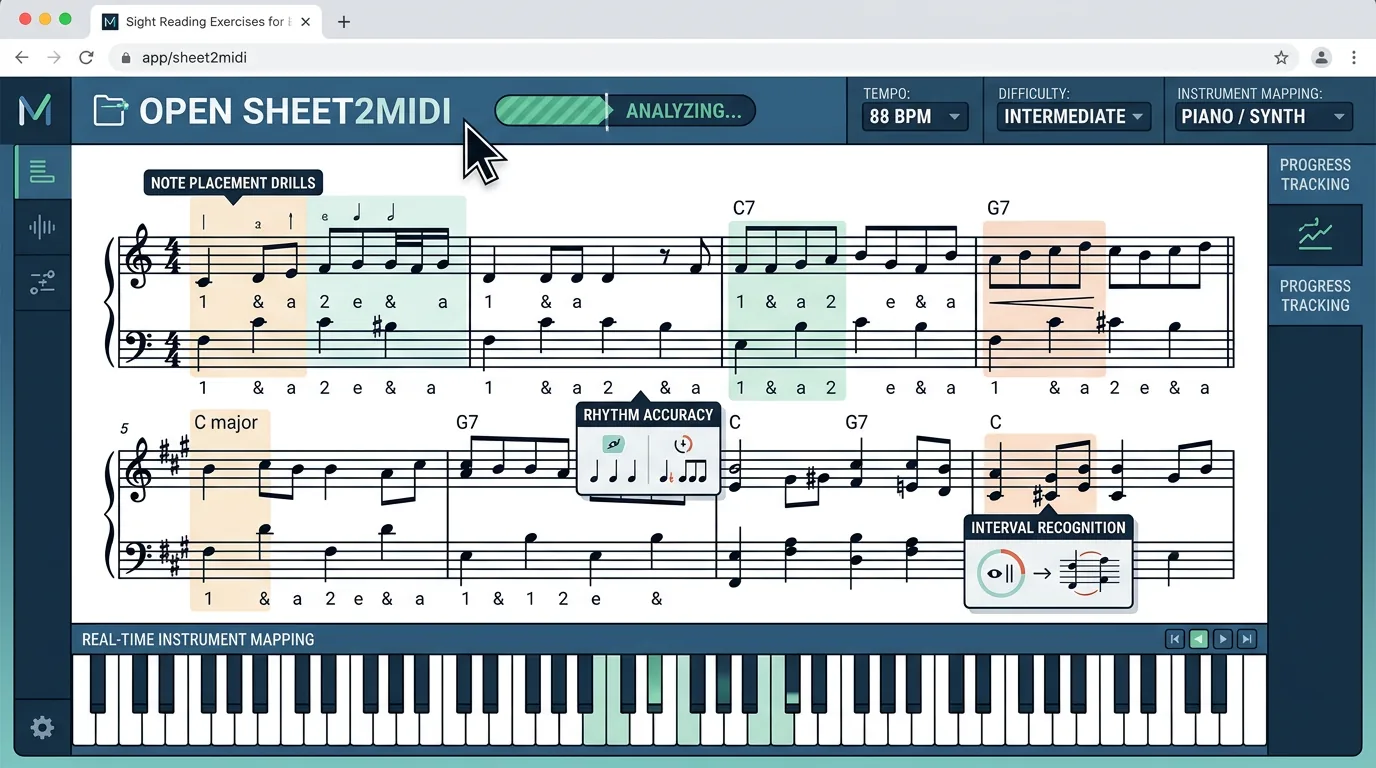
Turn a static score into editable MIDI
Contents
Sight reading exercises work best when they train a specific first-pass skill: keeping pulse, reading rhythm, finding pitch quickly, recovering after mistakes, and checking the result without memorizing the answer. Do not treat every new page as a full performance. Treat it as a short test of how well you can turn written music into sound under time pressure.
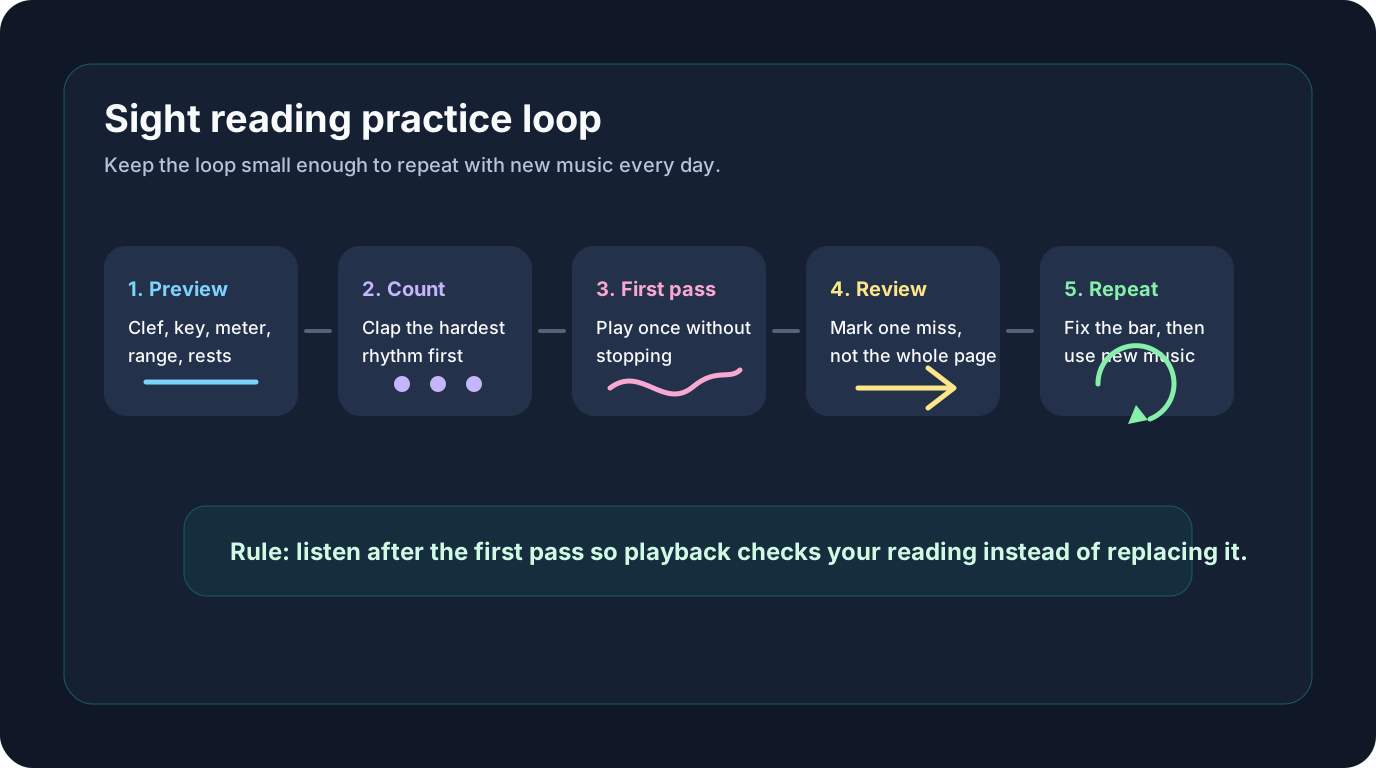
The useful loop is simple: preview the score, count the hard rhythm, play or sing one uninterrupted pass, review one miss, then repeat only the bars that actually broke. That loop helps students, ensemble players, singers, and teachers build real reading fluency instead of just collecting more practice sheets.
Start with what the exercise is testing
Before you play, ask what the page is really testing. A beginner line might test stepwise pitch reading. A choir excerpt might test re-entering after rests. A piano exercise might test grand-staff coordination. A trumpet line might test range preview. If you cannot name the challenge, you will not know what to review after the first pass.
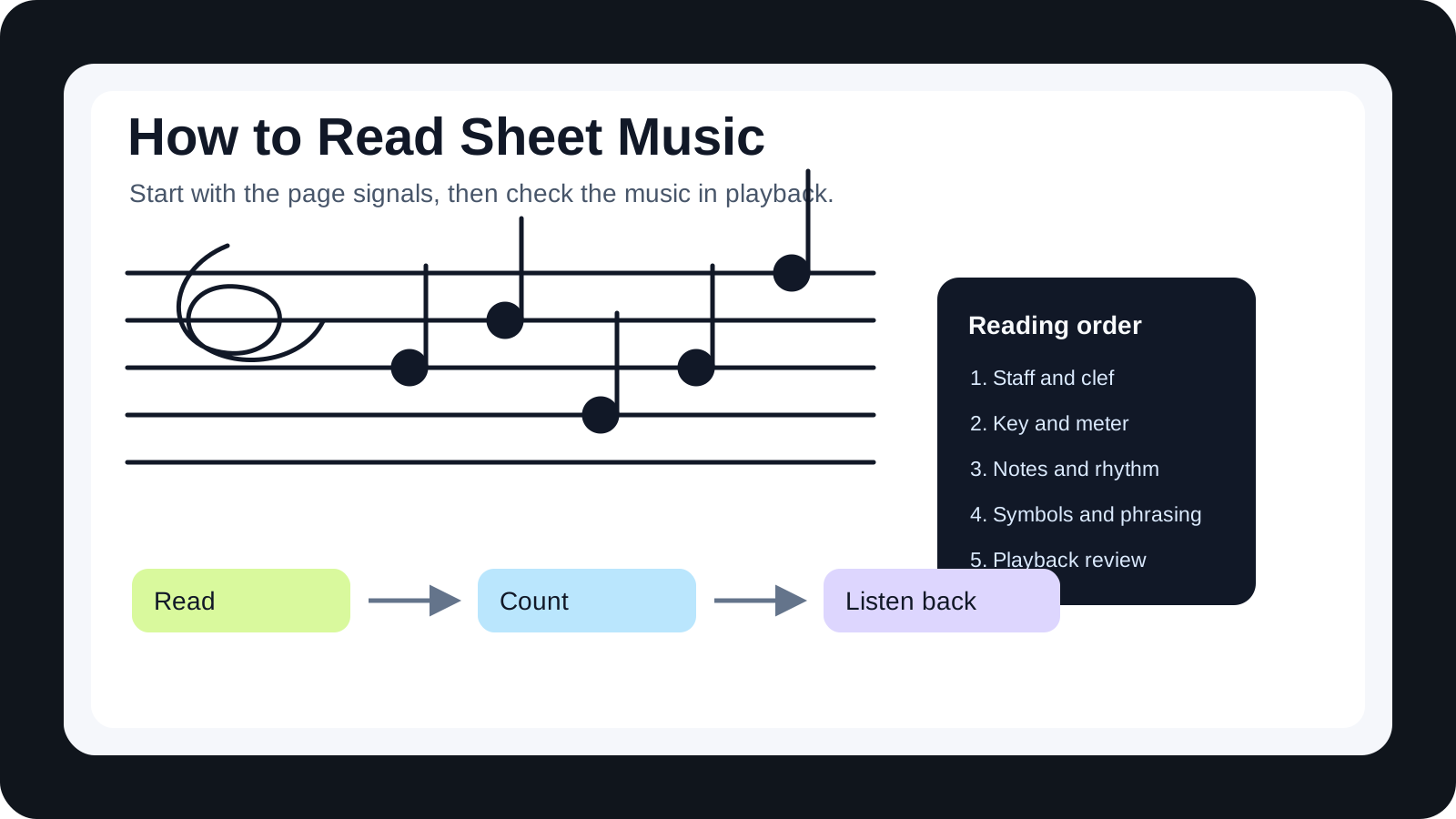
Use this first scan before touching the instrument:
| Signal | What to check | Why it matters |
|---|---|---|
| Clef and key | Which pitch map and altered notes apply | Wrong setup creates wrong notes before you begin |
| Meter | How the beats group inside each bar | Rhythm errors usually begin with weak counting |
| Range | Highest and lowest notes | Hard notes are easier when you see them early |
| Rests | Silent beats and re-entry points | Many sight-reading failures happen after silence |
| Repetition | Motifs, sequences, and repeated rhythms | Patterns let you read groups instead of isolated notes |
If the symbols themselves still feel unstable, start with the parent guide on how to read sheet music, then come back to exercises once the staff, clef, rhythm, and bar lines feel less mysterious.
Choose short, unfamiliar music
The best sight reading exercises are short and new. Four to eight bars is enough for most daily practice. A long page encourages survival mode. A short excerpt gives you a clean feedback cycle: one challenge, one pass, one correction.
Pick material that is easier than your repertoire but harder than your comfort zone. If you are reading beginner piano, use one hand at first. If you are reading for choir, isolate your line before singing with the full texture. If you are reading brass or woodwind parts, choose examples where range and breathing are manageable enough that rhythm can stay in control.
Here is a practical ladder:
| Level | Exercise type | What it trains | Good stopping point |
|---|---|---|---|
| 1 | One-line rhythms on a single note | Pulse, rests, ties, and subdivisions | You can clap without hesitating |
| 2 | Stepwise melodies | Clef reading and direction changes | You can keep time while naming notes |
| 3 | Small leaps and accidentals | Pitch prediction and key awareness | You recover after one wrong note |
| 4 | Rests and pickups | Entrances, counting, and ensemble readiness | You re-enter without guessing |
| 5 | Mixed excerpts | Real first-pass judgment | You know the one issue to fix next |
Do not replay the same excerpt until it becomes memory work. Once you know the line, it stops being sight reading. Use the repeat only to fix the problem you found, then move on to another short example.
Read rhythm before pitch
Rhythm decides whether the exercise survives. A wrong pitch can pass by in one beat. A broken rhythm can shift every bar after it. That is why the first practice pass should often be rhythm-only: tap the pulse, clap the written values, and speak the count before adding notes.
Look for the rhythm that can derail you:
- Pickups that start before beat one.
- Ties that hold across a beat or bar line.
- Dotted rhythms that borrow time from the next note.
- Rests before a new entrance.
- Groups of eighths or sixteenths that hide the main pulse.
If rhythm is the main obstacle, use the more focused guide on how to play tricky rhythms. It goes deeper on subdivision, looping, and slow playback for bars that look simple but keep landing late.
Use playback as a check, not a shortcut
Playback can make sight reading practice much more honest. It gives you a steady reference for pulse, pitch direction, and missed entrances. The catch is that playback should check your reading, not replace it.
A good order is:
- Scan the exercise yourself.
- Count or clap the rhythm.
- Perform one full pass without stopping.
- Listen to a reference only after the pass.
- Mark the one measure where your reading and the reference disagreed.
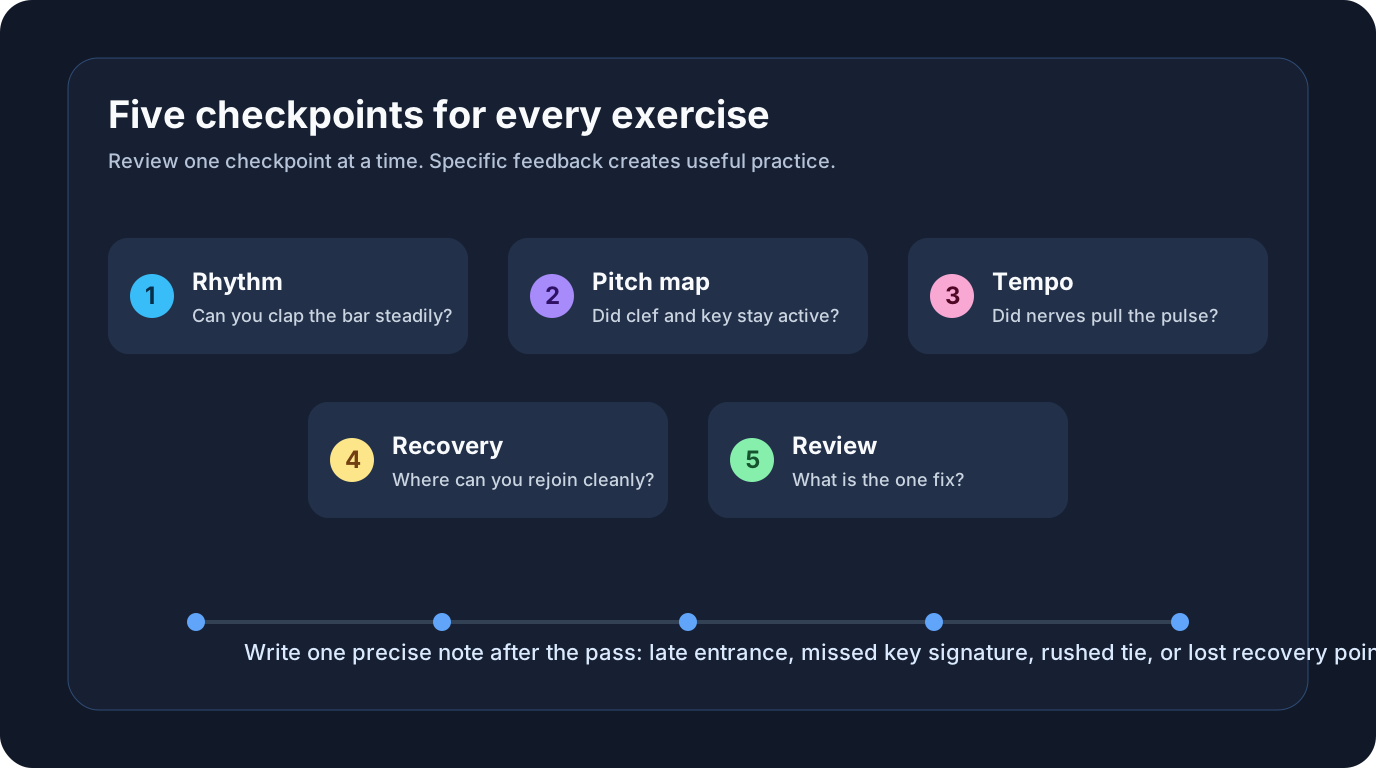
This matters because the goal is not to let software teach you every note. The goal is to make your own first pass more accurate. If you listen first, you may memorize the sound. If you read first, then listen, you learn what your eye and ear missed.
Turn clean sheet music into a reference track
Melogen fits this workflow when you have visible notation and want a quick playback reference. The local Sheet2MIDI page describes support for JPG, PNG, and PDF sheet music inputs, then produces an editable MIDI file you can inspect or use in a DAW. That makes it useful for teacher-provided exercises, public-domain material, your own notation, or short excerpts you are allowed to scan.

Use the tool after your first human pass:
- Choose a clean, legal source with readable staff lines.
- Convert the page with Melogen Sheet2MIDI.
- Listen for pulse, entrances, and pitch contour.
- Compare only the bars where you were unsure.
- Return to the instrument or voice and play the corrected bar in context.
This is especially helpful when you are practicing alone. A teacher or ensemble can correct you in real time. A MIDI reference cannot judge tone, bowing, breath support, phrasing, or style, but it can expose whether you counted the rest, held the dotted note, or jumped to the right pitch area.
Build a one-week exercise routine
Sight reading improves faster when the routine is boring in a good way. Keep the daily structure stable and change only the musical material.
| Day | Main exercise | First-pass rule | Review question |
|---|---|---|---|
| 1 | Rhythm-only four-bar lines | Clap before playing | Did the pulse stay steady? |
| 2 | Stepwise melodies | Read direction before note names | Did you see the contour early? |
| 3 | Small leaps | Preview the interval | Did the leap make you pause? |
| 4 | Rests and pickups | Count silence out loud | Did the re-entry land on time? |
| 5 | One unfamiliar key | Say altered notes first | Did the key signature stay active? |
| 6 | A short ensemble part | Find recovery points | Could you rejoin after a mistake? |
| 7 | Mixed first-pass test | Play once without stopping | What one issue repeats most often? |
The review question matters more than the number of exercises. Ten pages without review can train panic. Five short excerpts with a clear note after each pass can train better reading decisions.
Adapt exercises to your instrument or voice
The same sight-reading routine should feel different by instrument. A pianist may need to separate hands before playing together. A singer may need to read intervals and text rhythm before adding expression. A drummer may need to count rests and ensemble cues. A brass player may need to preview range and breathing. A guitarist may need to connect standard notation with fretboard position.
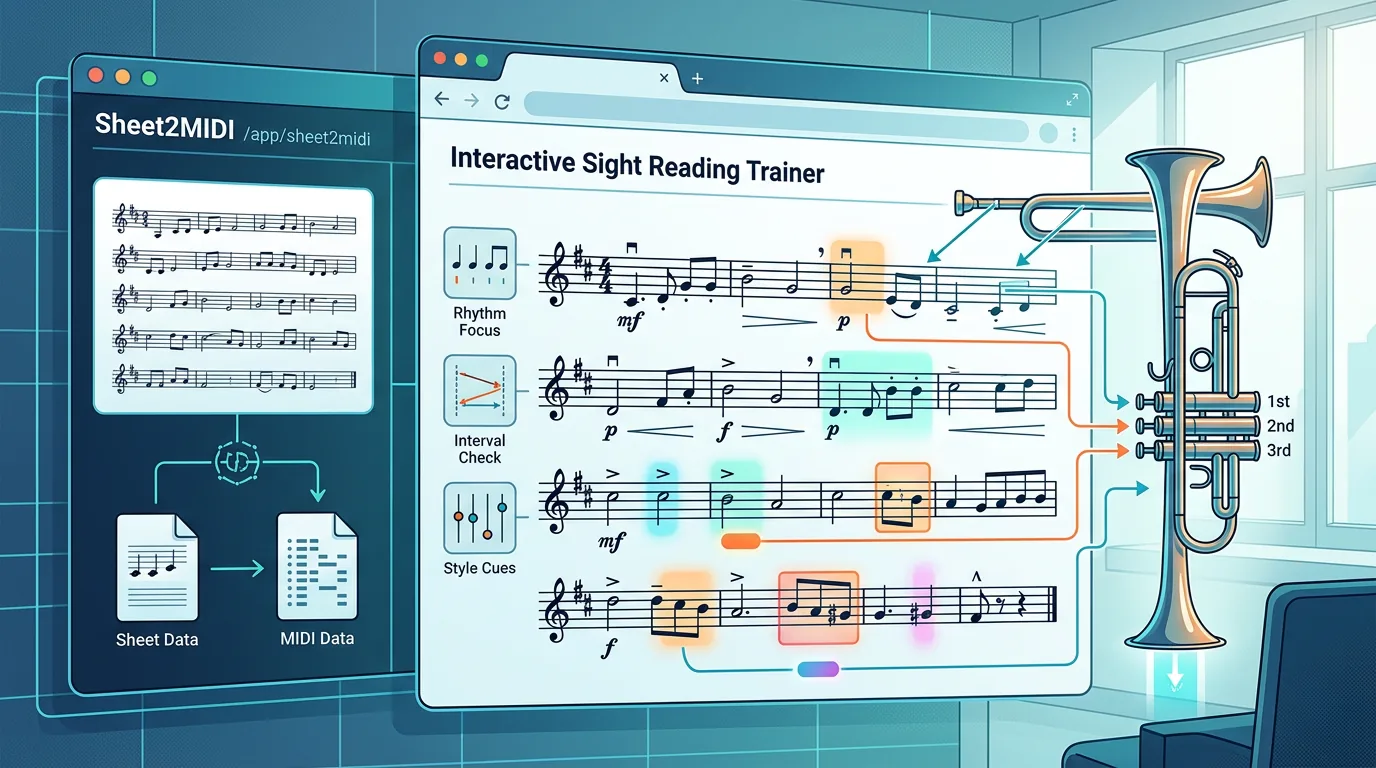
For an instrument-specific example, the trumpet sight reading guide shows how range, recovery points, and rhythm checks change the practice loop for one instrument. Use that as a model: keep the parent routine, then add the physical or technical problem your instrument creates.
Common mistakes to avoid
The first mistake is choosing music that is too hard. If every bar is a crisis, you are practicing guessing, not reading. Step down until the exercise has one main challenge.
The second mistake is stopping at every error. In real sight reading, recovery is part of the skill. Play through the first pass, then review. Stopping trains you to leave the pulse whenever something surprises you.
The third mistake is using playback too early. Listen after you have made an honest attempt. That order keeps the exercise tied to reading rather than imitation.
The fourth mistake is reviewing too broadly. Do not write, "bad sight reading." Write, "late after the rest in bar three" or "forgot the F sharp in the key signature." Specific errors become practice tasks.
Move from static notation to editable MIDI faster
Use Melogen Sheet2MIDI when you need a fast first pass from sheet music, scans, or PDFs before you do the detailed musical cleanup yourself.
The practical takeaway
Sight reading exercises should build a repeatable first-pass habit. Preview the page, count the rhythm, play once without stopping, check one problem, and move to another unfamiliar excerpt before memory takes over.
Use playback when it helps you hear the gap between what you read and what the page says. Keep the musical judgment with you: steady pulse, quick recovery, clear rhythm, and one useful correction after each pass. That is how sight reading becomes a trainable skill instead of a weekly surprise.
About the author
Zhang Guo
Composer - AI Product Manager
AI product manager and digital marketing consultant with a background in music. Creativity is the bridge between rhythm and logic, where musical intuition and mathematical precision can coexist in every meaningful product decision.
Follow on X