Religious Music Explained Across Traditions and Rituals
Explore religious music as sacred, liturgical, devotional, and worship practice, with listening context and respectful score workflows.
 Zhang Guo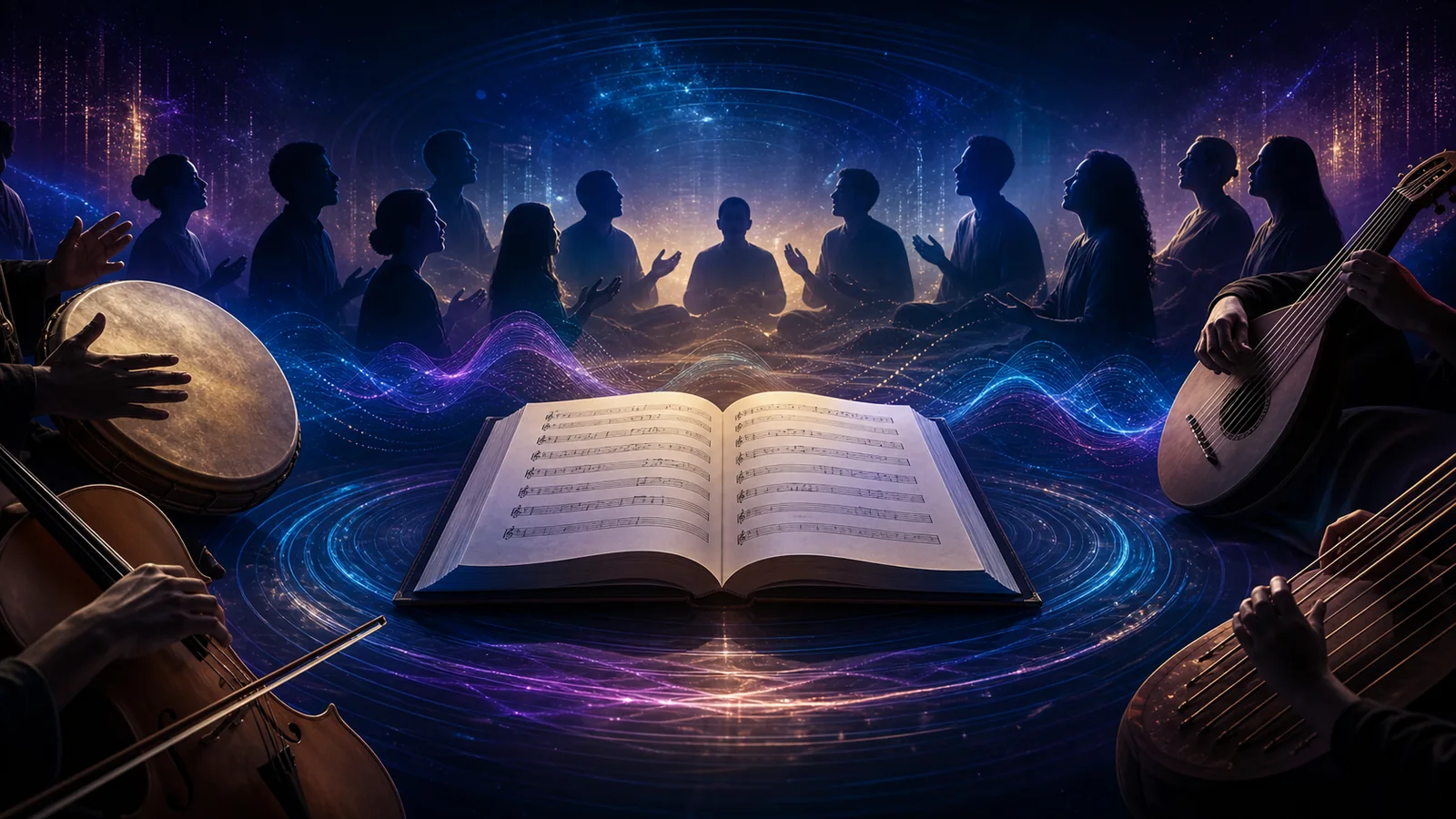
Turn a static score into editable MIDI
Contents
Religious music is music connected to belief, ritual, devotion, worship, or a community's sacred life. It is not one genre and it does not have one universal sound. A religious piece may be sung from memory, recited on a single pitch, performed by a congregation, led by specialists, written for a choir, played on instruments, or preserved in a notated score.
That broad definition matters. If you identify religious music only by organ, choir, chant, or solemn mood, you will miss traditions built around drums, repeated refrains, solo improvisation, handclaps, dance, or intimate home practice. The most reliable way to understand the music is to ask what it does, who performs it, where it belongs, and how the community itself describes it.
Religious music is an umbrella, not one style
Several labels overlap with religious music, but they are not perfect synonyms. Their meaning can also change across communities, institutions, and academic writing.
| Term | Useful working meaning | Context question |
|---|---|---|
| Religious music | the broad umbrella for music connected to religion or spiritual practice | Which belief, community, or practice gives the music meaning? |
| Sacred music | music treated as holy, set apart, or connected to sacred subjects | Is the music sacred because of its text, use, setting, or community status? |
| Liturgical music | music assigned a role within an ordered rite or service | What moment in the rite does the music support? |
| Devotional music | music used to express, cultivate, or accompany devotion | Is the practice communal, personal, domestic, processional, or contemplative? |
| Worship music | music used to support shared worship, often including congregational song | How does the music help a group sing, pray, respond, or move through a service? |
Melogen's guide to worship music explores that last category in more detail. Worship music is an important child topic, but it should not stand in for the entire parent category. Religious music also includes practices that are not organized around a modern worship band, hymnbook, choir anthem, or concert-style song.
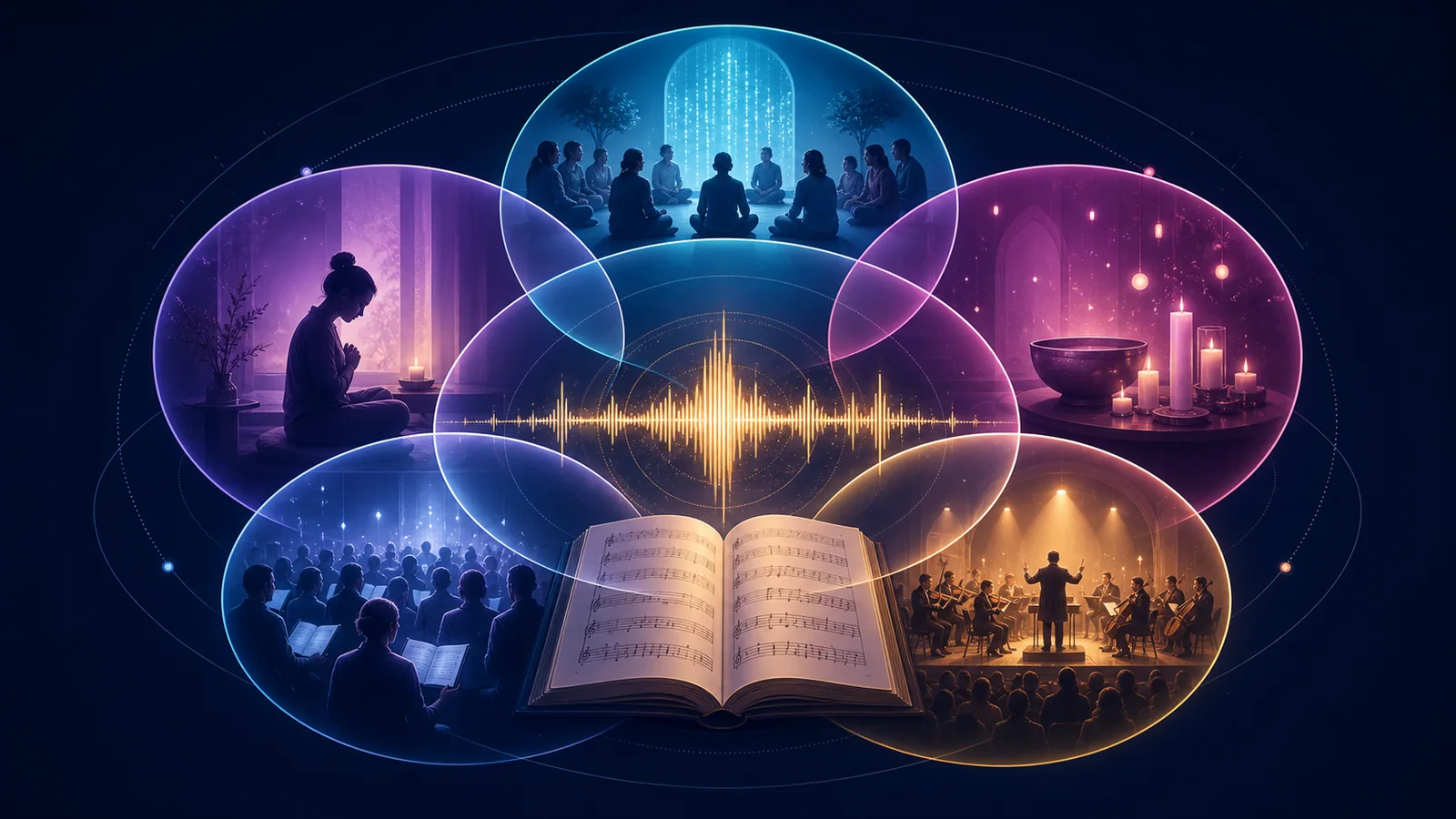
The umbrella also extends beyond music that sounds quiet or reverent to an outsider. A tradition can be ecstatic, rhythmically intense, participatory, processional, meditative, narrative, or highly formal. A concert performance of sacred repertoire may share notes with a ritual performance while changing the social setting and musical purpose.
Function tells you more than a generic genre label
UNESCO's overview of the performing arts as intangible cultural heritage notes that music often appears within festivals, rituals, oral traditions, and other community practices. That is a useful frame because it keeps the music attached to people and use rather than treating it as an isolated audio object.
Religious music can perform several jobs at once:
- Carry sacred or devotional text. Melody, recitation, rhythm, and repetition can make words memorable and shape how they are delivered.
- Mark ritual time. A musical cue can announce a procession, response, transition, prayer, offering, meditation, or conclusion.
- Coordinate participation. Refrains, call and response, repeated formulas, and a steady pulse can help a group act together.
- Support contemplation. Sustained tones, silence, repetition, and restrained texture may focus attention without asking for a conventional song form.
- Transmit memory. A community may preserve history, doctrine, poetry, language, identity, or a lineage of practice through performance.
- Create belonging. Familiar melodies and shared gestures can make participation audible, even when performers have different skill levels.
These functions explain why two pieces with very different sounds can both be religious music. They also explain why two performances of the same composition may not carry the same meaning. Context is not decorative metadata; it changes the musical event.
Selected living traditions show why context matters
No short list can represent the full range of religious music. The examples below are deliberately selective. They show different relationships among text, memory, participation, notation, and ritual, not a hierarchy of traditions.
Vedic chanting
UNESCO describes the tradition of Vedic chanting as a highly regulated oral practice used to preserve sacred Sanskrit texts. The example is important for musicians because it shows that precision can be maintained through trained listening, memorization, pronunciation, and vocal technique rather than depending first on Western staff notation.
Sankirtana in Manipur
The UNESCO entry for Sankirtana of Manipur presents singing, drumming, and dancing as an integrated ritual practice. Separating the vocal line from movement, percussion, gathering, and occasion would describe only part of the event.
Buddhist chanting in Ladakh
UNESCO's account of Buddhist chanting in Ladakh connects sacred-text recitation with monastic and community settings. It is a reminder that a transcription can document pitches and durations while leaving out language, lineage, ritual purpose, and the way knowledge is taught.
Byzantine chant
The UNESCO entry for Byzantine chant describes a living vocal tradition transmitted through both practice and a developed notational system. Oral knowledge and notation are not opposites here. The score participates in a larger teaching tradition rather than functioning as a complete substitute for it.
Qawwali
The Smithsonian Folkways collection Pakistan: The Music of the Qawal provides a public introduction to qawwali performance. For a listener, the important lesson is that repeated text, solo leadership, ensemble response, rhythmic intensification, and devotional setting work together. A generic label such as "world music" would erase the task and context that organize the sound.
Hymns, spirituals, gospel, and devotional song
The Library of Congress survey of religious and devotional music published in the United States shows how print culture circulated hymns, Sunday school songs, gospel hymns, and related repertoire. Printed scores are valuable evidence, but they are only one layer. Performance practice, congregational memory, racial and denominational history, and changes in arrangement all shape how a piece lives beyond the page.
How to listen without flattening the tradition
A respectful listening method does not require you to become an expert before pressing play. It does require more than guessing from sound alone.
Start with six questions:
- What does the source call the practice? Prefer community, archive, institution, or scholar terminology over a broad playlist label.
- Who performs it? Note whether the performers are specialists, clergy, a congregation, family members, a choir, an ensemble, or a mixed group.
- Where does it happen? A ritual space, home, procession, festival, rehearsal room, studio, or concert stage can change the musical job.
- What role does the text play? Translation helps, but pronunciation, recitation rules, poetic form, and sacred status may also matter.
- How is it learned? Listening, imitation, apprenticeship, notation, recordings, and institutional training create different kinds of musical authority.
- What is public and what is restricted? Availability online does not automatically mean a practice is intended for unrestricted copying, remixing, or performance.
Avoid treating every repeated phrase as a mantra, every unaccompanied vocal line as chant, or every choir as liturgical. Those shortcuts make search easier but analysis worse. Use the most specific term the evidence supports, and leave uncertainty visible when it does not.
From oral memory to notation and digital files
Religious music is often described through a false choice: oral tradition or written score. In practice, many traditions use several transmission methods together. A learner may listen to a teacher, memorize text, mark a score, rehearse with a group, consult a recording, and later create a digital reference.
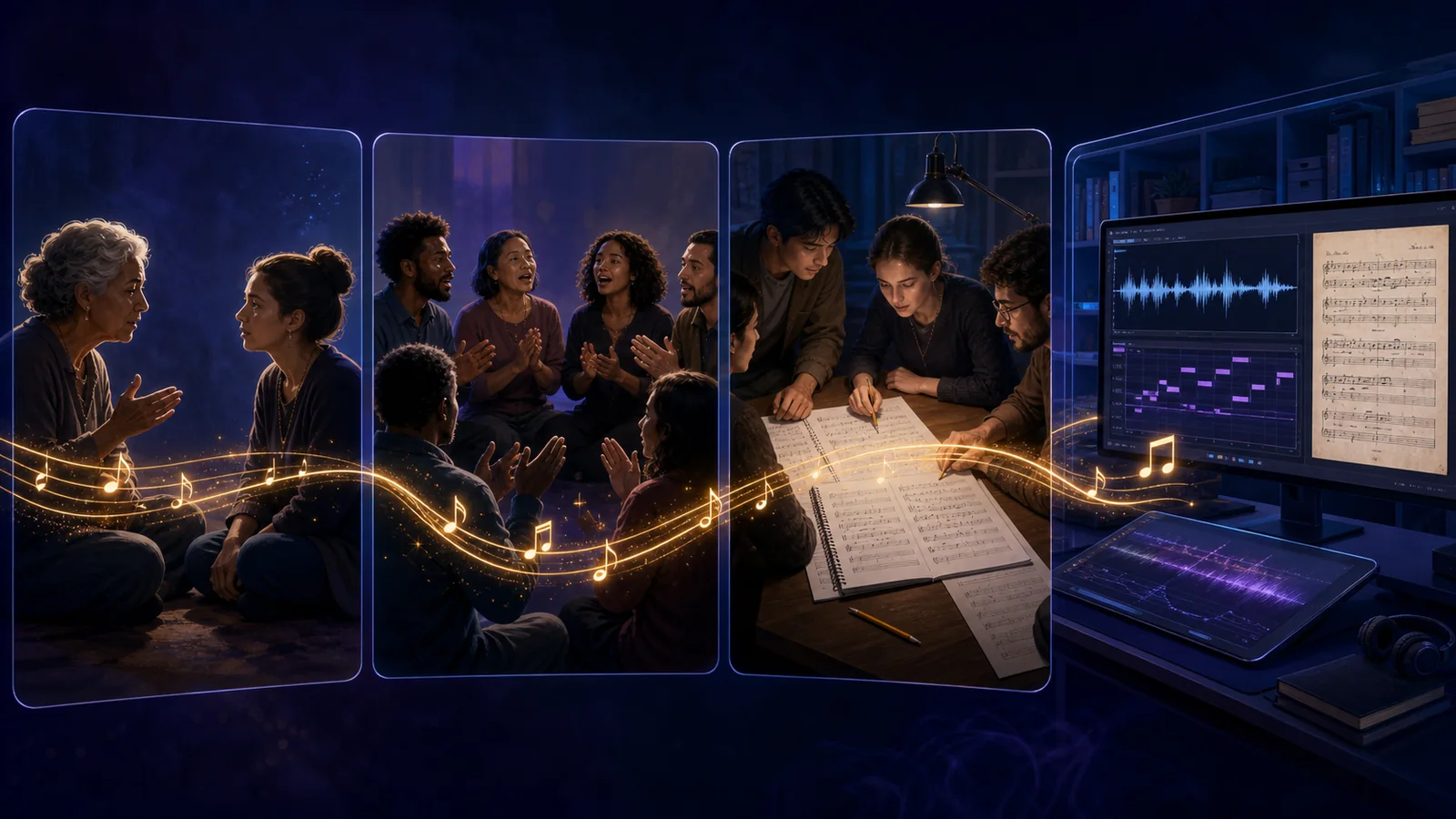
Each medium preserves some information and reduces other information:
| Medium | What it can preserve well | What it may leave out |
|---|---|---|
| oral teaching | pronunciation, timing, gesture, nuance, correction, lineage | easy external searching and stable visual comparison |
| staff or specialist notation | pitch, rhythm, form, parts, editorial decisions | timbre, embodied cues, flexible timing, social setting |
| audio recording | sound, pacing, ensemble relationship, one performance | full ritual context, performer intent, alternative versions |
| video | movement, space, interaction, visible technique | off-camera context, permissions, internal meaning |
| MIDI or MusicXML | editable pitch, rhythm, parts, playback, notation exchange | language, timbre, sacred status, rights, lived authority |
The practical conclusion is not "use less technology." It is "know what the technology cannot carry." A MIDI file can help a choir member hear an entrance. It cannot decide whether the articulation, language, ornament, or ritual use is appropriate.
For score-led ensemble work, the guide to choral music explains how voicing and rehearsal materials affect practice. In religious repertoire, that musical preparation should remain connected to text, setting, and community expectations.
Work with religious music scores respectfully
Before scanning, arranging, transcribing, or sharing a score, separate four questions that are often collapsed into one.
1. Do you have permission to use the source?
A work may be old while a modern edition, translation, arrangement, engraving, recording, or scan is still protected. Public access is not the same as public-domain status. Check the source's rights statement and the rules that apply to your use.
2. Is the score a complete musical authority?
Some scores are performance instructions; others are reminders for people who already know the style. Editorial notation may simplify rhythm, ornament, tuning, pronunciation, or responsorial practice. Keep the original source and any documentation beside the converted file.
3. What needs human review?
Proofread pitches, rhythm, repeated sections, ties, tuplets, accidentals, text underlay, transliteration, clefs, and part assignment. For a tradition you do not know, consult a qualified practitioner or reliable edition rather than making the software output sound "correct" by assumption.
4. What is the next legitimate task?
Rehearsal, accessibility, scholarship, preservation, and permitted arrangement can require different outputs. Choose MIDI for editable playback and timing work. Choose MusicXML when notation editing and exchange matter. Keep an image or PDF when the visual source itself carries essential editorial information.
Use Sheet2MIDI when the source is already notation
Melogen Sheet2MIDI is relevant when you already have a readable score image or PDF and need a first-pass digital reference. The current browser interface accepts JPG, PNG, and PDF notation sources and offers MIDI or MusicXML output. It is not an audio transcription service, a rights checker, a translation authority, or a replacement for tradition-specific teaching.
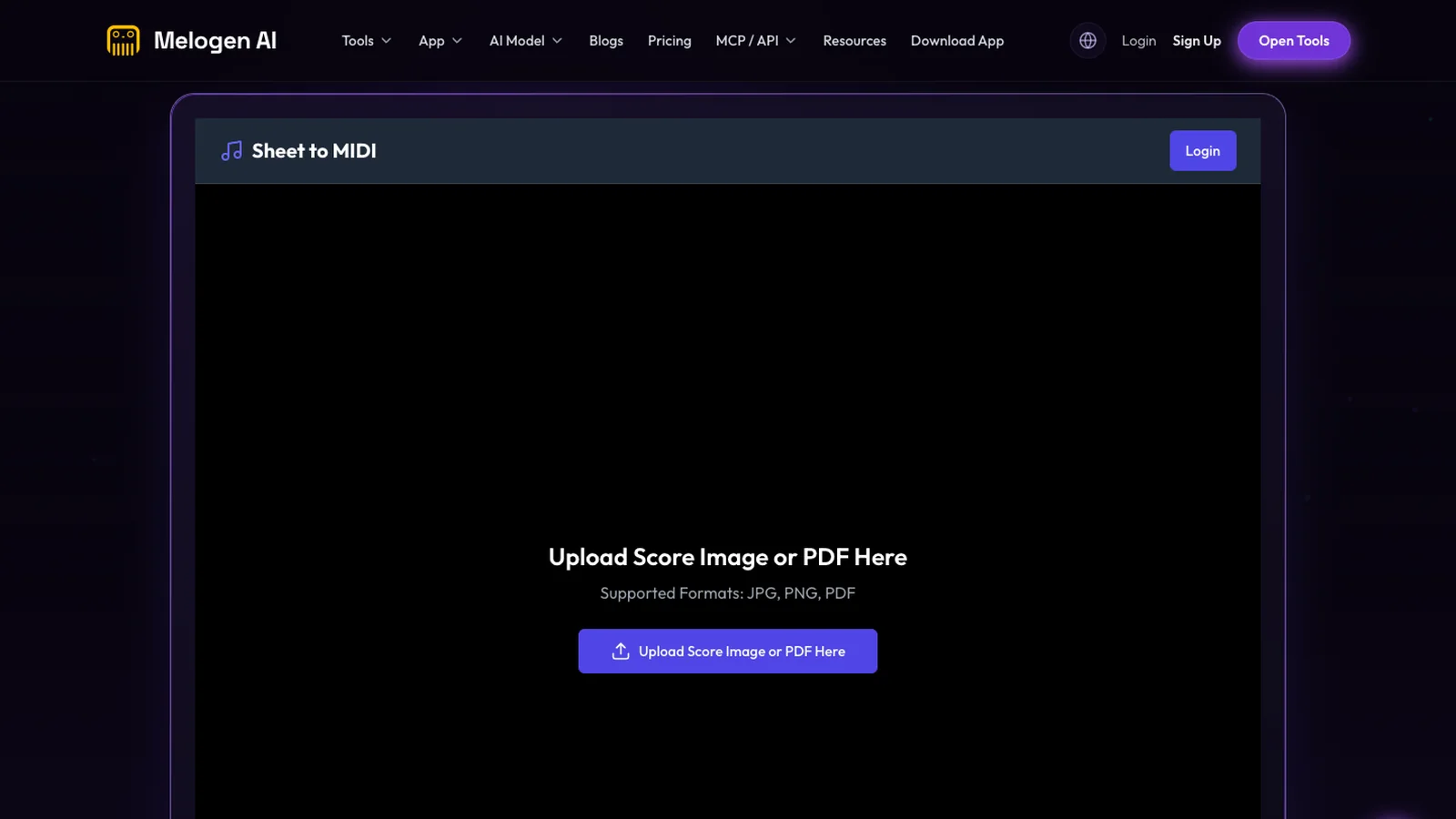
A careful workflow looks like this:
- Confirm that you are permitted to process the score or scan.
- Use the clearest available page, with straight staff lines and readable symbols.
- Upload the JPG, PNG, or PDF to Sheet2MIDI.
- Compare the result with the source before using playback as a rehearsal reference.
- Correct recognition errors and add any missing text, expressive detail, or performance notes in an appropriate editor.
- Keep the converted file labeled as a working aid, especially when the living practice includes information the score cannot encode.
Turn readable notation into an editable rehearsal reference
Upload a clear score image or PDF, then verify the MIDI or MusicXML against the source before rehearsal or analysis.
Frequently asked questions
What is religious music?
Religious music is music connected to religion, sacred practice, devotion, worship, ritual, or a faith community's shared life. It includes many musical systems and performance settings rather than one genre.
Is religious music the same as worship music?
No. Worship music is a major category within religious music, especially when music supports communal worship. Religious music is the broader umbrella and can also include liturgical chant, devotional recitation, processional music, sacred concert repertoire, domestic practice, and other traditions.
Does religious music have to include lyrics?
No. Text is central to many traditions, but instrumental music, percussion, bells, drones, processional sound, and silence can also have religious or ritual functions. The community's use and interpretation matter more than the presence of words alone.
Can religious music be written as sheet music?
Some religious music has detailed notation, some uses notation as a teaching aid, and some is transmitted mainly through listening and practice. A score can preserve important musical information without representing the entire tradition.
Can I convert a religious music score to MIDI?
You can convert permitted, readable notation into a working MIDI reference, then proofread it against the source. The MIDI file should not be treated as proof of correct pronunciation, style, ornamentation, ritual use, or permission.
How should I research an unfamiliar religious music tradition?
Start with the community's own terminology, reputable cultural institutions, archives, scholarly sources, and qualified practitioners. Record what is uncertain, distinguish a concert example from ritual use, and avoid generalizing from one recording.
The practical takeaway
The phrase "religious music" names a relationship among sound, belief, people, and practice. It does not name one tempo, instrument, scale, or emotional mood. Start with function and context, use specific tradition names when the evidence supports them, and treat notation or digital files as partial records rather than complete definitions.
When a permitted source is already written as readable notation, a conversion tool can make rehearsal and editing easier. The responsible workflow still ends where it began: with the source, the people who carry the practice, and careful human listening.
About the author
Zhang Guo
Composer - AI Product Manager
AI product manager and digital marketing consultant with a background in music. Creativity is the bridge between rhythm and logic, where musical intuition and mathematical precision can coexist in every meaningful product decision.
Follow on X