Trumpet Transposition Guide for B Flat Parts
Learn trumpet transposition for B-flat parts with written-pitch rules, concert-pitch checks, key examples, and Melogen MusicXML cleanup.
 Zhang Guo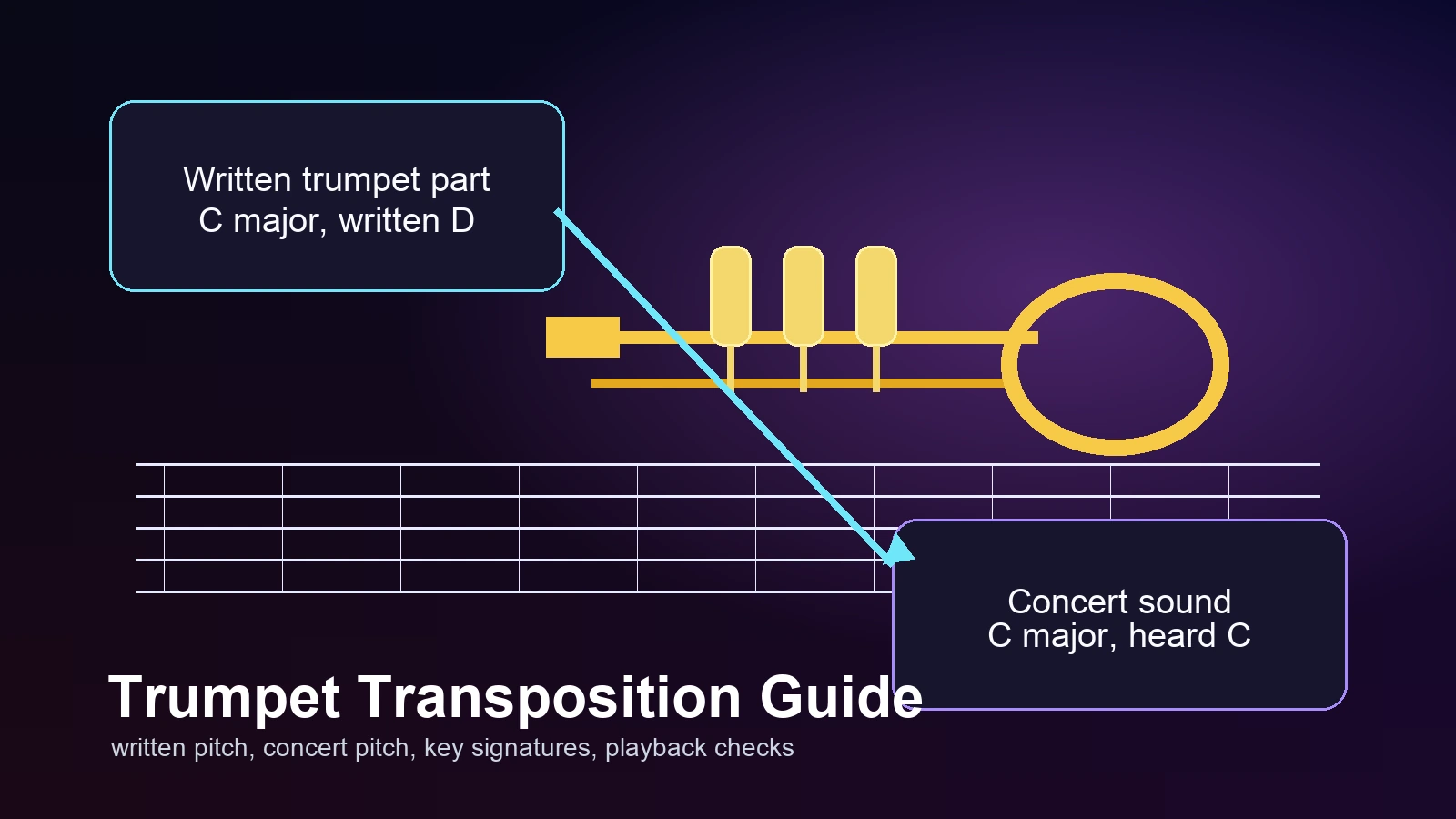
Turn a static score into editable MIDI
Contents
Trumpet transposition means the written note in a trumpet part does not always match the concert pitch that everyone hears. For the common B-flat trumpet, a written C sounds as concert B-flat. If you are writing from concert pitch for a B-flat trumpet player, write the part up a major second.
That rule is simple, but the mistakes around it are not. Players, arrangers, and teachers usually get into trouble when they fix the notes but forget the key signature, treat a scanned part as concert pitch, or skip the playback check. This guide keeps the job practical: name the direction, move the key first, proofread accidentals, then check the result against a concert-pitch reference.
Start with written pitch and concert pitch
The trumpet player reads written pitch. The piano, conductor score, DAW piano roll, and most non-transposing reference tracks use concert pitch. Before you move anything, decide which side you are starting from.
If a concert-pitch melody is C-D-E, the B-flat trumpet part should be written D-E-F-sharp. When the player reads those written notes, the audience hears C-D-E. If you already have a written trumpet part and want to check what it sounds like, move it down a whole step to hear the concert result.
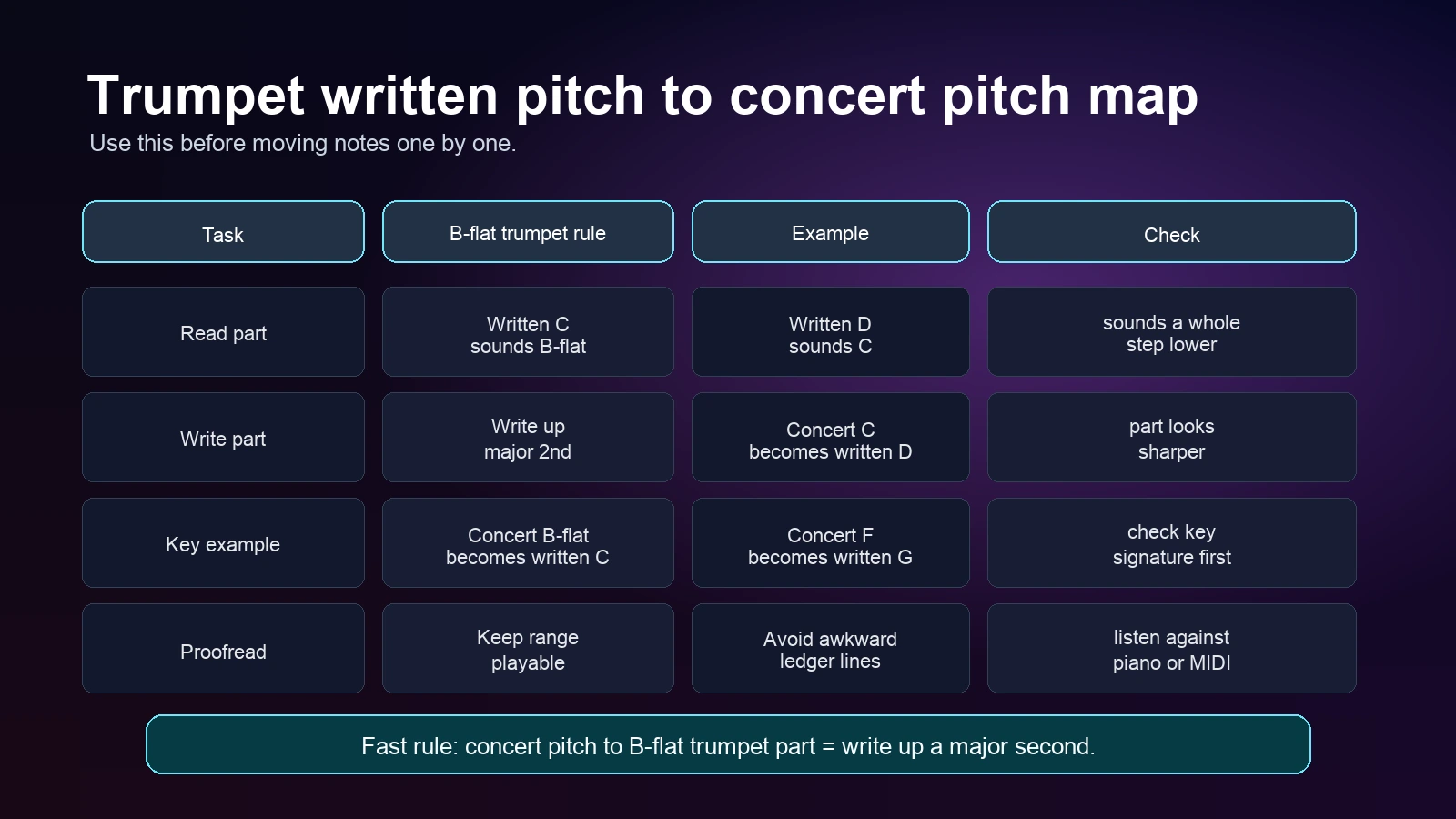
Use this quick table as the mental map:
| Direction | Rule | Example | What to check |
|---|---|---|---|
| Concert pitch to B-flat trumpet part | Write up a major second | Concert C becomes written D | Key signature gets sharper |
| B-flat trumpet part to concert pitch | Sound down a major second | Written D sounds concert C | Playback should match piano |
| Concert key to written key | Move key up a whole step | Concert B-flat becomes written C | Accidentals still make sense |
| Written key to concert key | Move key down a whole step | Written G becomes concert F | Range still sits well |
If you need the broader concept before the trumpet-specific rule, read Melogen's guide to transposing instruments. This article stays focused on trumpet parts and the B-flat workflow.
Move the key signature before notes
Do not start by moving individual notes one at a time. Move the key signature first, then transpose the melody, bass cues, and harmony notes inside that key.
For a B-flat trumpet part:
- If the concert score is in C major, the written trumpet part is in D major.
- If the concert score is in B-flat major, the written trumpet part is in C major.
- If the concert score is in F major, the written trumpet part is in G major.
- If the concert score is in E-flat major, the written trumpet part is in F major.
That key-signature move prevents a very common error: the notes are technically a whole step higher, but the written part still looks like the old key. The result becomes harder to read and easier to misplay.
| Concert key | B-flat trumpet written key | Main move | Watch for |
|---|---|---|---|
| C major | D major | Up a major second | F-sharp and C-sharp |
| B-flat major | C major | Up a major second | Naturals replacing flats |
| F major | G major | Up a major second | F-sharp in the written part |
| E-flat major | F major | Up a major second | B-flat remains in the written key |
If you are changing the key of a whole song, not preparing a trumpet part, use the broader how to transpose music workflow. Trumpet transposition is narrower: the concert key stays fixed, but the trumpet part is written differently so the player sounds in the right pitch.
Check accidentals and range after the move
After the key signature and notes move, proofread accidentals as notation, not just as keyboard pitches. A copied accidental may be correct in the source key but awkward in the written trumpet part. Repeated phrases should be spelled consistently, and chromatic passing tones should still point to the harmony around them.
Range matters too. A mathematically correct transposition can still create a written line that sits poorly on trumpet. If the written part pushes too high for the player's level, you may need a different octave, a simplified passage, or a different arrangement choice.
Use this check order:
| Layer | Question | Why it matters |
|---|---|---|
| Key signature | Did the written key move up a major second? | Prevents cluttered accidentals |
| Accidentals | Do chromatic notes spell cleanly? | Keeps the part readable at tempo |
| Range | Is the written line playable? | Avoids technically correct but impractical parts |
| Harmony cues | Did chord or rehearsal cues follow the same move? | Prevents mixed concert/written references |
| Playback | Does it sound right against concert pitch? | Catches direction errors fast |
Convert scans before deep cleanup
If your source is a PDF, scanned band part, or photo of a score, convert it before you spend time on detailed transposition. Static notation is hard to audit because every key signature, accidental, and note move is manual.
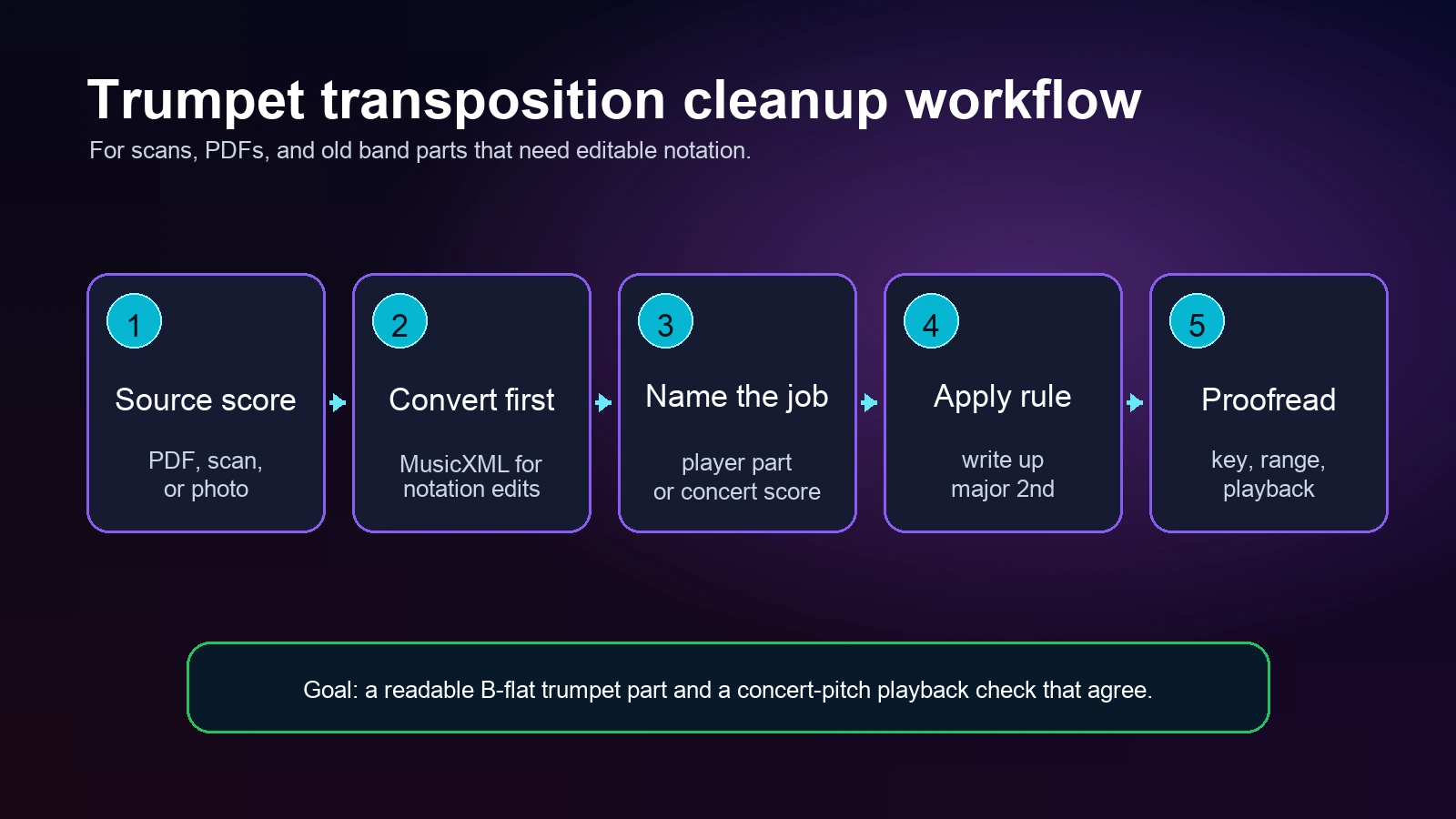
MusicXML is the better handoff when the next step is a notation editor. It keeps measures, clefs, notes, and score structure editable, so you can transpose, respell, and export a readable part. MIDI is useful for listening checks because a wrong concert pitch shows up immediately by ear.

Use this workflow when the source is legal and clear enough to read:
- Convert the PDF or scan into editable notation.
- Open the result in your notation editor.
- Decide whether the file is concert pitch or already a B-flat trumpet part.
- Apply the correct major-second direction.
- Export or play back a concert-pitch reference to confirm the result.
Melogen's PDF to MusicXML workflow is the stronger first step when you need notation cleanup. Use Sheet2MIDI when you mainly need a quick playback reference.
Keep trumpet transposition separate from fingering
Transposition and fingering are related, but they are not the same problem. Transposition decides what pitch should be written so the trumpet sounds at the intended concert pitch. Fingering decides which valve pattern produces a written note on the instrument.
That distinction helps when a student is confused:
| Confusion | What is actually wrong | Better fix |
|---|---|---|
| "My written C sounds wrong with piano" | Written pitch was compared as concert pitch | Move the trumpet sound down a major second |
| "This passage is too high after transposition" | Range or octave needs review | Adjust the part, not just the key |
| "I know the valves but the band sounds off" | Concert-pitch relationship may be wrong | Check against piano or MIDI |
| "I can read the note but miss the entrance" | Sight-reading/rhythm issue | Practice rhythm separately |
For the reading side, Melogen's trumpet sight-reading guide is the better companion. It covers rhythm, range preview, and playback practice after the written part itself is correct.
Where Melogen fits
Melogen helps when the source part is trapped in a static file and you need editable material before making musical decisions. Use PDF to MusicXML when the score needs notation editing. Use Sheet2MIDI when the fastest way to catch a wrong transposition is playback.
The boundary is important. Melogen can help turn visible notation into editable MusicXML or playable MIDI. It does not decide whether a passage is comfortable for a specific trumpet player, and it does not replace the final written-pitch versus concert-pitch proofread.
Turn a trumpet PDF into editable notation
Use Melogen PDF to MusicXML for the first pass, then finish trumpet transposition, spelling, and range checks in your notation editor.
Run a final trumpet transposition check
Before you share a part, run the checks from large to small. Most trumpet transposition errors are direction errors, key-signature errors, or playback checks that never happened.
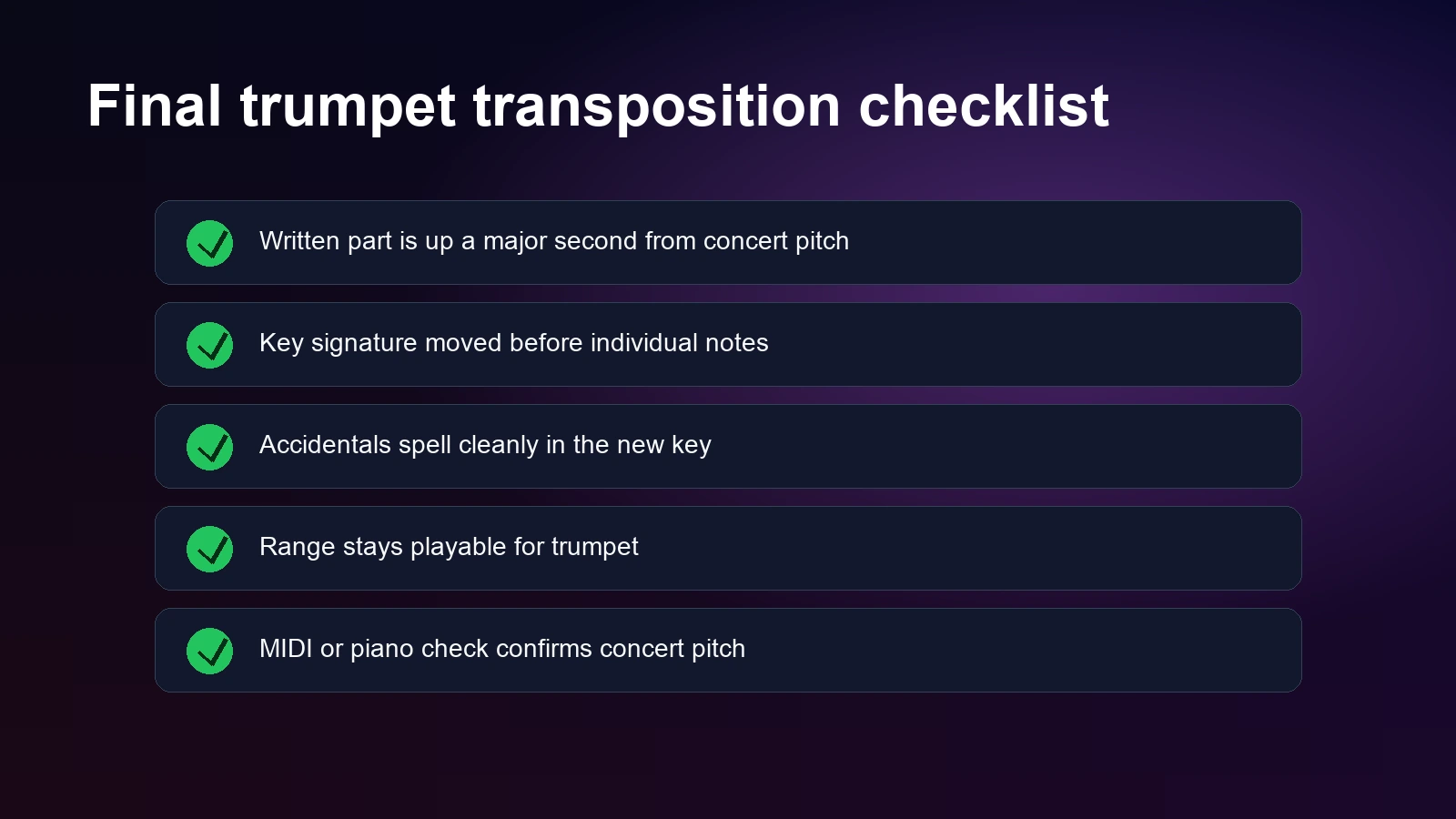
Use this final pass:
- The written B-flat trumpet part is up a major second from concert pitch.
- The key signature moved before individual notes.
- Accidentals spell cleanly in the written key.
- The range is playable for the intended trumpet player.
- Harmony, rehearsal, and cue notes use the same pitch logic.
- MIDI, piano, or notation playback confirms the concert pitch.
If anything sounds a whole step away from the ensemble, stop and check the direction before changing random notes. A trumpet part that is off by a major second is usually a transposition setup problem, not a wrong-note problem.
Frequently asked questions
What does trumpet transposition mean?
Trumpet transposition means the written trumpet note and the sounding concert pitch are different. For B-flat trumpet, written C sounds as concert B-flat, so concert-pitch material must be written up a major second for the player.
Is B-flat trumpet a transposing instrument?
Yes. The common B-flat trumpet is a transposing instrument. Its written notes sound a whole step lower than written when compared with concert-pitch instruments such as piano.
How do I transpose concert pitch for B-flat trumpet?
Write the B-flat trumpet part up a major second from concert pitch. Concert C becomes written D, concert F becomes written G, and concert B-flat becomes written C.
Should I transpose trumpet by note or by key?
Start with the key signature, then move the notes. Moving notes first often leaves the written part cluttered with avoidable accidentals.
Can MIDI help check trumpet transposition?
Yes. MIDI playback is useful for confirming whether the written part sounds in the intended concert pitch. It is not a substitute for trumpet range, articulation, or phrasing checks.
The practical takeaway
Trumpet transposition is manageable when you keep the direction visible. For B-flat trumpet, concert pitch to written part means write up a major second. Written part to concert pitch means sound down a major second.
Move the key signature first. Then move the notes. Proofread accidentals, range, and cue notes. If the source started as a PDF or scan, convert it into editable notation before deep cleanup. Finally, check playback against concert pitch so the written part and the sounding music agree.
About the author
Zhang Guo
Composer - AI Product Manager
AI product manager and digital marketing consultant with a background in music. Creativity is the bridge between rhythm and logic, where musical intuition and mathematical precision can coexist in every meaningful product decision.
Follow on X