What to Wear to a Concert for Every Venue and Role
Learn what to wear to a concert as an audience member or performer, with venue, weather, footwear, bag, hearing, and concert-black checks.
 Zhang Guo
Turn a static score into editable MIDI
Contents
What to wear to a concert depends first on your role and the venue, not on a universal fashion rule. Audience members can usually choose comfortable clothes that fit the setting, weather, and venue policy. Performers should follow the ensemble's written dress call, which may specify concert black, formalwear, footwear, or accessories.
If the ticket, presenter, or ensemble has not stated a dress code, prioritize clothes you can sit, stand, walk, and hear safely in. A practical outfit should also survive the queue, temperature changes, bag inspection, and the trip home.
Quick answer by concert situation
| Situation | A reliable starting outfit | Check before leaving |
|---|---|---|
| Classical concert audience | Smart casual or any clean, comfortable outfit | Venue dress guidance, stairs, room temperature |
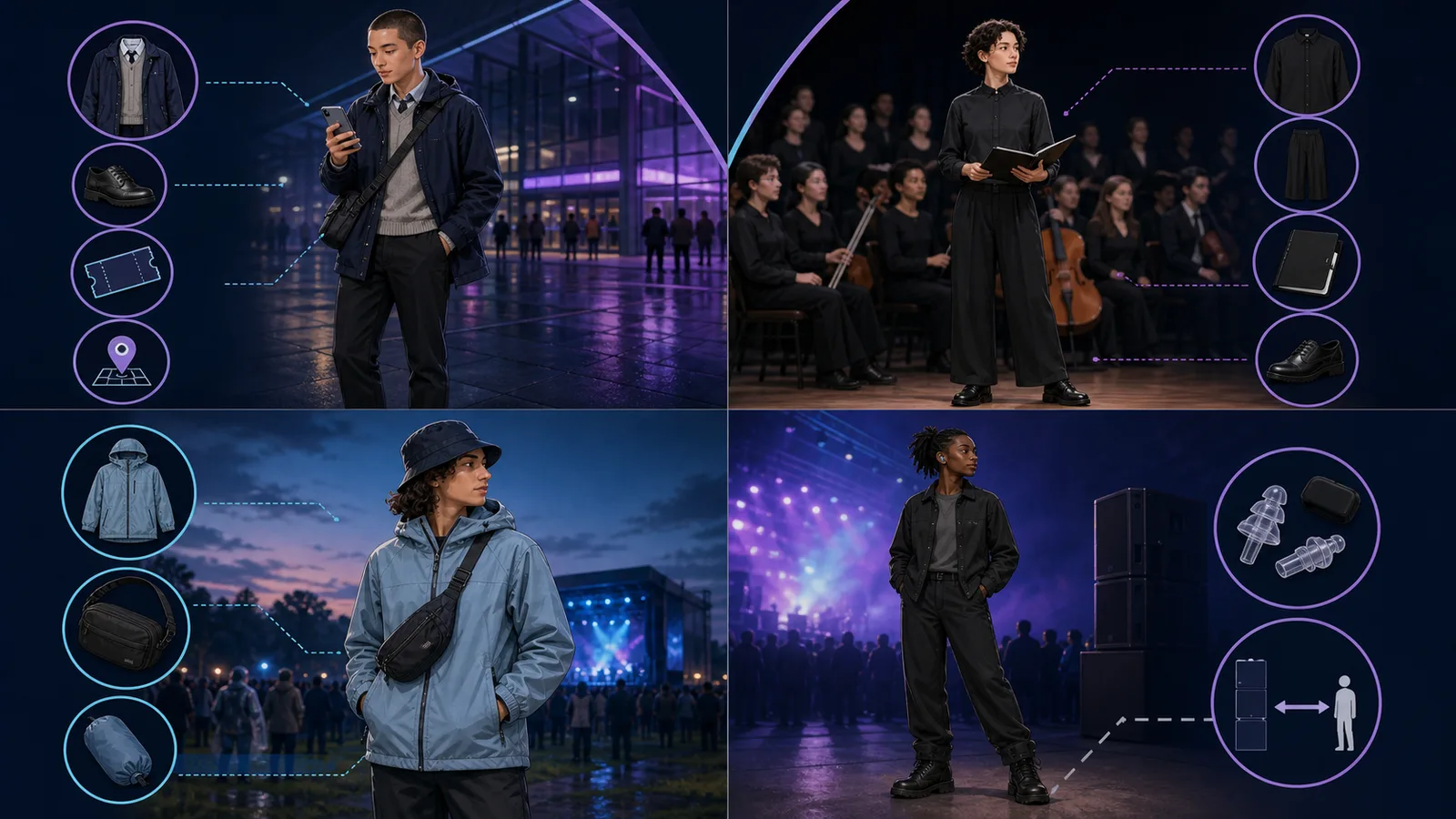
| Rock, pop, or amplified show | Breathable layers, stable closed-toe shoes, earplugs | Bag size, standing area, weather, hearing protection |
| Outdoor festival | Weather-ready layers and shoes suited to the ground | Rain policy, sun protection, bag and bottle rules |
| Jazz club or small venue | Comfortable smart casual with a light layer | Seating, food-service policy, room temperature |
| Orchestra or choir performer | The exact concert-black or formal specification supplied | Sleeve length, shoes, socks, accessories, folder |
| Solo performer | Clothing that supports movement and matches the event brief | Lighting, instrument contact points, stage entrances |
| Crew, teacher, or chaperone | Quiet, mobile, practical layers with secure pockets | Access credential, headset, lifting or safety needs |
Decide whether you are in the audience or on stage
The most important split is not classical versus pop. It is audience versus performer.
As an audience member, your outfit rarely affects the sound or visual unity of the event. Many concert halls actively welcome casual clothing. The London Symphony Orchestra's Barbican visitor guide says visitors should come as they feel comfortable and that jeans and trainers are acceptable. New Century Chamber Orchestra likewise says in its first-time concert guide that there is no strict audience dress code.
That does not mean every event is casual. A gala, opening-night reception, themed event, religious service, school ceremony, or invitation-only performance may set expectations. Treat the ticket and presenter's current instructions as the source of truth.
As a performer, clothing is part of the production. An ensemble may need a consistent stage picture, quiet fabrics, safe shoes, covered shoulders, a particular tie or scarf, or a precise version of concert black. New Century's guide illustrates the difference clearly: its audience has no strict code, while orchestra members wear varied all-black looks on stage.
Do not translate “concert black” into your own private definition. Ask for the written specification when any detail is unclear.
Match the venue before the genre
Genre can suggest a mood, but the venue determines the physical job your clothes must do.
Seated concert hall
Expect a queue, a lobby, stairs, a seat that may be narrow, and an auditorium that can feel cooler or warmer than outside. A removable layer is more useful than a complicated statement outfit. Choose shoes that are comfortable on stairs and quiet enough that you can move without distracting nearby listeners.
If this is your first classical concert, the guide to classical music for beginners can help with the listening side. Clothing does not need to become another barrier to entry.
Standing room, arena, or club
Stable footwear matters more when people will stand, move, or queue for hours. Avoid long trailing hems, loose hardware, or delicate shoes that become a problem in a dense crowd. Use breathable layers because the room may heat up after the show starts even if the queue outside is cold.
For an amplified event, hearing protection belongs in the outfit plan. The World Health Organization's safe-listening guidance recommends earplugs in noisy places, distance from loudspeakers, and frequent breaks from loud sound. Reusable musician-style earplugs are compact enough to carry even when you are unsure how loud the venue will be.
Outdoor concert or festival
Build the outfit around the forecast, ground, shade, and journey home. A light weatherproof layer is usually more adaptable than one heavy item. Choose shoes that can handle grass, gravel, dust, or mud without becoming unsafe.
Check the venue's current rules before packing sunscreen, umbrellas, water bottles, blankets, or portable seating. A useful object can still be refused at the gate if the event prohibits it.
Small jazz venue, restaurant, or house concert
The practical challenge is often temperature and space. A compact layer works better than a bulky coat at a close table. Keep bags small enough to stay out of aisles, and avoid accessories that strike glasses, chairs, instruments, or other people when you turn.
Choose clothes you can sit, stand, move, and hear in
An outfit can look appropriate in a mirror and still fail the concert itself. Test the movements you will actually make.
- Sit for ten minutes without adjusting the waistband, neckline, or hem.
- Walk stairs and stand for the expected length of the event.
- Lift your arms as you would while clapping, holding a rail, or moving an instrument.
- Check whether shoes slip, pinch, or create loud steps.
- Remove one layer without unpacking the whole bag.
- Make sure earrings, bracelets, zippers, or decorative hardware do not rattle.
- Confirm that required medication, hearing protection, and accessibility items are easy to reach.
For performers, repeat the test with the instrument or folder. A violinist must consider shoulder and chin contact. A cellist needs room at the knees. A singer needs unrestricted breathing. A pianist needs sleeves and cuffs that do not interfere with the keyboard. A conductor needs a clear range of arm movement.
The goal is not bland clothing. It is clothing that disappears while you listen or perform.
Use concert black as a specification, not a fashion guess
“Concert black” often means black clothing from head to toe, but ensembles differ on nearly every detail. One group may accept a black button-down and trousers. Another may require long sleeves, ankle-length garments, opaque hosiery, a jacket, a specific neck treatment, or closed-toe shoes.
Before buying or packing anything, check:
- Color: Is every visible item required to be solid black, including socks, belt, hair accessories, and shoe soles?
- Coverage: Are long sleeves, covered shoulders, full-length trousers, or a particular hem length required?
- Footwear: Must shoes be closed-toe, flat, polished, or suitable for standing on risers?
- Fabric: Does it reflect strongly under stage lighting, make noise, attract lint, or become transparent under light?
- Accessories: Are ties, scarves, jewelry, pins, or jackets supplied or prohibited?
- Mobility: Can you breathe, bow, sit, turn pages, and handle the instrument safely?
Keep a small emergency kit with a lint roller, safety pins or a compact sewing kit, a spare hair tie, and any ensemble-specific accessory. If the group provides a tie, scarf, badge, or folder, pack it with the music rather than relying on memory at the venue.
Pack for weather, bags, and venue rules
Venue policy can invalidate an otherwise sensible outfit. Read the current event page, not a generic social post, because bag, bottle, camera, umbrella, and re-entry rules change by venue and event.

Audience checklist
- Ticket and identification, if required
- Venue-compliant compact bag
- Removable layer
- Stable shoes
- Earplugs for amplified or uncertain sound levels
- Weather protection allowed by the venue
- Accessibility or medical items you need
Performer checklist
- Every required clothing item, including socks and shoes
- Music, folder, instrument accessories, and supplied uniform pieces
- Quiet emergency repair items
- A layer for backstage temperature that can be removed before entrance
- Water and hearing protection where appropriate and permitted
- Travel clothes if stagewear is uncomfortable or weather-sensitive
Do not hide prohibited objects inside clothing or assume a medical or accessibility item will be obvious to security. If a policy could affect access, contact the venue in advance and keep the response available on your phone.
Build a two-minute outfit check
Use this short decision sequence on the day of the concert.
- Read the source: Check the ticket, venue, presenter, or ensemble message.
- Name your role: Audience, performer, crew, teacher, parent, or chaperone.
- Check the physical setting: Seated or standing, indoor or outdoor, stairs or grass, quiet hall or amplified room.
- Check the full journey: Queue, weather, public transport, parking, coat storage, and return trip.
- Move in the outfit: Sit, stand, walk, raise your arms, and handle the instrument if relevant.
- Pack the small essentials: Ticket, allowed bag, layer, earplugs, required accessories, and accessibility items.
If all six checks pass, the outfit is concert-ready even if it does not match a stereotype about the genre.
Where Melogen fits for performers
Clothing is only one part of being ready to perform. If your rehearsal starts from a readable PDF, PNG, or JPG score, Melogen Sheet2MIDI can create an editable MIDI reference for practice. Proofread the converted pitches, rhythm, repeats, and voices against the source score before using it as a rehearsal guide.
That workflow is especially useful when you need to hear an inner part, slow down a passage in a DAW, or prepare a basic practice file before the concert. For singers, the guide to learning a choir part adds a structured rehearsal process beyond simply replaying the line.
Turn a readable score into an editable practice reference
Upload a PDF, PNG, or JPG score, then verify the converted notes and rhythm before rehearsal.
Frequently asked questions
Can I wear jeans to a classical concert?
Usually, yes, when the venue has not announced a dress code. Major concert presenters such as the London Symphony Orchestra explicitly welcome comfortable clothing, including jeans and trainers. Check the specific event in case it is a gala, formal ceremony, themed performance, or private reception.
What should I wear to a rock or pop concert?
Choose breathable layers and stable shoes suited to standing, stairs, and crowds. Check bag and weather rules, and carry properly fitted earplugs. Avoid clothing or accessories that can snag, trail, rattle, or become uncomfortable during a long queue.
What does concert black mean?
Concert black is an ensemble dress specification, not one universal outfit. Ask whether the group requires long sleeves, covered shoulders, full-length garments, particular shoes, supplied accessories, or all visible items to be solid black.
Should I dress according to the music genre?
Genre can influence style, but role, venue, weather, movement, safety, and explicit event instructions matter more. A themed outfit is optional unless the presenter says otherwise.
Are earplugs necessary at a concert?
They are a sensible option at loud or unpredictable venues. WHO recommends hearing protection in noisy places, staying away from loudspeakers, and taking quiet breaks. Earplugs must be fitted and used correctly to reduce exposure.
The practical takeaway
There is no single correct answer to what to wear to a concert. Audience members should begin with comfort, venue rules, weather, movement, and hearing safety. Performers should begin with the ensemble's exact dress call and test the outfit with the movements and equipment the performance requires.
Use the ticket or event page as the authority. Add stable shoes, a removable layer, an allowed bag, and hearing protection when the setting calls for them. If you can move freely, follow the rules, and stop thinking about your clothes once the music begins, you chose well.
About the author
Zhang Guo
Composer - AI Product Manager
AI product manager and digital marketing consultant with a background in music. Creativity is the bridge between rhythm and logic, where musical intuition and mathematical precision can coexist in every meaningful product decision.
Follow on X