When Did AI Music Start A Timeline for Musicians
When did AI music start? Trace the path from computer composition to MIDI, machine learning, neural audio, and today's prompt-based generators.
 Zhang Guo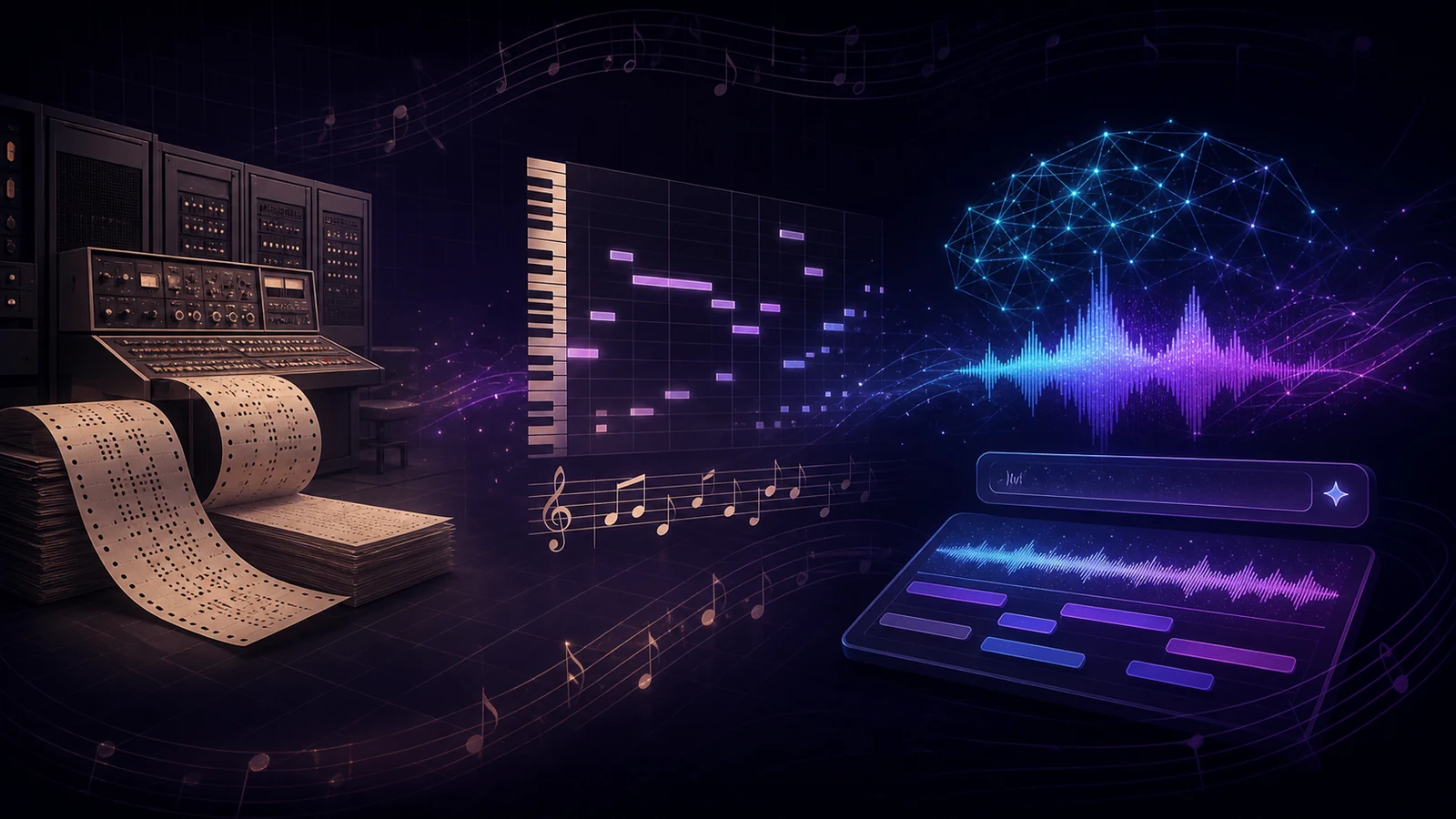
Turn a static score into editable MIDI
Contents
When did AI music start? The most useful starting point is 1956, when Lejaren Hiller and Leonard Isaacson used the ILLIAC I computer to create the ILLIAC Suite for string quartet. It was computer-assisted composition driven by musical rules and probability, not machine learning in the modern sense.
If you mean today's AI music—systems trained on musical data that generate notes or finished audio—the answer is later. Machine-learning music research accelerated in the 2010s, neural raw-audio generation became visible around 2020, and prompt-based song tools reached a broad creator audience in the early 2020s.
The answer depends on what counts as AI music
There was no single switch from "music" to "AI music." The field grew through several different technical ideas, and each one changed what the computer could contribute.
| Era | What the computer handled | Typical musical output | What changed |
|---|---|---|---|
| 1950s-1970s | Rules, probability, algorithmic choices | Notes and scores for human performers | A computer could help choose musical material |
| 1980s-2000s | Style models, expert systems, symbolic pattern analysis | MIDI-like events, harmonizations, style studies | Systems could model relationships across larger musical examples |
| 2010s | Neural networks trained on musical datasets | Melodies, piano rolls, MIDI sequences, timbre experiments | Models learned patterns from data instead of relying only on hand-written rules |
| 2020s | Large generative models and compressed audio representations | Longer symbolic pieces, raw audio, vocals, prompt-conditioned songs | Generation moved closer to a complete listening experience |
This is why a broad definition of what AI music is includes more than song generators. Transcription, notation recognition, structure analysis, source separation, and audio generation all belong to the wider history, even though they solve different jobs.
1956 gives us the clearest historical starting point
The University of Illinois account of the ILLIAC Suite describes how Hiller and Isaacson gave the ILLIAC I computer parameters for a four-movement string quartet. The program selected musical material under increasingly complex rules, and the result was transcribed into notation for musicians to perform.
That distinction matters. The computer did not render a finished vocal track or respond to a natural-language prompt. It operated in a symbolic world of notes, constraints, probability, and compositional experiments.
Calling the ILLIAC Suite "AI music" is partly retrospective. The work is better described as computer-assisted or algorithmic composition. Still, it established the central question that later AI music systems kept asking: can a machine make musically useful choices inside a structure created by people?
The answer was already more interesting than a simple yes or no. Hiller and Isaacson designed the rules, chose the experiments, evaluated the results, and prepared music for human performers. The creative process was distributed between program, composer, score, and ensemble.
Symbolic systems came before generated audio
For decades, computer music systems worked mainly with symbolic representations. A note could be stored as pitch, start time, duration, velocity, and instrument. That is much easier for a computer to model than a finished audio waveform containing performance nuance, room sound, voice, drums, distortion, and thousands of overlapping frequencies.
Symbolic music also matches how composers already think. A system can manipulate motifs, harmonies, rhythms, voices, or MIDI events without first generating the sound of a piano, singer, or orchestra.
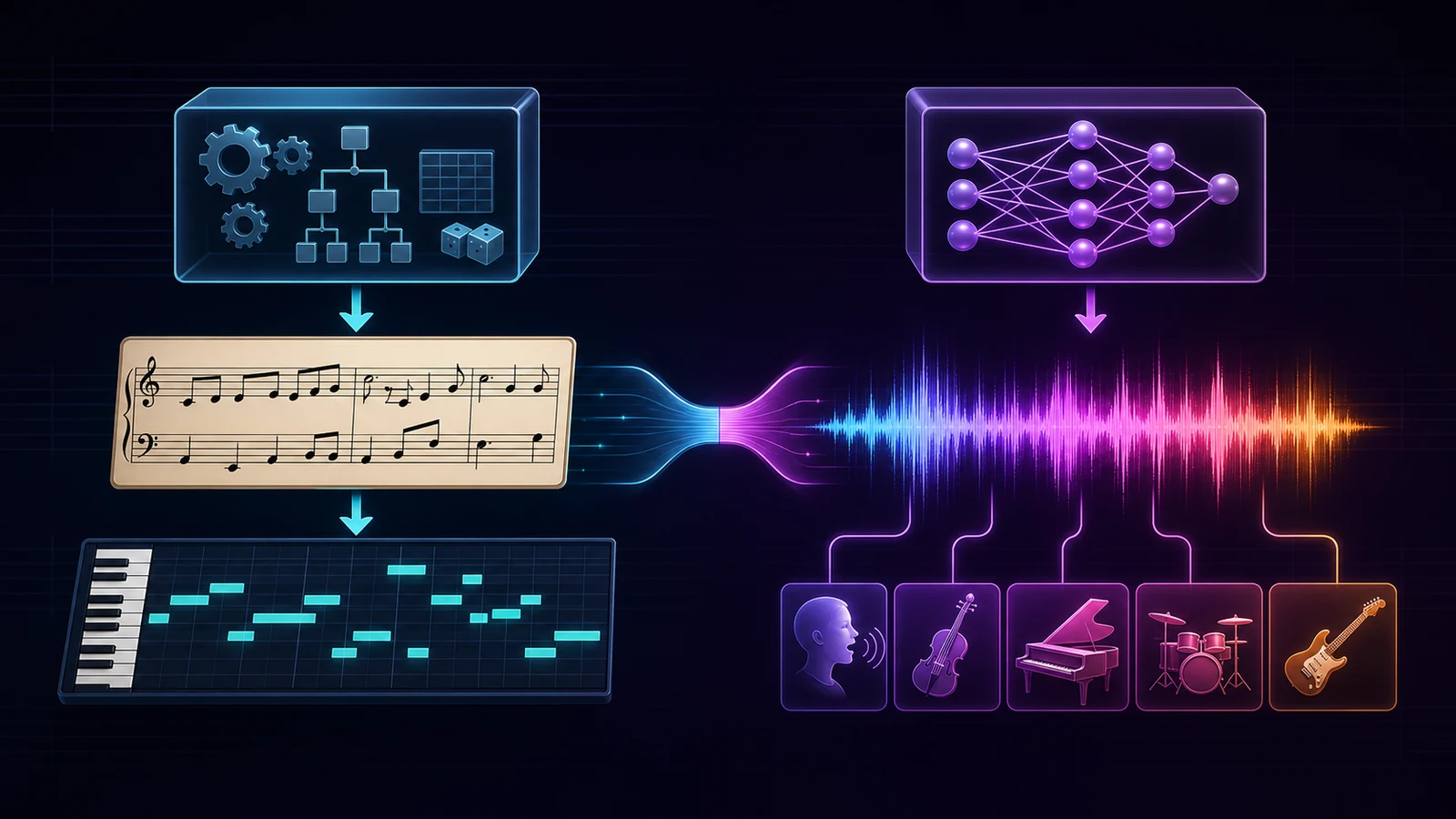
This split still matters today:
- Symbolic generation produces notes, MIDI, piano rolls, or score-like structures that remain easy to edit.
- Audio generation produces sound directly, including timbre, performance character, vocals, and production texture.
- Hybrid workflows generate one representation and use it to guide another, such as creating MIDI before rendering audio.
Symbolic output gives musicians control over individual notes and arrangement. Audio output can sound more complete sooner, but it is harder to revise at the same level of detail. Modern tools often trade between those two advantages.
The 2010s shifted the field from rules toward learning
Earlier systems often depended on rules chosen by researchers or on carefully designed representations. Machine learning changed the balance. Instead of describing every musical relationship in advance, researchers could train models to find recurring patterns in datasets of melodies, performances, or MIDI files.
Google Brain announced Magenta in June 2016 as a research project for machine intelligence in music and art generation. Its early work used open tools, MIDI, recurrent neural networks, and artist-facing experiments to make music generation a practical research community rather than a closed demonstration.
The musician-facing change was not simply "better melodies." The systems became easier to condition, continue, compare, and connect to familiar musical data. A model could learn a probability distribution over notes, then generate a continuation that reflected patterns in its training material.
In 2019, OpenAI's MuseNet showed a transformer generating multi-instrument compositions from MIDI data. That milestone is useful because it sits between two eras: it used a modern neural architecture, but it still represented music as symbolic events rather than finished raw audio.
Raw-audio models changed the sound of the result
The next major shift was generating audio itself. Raw audio is far more demanding than MIDI because a few minutes of sound contains millions of time steps and must preserve pitch, timbre, rhythm, dynamics, and long-range structure at once.
OpenAI introduced Jukebox in April 2020 as a neural model that generated raw musical audio conditioned by information such as genre and lyrics. Its samples had clear limitations, but the research demonstrated a path from symbolic note generation toward models that could produce voices and instrumental texture directly.
That technical change explains why the phrase "AI music" feels different now. A 1950s program returned compositional material that musicians performed. A symbolic neural model returned note events that could be rendered. A raw-audio model returned something a listener could play immediately.
The outputs moved closer to a finished record, even when the musical structure, sound quality, control, and rights questions were not solved.
Prompt-based tools made the technology visible
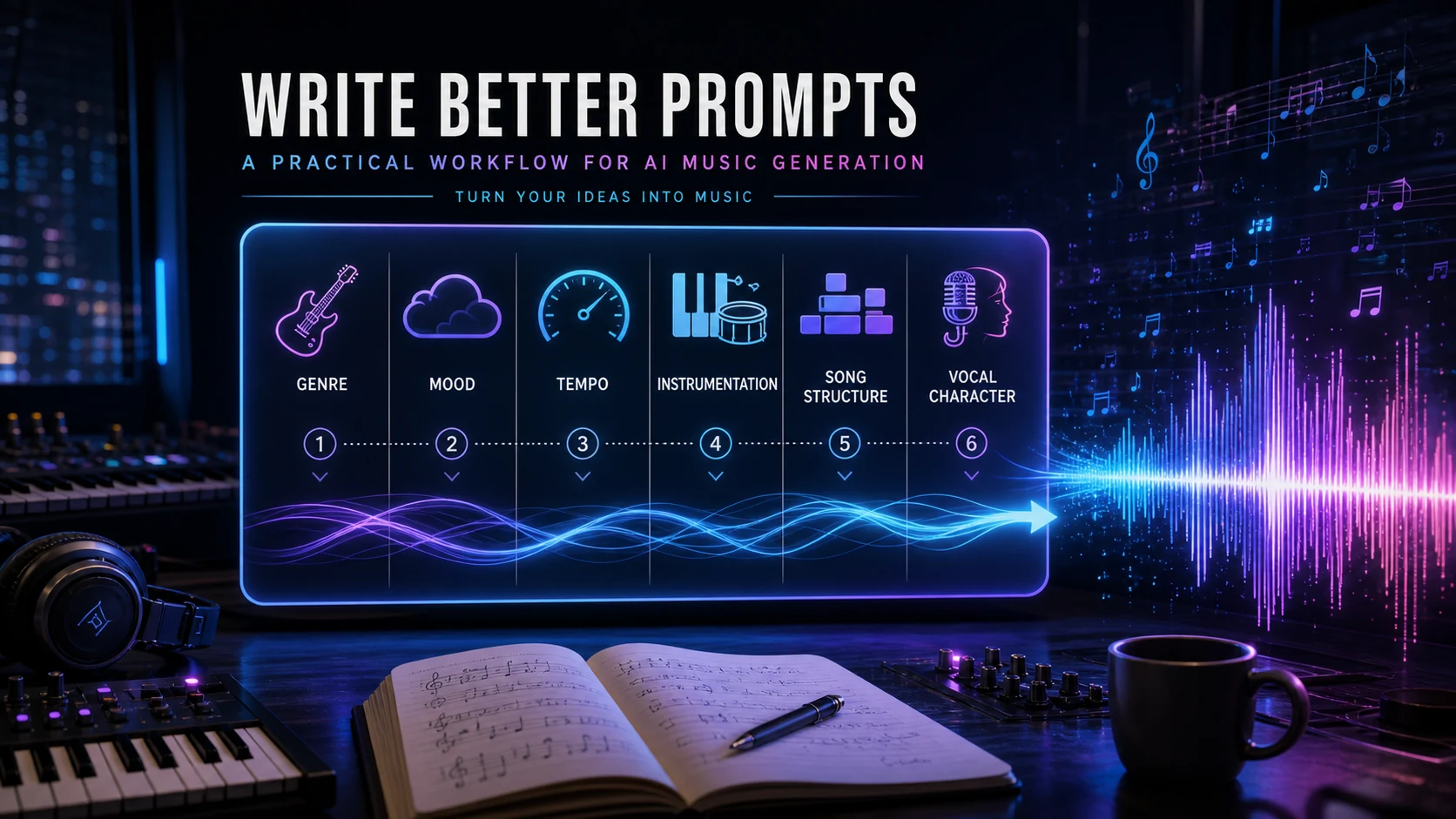
In the early 2020s, the interface changed as much as the model. A creator no longer needed to prepare a MIDI dataset or write code. A short text brief could describe genre, mood, instrumentation, vocal direction, tempo, or song structure, and the system could return an audio draft.
That is the point when AI music became a normal creator conversation rather than mostly a research subject. The important innovation was not only text input. It was the combination of an accessible interface, faster generation, longer outputs, and enough audio coherence to evaluate a musical direction.
Prompt tools also changed the skill required from the user. Earlier computer composition demanded programming and formal rules. Modern systems reward musical briefing: choosing the job, naming the arrangement, describing the groove, and deciding what to revise. The guide to writing prompts for Suno AI music shows how that newer interaction works in practice.
What changed for musicians and what did not
The history of AI music is not a straight line toward removing people. At every stage, the musician decides what the system is for.
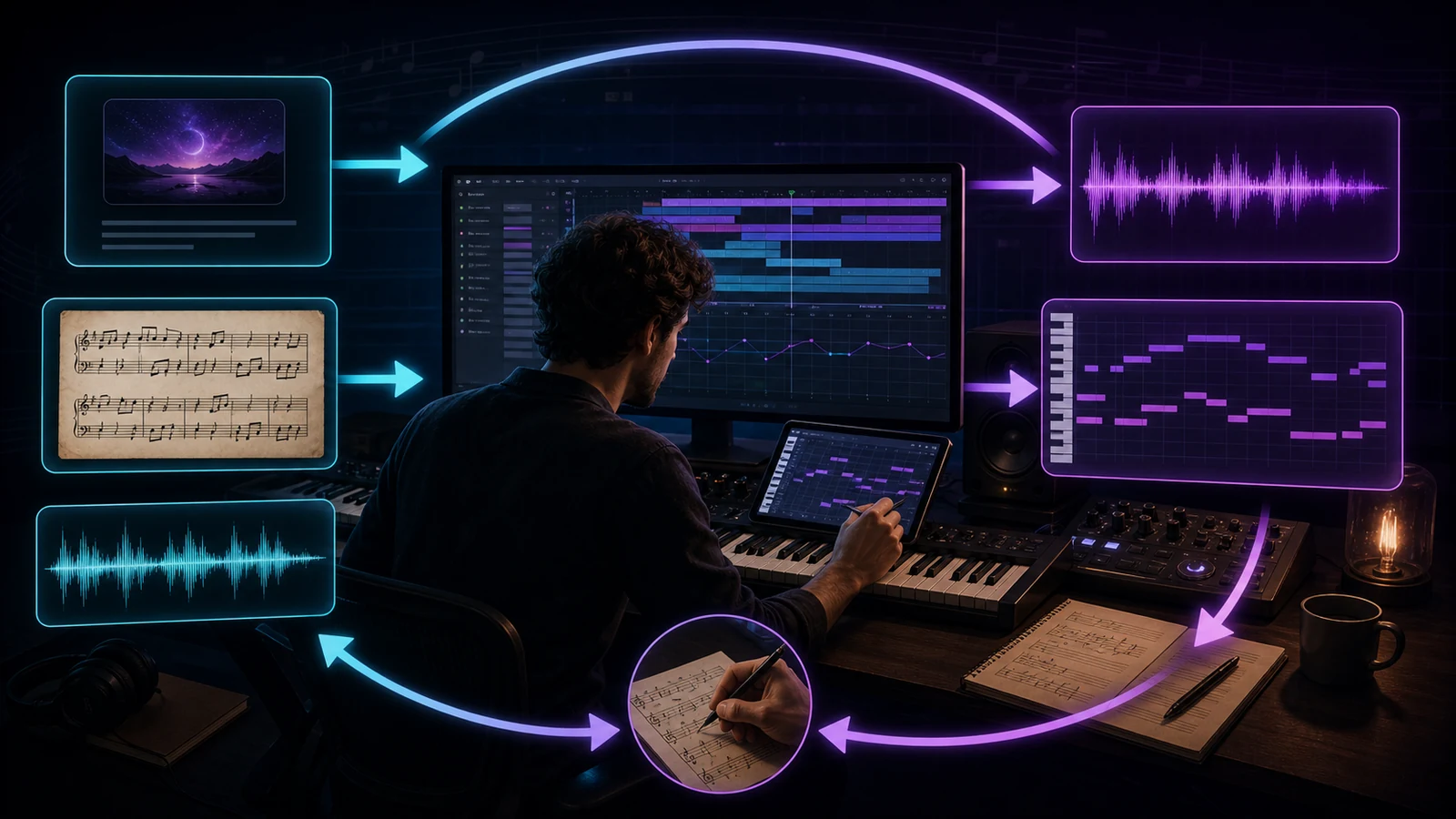
A modern creator might use a generator for a chorus sketch, convert an audio idea into MIDI, inspect a score, or test several arrangements before committing studio time. The machine changes the cost of the first pass. It does not settle whether the melody works, whether the form earns its length, or whether the result belongs in the project.
Use this historical pattern as a practical review loop:
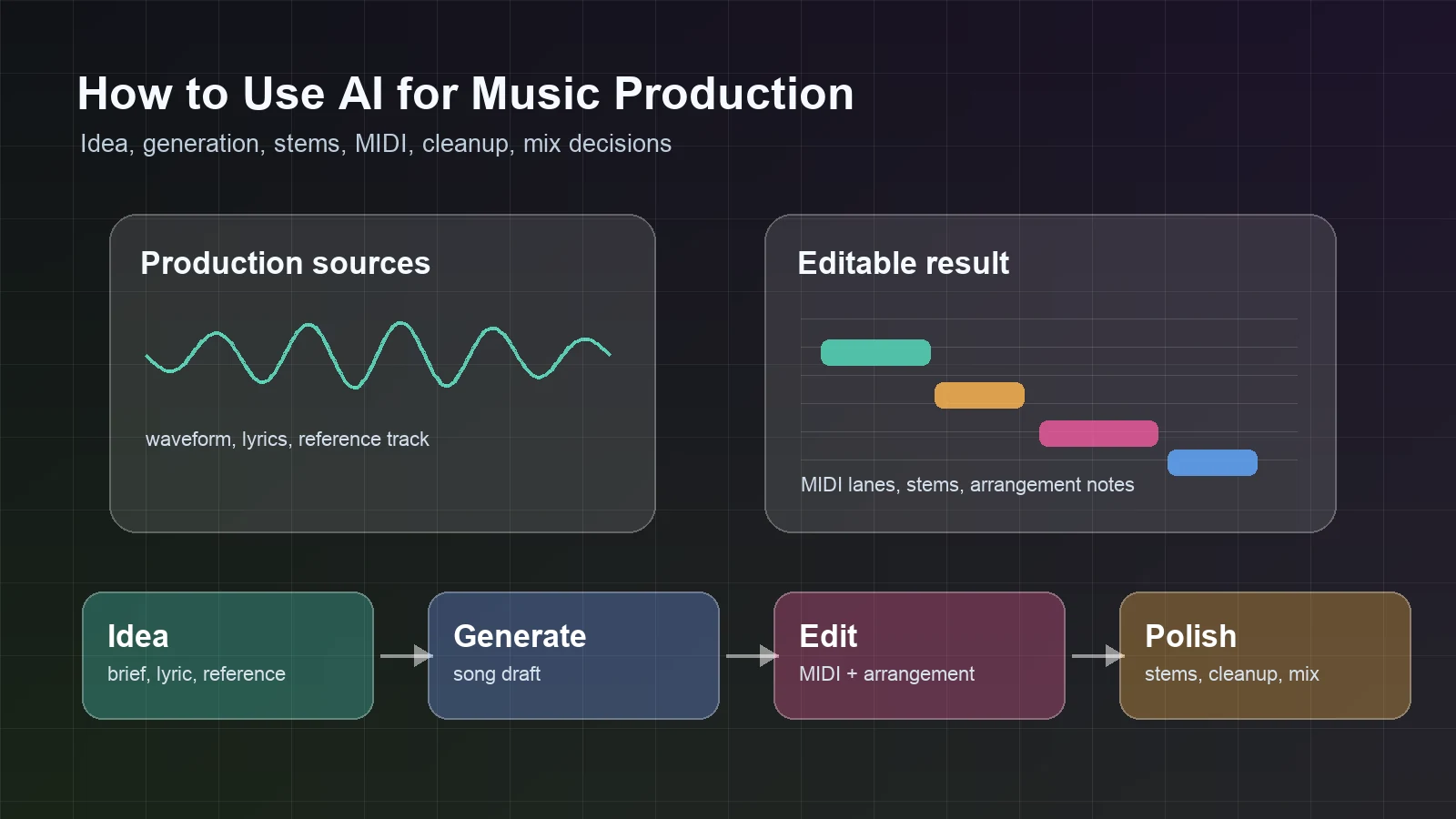
- Define the musical job. Decide whether you need a new idea, editable notes, finished audio, or analysis.
- Choose the right representation. MIDI and notation are easier to edit; audio is easier to audition as a production direction.
- Generate one bounded draft. Test a section, phrase, page, or short arrangement before scaling up.
- Review like a musician. Check form, rhythm, pitch, phrasing, texture, and emotional direction.
- Keep the useful decisions. Regenerate, edit, arrange, or discard based on the musical result rather than the novelty.
This is also the clearest answer to how AI is used in music now: it enters at a specific step, produces a draft or interpretation, and returns the work to a person.
Where Melogen fits on the timeline
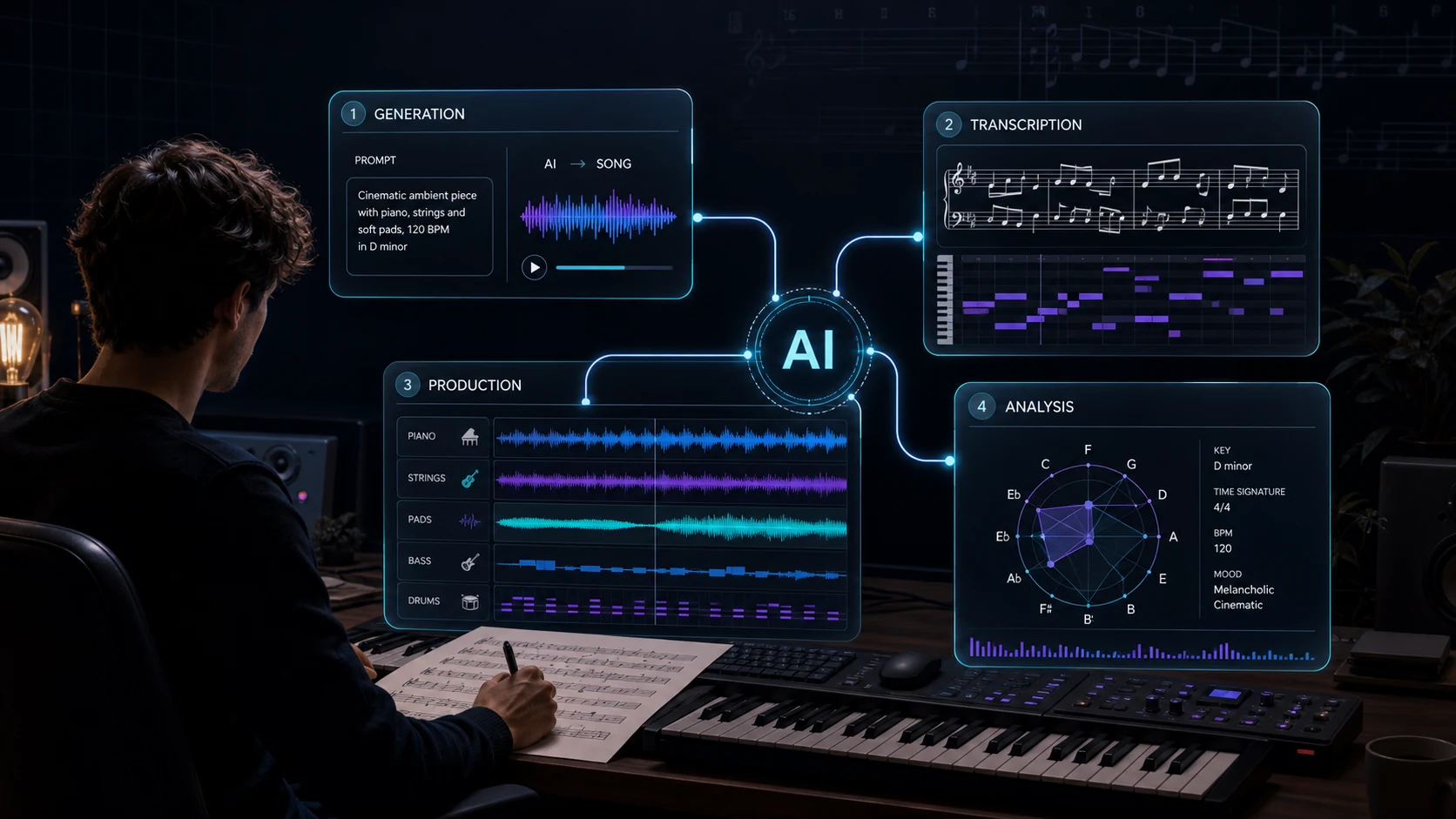
Melogen belongs to the modern workflow stage, where generation sits beside conversion, transcription, and analysis. Its Mureka route supports prompt-led music generation, while other Melogen tools handle audio-to-MIDI, score conversion, cleanup, and structural analysis.
The useful connection to history is not that one model replaces every earlier technique. It is that creators can now move between representations. A text direction can become an audio draft. Audio can become editable MIDI. A PDF score can become notation data. A finished score can become an analysis question.
Try a prompt-led music draft in Melogen
Use Mureka for an original song or instrumental starting point, then keep the musical decisions in your own review and editing loop.
FAQs
Was the ILLIAC Suite really AI music?
It is more precise to call it computer-assisted or algorithmic composition. It used programmed rules and probability rather than a trained neural model. It still belongs at the start of the AI music timeline because it demonstrated computer-generated compositional decisions in 1956.
What was the first AI-generated song?
There is no universally accepted first AI-generated song because the answer changes with the definition. Researchers produced computer-composed scores in the 1950s, later systems modeled musical style, neural networks generated symbolic music in the 2010s, and raw-audio models followed. A single "first song" hides those different milestones.
When did AI music become popular?
AI music became broadly visible in the early 2020s, when prompt-based tools made full-song generation accessible through consumer web interfaces. The research lineage is much older, but the interface and output quality changed who could try it.
Did MIDI create AI music?
No. MIDI is a representation for musical events, not an AI system. It became important because note events are easier for algorithms and learning systems to model, generate, and edit than finished audio waveforms.
Does modern AI music replace older computer-music methods?
No. Rule systems, MIDI, notation, signal processing, neural networks, and raw-audio generation remain useful for different jobs. A good workflow chooses the representation that leaves the musician with the right kind of control.
The practical takeaway
AI music started as a series of experiments, not a single product launch. Use 1956 as the practical historical starting point, the 2010s as the rise of modern machine-learning music systems, and the early 2020s as the point when prompt-to-song generation reached a broad creator audience.
The technology changed from rules to learned patterns, from symbolic notes to raw audio, and from research interfaces to everyday prompts. The durable workflow stayed surprisingly consistent: people define the musical problem, machines produce material, and musicians decide what deserves to become music.
About the author
Zhang Guo
Composer - AI Product Manager
AI product manager and digital marketing consultant with a background in music. Creativity is the bridge between rhythm and logic, where musical intuition and mathematical precision can coexist in every meaningful product decision.
Follow on X