Who Created Music Notation and Why It Changed Music
Learn who created music notation, why Guido d'Arezzo matters, and how staff notation still shapes MusicXML, MIDI, and score conversion today.
 Zhang Guo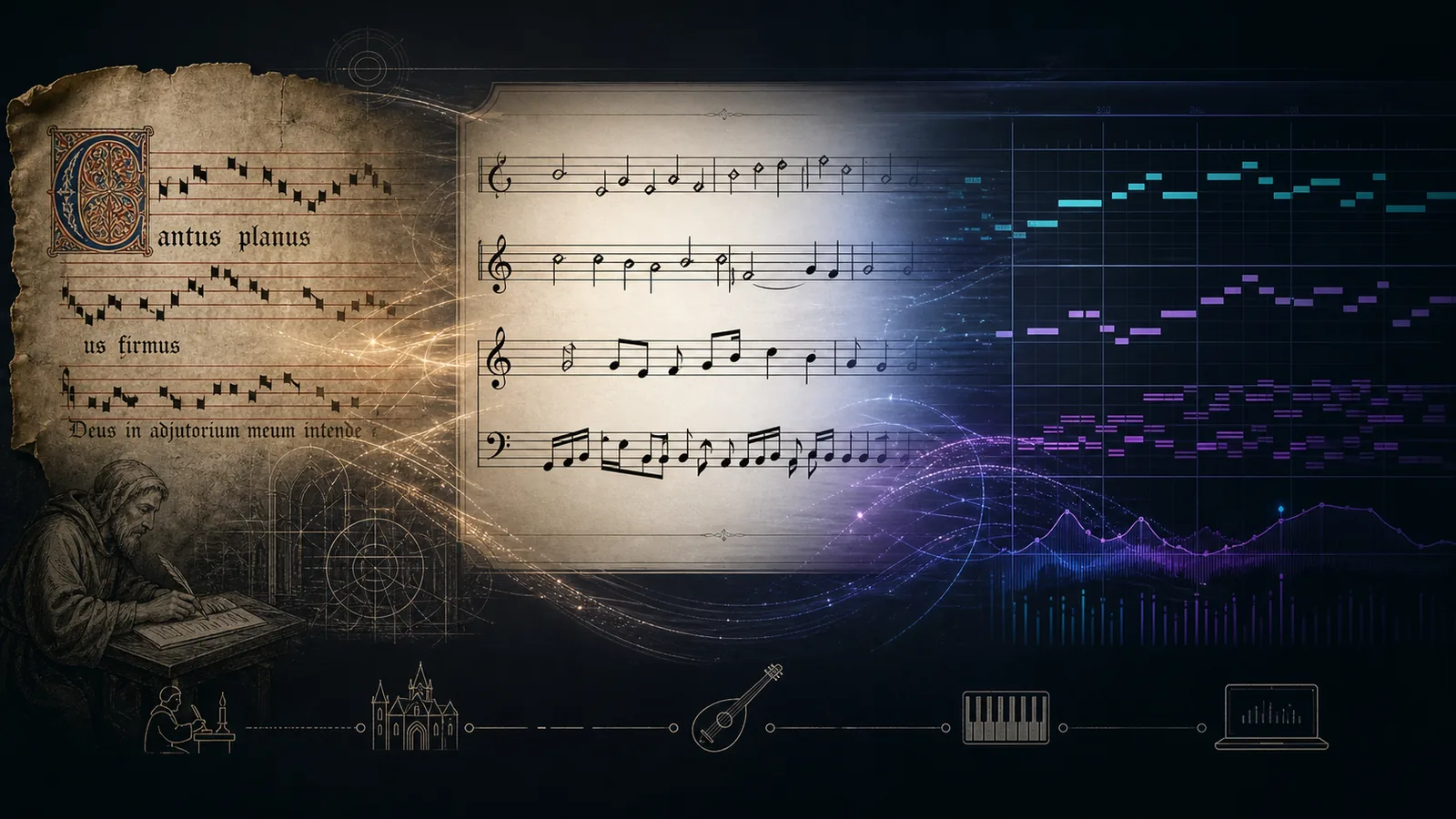
Turn a static score into editable MIDI
Contents
If you are asking who created music notation, the honest answer is that no single person invented the whole system. Written music grew over centuries as musicians looked for better ways to remember melodies, teach chant, coordinate ensembles, and preserve musical ideas beyond one teacher's memory.
The name most often attached to modern Western staff notation is Guido d'Arezzo, an Italian monk and music teacher from the 11th century. He did not create every note symbol we use today, but his staff-based teaching system made pitch much easier to read, learn, and transmit. That was the turning point that eventually led to the notation musicians still use in printed scores, MusicXML files, and score-to-MIDI workflows.
The Short Answer Is Guido d'Arezzo, With Context
Guido d'Arezzo is usually credited with one of the most important breakthroughs in music notation because he helped make pitch location visible. Earlier notation could guide memory, but it often assumed the singer already knew the chant. Guido's system used staff lines and teaching methods that let singers learn unfamiliar melodies more reliably.
That distinction matters. Saying "Guido created music notation" is useful shorthand, but it is not the full story. Many cultures wrote music or performance cues before the medieval staff. Medieval chant notation also existed before Guido. What Guido changed was the practical reading problem: he made the page a more precise pitch map.
Before Staff Notation, Marks Helped Memory
Early notation systems often acted like reminders. They could show contour, gesture, or performance direction, but they did not always give a complete modern-style answer to "which exact pitch, for how long, in which measure?"
In medieval chant, neumes were marks above words that helped singers remember melodic direction. A singer could see whether the line moved up, moved down, or repeated a gesture. That was helpful inside a living oral tradition, but it was not the same as handing a new singer a score and expecting accurate sight reading.
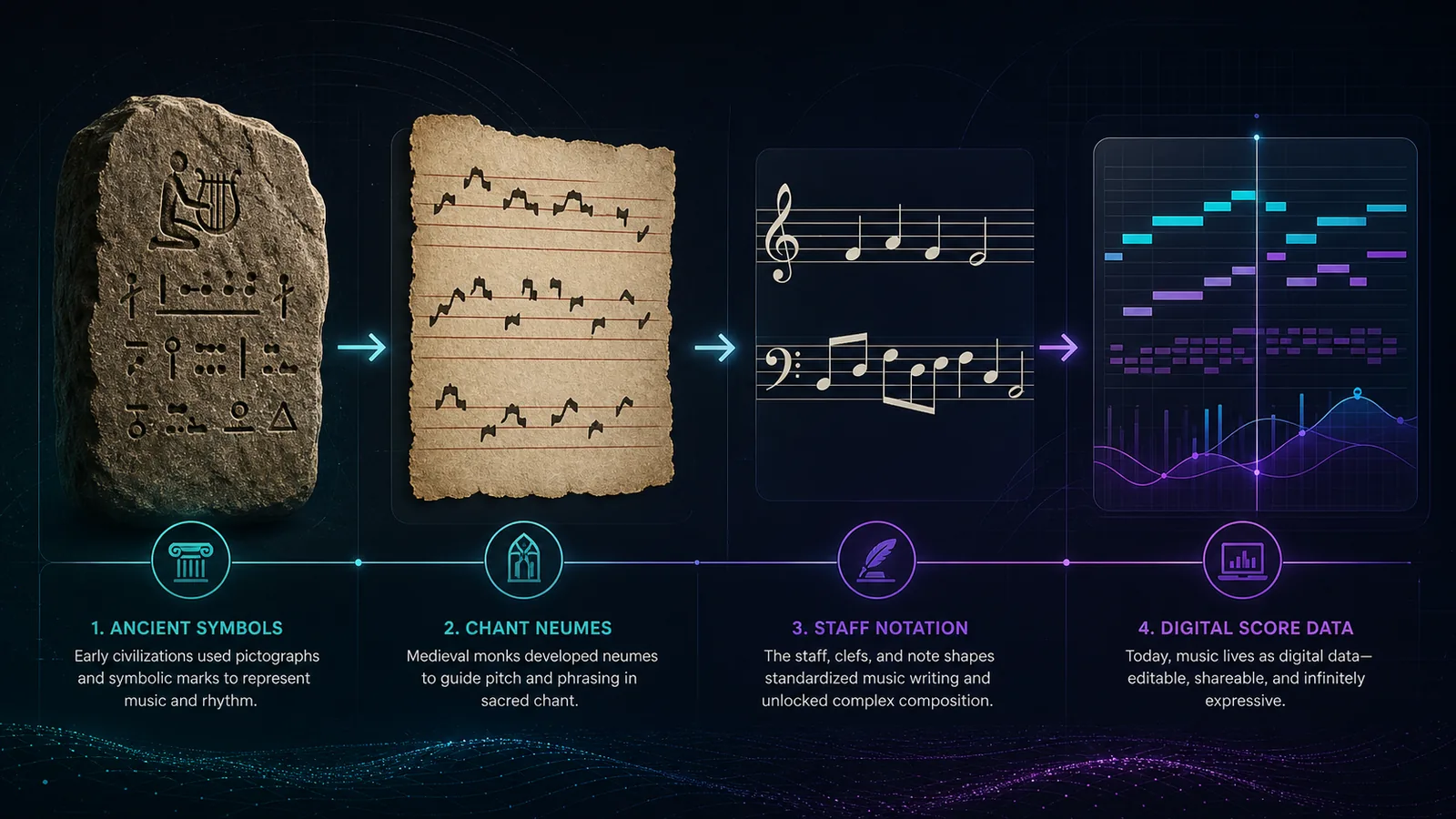
The shift toward lines was powerful because a line gives pitch a fixed visual address. Once pitch has a place on the page, teachers can point to it, students can compare it, and scribes can copy it with less ambiguity. That is why the staff became more than decoration. It became the coordinate system of written music.
If the staff itself feels abstract, the Melogen guide to the musical stave explains how five lines, spaces, clefs, and ledger lines turn noteheads into pitch information.
Why Guido's Staff Changed the Reading Problem
Guido's contribution is often summarized as staff notation, but the deeper achievement was instructional. He needed a way for singers to learn chant faster and with fewer errors. Staff lines solved one part of that problem because they anchored pitch. Solmization syllables solved another part because they gave singers a repeatable way to hear relationships between notes.
That made notation more independent from one local teacher. A written page could travel farther. A singer could learn more from the marks themselves. A choir could align around the same musical object instead of relying only on memory.
Here is the practical change:
| Before clearer staff notation | After staff-based pitch reading |
|---|---|
| Marks mostly reminded trained singers of a known melody | Staff position helped readers identify pitch more directly |
| Oral memory carried much of the musical detail | The page carried more of the musical instruction |
| Teaching depended heavily on local practice | A written score could be copied, taught, and compared more reliably |
| Melodic contour was easier than exact pitch | Pitch relationships became visible at a glance |
The modern score still adds many later layers: rhythm notation, bar lines, key signatures, dynamics, articulation, tempo marks, lyrics, and layout conventions. Guido's work did not complete that whole system. It made one central part of the system much more readable.
What Modern Notation Adds Beyond Pitch
Modern notation does more than place notes higher or lower. It organizes musical time, performance detail, and ensemble coordination.
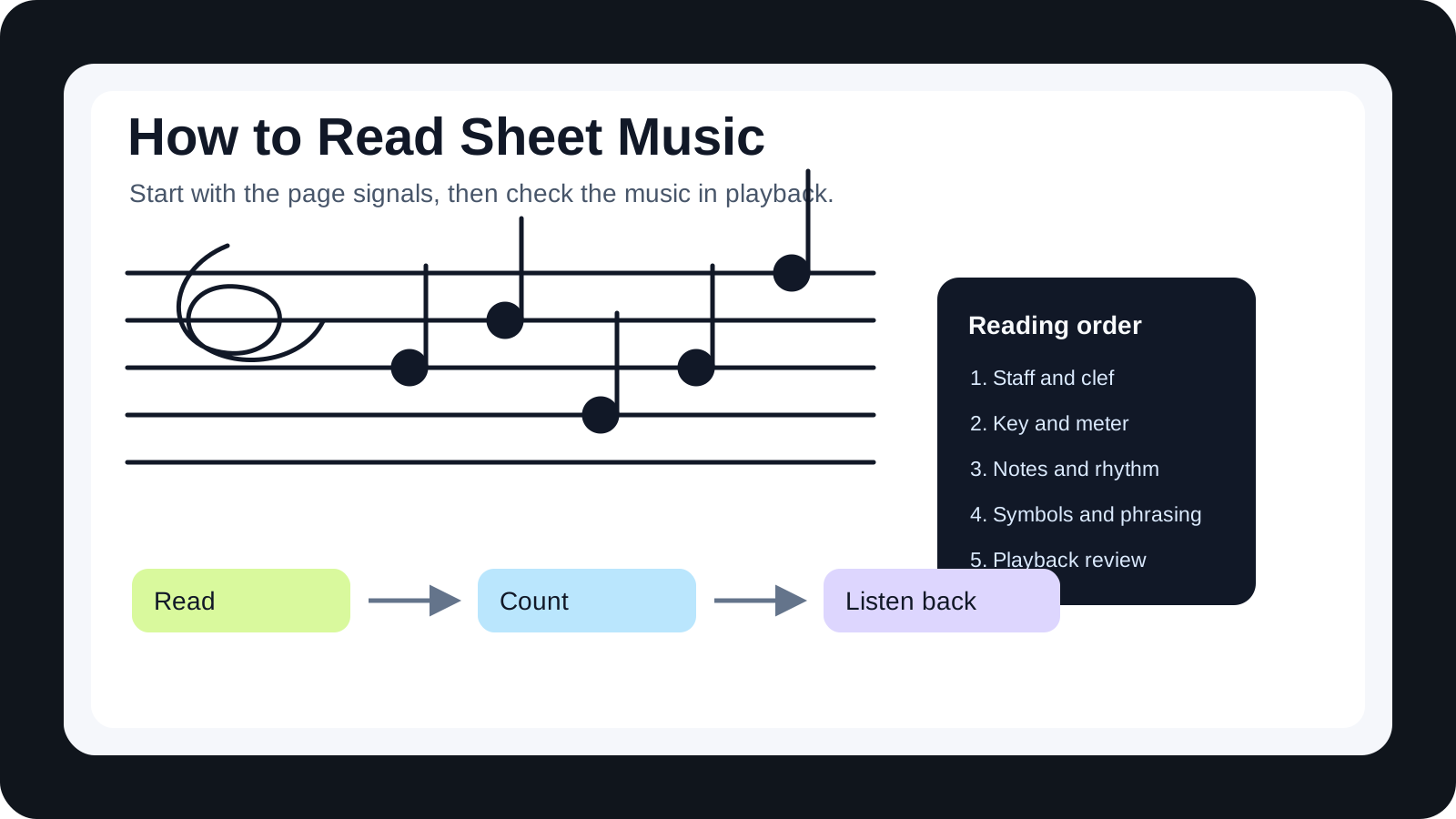
Read a score in layers:
| Layer | What it tells the musician | Why it matters |
|---|---|---|
| Staff and clef | Where pitches live | A notehead only has a stable pitch after the clef defines the map. |
| Rhythm values | How long notes and rests last | Pitch without time is not a performable phrase. |
| Meter and bar lines | How beats group | Musicians can count together and recover after mistakes. |
| Key signature and accidentals | Which notes are altered | The same staff position can change by key or local accidental. |
| Articulation and dynamics | How the sound should behave | The page carries expression, not just pitch data. |
| Layout and parts | Who plays what | Ensembles need readable separation between instruments and voices. |
That is why "music notation" is not just a historical curiosity. It is still the shared interface between composers, arrangers, performers, teachers, students, and notation software. A DAW piano roll can show performance data. A MusicXML file can preserve score structure. A printed score can guide rehearsal. They overlap, but they are not the same object.
For a beginner-friendly reading path, start with how to read sheet music. For file-format decisions, the MusicXML guide explains why notation-aware data is different from plain playback data.
Why Digital Music Still Depends on Notation
Digital music did not erase notation. It gave notation more destinations. A score can now become a PDF for reading, a MusicXML file for editing, a MIDI file for playback, or a DAW session for production. The hard part is choosing the right output.
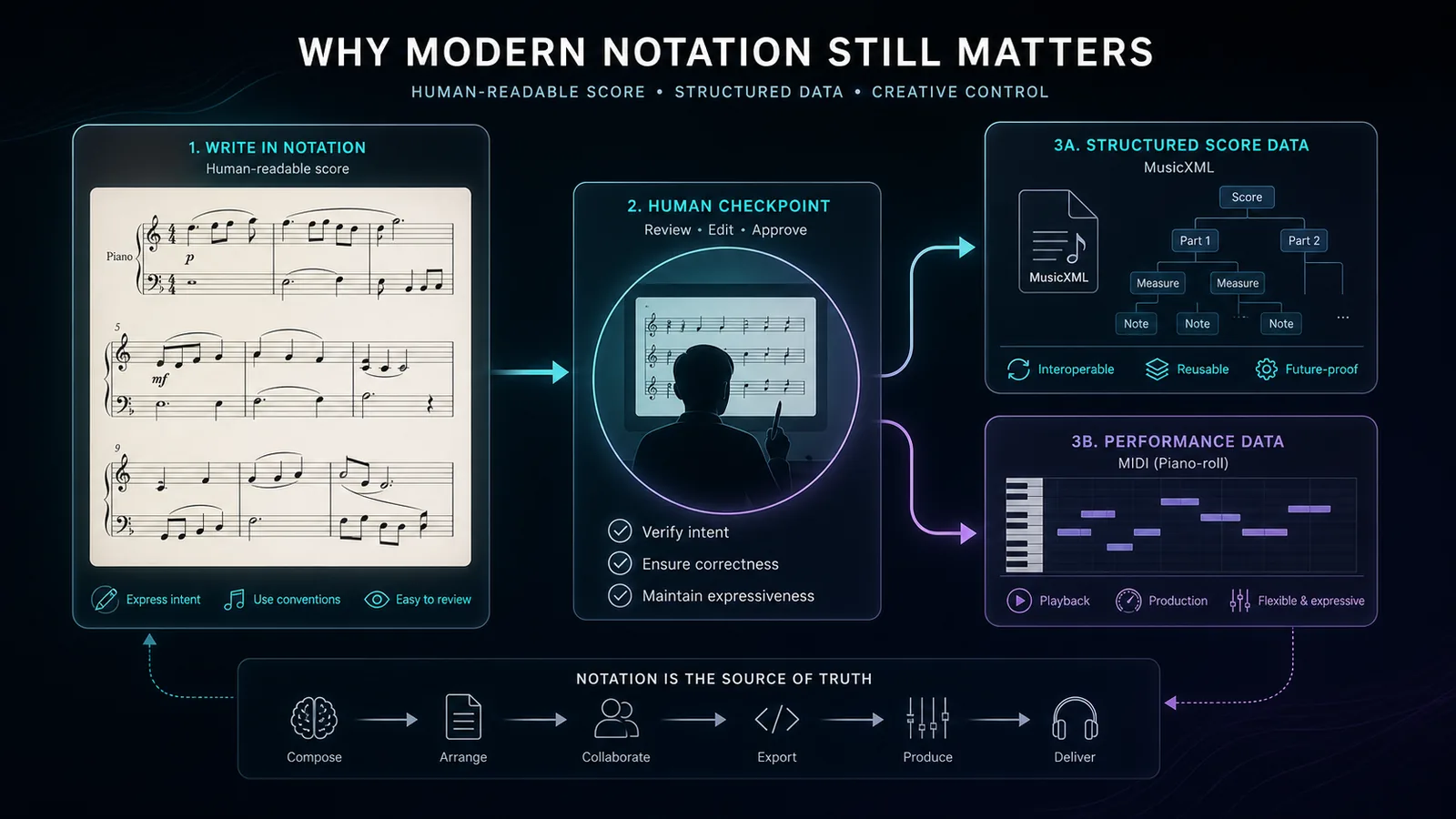
Use this decision table:
| Starting point | Best digital target | Why |
|---|---|---|
| A clean printed score or PDF | MusicXML when notation editing matters | Measures, staves, voices, clefs, and other score details can travel into notation software. |
| A score you mainly want to hear | MIDI | MIDI is practical for playback, DAW editing, and quick practice checks. |
| A scan with unclear notation | Clean the source first | OMR works from what it can see, so crooked or blurry notation creates cleanup later. |
| A historical or handwritten page | Human review plus a cautious conversion pass | The notation may not follow modern conventions cleanly enough for one-click conversion. |
This is the modern version of the old notation problem. The page still has to communicate musical intent clearly. The difference is that the reader may now be a musician, a notation editor, a DAW, or an OMR system.
Where Melogen Fits in the Modern Workflow
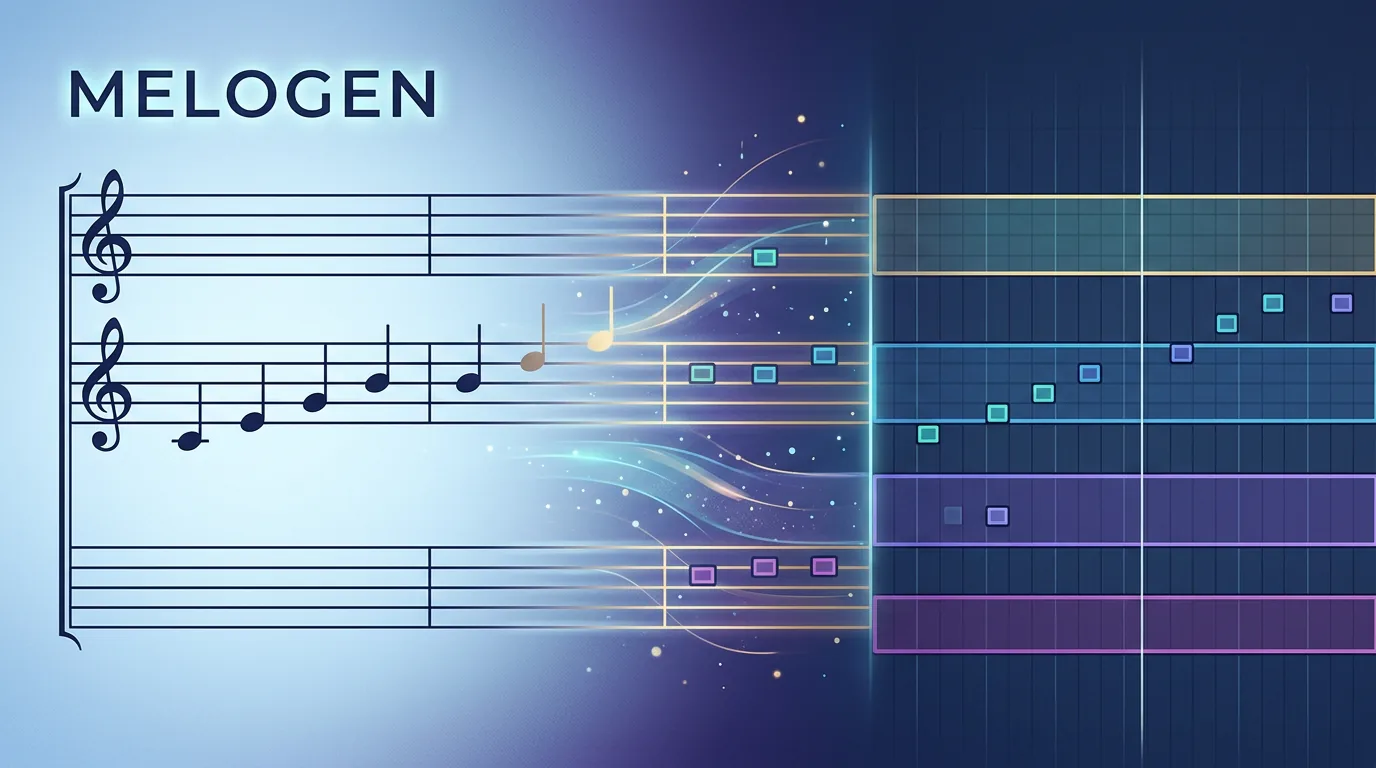
Melogen is useful after notation already exists on a page and you want a digital first pass. The local Sheet2MIDI product surface supports sheet music images and PDFs, including JPG, PNG, and PDF inputs, with MIDI output for editing or playback. The PDF to MusicXML route is the better fit when you need notation-aware editing in MuseScore, Dorico, Sibelius, Finale, or another score editor.
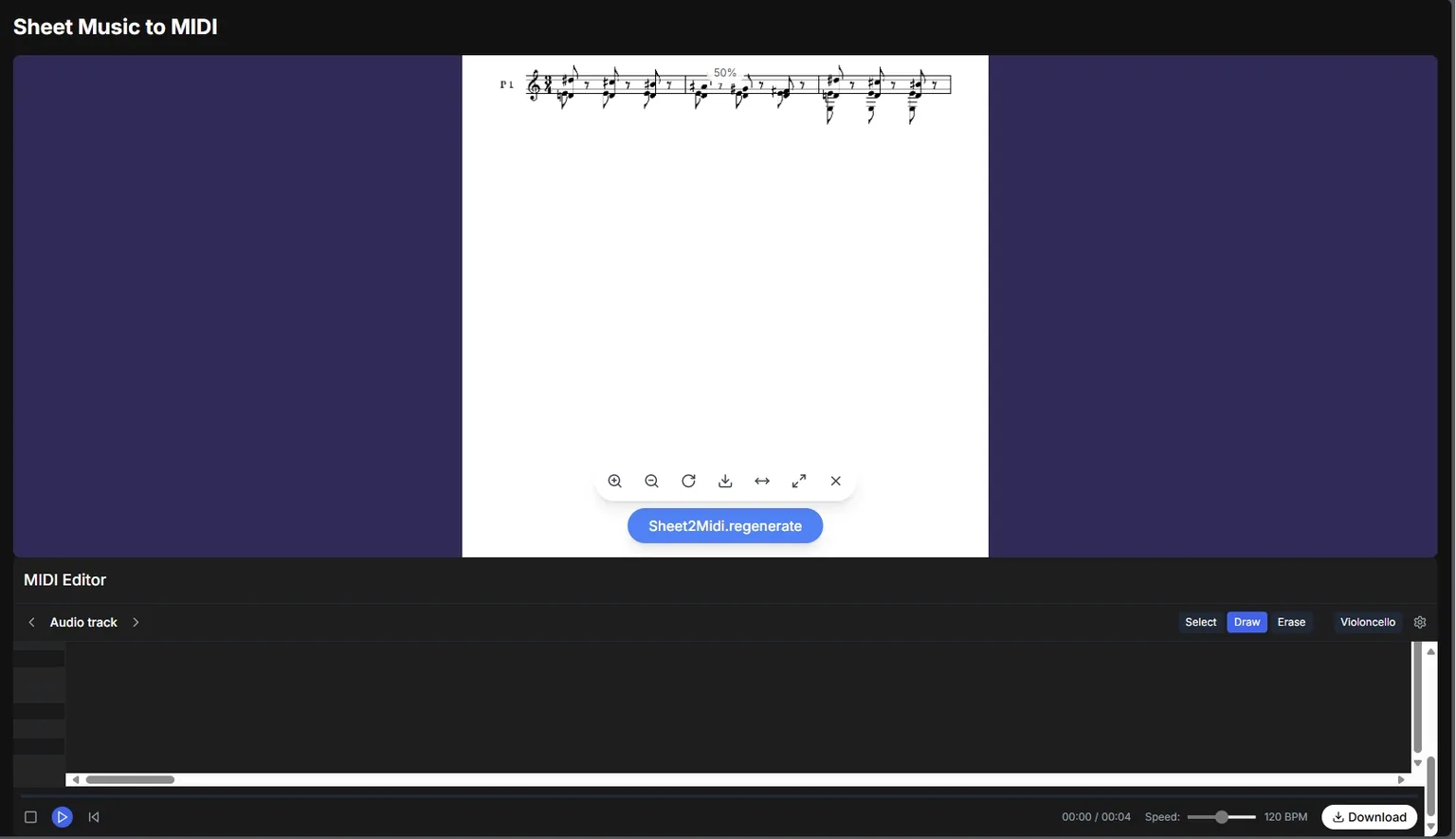
Use Melogen for practical tasks such as:
- turning a readable score into a MIDI reference
- checking whether a scanned page is clean enough to digitize
- moving a PDF score toward MusicXML cleanup
- creating a playback file before rehearsing or arranging
- comparing MIDI and MusicXML when you are unsure which output belongs downstream
The boundary is just as important. Melogen does not replace historical judgment, a teacher, or a musician's cleanup pass. It gives you a bridge from visible notation into editable digital music data, and then you still review the musical result.
Move from readable notation to editable music data
Use Melogen when you have a clear score image or PDF and want a first-pass MIDI or MusicXML file before musical cleanup.
FAQs
Did Guido d'Arezzo invent music notation?
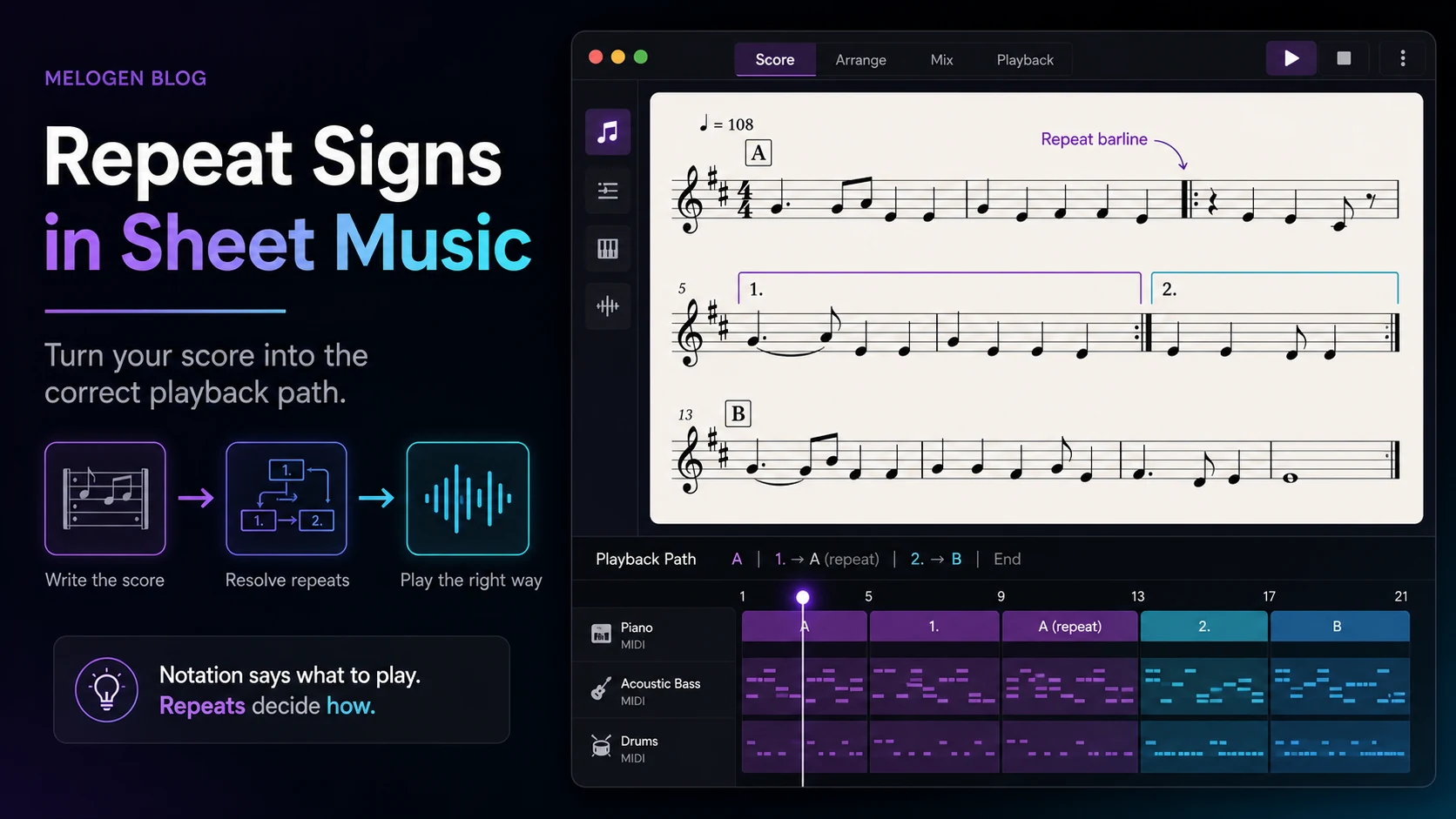
Guido d'Arezzo is the person most often credited with a major step toward modern Western staff notation. He did not invent every notation symbol, and he was not the first human to write musical cues. His importance is that his staff-based system made pitch easier to teach and read.
Was there music notation before Guido?
Yes. Earlier systems existed in several musical cultures, and medieval chant neumes were used before Guido. Many of those systems worked as memory aids or performance guides rather than complete modern scores.
Why do we use five staff lines today?
Five lines became a practical balance: enough vertical space for common pitch ranges, but still compact enough to read quickly. Clefs and ledger lines extend the system when music moves beyond the basic staff.
Is modern notation the same as MIDI?
No. Notation is a human-readable score system. MIDI is performance-style data for pitch, timing, velocity, and playback. MusicXML sits closer to notation because it can describe measures, parts, voices, clefs, and other score structure.
Can old notation be converted to MIDI automatically?
Sometimes, but the source has to be readable and close enough to modern notation for recognition tools to understand it. Historical manuscripts, unusual symbols, damaged scans, and handwritten pages usually need careful human review.
The Practical Takeaway
No single person created music notation from nothing. The system grew from memory marks, chant notation, staff lines, rhythmic symbols, and many later conventions. Guido d'Arezzo matters because he helped turn pitch into something a reader could locate on the page.
That idea still matters now. Whether you read a paper score, export MusicXML, or convert a scan into MIDI, notation is the bridge between musical intention and reusable music data. The better the notation communicates, the better the musician and the software can work with it.
About the author
Zhang Guo
Composer - AI Product Manager
AI product manager and digital marketing consultant with a background in music. Creativity is the bridge between rhythm and logic, where musical intuition and mathematical precision can coexist in every meaningful product decision.
Follow on X