How to Analyze a Song With a Listening Worksheet
Analyze a recording with timed listening passes, a reusable worksheet, and a worked example that turns observations into musical decisions.
 Zhang Guo
Turn a static score into editable MIDI
Contents
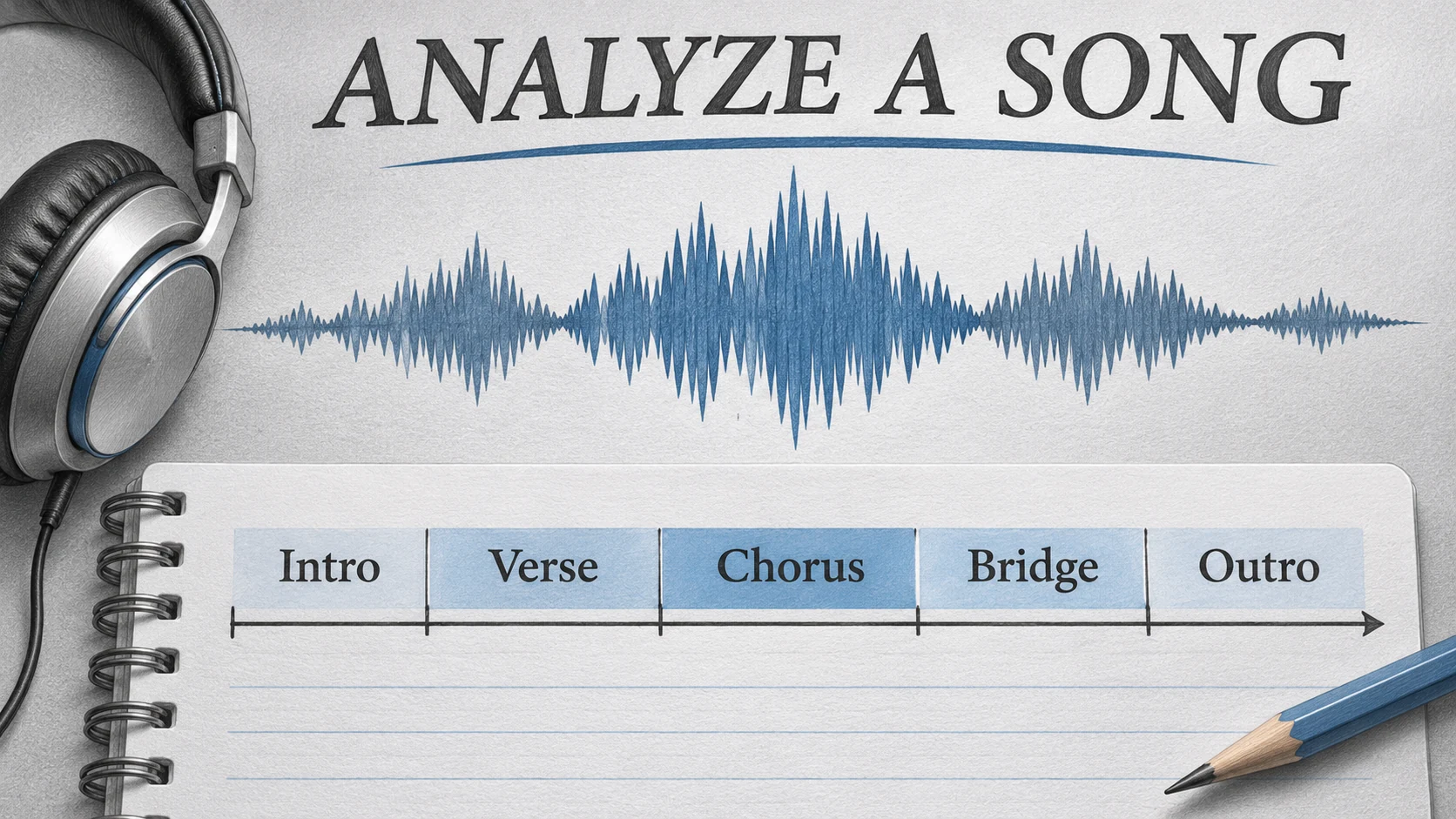
To analyze a song, listen in focused passes and write down when something happens, what you hear, and why it matters. Start with the recording rather than a list of theory terms. Your first useful result is a page of evidence you can return to during rehearsal, arranging, or class discussion.
You need the exact recording, a player that can repeat a short section, headphones, and somewhere to write timestamps. A keyboard helps with pitch questions, but you can finish a useful first analysis without identifying every chord.
Set one question before the first listen
Choose a question small enough to answer from the recording: Why does the chorus feel larger? How does the bass support the melody? What changes between the first and second verse? Write down the artist, track version, duration, and your question. A live performance and a studio mix may have different introductions, keys, and endings.
Listen once without pausing. Write a one-sentence impression, then leave it provisional. “The chorus feels urgent” is a starting question. “The chorus adds faster hi-hats and shorter vocal phrases” is evidence that can explain it.
The Association for Popular Music Education's song-analysis guidance connects preparation to tempo, meter, melody, texture, and harmony. The worksheet below turns those listening targets into a repeatable recording task.
Make three focused listening passes
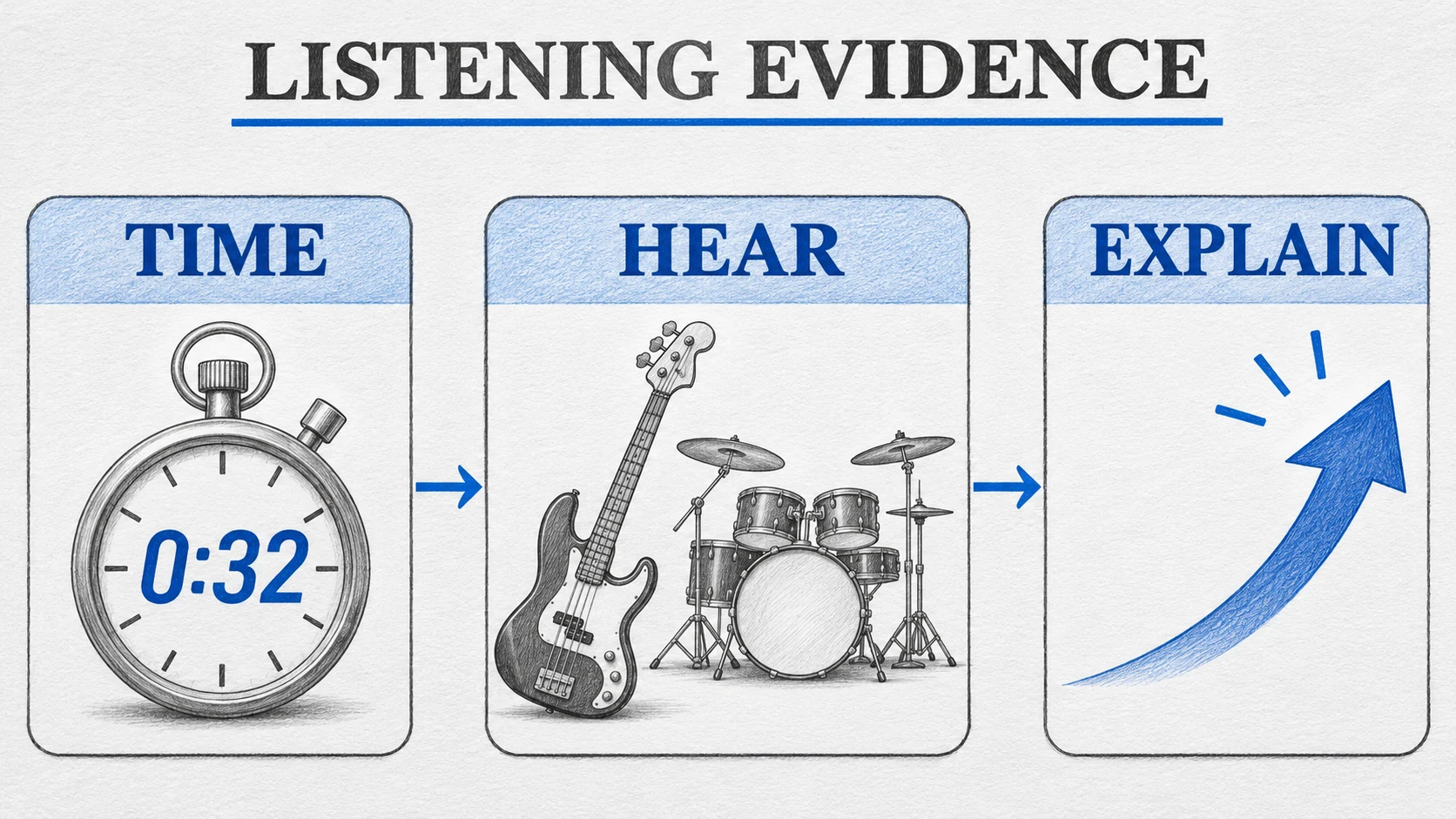
Pass one is time and rhythm. Tap along for several bars. Count where the strong beats fall. If you estimate tempo from 16 steady beats, measure the time from the first to the seventeenth tap: 16 beat intervals in 10 seconds gives 96 BPM. Check whether you are hearing the pulse at half or double that rate. Mark an estimate when the performance drifts.
Pass two is sound and pitch. Follow one role at a time: bass, chordal accompaniment, melody, then supporting voices. Describe a role before guessing an instrument. “Short low notes on each downbeat” is more reliable than naming a bass patch from a dense mix. Record uncertain chords as questions.
Pass three is change and meaning. Return to the biggest transitions. Compare the last two bars before a change with the first two after it. Count new layers, notice register and rhythm, and compare the lyric's viewpoint or repeated hook without copying the lyric into your notes.
Fill in the listening worksheet
Keep observation and interpretation in separate columns. A timestamp lets another listener check your reasoning; an instrument name or mood word alone does not.
| Time or bars | What I hear | What it does | Confidence or next check |
|---|---|---|---|
| Opening | Which sound starts and what pulse appears? | Establishes space, groove, or expectation | Is the first sound a pickup? |
| First vocal entry | Melody register, phrase length, accompaniment | Introduces the main viewpoint | Follow the bass separately |
| Main arrival | Added layers, changed rhythm, repeated hook | Creates lift or resolution | Compare with the preceding two bars |
| Contrasting passage | Removed parts, different texture or harmony | Resets attention or delays return | Does the harmony change too? |
| Ending | Cutoff, fade, repeated tag, final cadence | Closes the statement or leaves it open | Note the exact final event |
You do not need every row for every song. If there is no vocal, substitute the principal melody. If the song flows without repeated sections, describe each new event instead of forcing verse and chorus labels.
Work through an original 64-second example
Download our original 64-second listening sketch and the blank listening worksheet CSV. The synthesized example is in 4/4 at 120 BPM. Each bar lasts two seconds. Four eight-bar passages make 32 bars and 64 seconds. It uses piano-like tones, a lead synth, bass, harmony tones, and synthesized percussion; there is no singing.
The companion MIDI contains the four pitched parts. The WAV adds the synthesized drum pattern, so its timbres and percussion are the listening reference.
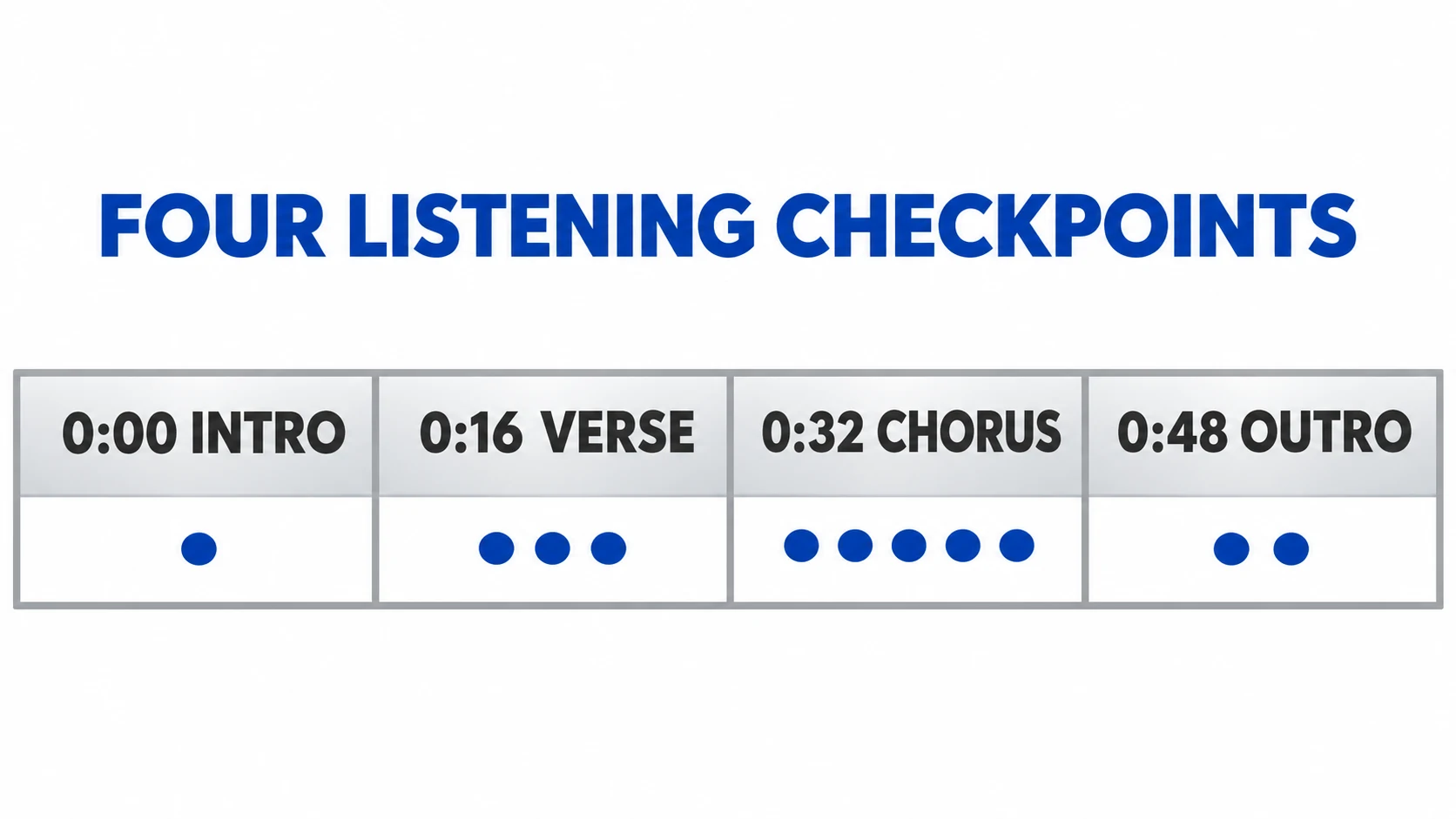
| Time | Arrangement in the sketch | Useful analysis sentence |
|---|---|---|
| 0:00–0:16 | Eight-bar piano-like arpeggio introduction | A repeated two-bar figure establishes the pulse with space around it. |
| 0:16–0:32 | Lead synth and bass enter over the same arpeggio | The lead melody changes the focus while the arpeggio provides continuity. |
| 0:32–0:48 | Synthesized drums and harmony tones enter; lead melody rises an octave | The arrival depends on density and register even though the piano figure repeats. |
| 0:48–1:04 | Lead synth, drums, and harmony stop; arpeggio and bass finish | Removing the upper layers releases the energy without a new harmonic idea. |
Now answer the original question, “Why does the main arrival feel larger?” The sketch adds synthesized drums, harmony tones, and a higher lead melody at 0:32. The repeated piano part makes the contrast audible. You can borrow that arranging principle in your own piece by changing density around a familiar idea.
Check pitch and form only where they answer the question
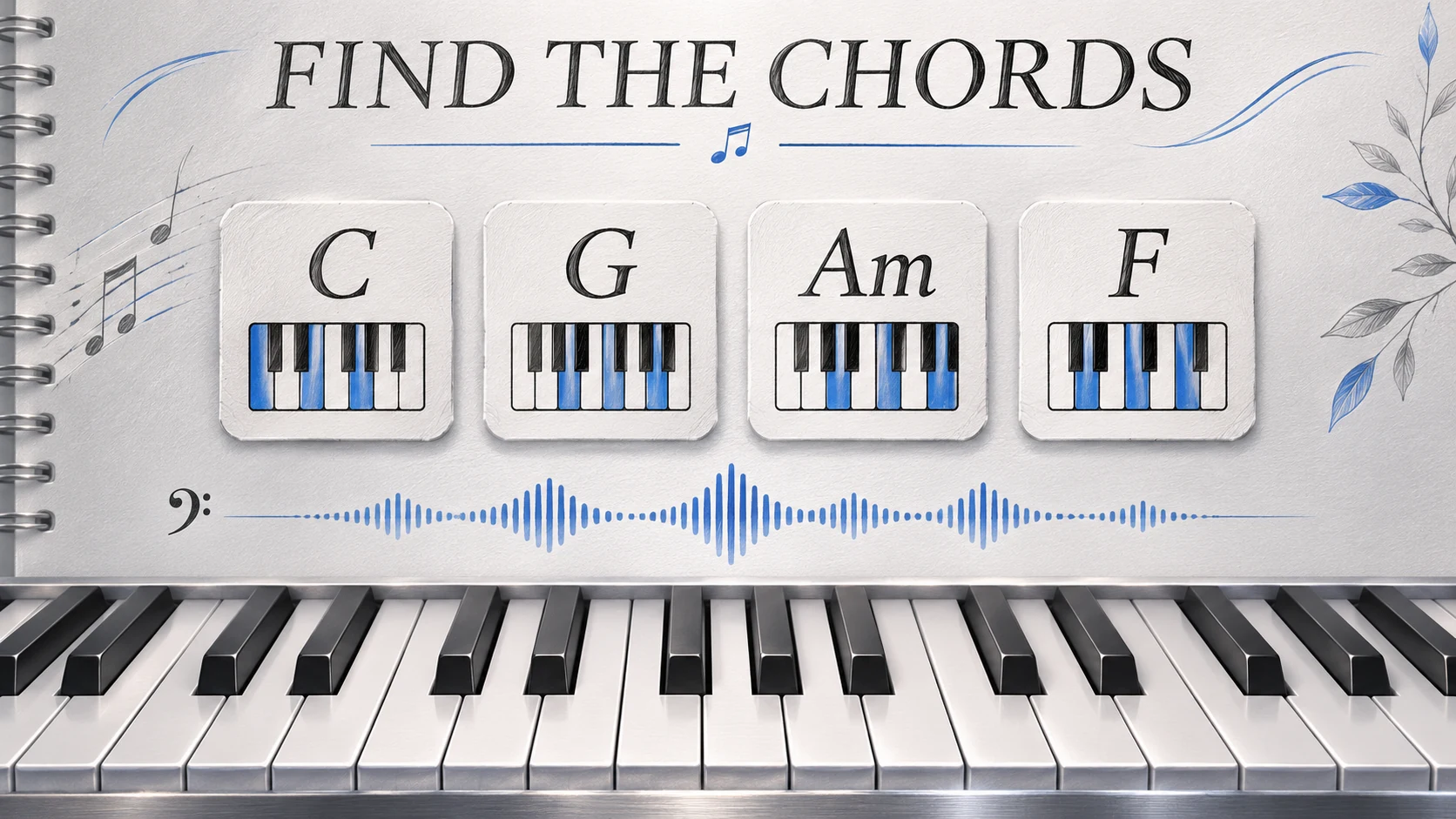
If the chorus lift might come from harmony, loop its first chord and the chord before it. Match bass notes, then test chord tones on an instrument. A bass note may be an inversion rather than a chord root. Leave an uncertain name unresolved until you can support it.
For a second reading of an audio recording, Melogen Song Analyzer accepts an audio upload or direct audio URL and provides a report workflow covering structure, harmony, mood, and instrumentation. Compare its estimated observations with your timestamped worksheet. Account access and credits apply to analysis, with preview and full-report access distinguished in the tool. A report is a starting point to verify, rather than a replacement for replaying the disputed passage.

Compare your listening notes with a song analysis
Use an audio recording in Melogen Song Analyzer, then verify its observations against your own timestamped worksheet.
For deeper formal terminology and score study, continue to musical structure analysis. Keep this worksheet focused on audible evidence rather than expanding every observation into a full theory essay.
Turn the notes into a useful result
Finish with a short paragraph: state your question, give two timed observations, explain their musical effect, and identify one uncertainty. For rehearsal, convert that into an action such as “leave space before the chorus entrance.” For songwriting, turn it into a test such as “repeat the accompaniment while adding a higher countermelody.”
Before you put the worksheet away, check that the version is named, timestamps can be found, observations are separated from guesses, and your conclusion answers the question you started with. That is a finished first analysis, even when a few chord symbols remain open.
About the author
Zhang Guo
Composer - AI Product Manager
AI product manager and digital marketing consultant with a background in music. Creativity is the bridge between rhythm and logic, where musical intuition and mathematical precision can coexist in every meaningful product decision.
Follow on X