How to Find the Chord Progression of a Song by Ear
Find a song’s chord progression with a timed bass-and-chord worksheet, an inversion example, and checks for uncertain chord changes.
 Zhang Guo
Turn a static score into editable MIDI
Contents
To find the chord progression of a song, first mark when the harmony changes, then identify the bass notes and test the notes above them. Write a short section as a timed chord chart before trying the entire track. Chord-recognition software can suggest names, but the recording and a playable chord are your checks.
Start with a repeated four- or eight-bar passage where the accompaniment is clear. Use a player with looping and a keyboard or guitar. Keep the original recording at its normal pitch when checking note names.
Mark the changes before naming chords
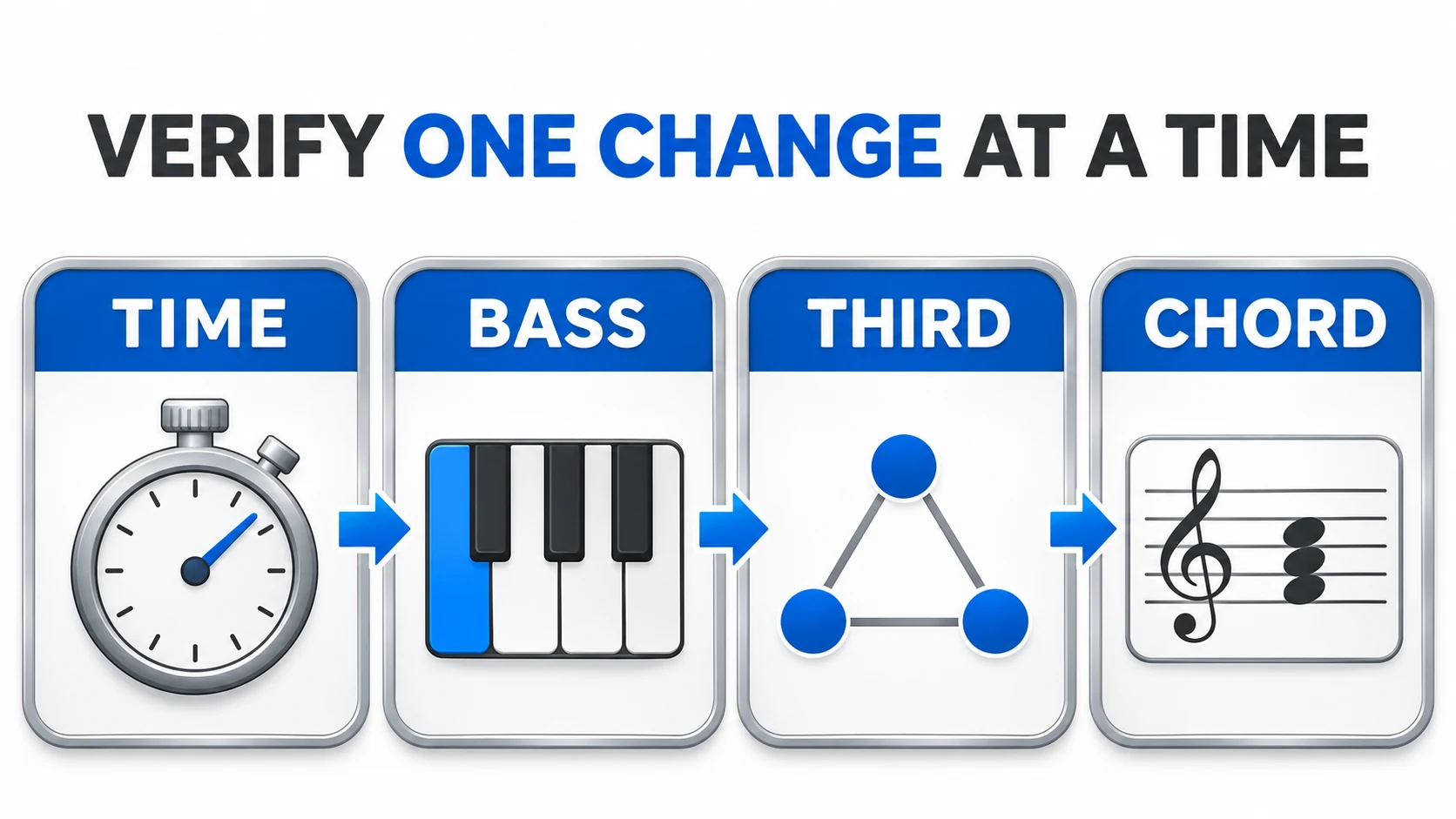
Count the pulse and draw a row of bars. Tap whenever the accompaniment seems to move. Some songs change once per bar, some twice, and some hold the same chord under a busy bass line. A passing bass note does not automatically mean a new chord.
Write a slash at each likely change and leave the chord blank. Replay the passage while counting. If a change consistently falls before the bar line, record that anticipation instead of moving it to beat one for neatness.
| Location | Bass note heard | Upper-note evidence | Candidate chord | Status |
|---|---|---|---|---|
| Bar 1 beat 1 | ? | ? | ? | Locate change |
| Bar 2 beat 1 | ? | ? | ? | Locate change |
| Bar 3 beat 1 | ? | ? | ? | Locate change |
| Bar 4 beat 1 | ? | ? | ? | Locate change |
This blank chart is useful even before you know the key. It separates rhythm errors from pitch errors.
Follow the bass, then test the third
Sing the sustained low note at each change and match it on your instrument. Move it up an octave if the recording is too low to sing. Ignore quick connecting notes initially; listen for the note that supports the chord.
Next, try a major and minor triad on the likely root. The third makes this comparison concrete: C major contains E, while C minor contains E-flat. Play quietly with the recording and listen for a stable fit rather than choosing the chord that sounds familiar on its own.
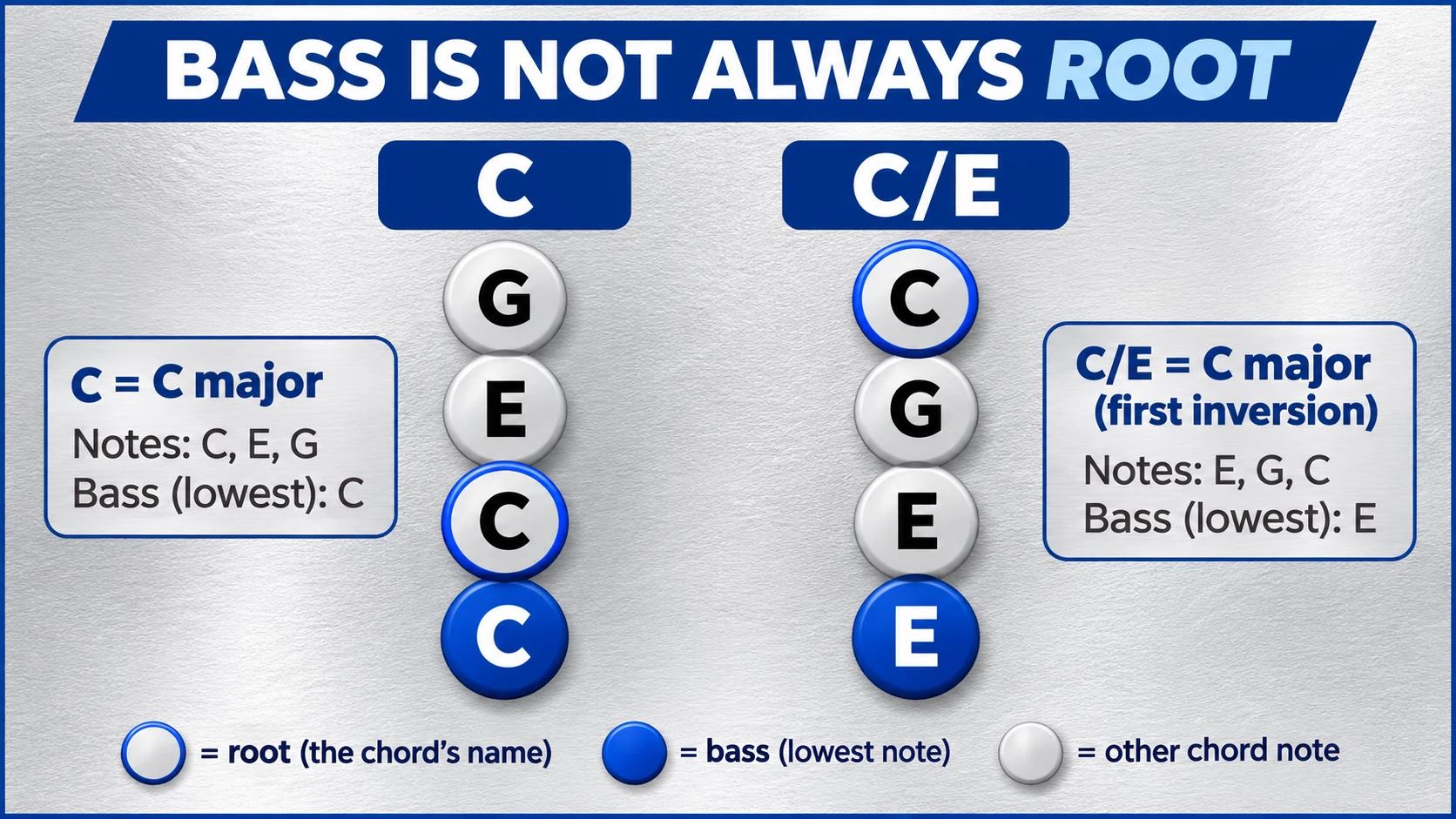
Open Music Theory's triad lesson explains the root, third, and fifth and how inversions retain chord identity. That distinction matters because the lowest note is not always the root.
If neither triad fits, check whether you found the wrong root before adding extensions. A suspended chord may omit the third; a power chord may provide only root and fifth. Use a partial label such as C5 or C? when that is all the evidence supports.
Solve the inversion trap with an original example
Listen to our original four-bar inversion exercise, or open its editable MIDI. It lasts eight seconds at 120 BPM, with one chord every two seconds.
Here is the four-bar teaching progression in C major. Play each collection for four beats with the listed lowest note. Then hide the chord-name column and identify it by ear. This example is an exercise, not a transcription of a released song.
| Bar | Lowest note | Other notes | Chord name | Why |
|---|---|---|---|---|
| 1 | C | E, G | C | C is both root and bass |
| 2 | B | D, G | G/B | G–B–D forms G major; B is in the bass |
| 3 | A | C, E | Am | A–C–E forms a minor triad |
| 4 | E | G, C | C/E | C–E–G is still C major, now over E |
The bass line is C–B–A–E. Calling every bass note a root would turn bar 2 into a B chord and bar 4 into an E chord. Testing the upper notes exposes both errors. With C as the local tonic, the progression is I–V6–vi–I6; in a practical chord chart, C–G/B–Am–C/E communicates the bass more directly.
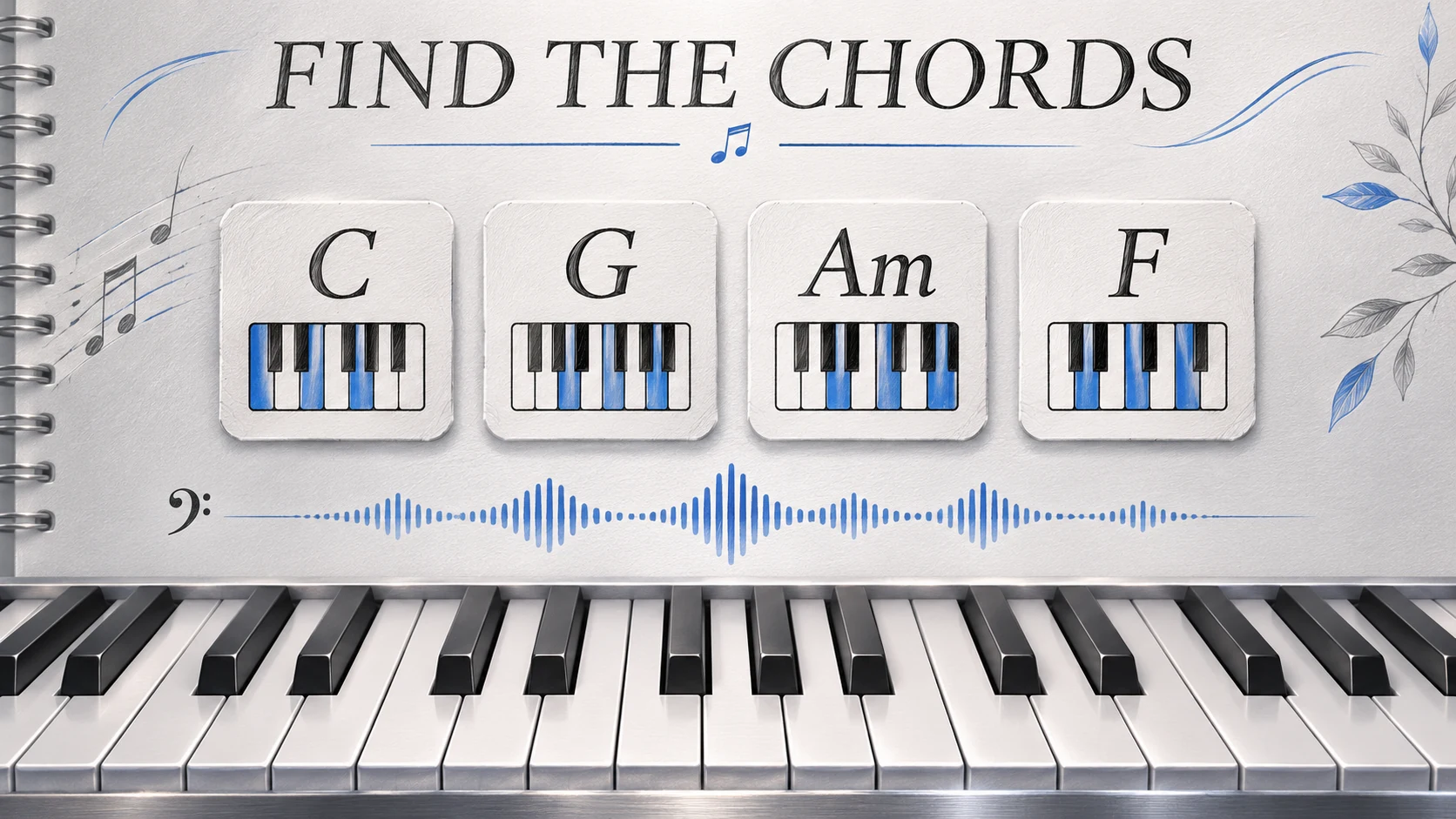
Repeat the exercise with C–G–Am–F in root position. Both examples begin similarly, but their last chords differ. The point is to verify the actual last chord rather than finishing the most familiar loop from memory.
Use the key as a hypothesis
Look for a note or chord that feels like home at a stable ending. Then check whether nearby chords support that key. In C major, C, Dm, Em, F, G, and Am are plausible starting candidates; the table of common guitar chord progressions helps with this vocabulary.
Keep listening when a chord falls outside the first key guess. Borrowed chords, secondary dominants, modal passages, and key changes are normal musical possibilities. Do not replace an audible major chord with a minor one just because your scale chart expects it.
Also check the instrument's setup. A guitarist using a capo may name shapes rather than sounding chords. A slowed recording may change pitch if the player does not preserve it. Label whether your chart uses concert pitch or shapes.
Check an automatic chord chart instead of copying it
A detector is useful for locating candidate changes. Check one difficult bar at a time: does the chord arrive at the right moment, does its bass agree, and do its third and seventh clash with the recording? A very brief label may describe a passing tone rather than a useful accompaniment change.
If the voice hides the accompaniment, Melogen's vocal remover can separate vocals, bass, drums, and other stems for closer listening. Separation can also smear notes, so return to the full mix before accepting a chord. It supplies a listening aid here, not a verified chord chart.

Finish with a playable section chart
Play your chart against the original for two complete loops. Check transitions as carefully as held chords. Add beat positions for early changes, slash bass notes that affect the arrangement, and extensions only when they matter to the sound.
Your section is ready when another musician can follow its timing and hear the same harmonic direction. Save unresolved moments with timestamps. Then repeat the process on the next section instead of assuming that the verse and chorus share the same loop.
About the author
Zhang Guo
Composer - AI Product Manager
AI product manager and digital marketing consultant with a background in music. Creativity is the bridge between rhythm and logic, where musical intuition and mathematical precision can coexist in every meaningful product decision.
Follow on X