How to Read Bass Guitar Sheet Music and Play the Line
Find the four open strings on the bass staff, choose frets for a written line, and play a one-bar groove with a rest on beat four.
 Zhang Guo
Turn a static score into editable MIDI
Contents
To learn how to read bass guitar sheet music, find an open string on the bass staff, name the next pitch, and decide which string puts it within reach. Then count how long to let it ring. Try the one-bar line below. The rest at the end matters just as much as the first note.
Locate the four open strings on the bass staff
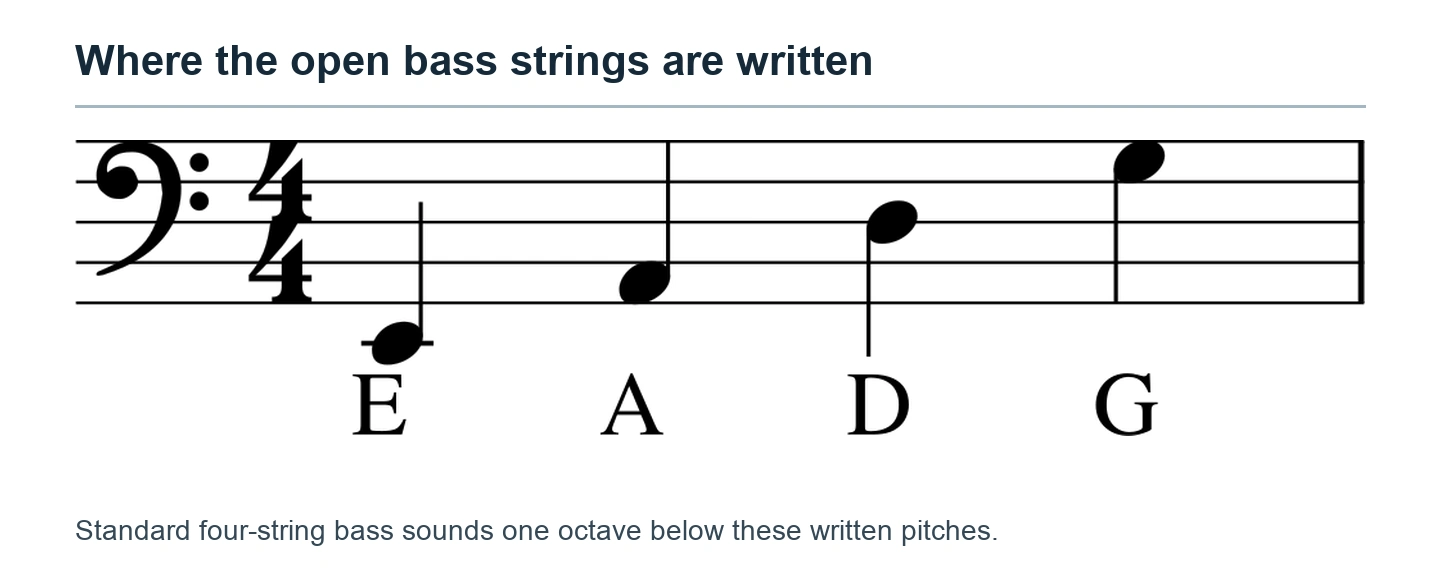
A conventional four-string bass part uses bass clef and is written one octave above its sounding pitch. In standard tuning the open strings sound E1, A1, D2 and G2. In a bass guitar part they are normally written E2, A2, D3 and G3. If a piano player reads the same written notes at concert pitch, the piano will sound an octave higher. Check the part label when reading an arrangement supplied for several instruments.
| String from thickest to thinnest | Written note | Find it on the staff |
|---|---|---|
| 4, E string | E2 | First ledger line below the staff |
| 3, A string | A2 | Bottom space |
| 2, D string | D3 | Middle line |
| 1, G string | G3 | Top space |
Play the notes slowly from left to right while pointing to each head. Next, cover the labels and try the pair A–D. Your eyes move from a space to a line, and your hand crosses from the third string to the second. That small motion is a useful reference when the next line gets busy.
Choose frets for an actual line
This exercise has no sharps or flats. Read the noteheads as A2, C3, D3, E3. Start from the open A string. C is three frets above A, so use fret 3 on that same string. For D, you can either move to fret 5 on A or cross to the open D string. Both give the same pitch.
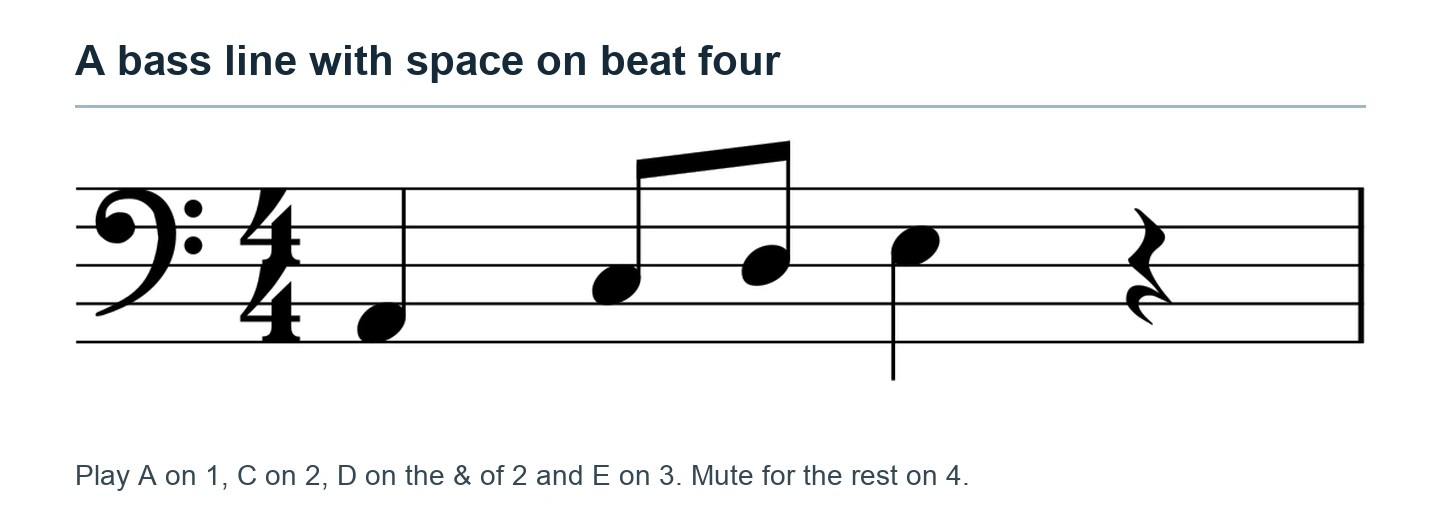
Try open A, A-string fret 3, open D, D-string fret 2. The open D lets your fretting hand stay near the second and third frets. On a second pass, try the D at fret 5 on A. Listen to how the two versions of D have slightly different colors. The staff specifies the pitch. Unless the part supplies a string or fingering, that choice belongs to you.
If your page instead shows four lines with numbers on them, each number gives a fret directly. The bass tab guide uses that layout. On the five-line staff here, the numbers you might pencil above a note are optional reminders.
Keep the rest inside the groove
Count one, two-and, three, four. A starts on one. The two beamed notes divide beat two into equal halves, C on “two” and D on “and.” E lands on three. Stop its sound when beat four begins, then leave the next beat clear before returning to A.
Play the rhythm once on the open A string so you can hear the silence. Add the pitches on your next pass. If the loop feels like a three-beat riff, tap your foot on four while the strings are silent.
Read the next line with fewer penciled notes
Find the first pitch relative to an open string, then look at the direction of travel. A move from one line to the neighboring space is one letter name up or down. The key signature and accidentals tell you which of those letters are sharp or flat. Count the bar before picking a fingering so a long note can give you time to shift.
When a note sounds wrong, try three checks in order. Say its written letter name, compare it with a nearby open string, and clap the attack on its intended beat. That separates a staff-reading error from a string-choice or timing error.
A clean PDF of a bass part can also provide a MIDI reference through Melogen Sheet2MIDI. Compare the converted first note with the open A or E of your bass before relying on playback from a notation editor. The octave convention and instrument setting both affect what you hear.

Check the rhythm of your printed bass line
Convert a short score into a MIDI reference, then compare the first note and the rest lengths with your bass.
About the author
Zhang Guo
Composer - AI Product Manager
AI product manager and digital marketing consultant with a background in music. Creativity is the bridge between rhythm and logic, where musical intuition and mathematical precision can coexist in every meaningful product decision.
Follow on X