How to Read Ukulele Sheet Music With High or Low G
Read a short ukulele melody from a treble staff, choose the right G for your tuning, and recognize when a page gives chord shapes or tab.
 Zhang Guo

Turn a static score into editable MIDI
Contents
If you're learning how to read ukulele sheet music, first identify what the page gives you. A five-line treble staff gives you pitches and timing. Four horizontal lines with fret numbers give you tablature. A small chord box shows a shape you can strum. These can appear together, but a chord box above a melody does not tell you where to play every melody note.
Match the page to the part you want to play
| What you see | What to read | What you can decide |
|---|---|---|
| Noteheads on a treble staff | Pitch, beat and duration | Where that pitch is most convenient on your uke |
| Four lines with fret numbers | The string and fret for each note | Timing from rhythmic stems, an aligned staff or a recording |
| A chord name and a grid | Finger placement for that chord | Strumming rhythm from the chart or accompaniment pattern |
If the page has lyrics and chord symbols but no melody staff, it may be an accompaniment chart. Strum the chord at each change and sing the melody separately. If you want to pick a tune, look for written melody notes or a tab that actually spells it out. For strum directions, the strumming pattern guide explains how to keep the down-and-up motion even.
Place the open strings in the right octave
On a common high-G soprano, concert or tenor ukulele, strings 4, 3, 2, 1 are tuned G4, C4, E4, A4. The fourth string is higher than the third. This reentrant tuning is the reason a row of notes going up the staff does not always move steadily across the strings. A low-G setup lowers only that fourth string to G3. Baritone ukuleles are commonly tuned differently, so check your instrument before applying this map.
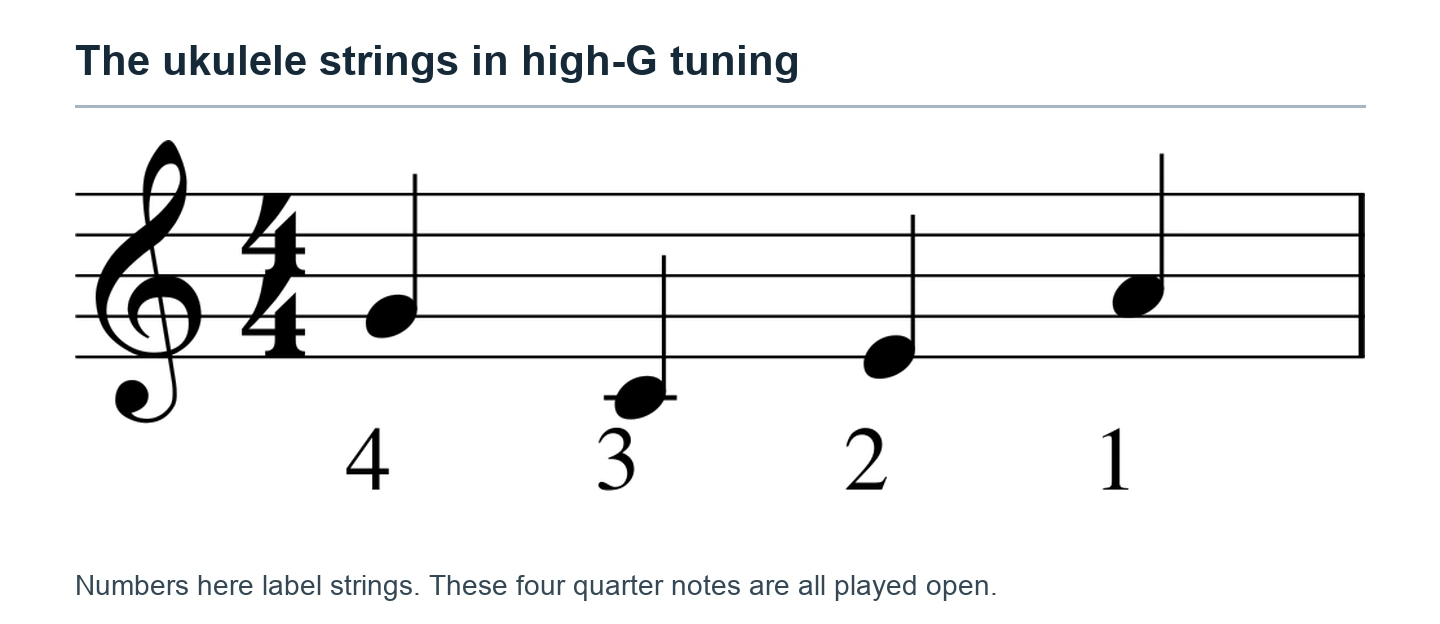
Middle C, C4, sits on the first ledger line below the treble staff. E4 sits on the bottom line and G4 on the second line from the bottom. A4 occupies the space directly above that G. Play open C, then open E, then E-string fret 3. The third note is G4. On a high-G uke it also matches the open fourth string.
Pick this two-bar melody
Every note in this exercise lasts one beat. Say C, D, E, G | G, A, G, E before trying it on the instrument. Keep G in the octave written on the page.
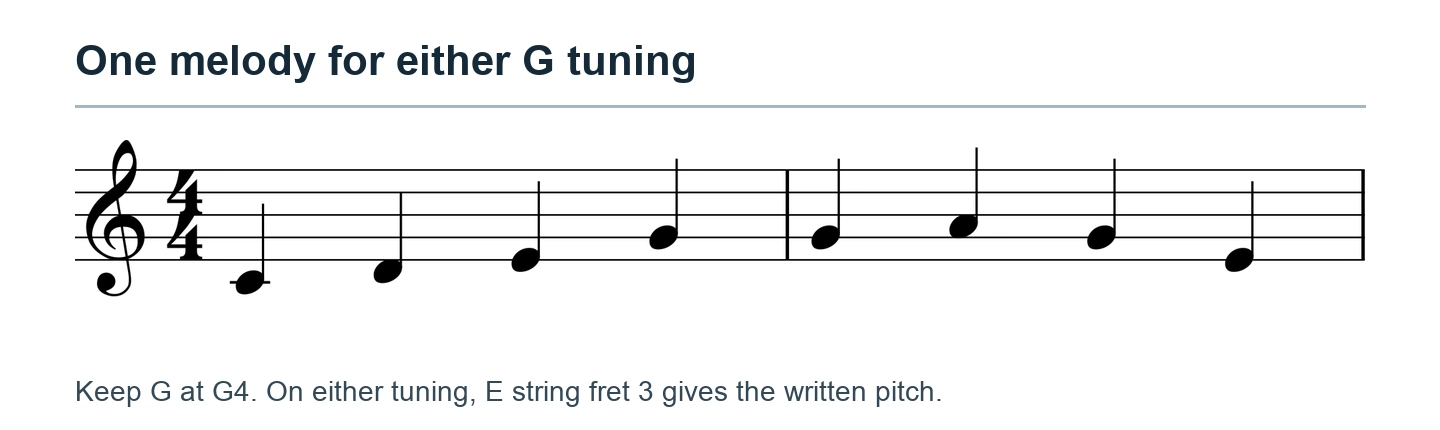
Use open C for the first note, then fret 2 on the C string for D. Switch to open E for the third note. To play G on the fourth beat, place a finger on fret 3 of the E string. That choice works with either fourth-string tuning. Repeat G on the next downbeat, play open A, then return through G to open E.
Listen to the two bars at 84 beats per minute. The plucked reference uses the sounding pitches in the exercise. If the fourth note of your version lands below middle C, you probably played open low G instead of written G4.
Test a fingering instead of changing the melody
Try the melody with the E-string G first. If your fourth string is tuned high, play it again using open G. Listen for the difference in sustain while keeping the written pitches identical. If both versions work, choose the one that leads more smoothly to the next note.
For your next tune, mark just the first unfamiliar pitch and any note where two strings offer a plausible choice. Read the rhythm from the staff before committing to a fingering. A conventional staff passage printed above tab can provide a listening reference through Melogen Sheet2MIDI. Use the staff as the source and decide the string positions yourself.

Hear the pitches on a printed ukulele part
Use the staff portion of a clean score for a MIDI reference and check it against your tuning.
About the author
Zhang Guo
Composer - AI Product Manager
AI product manager and digital marketing consultant with a background in music. Creativity is the bridge between rhythm and logic, where musical intuition and mathematical precision can coexist in every meaningful product decision.
Follow on X