How to Read Violin Sheet Music From the Page to the Bow
Read treble-clef pitch, finger numbers, slurs, bow directions and ties in two short violin examples you can play in first position.
 Zhang Guo
Turn a static score into editable MIDI
Contents
If you're learning how to read violin sheet music, take one bar and answer three questions before you lift the bow. Which notes are sharp or flat? Where will your fingers go? Which notes share a bow stroke? A printed finger number can answer the second question, while a curved line between two different pitches often answers the third.
Read four notes on the D string
Here is a bar in D major. The two sharps in the key signature apply to F and C. The notes are D4, E4, F-sharp4 and G4, all quarter notes. Count four even beats. The first note is in the space just below the bottom line of the treble staff. Follow the notes up by step from there.
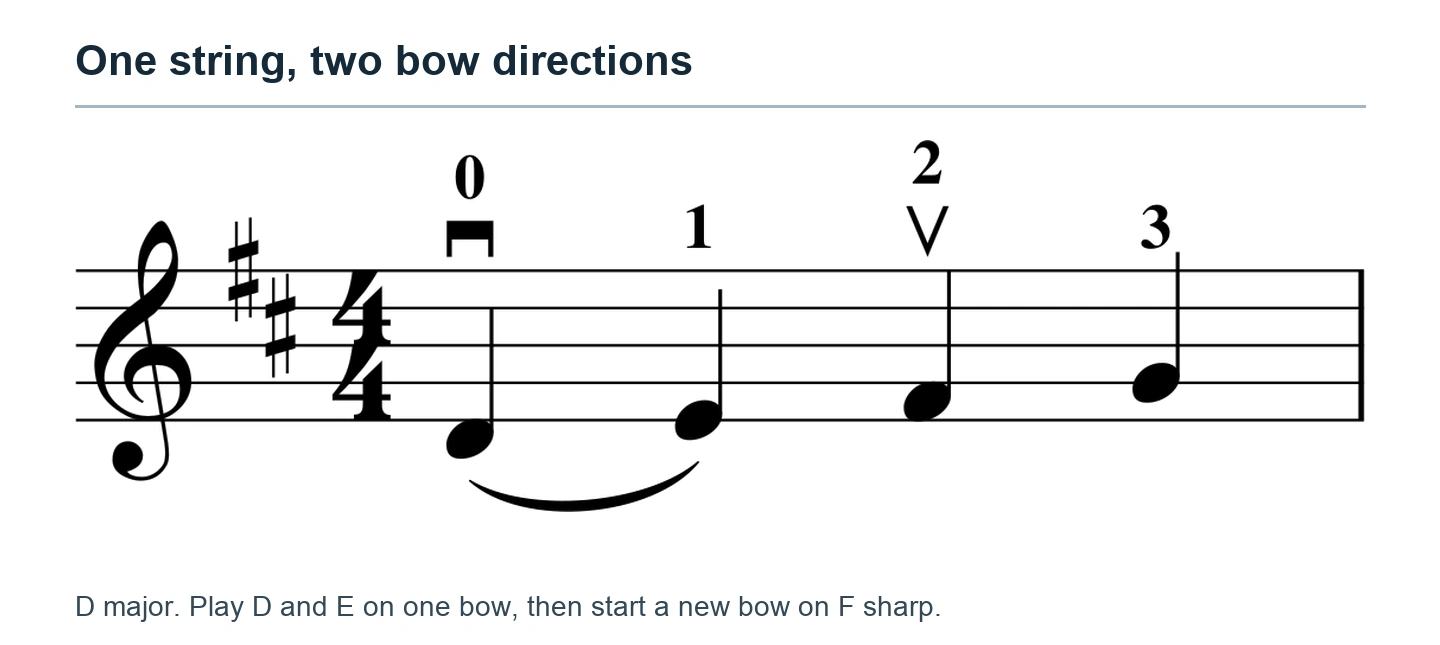
| Beat | Written pitch | First-position choice on the D string |
|---|---|---|
| 1 | D4 | Play the open string, marked 0 |
| 2 | E4 | Place finger 1, your index finger |
| 3 | F-sharp4 | Use finger 2, a whole step above E |
| 4 | G4 | Place finger 3 a half step above F sharp |
The printed digits are fingering suggestions. A 2 means the second finger, not the second string. If another phrase has F natural, that second finger moves closer to the first. For the pitch locations of the individual strings, use the violin open-string chart.
Follow the bow marks through the bar
The squared arch above the first D calls for a down-bow, moving from the frog toward the tip. The slur links D and E. Start the down-bow on D and place finger 1 for E while the bow keeps traveling. The listener should hear two pitches within one stroke.
The V above F sharp calls for an up-bow, toward the frog. The slur has ended, so change direction on beat three. G has no slur joining it to F sharp. In this exercise, give G the next separate down-bow. You now have four pitches but only three bow strokes.
Try the bowing on open D first. Move down for two beats, up for one and down for one. Once your arm keeps that pattern without a pause, add the left hand. If E gets an unwanted accent, listen for an extra bow change between D and E.
Play this pitch reference after trying the bar. The synthetic tone repeats at 72 beats per minute so you can check F sharp and the length of each beat. Use the printed markings for bow direction.
Tell a slur from a tie
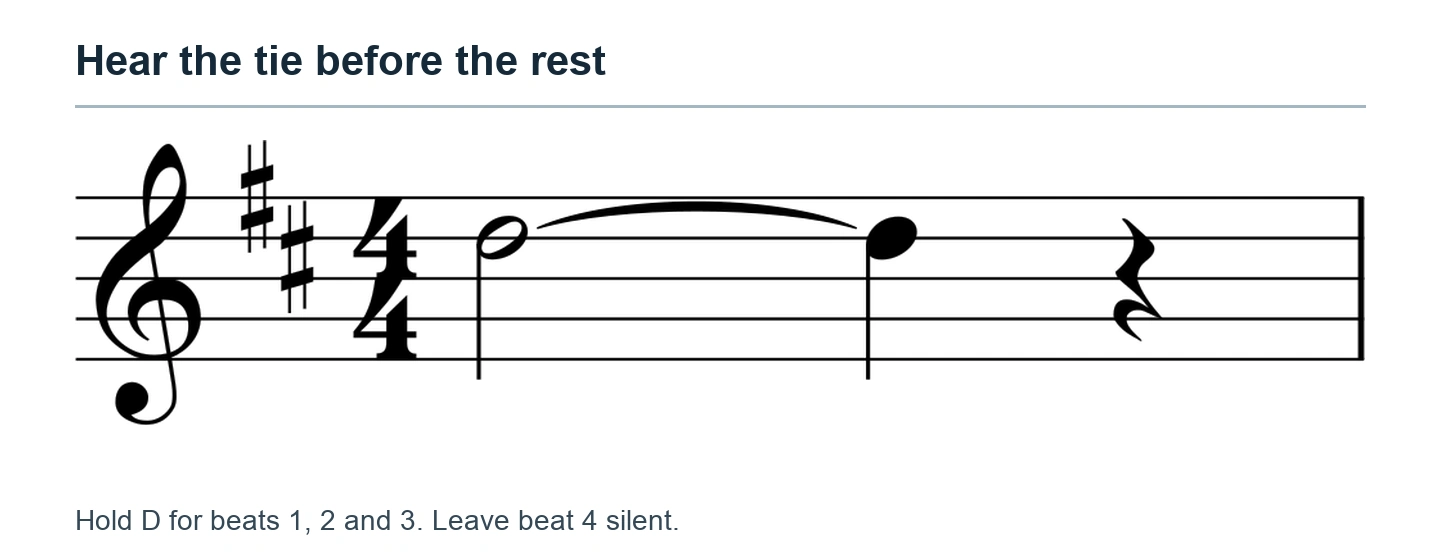
Compare the first curve with the one below. Both ends of the second curve touch D5. The half note lasts two beats and the quarter note adds a third. Sustain one D through one, two, three, then stop for the quarter rest on four.
Bring the same checks to your own part
Read the key signature, then look for accidentals in the measure. Speak the rhythm while tracing the notes. Mark only the string choice or bow change that actually trips you up. If the music shows a Roman numeral for a string, check the edition's legend. In ordinary violin fingering, string I is E and string IV is G.
Choose a short phrase that stays comfortable in first position. The guide to basic violin sheet music can help you select one. Play slowly enough to hear the difference between an incorrect pitch and an unwanted bow change.
When you need a pitch-and-rhythm reference for a clean printed part, Melogen Sheet2MIDI accepts a PDF or score image and can produce an editable MIDI file. Check the notes against the original. The bow marks and fingering on the printed part are the instructions for your hands.
Hear a phrase from your violin part
Start with a short clean score and compare its MIDI pitches and rhythm with the printed phrase.
About the author
Zhang Guo
Composer - AI Product Manager
AI product manager and digital marketing consultant with a background in music. Creativity is the bridge between rhythm and logic, where musical intuition and mathematical precision can coexist in every meaningful product decision.
Follow on X